
Font size
 Worksheets
Unit Review: Chemical Reactions
Total questions: 75
Worksheet time: 2hrs 42mins
Na3PO4 + (a) KOH → (b) NaOH + K3PO4
MgF2 + Li2CO3 → MgCO3 + (a) LiF
P4 + (a) O4 → (b) P2O3
(a) RbNO3 + BeF2 → Be(NO3)2 + (b) RbF
(a) AgNO3 + Cu → Cu(NO3)2 + (b) Ag
CF4 + (a) Br2 → CBr4 + (b) F2
(a) HCN + CuSO4 → H2SO4 + Cu(CN)2
GaF3 + (a) Cs → (b) CsF + Ga
N2 + (a) F2 → (b) NF3
(a) NaF + Br2 → (b) NaBr + F2
Pb(OH)2 + (a) HCl → (b) H2O + PbCl2
(a) AlBr3 + (b) K2SO4 → (c) KBr + Al2(SO4)3
CH4 + (a) O2 → CO2 + (b) H2O
(a) Na3PO4 + (b) CaCl2 → (c) NaCl + Ca3(PO4)2
(a) K + Cl2 → (b) KCl
(a) Al + (b) HCl → (c) H2 + (d) AlCl3
N2 + (a) H2 → (b) NH3
SO2 + (a) Li2Se → SSe2 + (b) Li2O
(a) NH3 + H2SO4 → (NH4)2SO4
The following is what type of reaction: PbCl2 + 2AgNO3 → Pb(NO3)2 + 2AgCl
Synthesis
Single Replacement
Double Replacement
Combustion
NH3 + HCl → NH4Cl
Synthesis
Single Replacement
Double Replacement
Combustion
element displacing another element in a compound
burning of a substance
What type of chemical reaction is this? 2Al(OH)3 → Al2O3 + 3H2O
Synthesis
Single Replacement
Double Replacement
Synthesis
Single Replacement
Double Replacement
Decomposition
Single Replacement
Double Replacement
Combustion
Synthesis
Single Replacement
Double Replacement
Decomposition
Synthesis
Single Replacement
Double Replacement

What type of reaction is taking place in this picture?
Synthesis
Single Replacement
Double Replacement
Combustion
Synthesis
Single Replacement
Double Replacement
Combustion
Synthesis
Single Replacement
Double Replacement
Combustion
What reaction has the following general formula:
A + B --> AB
Synthesis
Decomposition
Single Replacement
Double Replacement
Combustion
What reaction has the following general formula:
AB + CD --> CB + AD
Synthesis
Decomposition
Single Replacement
Double Replacement
Combustion
What reaction has the following general formula:
A + CD --> C + AD
Synthesis
Decomposition
Single Replacement
Double Replacement
Combustion

Synthesis
Combustion
Decomposition
Single Replacement
Double Replacement
C4H12 + 7O2 → 4CO2 + 6H2O
Decomposition
3KOH + H3PO4 --> K3PO4 + 3H2O
Single replacement
Double replacement
Combustion

What type of reaction involves one element replacing another element in a compound?
Single Replacement
Double Replacement
Synthesis
Decomposition
Combustion
How many Hydrogen atoms are in 4 H2O? (a) How many oxygen atoms? (b)
How many O's are in Al₂(SO₄)₃
(a)
3(NH₄)₂CrO₄
Number of N: (a)
Number of H: (b)
Number of Cr: (c)
Number of O: (d)
How many elements are in 2 C6H12O7? (a)
How many C: (b)
How many H: (c)
How many O: (d)
How many TOTAL atoms: (e)
2 CH2CO3OH
Number of C: (a)
Number of H: (b)
Number of O: (c)
How many Sulfur's are in Al₂(SO₄)₃
4
3
7
12
How many Nitrogen atoms are in the in H3C2ON5?
2
3
4
5
Match the element to the number of atoms it has.
2 Al(C2H3O4)2
aluminum
2
carbon
8
hydrogen
12
oxygen
16
What does the subscript in a chemical formula tell you?
How many molecules are present
How many atoms are present
How many elements are present
How many neutrons are present
What elements are represented in this chemical formula? Fe2O3
Iron, Oxygen
Francium, Europium, Oxygen
Ferrium, Oxygen
Berylium, Oxygen
How many more atoms of Oxygen than than Magnesium are in this formula? (subtraction) MgSO4
4
3
2
6
Match the formula to the description:
SO3
1 sulfur, 3 oxygen's
2 SO3
2 sulfur's, 6 oxygen's
2 S2O3
4 sulfur's, 6 oxygen's
3 SO4
3 sulfur's, 12 oxygen's
SO4
1 sulfur, 4 oxygen's
Which element has the greatest number of atoms? AgNO3
Silver
Gold
Nitrogen
Oxygen
The ______ are numbers found on the lower right-hand side of an element symbol.
Coefficient
Exponent
Multiplier
Subscript
Coefficients in chemical formulas...
are found at the beginning of a formula and multiply just the first atom
are found at the end of a formula and multiply EVERYTHING!
are found at the end of a formula and multiply only elements inside the parentheses.
are found at the beginning of a formula and multiply EVERYTHING!
4CF2Cl3
carbon
4
fluorine
8
chlorine
12
Put the elements in order from smallest to largest number of atoms:
2 C3H5(NO3)4
carbon
nitrogen
hydrogen
oxygen
3 H2SO4
There are (a) hydrogens, (b) sulfurs, and (c) oxygens
A ______ is a number written in front of a chemical formula.
Coefficient
Subscript
Exponent
Coordinator
What is collision theory?
Molecules must collide in the correct orientation with enough energy to bond.
Molecules need enough energy to collide and react.
Atoms constantly collide and react.
The minimum energy needed for atoms to react
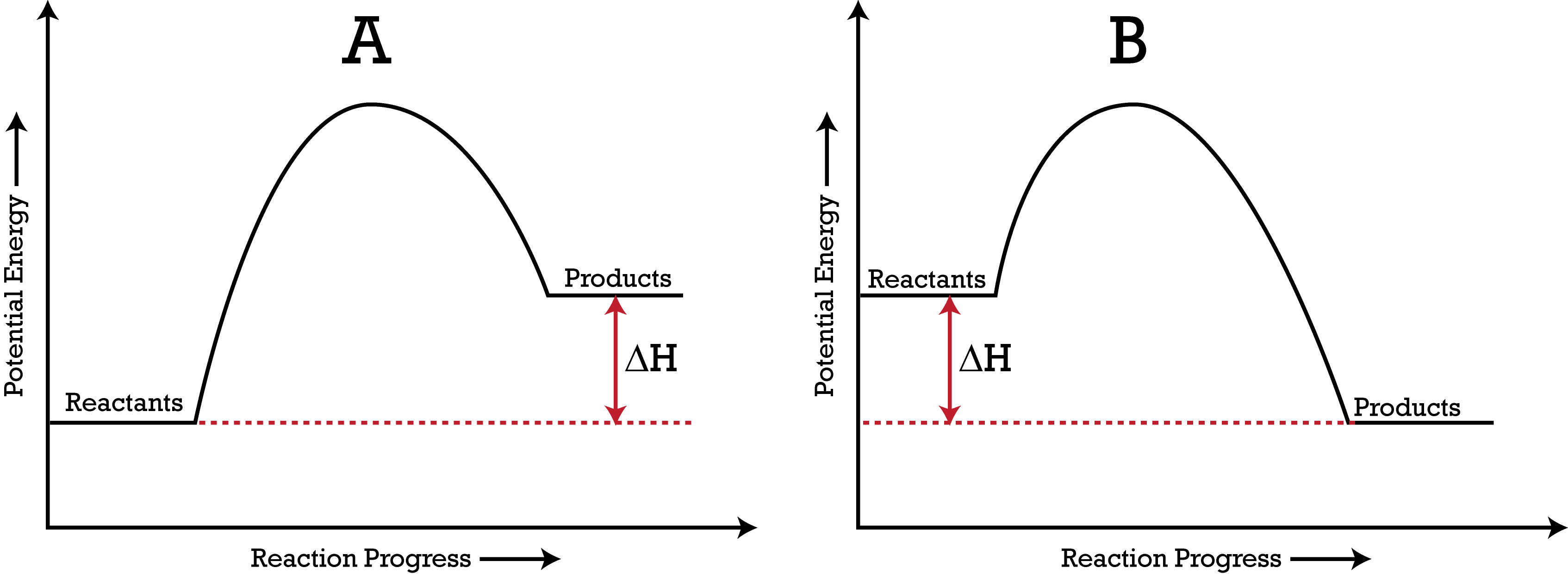
Which PE Diagram represents an endothermic reaction?
A
B
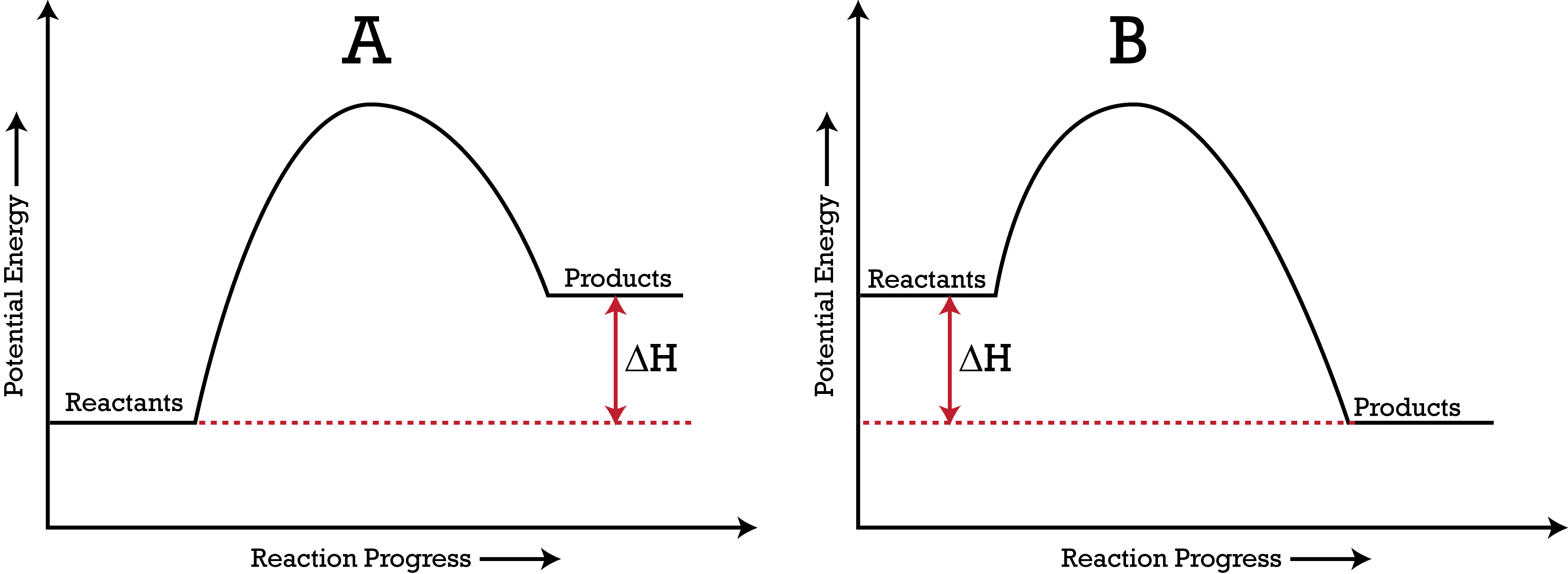
Which PE Diagram represents an exothermic reaction?
A
B
What is the rate of reaction?
How much energy is needed for a reaction to occur.
The energy required to break a bond.
The time it takes for a reaction to occur.
Collision Theory
What is the purpose of a catalyst?
Helps to slow down a reaction
Raises the activation energy
Lowers the activation energy
Is consumed by the reaction
What factors effect rate of reaction?
Temperature, Concentration, Pressure and Energy
Surface Area, Concentration, Energy and Pressure
Temperature, Pressure, Concentration and Surface area
Pressure, Surface area, Density and Energy
Would the reaction rate speed up or slow down: A tablespoon of powdered sugar placed into HCL.
Slow down
Speed up
Stays the same
Increasing the temperature of your solution will.......
Not affect the rate of reaction.
Speed up the rate of reaction
Slow down the rate of reaction
Decreasing the concentration of a substance will usually........
Slow down the reaction
Speed up the reaction
Have no affect on the reaction
Which has more surface area?
Large chunks of chalk
Cube of sugar
Powdered sugar
Small chunks of sugar
If you shrink the container size that your gas substance is in what will happen?
The reaction rate will stay the same
The reaction rate will speed up
The reaction rate will slow down
What criteria must be met for reactant collisions to result in a successful product?
The reactants must collide with each other
The reactants must collide with enough energy and be in the right positions
The reactants must have enough energy to form the activated complex

