wayground logo

Free Printable Worksheets

Font size

S
M
L
XL
Worksheets

Genetics and Heredity

Total questions: 54

Worksheet time: 27mins

Name
Class
Date
1.
D = dimples        d = no dimples 
What is the genotype for a homozygous recessive offspring?
a)
DD
b)
Dd
c)
dd
2.
Round (R) seeds are dominant to wrinkled (r) seeds.
What is the genotype for a homozygous dominant offspring?
a)
RR
b)
Rr
c)
rr
3.
If two purebred species (BB) are crossed, what percentage of their offspring would be BB?
a)
25%
b)
50%
c)
75%
d)
100%
4.
What type of traits "show up" in a population more often?
a)
dominant
b)
recessive
c)
punnett squares
d)
alleles
5.
What do you call the physical expression of a gene?
a)
genotype
b)
dominant
c)
phenotype
d)
allele
6.
Short hair (S) is dominant to long hair (s).
What is the genotype for an offspring with long hair?
a)
SS
b)
Ss
c)
ss
7.
Each parent contributes one of the genes for a particular trait. The genes of the pair are called:
a)
variables
b)
gametes
c)
hybrids
d)
alleles
8.
In snapdragons, Tallness (T) is dominant to dwarfness (t). In a cross between two plants that are homozygous for the recessive allele, the percent of offspring expected to exhibit tallness is
a)
 25%
b)
 75%
c)
100%
d)
0%
9.
The gene makeup of an organism for a particular trait is known as its
a)
dominance
b)
phenotype
c)
allele
d)
genotype
10.
What percentage of the offspring will be purebred dominant?
a)
0%
b)
25%
c)
50%
d)
75%
11.

A segment of DNA refers to a:

a)

Gene

b)

Allele

c)

Chromosome

d)

Mutation

12.

Which of the following indicate or describe a genotype?

a)

Blue eyes

b)

BB

c)

Bb

d)

Homozygous recessive

e)

Spotted

13.

Different forms or versions of a gene are called:

a)

Traits

b)

Alleles

c)

Variants

d)

Chromosomes

14.

Which of the following scientists is known for his study of pea plants and is often called the "Father of Modern Genetics?"

a)

Charles Darwin

b)

Aristotle

c)

Carolus Linneaus

d)

Gregor Mendel

15.

Genes may have different alleles. These alleles may be:

a)

Dominant or recessive

b)

Genotype or phenotype

c)

Dominant

d)

Recessive

16.

These alleles always show up and mask other traits. They are called:

a)

Dominant

b)

Recessive

c)

Homozygous

d)

Heterozygous

17.

Which of the following indicate or describe a phenotype?

a)

Blue eyes

b)

BB

c)

Bb

d)

Homozygous recessive

e)

Spotted

18.

Which of the following genotypes are homozygous?

a)

HH

b)

Tt

c)

ii

d)

Aa

e)

BB

19.

Alleles that may be masked or covered up are called:

a)

Dominant

b)

Recessive

c)

Homozygous

d)

Heterozygous

20.

Which of the following genotypes are heterozygous?

a)

HH

b)

Tt

c)

ii

d)

Aa

e)

BB

21.

Which of the following genotypes are homozygous recessive?

a)

rr

b)

Tt

c)

aa

d)

RR

22.

What is the genotype ratio for this punnett square?

a)

1:2:1

b)

3:1

c)

4:0

d)

2:1:2

23.

Why do some traits "skip" a generation?

a)

because they are dominant traits

b)

because they are recessive traits

c)
blind dumb luck
d)

because they are homologous chromosomes

24.
An allele whose trait only shows up when no dominant allele is present.
a)
stealth ninja spider-monkey allele
b)
dominant allele
c)
recessive allele
d)
present allele
25.
This type of inheritance pattern is a MIXTURE of both traits, like the old theory of blending
a)
incomplete dominance
b)
co-dominance
c)
complete dominance
d)
recessive pattern
26.
This type of inheritance pattern shows BOTH traits in possible offspring:
a)
complete dominance
b)
incomplete dominance
c)
co-dominance
d)
Indomitable 
27.

What is the phenotype ratio for this punnett square?

a)

1:2:1

b)

3:1

c)

4:0

d)

2:1:2

28.
When two or more alleles for a trait exist in a population.  Ex: Different hair colors or blood types
a)
SHAZAM!
b)
Multiple Genes
c)
Multiple Alleles
d)
Polysaccharide
29.
___________is the likelihood, or chance, that a certain event will occur.
a)

luck

b)

probability

c)

locus

d)

inheritance

30.

Which Mendel law states that organisms inherit 2 copies of each gene and donate one to their offspring

a)
law of independent assortment
b)
law of segregation
c)
law of genetic linkage
d)
law of inheritance
31.

Based on the picture of Mendel's experiment, which of Mendel's Laws could you propose apply?

a)
Law 1, The Law of Dominance
b)
Law 2, The Law of Segregation
c)
Law 3, The Law of Independent Assortment
d)
Both Law 1 and Law 2
32.

Which of Mendel's laws states that, when an organism is hybrid for a pair of contrasting traits, the dominant trait is the one that is shown. 

a)
Law of Dominance
b)
Law of Independent Assortment
c)
Law of of Segregation
d)
Law of Incomplete Dominance
33.
What is the phenotypic ratio of a dihybrid cross of 2 heterozygous parents?
a)

3:4:3:6

b)

1:2:3:4

c)

9:3:3:1

d)

8:4:3:1

34.

Cross RRYY x rryy. R=round seeds, r=wrinkled seeds; Y=yellow seeds, y=green seeds. What percent will have Round/Yellow seeds? 

a)

0%

b)

25%

c)

50%

d)

100%

35.
The letters on the TOP AND SIDE of a punnett square represent ______________.
a)
The combination of alleles in offspring.
b)
The possible alleles given by the parents following meiosis.
c)
The genotype and phenotype of offspring.
d)
The results of genetic mutations in offspring.
36.
Why do we see only tall plants in the second generation?
a)
The gene for tall height is dominant
b)
The gene for short height is dominant
c)
The gene for tall height is recessive
d)
The parents did not have the tall gene
37.
The dominant trait in this punnett square is
a)
yellow pea seeds
b)
green pea seeds
c)
there is no dominant seed
38.
this image is an example of
a)
codominance
b)
dominance
c)
incomplete dominance
39.

A breed of chicken shows CODOMINANCE for feather color. One allele codes for black feathers, another codes for white feathers. The feathers of heterozygous chickens of this breed will be:

a)
all black
b)
all white
c)
all gray
d)
speckled black and white
40.
In some carnations, flower color exhibits codominance.  Identify the correct genotypes for red, white, and speckled carnations.
a)

Red = RR, white = rr, speckled = R'r

b)
Red = RR, white = WW, speckled = rw
c)

Red = RR, white = ww, Speckled = R'w

d)
Red = RR, white = WW, speckled = RW
41.
What do we use pedigrees for?
a)
To look at families
b)
To make determinations about the offspring
c)
To track traits in families
d)
Nothing
42.

In a pedigree, which shape represents a male?

a)

circle

b)

square

43.

On a pedigree, this symbol represents an ----

a)

unaffected male.

b)

unaffected female.

c)

affected male.

d)

affected female.

44.

How many individuals are there in the 3rd generation?

a)

1

b)

2

c)

4

d)

6

45.

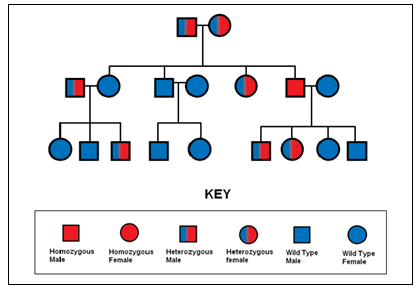
What mode of inheritance shown here?

a)

Recessive because it "skips" a generation

b)

Dominant because it shows up in every generation

46.

If this pedigree is tracking an autosomal recessive disorder, what MUST the genotype of individual 4 be?

a)

HH

b)

Hh

c)

hh

47.

Assuming a trait is X-LINKED RECESSIVE, a person with the genotype "XaY" would be an

a)

affected male

b)

unaffected male

c)

affected female

d)

unaffected female

48.

Assuming a trait is X-LINKED RECESSIVE, a person with the genotype "XaXa" would be an

a)

affected male

b)

unaffected male

c)

affected female

d)

carrier female

49.

If a pedigree is tracking an AUTOSOMAL RECESSIVE trait, a person with the genotype "Aa" would be

a)

shaded

b)

not shaded

50.

Assuming a trait is X-LINKED RECESSIVE, what are the genotypes of an UNAFFECTED person?

a)

XAY

b)

XaY

c)

XAXA

d)

XaXa

51.

If a pedigree is tracking an AUTOSOMAL DOMINANT trait, a person with the genotype "Aa" would be

a)

shaded

b)

not shaded

c)

half shaded (carrier)

52.

Is this pedigree tracking an X-linked trait, autosomal dominant or autosomal recessive?

a)

autosomal dominant

b)

autosomal recessive

c)

X-linked

53.

Assuming a trait is X-LINKED RECESSIVE, what are the genotypes of an AFFECTED person?

a)

XAY

b)

XaY

c)

XAXA

d)

XAXa

e)

XaXa

54.

Assuming a trait is AUTOSOMAL DOMINANT, a person with the genotype "aa" would be

a)

shaded

b)

not shaded