wayground logo

Free Printable Worksheets

Font size

S
M
L
XL
Worksheets

sh2 ch6

Total questions: 60

Worksheet time: 49mins

Name
Class
Date
1.
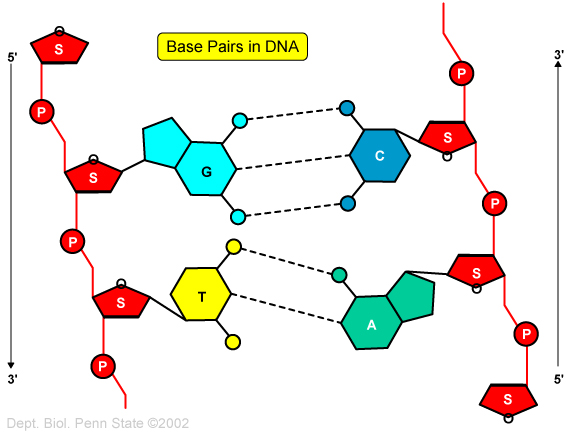
Which sequence of DNA bases would pair with this partial strand
ATG TGA CAG
a)
ATG TGA CAG
b)
TAC ACT GTC
c)
GTA AGT GAC
d)
CAT TCA CTG
2.
In a molecule of double-stranded DNA, the amount of Adenine present is always equal to the amount of
a)
cytosine
b)
guanine
c)
thymine
d)
uracil
3.
Adenine bonds with ______________.
a)
Guanine
b)
Thymine
c)
Cytosine
d)
Adenine
4.
Guanine bonds with ______________.
a)
Adenine
b)
Guanine
c)
Cytosine
d)
Thymine
5.
Which 2 molecules form the sides (backbone) of the DNA ladder?
a)
deoxyribose sugar and adenine
b)
deoxyribose sugar and a hydrogen bond
c)
deoxyribose sugar and the nucleus
d)
deoxyribose sugar and phosphate
6.
Which organelle is DNA usually found in?
a)
cell membrane
b)
vacuole
c)
chloroplast
d)
nucleus
7.
Nitrogenous bases are joined by which type of bond?
a)
polar bonds
b)
ionic bonds
c)
covalent bonds
d)
hydrogen bonds
8.
The enzyme that unzips the DNA to prepare for replication
a)
helicase
b)
replicase
c)
polymerase
d)
synthase
9.
DNA replication results in two DNA molecules,
a)
each one with two original strands
b)
each one with two new strands
c)
each one with one new strand and one original strand
d)
one with two new strands and the other with two original strands
10.
order of replication
a)
3, 2, 1, 4
b)
2, 1, 4, 3
c)
2, 3, 1, 4
d)
3, 4, 1, 2
11.
What is the correct complimentary strand for the following DNA?ATCGAG
a)
TACGAG
b)
ATCGAG
c)
TAGCTG
d)
TAGCTC
12.
In what phase of the cell cycle does DNA replication take place?
a)
G1
b)
S
c)
G2
d)
M
13.
What are the 4 nitrogen bases?
a)
adenine, thymine, cytoplasm, and guanine
b)
adenine, thymine cytosine, and guanine
c)
adenine, thymine, cytosine, and gylcerol
d)
adenine, thymine, cytosine, and glucose
14.
Which of the following units are repeatedly joined together to form a strand of DNA?
a)
amino acids
b)
nucleotides
c)
fatty acids
d)
polysaccharides
15.
Okazaki fragments form on the:
a)
lagging strand
b)
leading strand
c)
base-pairs
d)
5' end
16.
Which of the following is required for DNA replication to occur?
a)
DNA helicase
b)
DNA ligase
c)
DNA polymerase
d)
all of these
17.
During replication, what enzyme adds complimentary bases?
a)
helicase
b)
synthesase
c)
ligase
d)
polymerase
18.

Which enzyme is responsible for forming phosphodiester bonds between the Okazaki fragments?

a)

Ligase

b)

Helicase

c)

DNA Polymerase 1

d)

DNA Polymerase 3

19.

Direction that DNA is replicated

a)

3' to 5'

b)

5' to 3'

20.

The separation of the two single strands of DNA creates a ‘Y’ shape?

a)

enzyme

b)

unzip

c)

A replication fork

21.
What strand is copied faster?
a)
Leading
b)
Lagging
22.

H is the

a)

leading strand

b)

lagging strand

c)

parent strand

d)

none of these

23.

Structure C is

a)

helicase

b)

primase

c)

DNA polymerase III

d)

gyrase

24.

Which series of steps is in the correct order?

1. Recoils

2. Straightens the double helix

3. Breaks hydrogen bonds

4. Adds free nucleotides

a)

1, 2, 3, 4

b)

3, 4, 2, 1

c)

3, 2, 4, 1

d)

2, 3, 4, 1

25.

Based on the diagram, the enzyme (represented in gray) is most likely...

a)

DNA polymerase

b)

ligase

c)

primase

d)

helicase

26.
If a strand reads:
3' A A A T T T C 5'
The matching strand would read...
a)
5' T T T A A A G 3'
b)
3' T T T A A A G 5'
c)
5' A A A T T T C 3'
d)
3' U U U A A A G 5'
27.

The bonds that hold the two strands of DNA together come from...

a)

the attraction between phosphate groups

b)

strong covalent bonds between bases and sugars

c)

carbon to carbon covalent bonds in the sugar

d)

weak hydrogen bonds between the bases

28.
After analyzing a sample of DNA, a scientist recorded the data shown in the table. What percentage of the DNA sample is cytosine?
a)
22%
b)
25%
c)
28%
d)
56%
29.

Enzyme that connects the DNA to the backbone (glues)

a)

Ligase

b)

Polymerase

c)

Helicase

d)

Primase

30.
Why is it crucial that living things are able to replicate their DNA?
a)
Each cell must have its own DNA
b)
Less copies of DNA are needed when a new cell is created
c)
A cell needs multiple copies of DNA
d)
Only muscle cells need DNA 
31.
Where does translation of the genetic code into proteins take place?
a)
Golgi Apparatus
b)
Endoplasmic Reticulum
c)
Cytoplasm
d)
Nucleus
32.
Which of the following is true about the role of ribosomes in translation?
a)
Attach to the DNA strand
b)
Remove introns from mRNA
c)
Translate mRNA into tRNA
d)
Synthesize proteins from mRNA
33.
Which of the following statements about genes is true?
a)
Genes are only present in the mitochondria
b)
Genes are non-coding regions of DNA
c)
Genes are decoded in the cytoplasm
d)
Genes are translated into proteins
34.
What is the process that involves the synthesis of mRNA from DNA in the nucleus?
a)
Replication
b)
Transcription
c)
Translation
d)
Translocation
35.
What is the function of RNA polymerase during transcription?
a)
Adds ribosomes to mRNA
b)
Removes introns from mRNA
c)
Attaches to the beginning of the gene on the DNA strand
d)
Transports tRNA to the ribosomes
36.
What is the function of introns and exons in mRNA editing?
a)
Exons are non-coding regions
b)
Introns code for amino acids
c)
Introns are spliced together
d)
Exons code for proteins
37.
How many different types of amino acids can be put together in a specific protein sequence?
a)
5
b)
15
c)
20
d)
10
38.
What is the term for a triplet of nucleotide bases that codes for an amino acid?
a)
Exon
b)
Anticodon
c)
Intron
d)
Codon
39.

Which of the following molecules carries amino acids to the ribosome during translation?

a)

mRNA

b)

tRNA

c)

rRNA

d)

DNA

40.
If a segment of double-stranded DNA has 40 percent A, how much of it is C?
a)
40
b)
10
c)
15
d)
20
41.
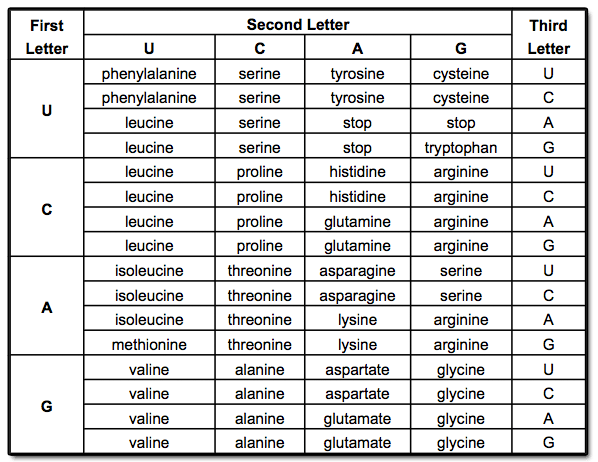
What is the correct amino acid sequence for the mRNA code AUGCCAGUAUGA
a)
Met-Pro-Ala-Val
b)
Met-Pro-Val
c)
Tyr-Gly-His
d)
Tyr-Gly-Arg-His
42.
tRNA is involved in
a)
carrying amino acids 
b)
carrying ribosomes
c)
carrying glucose
d)
carrying lipids
43.
Transcribe the following piece of DNA:
ATCGTA
a)
UAGCAU
b)
TAGCAT
c)
ATCGTA
d)
AUCGUA
44.
What is the correct sequence?
a)
RNA --> DNA --> Protein
b)
Protein --> RNA --> DNA
c)
DNA --> RNA --> Protein
d)
DNA --> Protein --> RNA
45.
If an mRNA codon is AGU, which of the following would be the appropriate tRNA anticodon?
a)
TCA
b)
UGA
c)
AGU
d)
UCA
46.

Which base is found in RNA instead of thymine?

a)

Adenine

b)

Guanine

c)

Cytosine

d)

Uracil

47.

What sugar does RNA contain?

a)

Deoxyribose

b)

Glucose

c)

Ribose

d)

Fructose

48.

What is the function of mRNA?

a)

It transports amino acids to the ribosome.

b)

It is found in the ribosome.

c)

It is a copy of one strand of DNA and it takes a message to the ribosomes.

d)

It catalyzes biochemical reactions.

49.

Where is rRNA found?

a)

In the nucleus

b)

In the ribosome

c)

In the mitochondria

d)

In the cytoplasm

50.

What are the non-coding sequences that are removed from the RNA transcript during post-transcriptional modifications called?

a)

Exons

b)

Introns

c)

Polypeptides

d)

Codons

51.

What is the function of an anticodon?

a)

It starts the replication process.

b)

It signals the end of translation.

c)

It carries amino acids to the ribosome.

d)

It is a three-base coding sequence that pairs with a codon on mRNA.

52.

What type of gene mutation has occurred here?

T-G-A-C-C-A

T-G-A-C-C-A-A

a)

Substitution

b)

Deletion

c)

Insertion

d)

Inversion

53.

Mutations are random.

a)

True

b)

False

54.

Mutations can benefit humans because they can:

a)

Cause illness

b)

Make an organism more suited to live in its environment.

c)

Make organisms live shorter lives

d)

Cause organisms to grow extra limbs.

55.

Mutations can be negative because

a)

They can cause cancer

b)

They can cause birth defects

c)

They can help an organism thrive in its environment.

d)

They can affect offspring.

56.

Occurs when the DNA change does not alter the amino acid sequence of the polypeptide.

a)

Frameshift Mutation

b)

Insertion

c)

Missense mutation

d)

Silent Mutation

57.
Why are insertion and deletion mutations so harmful?
a)
They change all of the codons from the mutation on down the line, which changes the amino acid sequence
b)
They insert things that an organism doesn't need.
c)
They often delete things that organisms need.
d)
Insertion and deletions are not any more harmful than substitution mutations.
58.
What situation causes a deletion?
a)
Part of the chromosome is missing
b)
Part of the chromosome is attached backwards
c)
Part of the chromosome breaks off and attaches to a different chromosome
d)
Part of a chromosome is duplicated 
59.

DOES THE DNA MUTATION ALWAYS ALTER THE AMINO ACID SEQUENCE?

a)

Yes

b)

No

60.

What type of mutation is shown in the diagram?

a)

Point mutation - missense

b)

Frameshift Mutation - deletion

c)

Frameshift Mutation - addition

d)

Point mutation - nonsense