NEW
Font size
 Worksheets
Unit 4 Question Bank AP CHEM
Total questions: 80
Worksheet time: 40mins


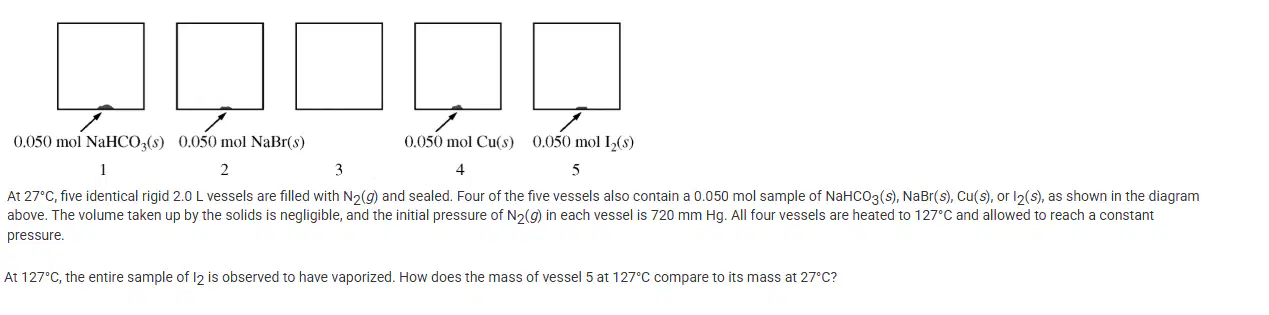


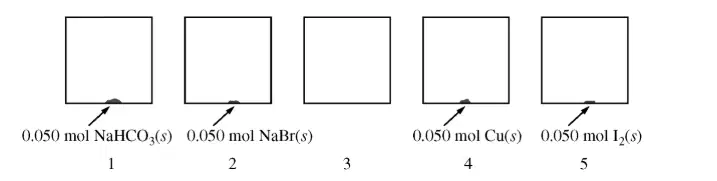
At 27°C, five identical rigid 2.0 L vessels are filled with N2(g) and sealed. Four of the five vessels also contain a 0.050 mol sample of NaHCO3(s), NaBr(s), Cu(s), or I2(s), as shown in the diagram above. The volume taken up by the solids is negligible, and the initial pressure of N2(g) in each vessel is 720 mm Hg. All four vessels are heated to 127°C and allowed to reach a constant pressure.
At 127°C, the pressure in vessel 1 is found to be higher than that in vessel 2. Which of the following reactions best accounts for the observation?
NaHCO3(s) → Na(s) + HCO3(s)
NaHCO3(s) → NaH(s) + CO3(s)
2 NaHCO3(s) → Na2CO3(s) + CO2(g) + H2O(g)
2 NaHCO3(s) + N2(g) → 2 NaNO3(s) + C2H2(g)
A 20. mL sample of 0.50 M HC2H3O2(aq) is titrated with 0.50 M NaOH(aq). Which of the following best represents the species that react and the species produced in the reaction?
H+(aq) + OH−(aq) → H2O(l)
H+(aq) + C2H3O2−(aq) + Na+(aq) + OH−(aq) → H2O(l) + NaC2H3O2(aq)
HC2H3O2(aq) + OH-(aq) → C2H3O2-(aq) + H2O(l)
HC2H3O2(aq) + NaOH(aq) → H2O(I) + Na+(aq) + C2H3O2-(aq)

Based on the chemical equations given, which of the following statements is correct?
HCN is a weaker acid thanH20
CN- is a stronger acid thanHCN
CN- is a stronger base thanHCN
CN- is a weaker base thanHCN
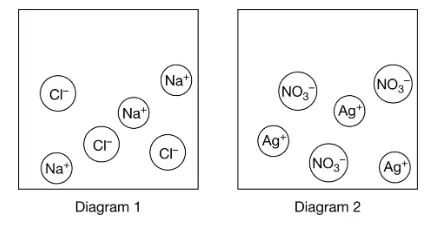
The diagrams above represent solutes present in two different dilute aqueous solutions before they were mixed. Water molecules are not shown. When the solutions were combined, a precipitation reaction took place. Which of the diagrams below is the best particle representation of the mixture after the precipitation reaction occurred?



When a student adds 30.0 mL of 1.00 M HCl to 0.56 g of powdered Fe, a reaction occurs according to the equation above. When the reaction is complete at 273 K and 1.0 atm, which of the following is true?
HCl is in excess, and 0.100 mol of HCl remains unreacted.
HCl is in excess, and 0.020 mol of HCl remains unreacted.
0.015 mol of FeCl2 has been produced.
0.22 L of H2 has been produced.
To gravimetrically analyze the silver content of a piece of jewelry made from an alloy of Ag and Cu, a student dissolves a small preweighed sample in HNO3(aq). Ag+(aq) and Cu2+(aq) ions form in the solution. Which of the following should be the next step in the analytical process?
Centrifuging the solution to isolate the heavier ions
Evaporating the solution to recover the dissolved nitrates
Adding enough base solution to bring the pH up to 7.0
Adding a solution containing an anion that forms an insoluble salt with only one of the metal ions
A sample of a compound that contains only the elements C, H, and N is completely burned in O2 to produce 44.0 g of CO2, 45.0 g of H2O, and some NO2 . A possible empirical formula of the compound is
CH2N
CH5N
C2H5N
C3H3N2

The reaction represented above goes essentially to completion. The reaction takes place in a rigid, insulated vessel that is initially at 600 K
A sample of CH3OH(g) is placed in the previously evacuated vessel with a pressure of P1 at 600 K. What is the final pressure in the vessel after the reaction is complete and the contents of the vessel are returned to 600 K?
P1 / 9
P1 / 3
P1
3P1

When water is added to a mixture of Na2O2(s) and S(s) , a redox reaction occurs, as represented by the equation below.
Atoms of which element are reduced in the reaction?
S; each atom loses four electrons
Na in Na2O2; each atom loses one electron
O in Na2O2; each atom gains one electron
O in H2O; each atom gains one electron

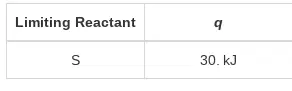
Two trials are run, using excess water. In the first trial, 7.8 g of Na2O2(s) (molar mass 78 g/mol) is mixed with 3.2 g of S(s). In the second trial, 7.8 g of Na2O2(s) is mixed with 6.4 g of S(s). The Na2O2(s) and S(s) react as completely as possible. Both trials yield the same amount of SO2(aq). Which of the following identifies the limiting reactant and the heat released, q, for the two trials at 298 K?


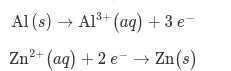
The half-reactions for the oxidation-reduction reaction between Al(s) and Zn2+(aq) are represented above. Based on the half-reactions, what is the coefficient for Al(s) if the equation for the oxidation-reduction reaction is balanced with the smallest whole-number coefficients?
1
2
3
4
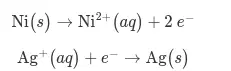
Which of the following is the balanced net ionic equation for an oxidation-reduction reaction between Ag+(aq) and Ni(s) based on the half-reactions represented above?




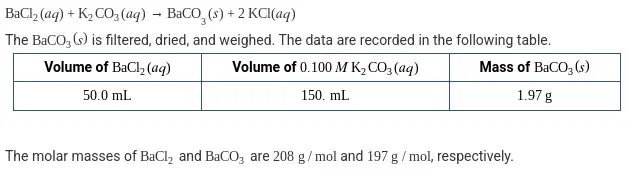
Students are asked to design an experiment to determine the molarity of a BaCl2(aq) solution. After examining the KSp values of some barium-containing compounds, the students decide to use 0.100�K2CO3(aq) to precipitate the barium ions. An excess of K2CO3(aq) is added to a 50.0mL sample of the BaCl2(aq) solution, and the reaction represented by the following equation occurs.
Question:On the basis of the experimental data, what was [Ba2+] in the original 50.0mL sample of the solution?
0.05M
0.10M
0.20M
0.40M

H+(aq)
K+(aq)
CI-(aq)
CO2-3(aq)

A 6.0 mol sample of C3H8(g) and a 20. mol sample of Cl2(g) are placed in a previously evacuated vessel, where they react according to the equation above. After one of the reactants has been totally consumed, how many moles of HCl(g) have been produced?
4.0 mol
8.0mol
20.0mol
24.0mol

Reaction 2 occurs when an excess of 6 M HCl(aq) solution is added to 100. mL of NaOCl(aq) of unknown concentration. If the reaction goes to completion and 0.010 mol of Cl2(g) is produced, then what was the molarity of the NaOCl(aq) solution
0.0010 M
0.010 M
0.10 M
1.0 M
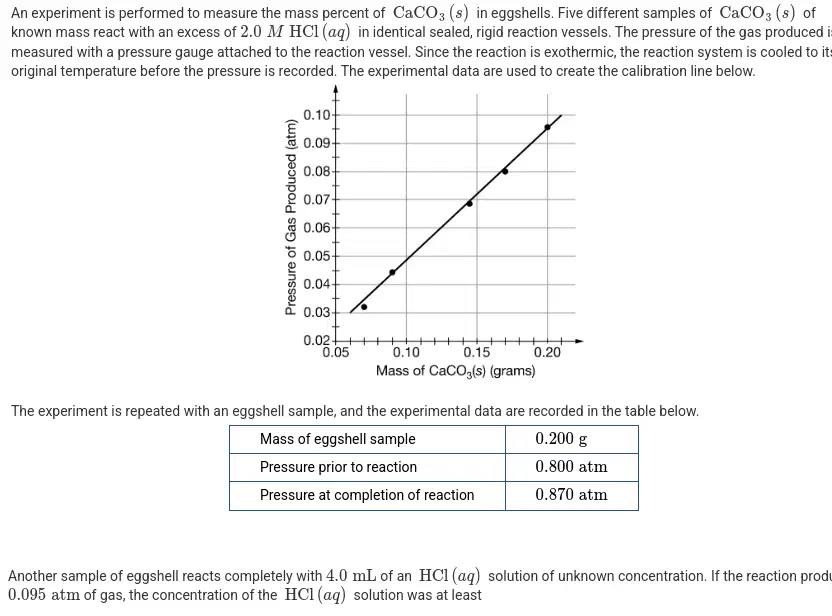
0.0020M
0.050 M
0.50 M
1.0 M
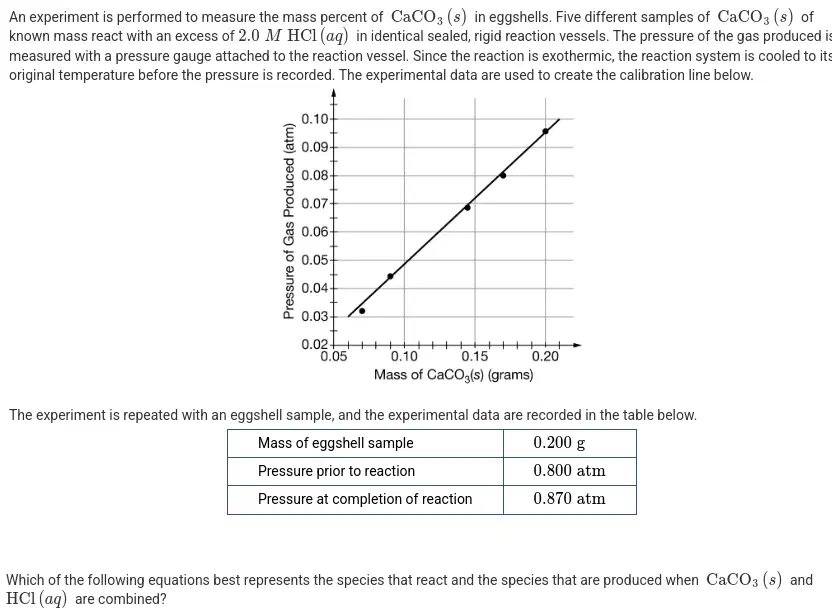




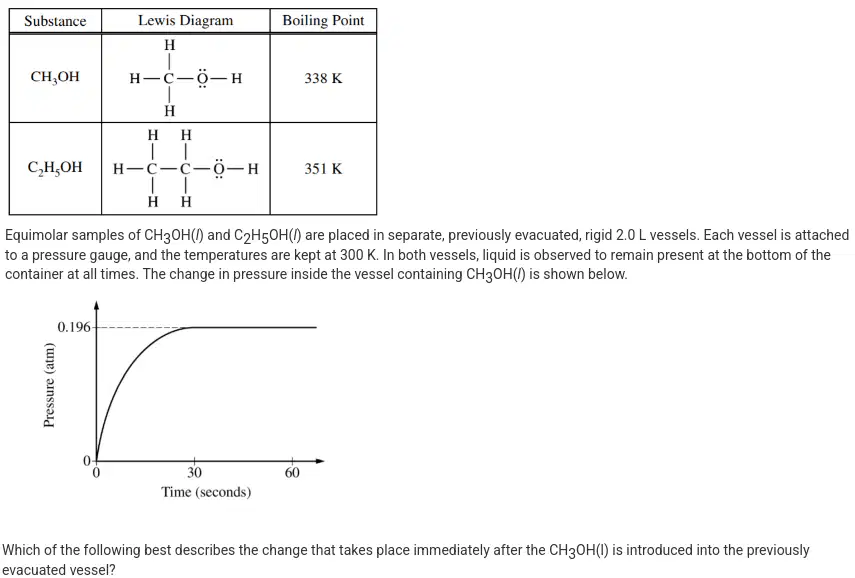
A chemical change takes place because covalent bonds are broken.
A chemical change takes place because intermolecular attractions are overcome.
A physical change takes place because covalent bonds are broken.
A physical change takes place because intermolecular attractions are overcome.
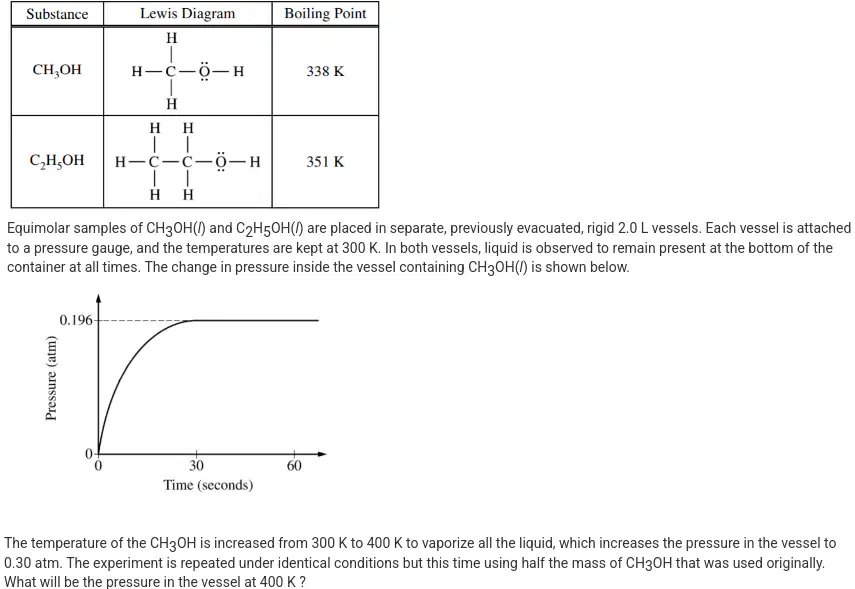
0.15 atm
0.30 atm
0.40 atm
0.60 atm

A 2mol sample of F2(g) reacts with excess NaOH(aq) according to the equation above. If the reaction is repeated with excess NaOH(aq) but with 1 mol of F2(g), which of the following is correct?
The amount of OF2(g) produced is doubled.
The amount of OF2(g) produced is halfed .
The amount of NaF(aq) produced remains the same.
The amount of NaF(aq)
produced is doubled
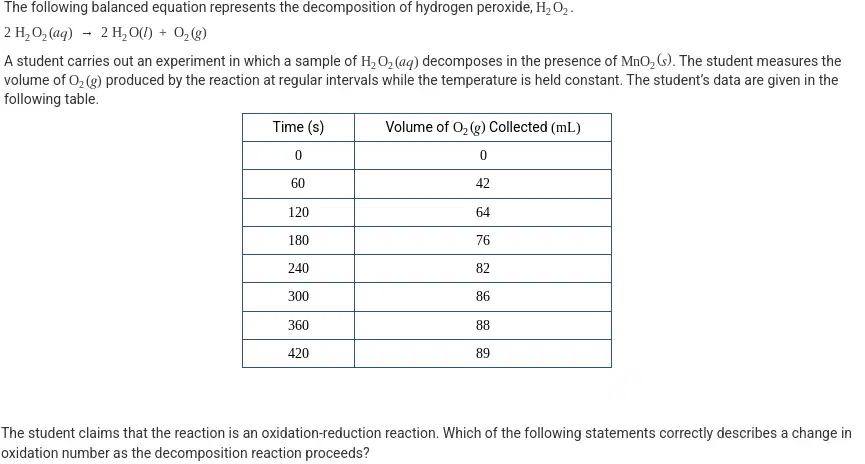
The oxidation number of hydrogen changes from +2 to +1.
The oxidation number of hydrogen changes from +1 to +2.
The oxidation number of oxygen changes from -2 to -1.
The oxidation number of oxygen changes from -1 to 0.
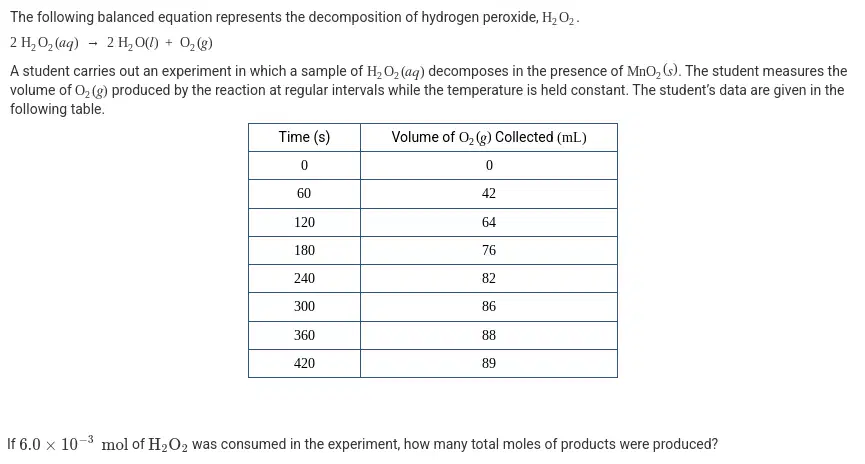
6.0 x 10⁻³mol
9.0 x 10⁻³mol
12.0 x 10⁻³mol
18.0 x 10⁻³mol

A student places a sample of a pure metal in a crucible and heats it strongly in air. Data from the experiment are given in the table above. The final mass was determined after the sample was cooled to room temperature. Which of the following statements related to the experiment is correct?
The mass of the sample decreased, so physical changes occurred as the metal first melted and then boiled out of the crucible.
The mass of the sample increased, so a chemical change occurred when bonds formed between the metal and another substance.
There was nothing for the metal to react with, so only a physical change could have occurred.
The sample was only heated, so neither a physical nor a chemical change occurred.

What are the relative strengths of the acids and bases in the reaction represented by the equation above?


If equal masses of the following compounds undergo complete combustion, which will yield the greatest mass of CO2?
Benzene, C6H6
Cyclohexane, C6H12
Glucose, C6H12O6
Methane, CH4
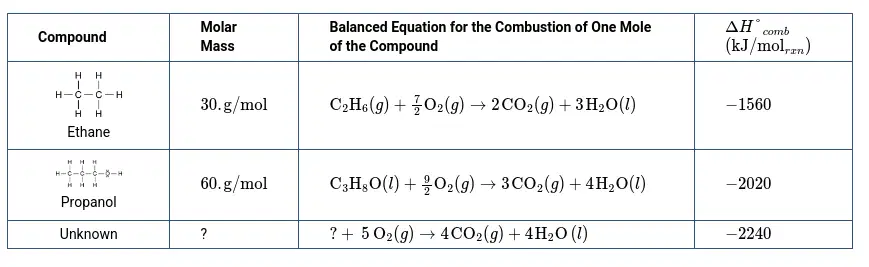
Which of the following is the molecular formula of the unknown compound?
C4H8
C4H8O
C4H4O2
C4H8O2
Which of the following correctly identifies a Brønsted-Lowry conjugate acid-base pair in a solution prepared by mixing together HNO2(aq) and NH3(aq) ?
The acid is HNO2(aq), and the conjugate base is NH3(aq).
The acid is HNO2(aq), and the conjugate base is NO2−(aq).
The acid is NH4+(aq), and the conjugate base is NO2−(aq).
The acid is NH3(aq), and the conjugate base is NH4+(aq).

Each student in a class placed a 2.00 g sample of a mixture of Cu and Al in a beaker and placed the beaker in a fume hood. The students slowly poured 15.0 mL of 15.8 M HNO3(aq) into their beakers. The reaction between the copper in the mixture and the HNO3(aq) is represented by the equation above. The students observed that a brown gas was released from the beakers and that the solutions turned blue, indicating the formation of Cu2+(aq). The solutions were then diluted with distilled water to known volumes.
Which of the following is true about the reaction?
It is a Brønsted-Lowry acid-base reaction, because the solution is neutral at the end.
It is a Brønsted-Lowry acid-base reaction, because HNO3(aq) is a strong acid.
It is a redox reaction, because Cu(s) is oxidized and H+(aq) is reduced.
It is a redox reaction, because Cu(s) is oxidized and the nitrogen atom in NO3−(aq) is reduced.
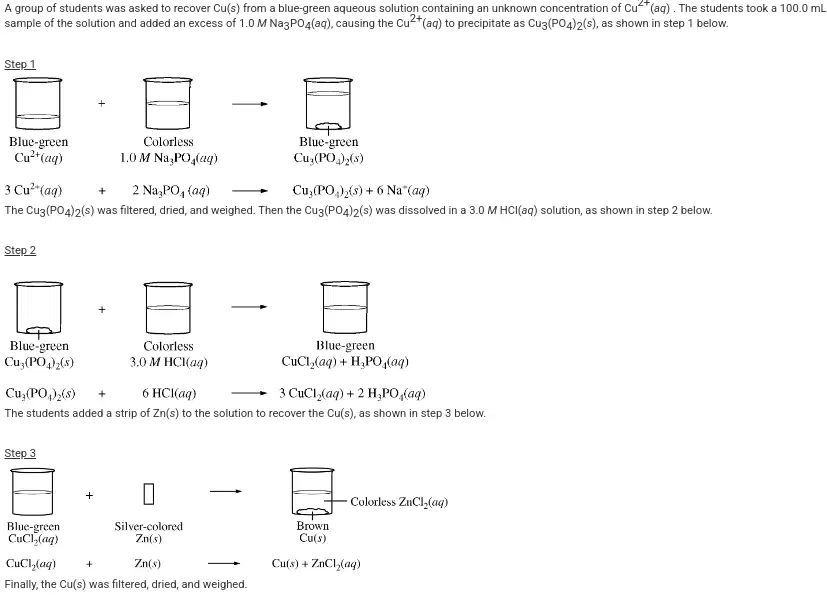
0.10M
0.30M
1.0M
3.0M
A student mixes 20g of white KCI crystals with distilled water in a beaker. After the mixture was stirred, no crystals are visible and the solution is clear. After several days, all of the water evaporates and white crystals are found in the beaker. Which of following pieces of experimental evidence would best help the student to confirm that a new compound had not been made and that only a physical change occurred?
The solution does not change color after stirring.
The KCl crystals are no longer visible after mixing with water.
There is a temperature change in the solution during the dissolving process.
After the water has evaporated, the white crystals in the beaker have a mass of 20g

For the dissolution of HCl in water represented above, which of the following pairs includes the Brønsted-Lowry bases?
HCl(aq) and Cl- (aq)
HCl(aq) and H3O+(aq)
H2O(l) and H3O+(aq)
H2O(l) and Cl- (aq)

A 100mL sample of 0.1M MgCl2(aq) and a 100mL sample of 0.2M NaOH(aq) were combined, and Mg(OH)2(s) precipitated, as shown by the equation above. If the experiment is repeated using solutions of the same molarity, which of the following changes in volume will double the amount of Mg(OH)2(s) produced?
Using the same volume of MgCl2(aq) but twice the volume of NaOH(aq)
Using twice the volume of MgCl2(aq) but half the volume of NaOH(aq)
Using twice the volume of MgCl2(aq) but the same volume of NaOH(aq)
Using twice the volume of MgCl2(aq) and twice the volume of NaOH(aq)

They are oxidized by Cl- ions.
They are reduced to NO2- ions.
They are decomposed by reacting with M+ ions.
They remain dissolved in the filtrate solution.

NaCl
KCl
CuCl
LiCl
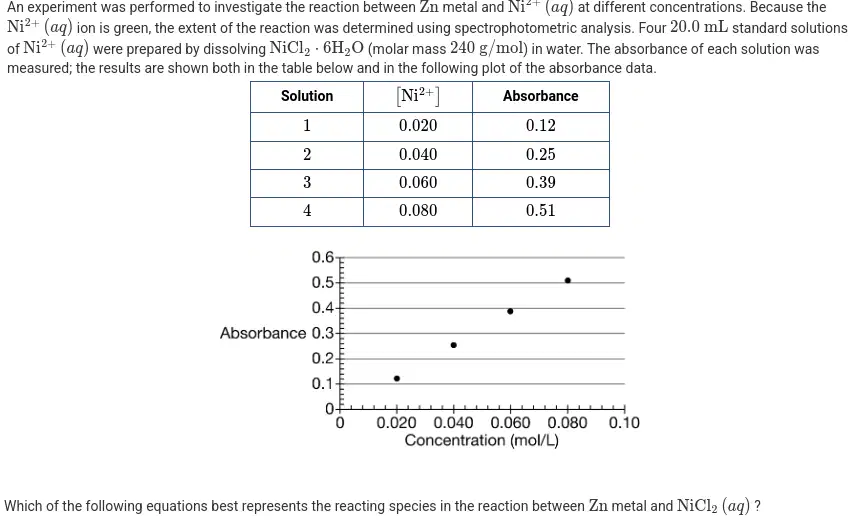




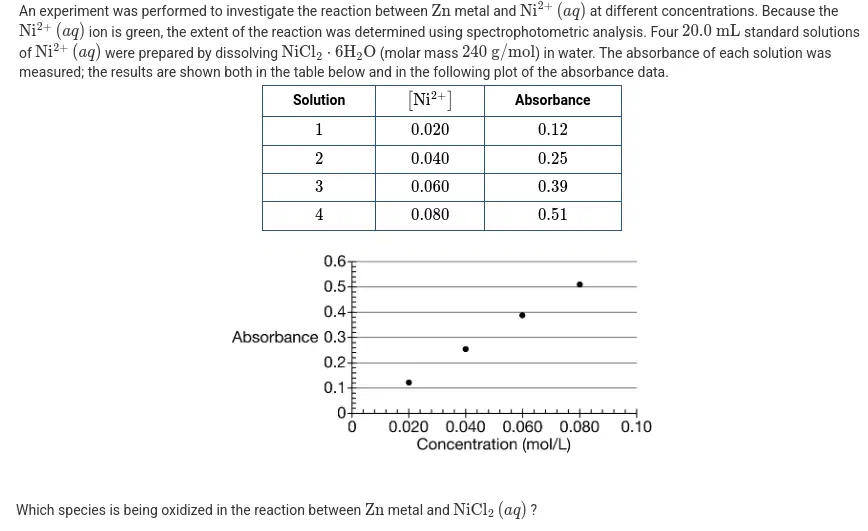
Zn
Zn2+
Ni
Ni2+
A 10.0 g sample of Pb(NO3)2(s) is dissolved in distilled water and an excess of 1.0M HCl(aq) is added. The PbCl2(s) formed is filtered and placed in an oven to dry. The final mass of the precipitate is significantly greater than predicted. Which of the following could account for the discrepancy?
The sample of Pb(NO3)2(s) was wet.
The Ksp of PbCl2(s) is extremely small.
The precipitate was not dried to a constant mass.
A 3.0M HCl(aq) solution was used instead of a 1.0M HCl(aq) solution.

A solution of a salt of a weak acid HY is added to a solution of another weak acid HX. Based on the information given above, which of the following species is the strongest base?
HX(aq)
Y−(aq)
HY(aq)
X−(aq)
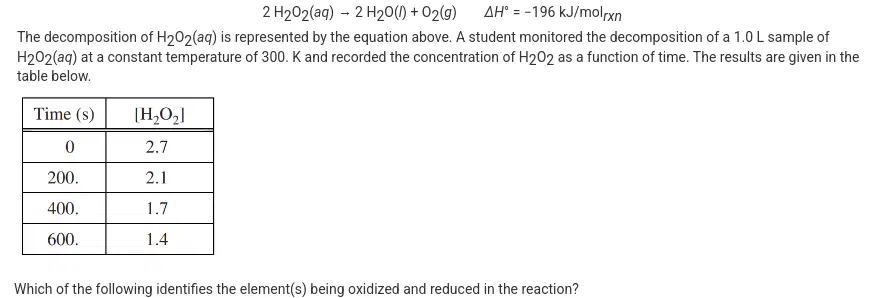
Hydrogen is oxidized and oxygen is reduced.
Oxygen is oxidized and hydrogen is reduced.
Oxygen is both oxidized and reduced.
No elements are oxidized or reduced; the reaction is not a redox reaction.
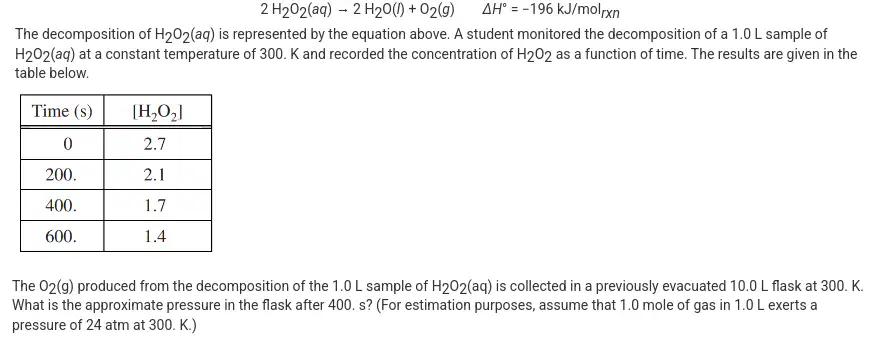
1.2 atm
2.4 atm
12 atm
24 atm
Li3N(s) + 2 H2(g) ⇄ LiNH2(s) + 2 LiH(s)
ΔH° = -192 kJ/molrxn
Because pure H2 is a hazardous substance, safer and more cost effective techniques to store it as a solid for shipping purposes have been developed. One such method is the reaction represented above, which occurs at 200°C.
Which of the following happens to H atoms in the forward reaction?
H atoms are oxidized only.
H atoms are reduced only.
H atoms are both oxidized and reduced.
H atoms are neither oxidized nor reduced.
Li3N(s) + 2 H2(g) ⇄ LiNH2(s) + 2 LiH(s)
ΔH° = -192 kJ/molrxn
Because pure H2 is a hazardous substance, safer and more cost effective techniques to store it as a solid for shipping purposes have been developed. One such method is the reaction represented above, which occurs at 200°C.
When 70. g of Li3N(s) (molar mass 35 g/mol) reacts with excess H2(g), 8.0 g of LiH(s) is produced. The percent yield is closest to
17%
25%
50%
100%
Gaseous hydrogen and gaseous chlorine can react to form hydrogen chloride gas, as represented by the following equation.
H2(g)+Cl2(g)→2 HCl(g)
Equimolar amounts of H2 and Cl2 are placed in an evacuated reaction vessel at 500 K. Which of the following statements correctly predicts how the pressure will be affected as the reaction proceeds at a constant temperature and explains why?
The pressure will remain constant because the number of gas particles is constant.
The pressure will be halved because one substance is produced from two substances.
The pressure will increase because the coefficient of HCl in the balanced chemical equation is greater than that of the reactants.
The pressure will decrease because the average speed of the gaseous product molecules is less than the average speed of the gaseous reactant molecules.

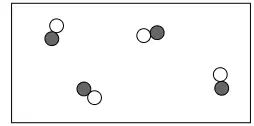
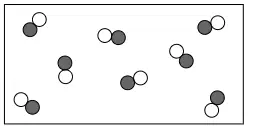
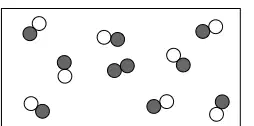
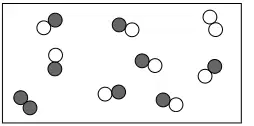

Based on the information given above, which of the following is the strongest acid?
HX (aq)
Y-(aq)
HY(aq)
X-(aq)
A student finds the mass of a pure sample of a metal chloride hydrate. The student heats the sample several times, reaching a constant mass that contains 0.100 mole of anhydrous metal chloride. Which of the following questions about the hydrated metal chloride substance is most likely to be answered by the results of the experiment?
How many moles of water are in one mole of the substance?
How many moles of the metal cation are in one mole of the substance?
What is the identity of the metal cation in the formula of the substance?
What is the melting point of the substance?

A student had two dilute, colorless solutions, HCl(aq) and NaOH(aq), which were at the same temperature. The student combined the solutions, and the reaction represented above occurred. Which of the following results would be evidence that a chemical reaction took place?
The resulting solution is colorless.
The temperature of the reaction mixture increases.
The total volume of the mixture is approximately equal to the sum of the initial volumes.
The resulting solution conducts electricity.

2 Li(s) + 2 H+(aq) + 2 OH−(aq) → 2 Li+(aq) + 2 OH−(aq) + H2(g)
2 Li(s) + 2 H2O(l) → 2 Li+(aq) + 2 OH−(aq) + H2(g)
2 Li(s) + 2 H2O(l) → 2 LiOH(s) + H2(g)
2 Li(s) + 2 H2O(l) → 2 LiH(s) + H2(g)

No gas will be produced when K(s) is used.
Some gas will be produced but less than the amount of gas produced with Li(s).
Equal quantities of gas will be produced with the two metals.
More gas will be produced with K(s) than with Li(s).

O2(g) is the limiting reactant and 2.0mol of SO2(g) is formed.
O2(g) is the limiting reactant and 4.0mol of SO2(g) is formed.
FeS(g) is the limiting reactant and 4.0mol of SO2(g) is formed
FeS(s) is the limiting reactant and 0.5mol of O2(g) remains unreacted.

Extraction of Fe(s) from pyrite, FeS2, is a two-step process, as represented above. The maximum amount of Fe(s) that could be extracted from 120grams of FeS2 (molar mass 120 g/mol) is approximately
28 Grams
56 Grams
84grams
112grams

40g
240g
480g
960g
The volume of the resulting solution will be equal to the sum of the volumes of the original solutions.
The mass of the resulting solution will be equal to the sum of the masses of the original solutions.
The resulting solution would contain a precipitate.
The resulting solution will be clear.

The initial amount of C6H12O6 in the container must have been 0.10mol.
Exactly 0.30mol of C6H12O6 must have reacted because C atoms were conserved
Exactly 0.40mol of O2 of must have reacted because the temperature and container volume are the same.
More than 0.60mol of O2 must have reacted because it was present in excess

In the reaction represented above, the number of MnO4- ions that react must be equal to which of the following?
One-fifth the number of Fe2+ ions that are consumed
Eight times the number of H+ ions that are consumed
Five times the number of Fe3+ ions that are produced
One-half the number of H2O molecules that are produced
Which of the following is the net ionic equation for the reaction between aqueous sodium fluoride and hydrochloric acid?




Equal volumes of 0.2M solutions of lead(II) nitrate and potassium bromide are combined to form lead(II) bromide as a yellow precipitate. Which of the following is the correct net ionic equation for the reaction?




The reaction between aqueous strontium chloride (SrCl2) and aqueous potassium sulfate (K2SO4) forms a precipitate of strontium sulfate (SrSO4). Which of the following represents the net ionic equation for the reaction?





When 0.20 M NH4Cl(aq) and 0.20 M NaOH(aq) are mixed, the reaction represented by the equation above occurs and a strong smell of ammonia, NH3, is observed. Based on this information, which of the following statements is true?
NH4+(aq) acts as a Brønsted-Lowry base.
NH4+(aq) is a stronger acid than H2O(i) is.
NH3(aq) is a stronger base than OH−(aq) is.
NH4+(aq) and Cl−(aq) are a conjugate acid-base pair.




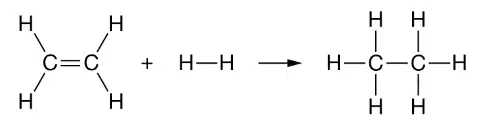
When C2H4(g) reacts with H2(g), the compound C2H6(g) is produced, as represented by the equation above. The reaction is correctly classified as which of the following types
Acid-base, because two hydrogen atoms are donated to C2H4(g).
Precipitation, because two reactant species form a single product
Decomposition, because pure H2(g) is consumed
Oxidation-reduction, because H2(g) is oxidized
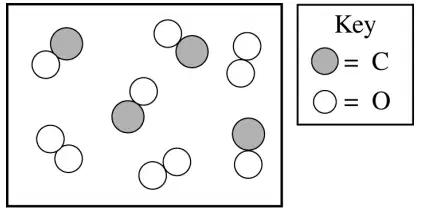
A mixture of CO(g) and O2(g) is placed in a container, as shown above. A reaction occurs, forming CO2(g). Which of the following best represents the contents of the box after the reaction has proceeded as completely as possible?
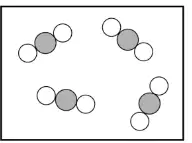
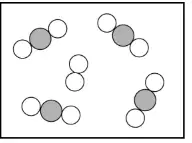
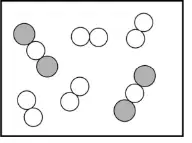
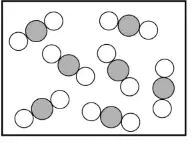
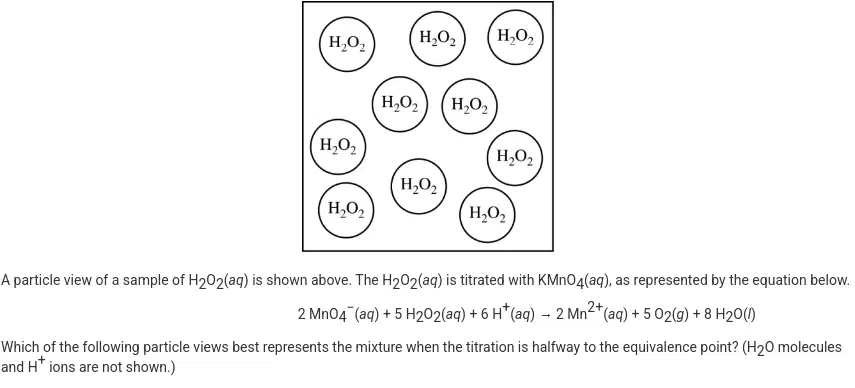
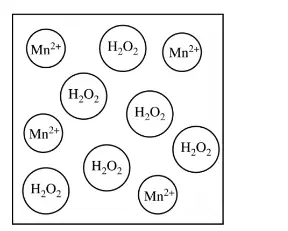
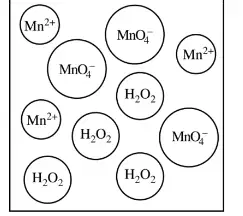
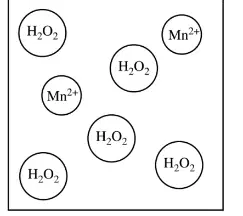
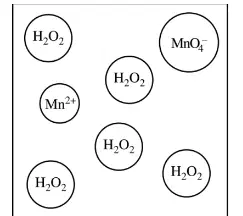

Which of the following particle diagrams best represents the products when four molecules of H2O2(l) decompose into water and oxygen gas at room temperature
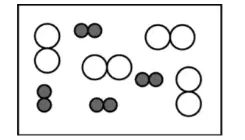
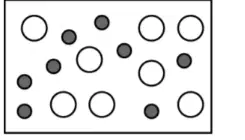
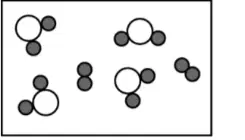
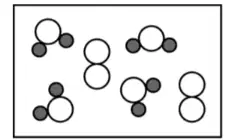
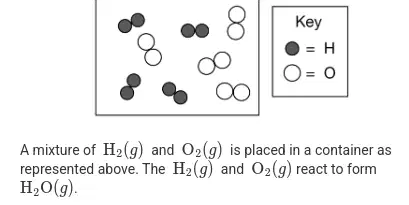
Which of the following best represents the container after the reaction has gone to completion?
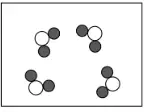
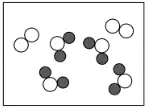
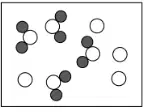
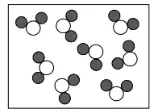
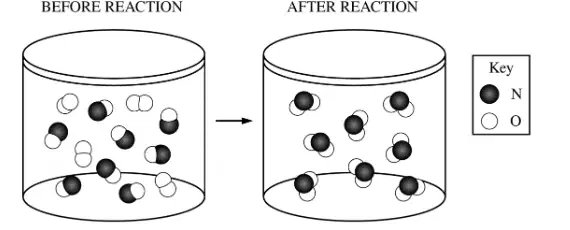
The reaction between NO(g) and O2(g) to produce NO2(g) in a rigid reaction vessel is represented in the diagram above. The pressure inside the container is recorded using a pressure gauge. Which of the following statements correctly predicts the change in pressure as the reaction goes to completion at constant temperature, and provides the correct explanation?
The pressure will increase because the product molecules have a greater mass than either of the reactant molecules.
The pressure will decrease because there are fewer molecules of product than of reactants.
The pressure will decrease because the product molecules have a lower average speed than the reactant molecules
The pressure will not change because the total mass of the product molecules is the same as the total mass of the reactant molecules.
A student was studying physical and chemical changes. The student carried out some procedures in the laboratory and recorded observations. For one of the procedures, the student concluded that a physical change took place, but not a chemical change. Which of the following could have been the results of the procedure?
A cube of metal was changed into a flat sheet of metal.
When two liquids at room temperature were combined in a beaker, the beaker became hot.
When two clear liquids were combined, the resulting mixture was cloudy.
When a colorless liquid was added to a blue liquid, the resulting solution was yellow.
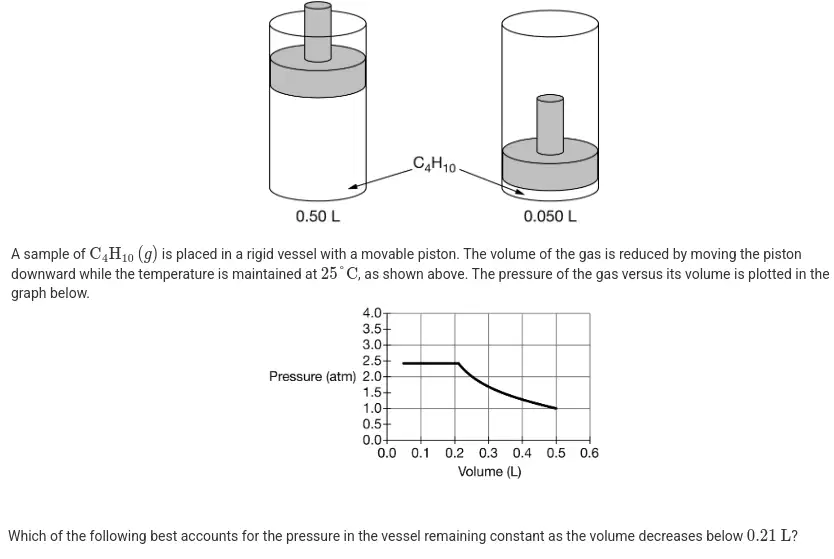
The density of the C4H10(g) increases.
The surface area of the interior of the vessel decreases.
The temp of the C4H10(g) decreases.
Some C4H10(g) condenses to form C4H10(i).

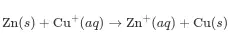
The reaction between solid copper and aqueous silver nitrate produces solid silver and a blue solution, as represented by the balanced equation shown above. Based on the balanced equation, which of the following identifies the oxidation and reduction half-reactions?



In the gas-phase reaction represented by the following equation, methane (CH4) and water (H2O) are produced from carbon dioxide (CO2) and hydrogen (H2) at high temperature and pressure
Which of the following is a correct statement about oxidation and reduction during the reaction?
Hydrogen is oxidized, and carbon is reduced.
Carbon is oxidized, and oxygen is reduced.
Oxygen is oxidized, and hydrogen is reduced.
It is not an oxidation-reduction reaction.
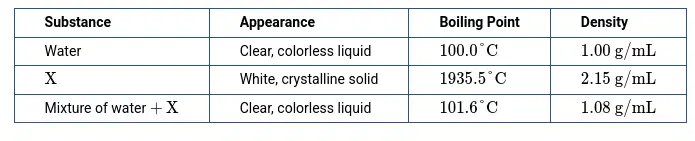
The table above summarizes data given to a student to evaluate the type of change that took place when substance X was mixed with water. The student claimed that the data did not provide enough evidence to determine whether a chemical or physical change took place and that additional tests were needed. Which of the following identifies the best way to gather evidence to support the type of change that occurred when water and X were mixed?
Measuring the melting point of the mixture of water and X
Adding another substance to the mixture of water and X to see whether a solid forms
Measuring and comparing the masses of the water, X, and the mixture of water and X
Measuring the electrical conductivities of X and the mixture of water and X

The compound C6H8O6 reacts with I2 according to the reaction represented by the equation above. The reaction is correctly classified as which of the following types?
Acid-base, because H+ ions are produced.
Precipitation, because there are only two reactants but there are three products
Double replacement, because both H and I appear as ions in the products.
Oxidation-reduction, because I2 is reduced.
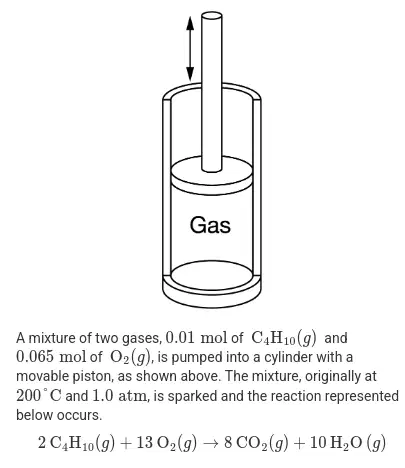
Which of the following is true after the product gases return to the original temperature and pressure, and why will the change occur? (Assume all gases behave ideally.)
The piston will be higher than its original position, because the cylinder will contain a greater number of gas molecules.
The position of the piston will be unchanged, because the total mass of the gases in the cylinder does not change.
The position of the piston will be unchanged, because the temperature and pressure of the contents of the cylinder remain the same
The piston will be lower than its original position, because the product molecules are smaller than the reactant molecules.
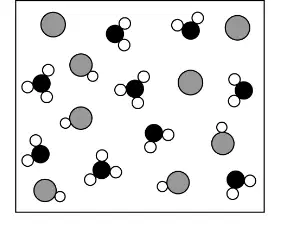
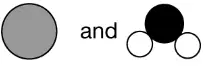
The particle diagram above represents an aqueous solution of a weak monoprotic acid. The white circles represent H atoms. Which of the following shows the species that act as a Brønsted-Lowry base and its conjugate acid, in that order, in the solution?



A student placed a piece of Zn(s) in a beaker containing CuSO4(aq). After 45 minutes, the student observed a brown solid at the bottom of the beaker and that the solution had turned from blue to colorless. Which of the following balanced equations best represents only the species that react and the species that are produced in the reaction?