Wayground logo

Free Printable Worksheets

Font size

S
M
L
XL
Worksheets

Mod 3 Review

Total questions: 80

Worksheet time: 2hrs 14mins

Name
Class
Date
1.
What is the formula to calculate speed?
a)
S = t/d
b)
S = d/t
c)
S = d x t
d)
S = t x d
2.
What is velocity?
a)
the quickness of an object
b)
the location of an object
c)
acceleration
d)
speed in a specific direction
3.
A change in velocity over time is known as:
a)
acceleration
b)
constant speed
c)
average speed
d)
displacement
4.
The unit we use to measure acceleration is ___. 
a)
meters / second 
b)
meters 
c)
seconds 
d)
meters / second / second 
5.
The speedometer on your car tells you
a)
average velocity
b)
instantaneous velocity
c)
average speed
d)
instantaneous speed
6.
At 60 seconds, how far had this object traveled? 
a)
0 m
b)
10 m
c)
20 m
d)
40 m
7.
An airplane lands on a runway with a velocity of 150 m/s. How far will it travel until it stops if its rate of deceleration is constant at -3 m/s2?
a)
525 m
b)
3750 m
c)
6235 m
d)
9813 m
8.
A ball is thrown downward from the top of a roof with a speed of 25 m/s. After 2 s, its velocity will be:
a)
19.6 m/s
b)
-5.4 m/s
c)
-44.6 m/s
d)
44.6 m/s
9.
How much time would it take for an object to fall 4.7 meters?
a)
0.959 s
b)
4.79 s
c)
0.979 s
10.
If a car is traveling forward at 15 m/s, how fast will it be going in 1.2 seconds if the acceleration is -10 m/s2?
a)
27 m/s
b)
3 m/s
c)
-27 m/s
d)
-3 m/s
11.
A boat travels 12.0 m while it reduces its velocity from 9.5 m/s to 5.5 m/s. What is the magnitude of the boat’s acceleration while it travels the 12.0 m?
a)
1.3 m/s2
b)
2.5 m/s2
c)
3.0 m/s2
d)
7.5 m/s2
12.
A car is traveling at 21.0 m/s. It slows to a stop at a constant rate over 5.00 s. How far does the car travel during those 5.00 seconds before it stops? 
a)
4.20 m
b)
52.5 m
c)
105 m
d)
158 m
13.
A dog runs with an initial speed of 7.5 m/s to a stop in 15 seconds.  What is the dog's acceleration?
a)
-7.5 m/s
b)
-7.5 m/s2
c)
-0.5 m/s2
d)
7.5 mi//hr
14.
A roller coasters accelerates from an initial velocity of 6.0 m/s to a final velocity of 70 m/s over 4 seconds.  What's the acceleration?
a)
24 m/s2
b)
18 m/s2
c)
16 m/s2
d)
16 m/s
15.
The SI unit for length or distance is
a)
foot (ft)
b)
inch (in)
c)
mile (mi)
d)
meter (m)
16.
The SI unit for time is
a)
second (s)
b)
minute (min)
c)
hour (hr)
d)
year (yr)
17.
What is the SI unit for acceleration?
a)
m/s
b)
m
c)
m/s2
d)
s
18.
What is the SI unit for speed and velocity?
a)
Km
b)
s
c)
m/s
d)
m/s2
19.
A ball is thrown downward from the top of a roof with a speed of 25 m/s. After 2 s, its velocity will be:
a)
19.6 m/s
b)
-5.4 m/s
c)
-44.6 m/s
d)
44.6 m/s
20.
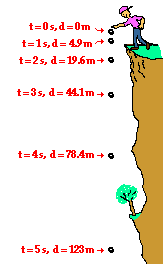
What happens to the velocity of a ball as it is dropped off a cliff? 
a)
It decreases at a uniform rate 
b)
It increases at a uniform rate 
c)
It is constant 
d)
It increases at a non-uniform rate
21.

The force that opposes the motion of two surfaces sliding past each other is called ___________.

a)

unbalanced

b)

inertia

c)

friction

22.
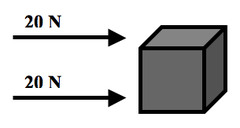
What is the net force?
a)
40 N left
b)
0 N Balalnced
c)
400 N right
d)
40 N right
23.
What is the net force?
a)
10 N
b)
0 N
c)
25 N
d)
1 N
24.

What units are used to measure force?

a)

Kilogram

b)

Meter

c)

Pascal

d)

Newton

25.
How will this object move? 
a)
It won't move. 
b)
It will move to the right. 
c)
It will move to the left. 
d)
It will move up. 
26.
A ____________ is a push or a pull on an object.
a)
friction
b)
force
c)
magnet
d)
gravity
27.
___________ is the amount of matter in an object.
a)
mass
b)
weight
c)
volume
d)
force
28.
On which surface would friction be the greatest?
a)
carpet
b)
ice
c)
snow
d)
water
29.
How will this object move? 
a)
It won't move. 
b)
It will move to the right. 
c)
It will move to the left. 
d)
It will move up. 
30.
What is the net force?
a)
30 N left
b)
25 N right
c)
5 N left
d)
55 N right
31.
In a tug of war the left team pulls with a force of 200N. The right team pulls with a force of 150N. What is the resultant force?
a)
50N to the left.
b)
350N to the left.
c)
350N to the right.
d)
50N to the right.
32.
How will this object move? 
a)
It won't move. 
b)
It will move to the right. 
c)
It will move to the left. 
d)
It will move in both directions. 
33.

Which force is so low that it causes the man to slip and fall?

a)

Gravity

b)

Friction

c)

Air Resistance

34.
If these teams are pulling with the same amount of force what will happen?
a)
The left team will win.
b)
They will not move at all.
c)
The right team will win.
d)
Both will fall down.
35.

Calculate the Net Force.

a)

60N, Left

b)

40N, Right

c)

0 N

d)

60N, Right

36.

Calculate the Net Force.

a)

40N, Left

b)

40N, Right

c)

0N, Balanced

37.

Which force is seen here?

a)
inertia
b)
motion
c)
gravity
d)

tension

38.

Any change in motion must be initiated by a(n) ________________ force.

a)

Balanced

b)

Contact

c)

Field

d)

Unbalanced

39.

One newton accelerates ____________ of mass at 1 m/s^2

a)

1kg

b)

2kg

c)

3kg

d)

4kg

40.

The law of inertia states that...

a)

any object with mass also has inertia

b)

for every action force, there is an equal and opposite reaction force.

c)

objects will remain in their current state unless acted on by a net external force.

d)

the acceleration of an object is directly proportional to the net force acting on the object.

41.

What happens to acceleration if you halve the mass of the object?

a)

Acceleration is halved

b)

Acceleration doubles

c)

Acceleration does not change

d)

Acceleration increases by 1/3

42.

The weight of an object is dependent on which to factors?

a)

mass

b)

velocity

c)

gravity

d)

normal force

43.

An astronaut on the moon has ______________ than on the Earth. On the moon, g = 1.62 m/s^2

a)

a larger weight

b)

a smaller mass

c)

more weight

d)

less weight

44.

(a)   : push or pull on an object.

45.

The tendency of matter to resist a change in its motion.

a)

Inertia

b)

Acceleration

c)

Net force

d)

Pressure

46.

Match the following

a)

Objects at rest remain at rest, and objects in motion continue in a straight line at a constant velocity unless acted on by a net external force.

1.

Law of inertia

b)

The acceleration of an object is directly proportional to the net force acting on the object and is inversely proportional to its mass.

2.

Law of acceleration

c)

For every action force, there is an equal and opposite reaction force.

3.

Law of action-reaction

47.

Which of the following is a field force?

a)

Tension

b)

Gravity

c)

Friction

d)

Air resitance

48.

Which of the following forces should you consider if you want to calculate the acceleration of a falling object if it is not in a vacuum

a)

strong force

b)

electromagnetic force

c)

air resistance force

d)

gravity

e)

weak force

49.

Multiple, simultaneous forces that cancel each other out are called ________________ forces.

a)

balanced

b)

accelerating

c)

unbalanced

d)

summative

50.

Draw a force diagram of an object experiencing both gravity and normal force but has a net force of zero.

51.

An 10 kg object is moving with an acceleration of 2 m/s squared. What is the force of the object? (F=ma)

a)

20 N

b)

10 N

c)

2 N

d)

5 N

52.

If the man pushes with an equal amount of force, which object will accelerate more?

a)

Car because it has more mass

b)

Lawnmower because it has less mass

c)

Car because it has less mass

d)

Lawnmower because it has more mass

53.

A 20-N net force acts on an object with a mass of 2.0 kg. What is the object's acceleration?

a)

10 m/s2

b)

0.1 m/s2

c)

40 m/s2

d)

22 m/s2

54.

What force would be required to accelerate a 72 kg. cart from 26 km/h to 10 km/h in 3.5 seconds.

a)

329 N

b)

-329 N

c)

740 N

d)

-740 N

55.

A 1,000 kg truck moving at 10 m/s runs into a concrete wall. It takes 0.5 seconds for the truck to completely stop. What is the magnitude of force exerted on the truck during the collision?

a)

1,000 N

b)

5,000 N

c)

10,000 N

d)

20,000 N

56.

A vector includes ______ and ________.

a)

direction, magnitude

b)

magnitude, units

c)

direction, units

d)

scalars, scalars

57.

A resultant vector is

a)

equal to the sum of one vector.

b)

equal to the sum of two or more vectors.

c)

equal to the difference of one vector.

58.

What is the resultant of these two vectors?

a)

+17 m

b)

+3 m

c)

-17 m

d)

-3 m

59.

If two vectors to be added are at right angles, you will need to....

a)

Multiply

b)

Divide

c)

Pythagorean Theorem

d)

Use trigonometry

60.
Find the measure of the indicated angle (?) round to the nearest tenth.
a)
9.4
b)
55.2
c)
20.15
d)
19.4
61.

What is the magnitude of the resultant vector, r?

a)

3

b)

4

c)

5

d)

7

62.

Describe the direction of the vector above.

a)

30 degrees

b)

30 degrees North East

c)

30 degrees North of East

d)

30 degrees East of North

63.

An airplane flies due north at 150 km/h with respect to the air. There is a wind blowing at 75 km/h due east. What are the plane's speed with respect to the ground?

a)

167.7 km/h at 26.6 degrees north of east

b)

225 km/h at 26.6 degrees east of north

c)

167.7 km/h at 63.4 degrees north of east

d)

129.9 km/h at 63.4 degrees north of east

e)

129.9 km/h at 26.6 degrees east of north

64.

What is the resultant vector of the two labeled vectors?

a)

+2 km

b)

+14 km

c)

-2 km

d)

-14 km

65.
If you throw a baseball straight up, what is its acceleration at the highest point?
a)
9.8 m/s2
b)
9.8 m/s
c)
0 m/s2
d)
0 m/s
66.
What is the horizontal acceleration of a projectile?
a)
0 m/s2
b)
9.8 m/s2
67.
Two objects of the same mass are launched from the ground. Object A has a launch angle of 45, while Object B has a launch angle of 65. Which object will hit the ground first?
a)
A
b)
B
c)
Both objects hit the ground at the same time
d)
unable to determine with the given information
68.

In a projectile motion we always have...

a)

1 component (x)

b)

3 components (x,y, and z)

c)

2 components (x and y)

d)

0 components

69.

If a ball thrown straight up into the air takes 4 seconds to reach the top (peak), how long will it take to travel from the peak back to the original position?

a)

0s

b)

1s

c)

3s

d)

4s

70.

What is the velocity of an object launched straight up at its highest point?

a)

zero

b)

equal to its vx

c)

½ its maximum value

d)

equal to gravity

71.

At what point is vy= 0 m/s?

a)

A

b)

B

c)

C

d)

D

e)

None of these points

72.
If you drop a banana, how fast is it going after 2 seconds?
a)
4.9m/s
b)
9.8m/s
c)
19.6m/s
d)
29.4m/s
73.
A ball is thrown horizontally at a height of 2.2 meters at a velocity of 65 m/s. Assume no air resistance. How long until the ball reaches the ground?
a)
0.45 s
b)
0.67 s
c)
0.22 s
d)
0.47 s
74.

The Law of Conservation of Energy states that energy is never __________________ or _________________, only transferred.

a)

created, destroyed

b)

created, subtracted

c)

added, subtracted

d)

destroyed, subtracted

75.

What are the units of energy?

a)

Watt

b)

Newton

c)

Joule

d)

Kelvin

76.
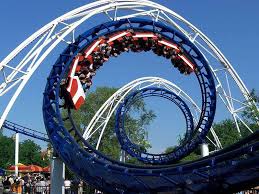
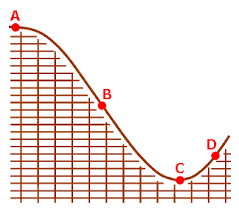
At which point(s) on the roller coaster is the gravitational potential energy at its maximum?
a)
A
b)
B
c)
C
d)
D
77.
A 0.40 kilogram bird is flying at a constant speed of 8.0 m/s. What is the bird's kinetic energy ?
a)
3.2 J
b)
4.2 J
c)
2.0 J
d)
12.8 J
78.

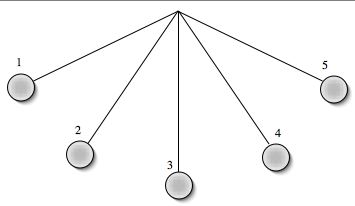
When a pendulum swings, at which point is kinetic energy greatest?

a)

1

b)

2

c)

3

d)

4

79.

A boulder with a mass of 2,500kg rests on a ledge 200m above the ground. What is the boulder's gravitational potential energy (GPE)? (use 9.8 m/s^2 for g)

(a)   J

80.

A 1600kg car travels at a speed of 12.5m/s. What is its kinetic energy (KE)?

(a)