
 Worksheets
Wildlife Population Unit Test Review
Total questions: 44
Worksheet time: 43mins
Using the word bank, match the variable to the proper reproductive strategy.
Density Independent
Live in unstable environments
Mature early
Rodents
Produce many offspring
Density Dependent
Live in a stable environment
Few offspring
Long life expenctancy
Whales
Which of the following measures the age distribution of individuals in a population?
Change dynamics
Fecundity
Potential growth rate
Age structure
Which of the following refers to the potential for reproduction of an organism or population?
Fecundity
Fertility
Production
Sex structure
Which of the following best describes the number of individuals which travel out of a population over a period of time?
Immigration
Fertility
Emigration
Birth
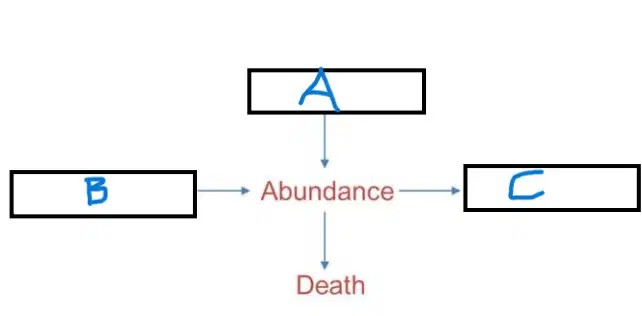
Complete the model using the following: (a) (b) (c)
An example of a r-selected organism is a __________.
bear
moose
whale
mouse
Individuals of one species living and interacting together as a group.
wildlife population
population ecology
recruitment
colonies
An individual achieves access to resources over other individuals through aggression.
dominance
predation
paraitism
competition
Location of animals within a space.
dispersion
range
limiting factor
production
Changes in a population’s abundance and range over a period of time.
wildlife population
density
population dynamics
recruitment
Population size
density
abundance
recruitment
population ecology
Number of animals per unit area.
density
recruitment
wildlife population
wildlife ecology
The measurement and study of population dynamics.
population ecology
population growth
population distribution
population dynamics
Number of new individuals produced in the population over a period of time.
birth rate
death rate
immigration rate
emigration rate
Number of individuals entering a population from another over a period of time.
immigration rate
emigration rate
birth rate
death rate
The number of organisms surviving long enough to be added to a population.
recruitment
ecosystem
abundance
population dynamics
Death Rate: number of individuals in a population who expire over a period of time; also known as (a) rate.
The number of individuals who migrate out of a population over a period of time.
emigration rate
immigration rate
birth rate
death rate
The age distribution of individuals in a population
age structure
sex structure
fecundity
production
male : female
sex structure
age structure
fertility
production
The potential for reproduction of an organism or population is known as _________.
Fecundity
Mortality
Longevity
Growth Rate
The number of offspring produced during a period of time is referred to as _________.
Production
Reproduction Rate
Birth Rate
Fertility
A factor that restricts the size of a population from reaching its full potential is called a _________.
Limiting Factor
Carrying Capacity
Growth Rate
Population Density
Physical and environmental factors that vary and act independently of population numbers are known as _________.
Density Independent Factors
Density Dependent Factors
Biotic Factors
Abiotic Factors
Non-living, physical, and chemical elements that can influence wildlife populations are called _________.
Abiotic Factors
Biotic Factors
Organic Compounds
Living Organisms
Factors that vary depending on population numbers and influence the regulation of population size are known as _________.
Density Dependent Factors
Density Independent Factors
Abiotic Factors
Biotic Factors
Living or once-living organisms within a habitat that have an influence on wildlife populations are referred to as _________.
Biotic Factors
Abiotic Factors
Geological Factors
Chemical Factors
The ability an organism has to survive in a particular environment; health of an animal is known as _________.
Physical Condition
Adaptation
Survival Instinct
Environmental Fitness
The relationship between predator and prey is called _________.
Predation
Symbiosis
Parasitism
Mutualism
An animal hunting and killing other animals for food is known as a _________.
Predator
Herbivore
Scavenger
Omnivore
An animal that is being hunted or killed for food is referred to as _________.
Prey
Predator
Scavenger
Herbivore
A parasite feeds off a host organism in a relationship known as _________.
Parasitism
Mutualism
Commensalism
Predation
The reaction of two or more animals seeking the same resource at the same time is called _________.
Competition
Cooperation
Symbiosis
Predation
Dominance occurs when one individual achieves preferential access to resources, including food, cover and mates over other individuals. This may be achieved through submission or smaller body size.
True
False
Which of the following methods for measuring populations utilizes recording signs of animals, such as droppings, tracks, nest counts, etc.?
Census
Index of population size
Measurement parameters
Rate of increase
__________ factors effects occur through the interaction of animals, plants and other organisms.
Abiotic
Biotic
Limiting
Population
Density is divided into which of the two factors?
Fertility and fecundity
Independent and dependent
Immigration and emigration
Biotic and abiotic
Death rate is expressed as the number of deaths per how many individuals per unit of time?
10
100
1000
10,000
Which of the following is a means of manipulating wildlife habitats?
Hunting
Trapping
Setting bag limits
Putting up fences
Which of the following is NOT a permanent mark used in the mark and recapture technique?
Ear Tag
Paint
Tattoo
Leg Band
Emigration rates can be due to a habitat’s __________.
Translocation
Limited-carrying capacity
Decomposers
Food chain
Disease is an abiotic factor.
True
False
Fertility refers to the natural capacity to and the number of offspring produced.
True
False
Recruitment is affected by immigration.
True
False

