Wayground logo

Free Printable Worksheets

Font size

S
M
L
XL
Worksheets

Movements at a joint

Total questions: 19

Worksheet time: 13mins

Name
Class
Date
1.

The elbow and knee are ​ (a)   joints​ ​

Choose from the below words
hinge
ball and socket
saddle
pivot
2.

Hinge joints can only create the movements of ​ (a)   ​ and ​ (b)   . ​

Choose from the below words
Flexion
extention
rotation
abduction
adduction
Circumduction
3.

Which bone connects the foot to the leg?

a)

Femur

b)

Talus

c)

Scapula

d)

Patella

4.

The bone that meets the pelvis to form the hip joint is (a)  

Choose from the below words
Femur
Tibia
Fibula
Radius
5.

The type of joint formed where the radius and ulna meet the humerus is a (a)   .

6.

The shoulder joint is a (a)   .

Choose from the below words
Hinge joint
Pivot joint
Ball and socket joint
Saddle joint
7.

Match the following parts of the skeleton with their functions.

a)

Rib cage

1.

Protects the heart and lungs

b)

Pelvis

2.

Supports the lower body

c)

Cranium

3.

Protects the brain

d)

Vertebrae

4.

Supports the spine

8.
Hip and shoulder have examples of this type of joint
a)
ball and socket
b)
condyloid
c)
hinge
d)
gliding
9.

The joints that allow the most movement are called

a)

Fixed

b)

Fibrous

c)

Cartilaginous

d)

Synovial

10.

Which of the following is part of a Synovial joint

a)

Synovial membrane

b)

Joint cavity

c)

Ligament

d)

Cartilage

11.

Flexion means to

a)

Increase the angle of a joint

b)

Decrease the angle of a joint

c)

Take a limb away from the body

d)

Return a limb towards the body

12.

When kicking a football the knee

a)

Flexes

b)

Extends

c)

Abducts

d)

Adducts

13.
Identify the joint action being performed.
a)
Extension
b)
Flexion
c)
Abduction
d)
Adduction
14.
Identify the joint action being performed.
a)
Extension
b)
Flexion
c)
Abduction
d)
Adduction
15.
Identify the joint action being performed.
a)
Circumduction
b)
Lateral Rotation
c)
Medial Rotation
d)
Eversion
16.
Identify the joint action being performed.
a)
Inversion
b)
Eversion
c)
Plantarflexion
d)
Dorsiflexion
17.

Movement of a bone around its axis is called (a)   .

18.
Movement away from the mid-line is called _____________.
a)
abduction
b)
adduction
c)
internal rotation
d)
external rotation
19.

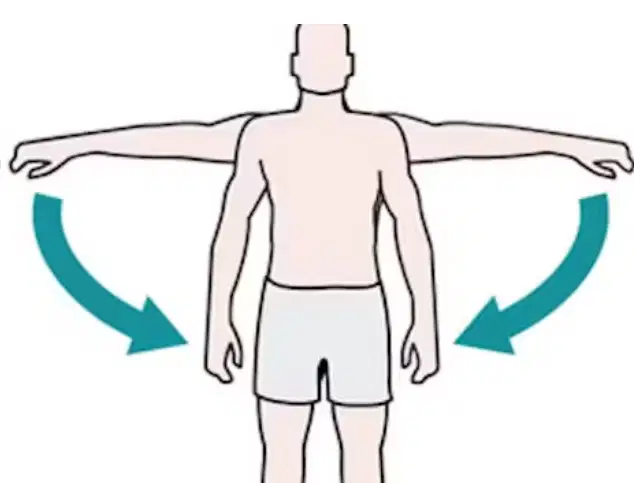
What is the movement when a limb returns to the mid-line of the body?

a)

Adduction

b)

Abduction

c)

Ciurcumduction

d)

Rotation