Worksheets
Unit 8: Ecosystems
Total questions: 81
Worksheet time: 43mins
Which biome do we live in?
Tundra
Desert
Temperate Forest
Savanna
Ethan is planning a vacation and wants to choose a biome to visit. Which biome would you recommend Ethan to visit if he wanted to see a lot of rain and variety of species.
Tropical Rainforest
Desert
Tundra
Savanna
What is the definition of a community?
A community is a group of individuals who share common interests, values, or characteristics and interact with one another within a specific social structure.
A community is a random collection of people who do not interact with each other.
A community is a group of people living in the same geographical area without any social interaction.
A community is a network of individuals connected only through digital platforms.
What is the definition of a population?
A population is defined as a group of individuals of the same species that live in the same area and interact with one another.
A population is a group of different species living together.
A population is a single organism living in isolation.
A population is a collection of ecosystems.
Who is considered the Father of Taxonomy?
Carl Linnaeus
Charles Darwin
Gregor Mendel
Louis Pasteur
What is Binomial Nomenclature?
A system of naming species using two terms, the first one indicating the genus and the second the species
A method of classifying organisms based on their habitat
A technique for breeding plants and animals
A process of photosynthesis in plants
Match the following terms with their definitions:
Species
A group of organisms that can interbreed and produce fertile offspring.
Community
A group of different species that live together in one area.
Habitat
The natural home or environment of an animal, plant, or other organism.
Ecosystem
A biological community of interacting organisms and their physical environment.
Biome
A large geographical biotic unit, a major community of plants and animals with similar life forms and environmental conditions.
List the 8 levels of taxonomy classification from largest to smallest.
Domain, Kingdom, Phylum, Class, Order, Family, Genus, Species
Kingdom, Phylum, Class, Order, Family, Genus, Species, Domain
Phylum, Class, Order, Family, Genus, Species, Domain, Kingdom
Class, Order, Family, Genus, Species, Domain, Kingdom, Phylum
Fill in the blank: The mnemonic device to remember the order of taxonomy classification is 'Dear King Phillip Came Over For Green Salad'.
The mnemonic device to remember the order of taxonomy classification is 'Dear King Phillip Came Over For Green Salad'.
The mnemonic device to remember the order of taxonomy classification is 'Daring Kids Prefer Cheese Over Fried Green Spinach'.
The mnemonic device to remember the order of taxonomy classification is 'Dancing Kangaroos Play Chess On Friday's Green Sofa'.
The mnemonic device to remember the order of taxonomy classification is 'Dolphins Keep Playing Cards On Friday's Green Sand'.
Taxonomic keys are useful in determining the identity of organisms because they:
provide a systematic way to identify organisms based on characteristics
are a type of organism
are used to measure the size of organisms
are a tool for genetic modification
What is the study of the interactions of living organisms with one another and their environment called?
Biogeography
Ecology
Biology
Geography
Fill in the blank: The abiotic and biotic factors that act upon organisms and ultimately determine its form of survival are part of the _______.
Environment
Ecosystem
Habitat
Biosphere
The living factors of an environment, such as bacteria, protists, fungi, plants, and animals, are called:
Abiotic factors
Biotic factors
Ecosystem
Habitat
Identify the non-living part of the environment including water, rocks, light, nutrients, soil, and temperature.
Biotic
Abiotic
Organic
Synthetic
What does the term 'density' refer to in population ecology?
The number of individuals per unit area or volume
The total biomass of a population
The growth rate of a population
The age distribution of a population
What is the term for the pattern of organisms within a given area that results from a need for nutrients, water, or some other important items?
Dispersion
Clumped
Uniform
Random
Fill in the blank: The study of population sizes and distribution is known as ________.
demography
geography
sociology
ecology
What happens to populations as resources become scarce?
Population numbers increase
Competition decreases
Population numbers decrease
Health conditions improve
Fill in the blank: The largest population that an environment can support at any given time is known as ________.
carrying capacity
population density
biomass
ecological footprint
An example of mutualism as a type of symbiotic relationship is:
The relationship between bees and flowers, where bees get nectar and flowers get pollinated.
The relationship between a lion and a zebra, where the lion hunts the zebra.
The relationship between a tapeworm and a human, where the tapeworm feeds on the human's nutrients.
The relationship between a cat and a mouse, where the cat preys on the mouse.
Describe in detail an example of commensalism as a type of symbiotic relationship.
A relationship where one organism benefits and the other is harmed
A relationship where both organisms benefit
A relationship where one organism benefits and the other is unaffected
A relationship where both organisms are unaffected
Which of the following is an example of parasitism as a type of symbiotic relationship?
A tapeworm living in the intestines of a mammal
Bees pollinating flowers
Clownfish living among sea anemones
Birds eating insects off a rhino's back
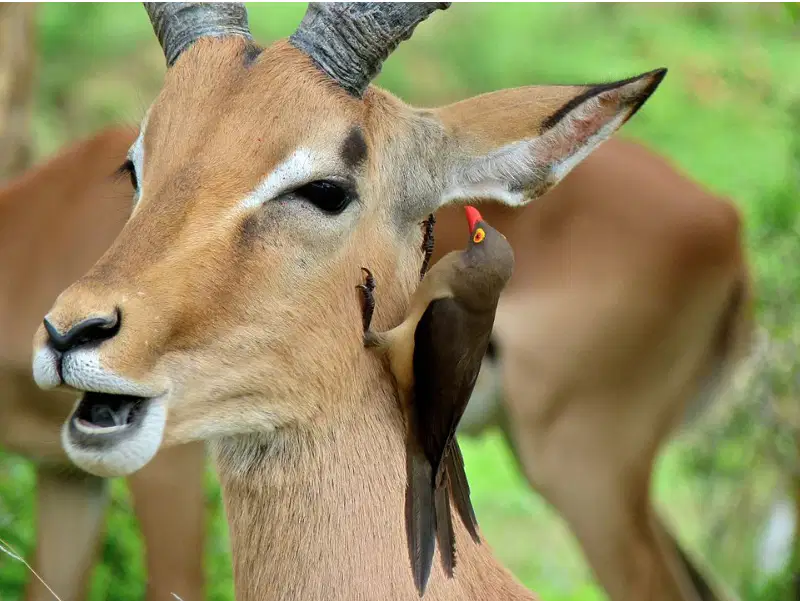
What is the relationship called where one species benefits and the other is unaffected?
Mutualism
Commensalism
Parasitism
Predation
What is primary succession?
The development of a community in an area that has never supported life before
The process of one community replacing another over time
The gradual change in species composition in a given area
The establishment of a community in an area that was previously occupied
Which of the following is a pioneer species in primary succession?
Lichens
Small mammals
Bushes
Trees
What role do birds play in primary succession?
Birds are primary producers in primary succession.
Birds are decomposers in primary succession.
Birds are pollinators in primary succession.
Birds are seed dispersers in primary succession.
In the context of ecological succession, a climax community is:
a community that is in the initial stage of succession
a community that is undergoing rapid change
a stable community that has reached equilibrium
a community that is declining in biodiversity
A natural phenomenon that would require an ecosystem to begin with primary succession is:
Volcanic eruption
Flooding
Forest fire
Hurricane
What does 'Bio' mean in the context of biogeochemical cycles?
Life
Earth
Water
Air
What does 'Geo' mean in the context of biogeochemical cycles?
Life
Earth
Water
Air
According to the Law of Conservation of Matter, what happens to matter?
It is created
It is destroyed
It is transferred and transformed
It disappears.
How is carbon dioxide removed from the air?
By photosynthesis
By burning organic material
By animals breathing out
By breaking down food
What percentage of the atmosphere is Nitrogen?
50%
78%
90%
3%
Fill in the blank: Nitrogen moves between plants, animals, bacteria, the atmosphere, and ____.
soil
water
rocks
clouds
Which of the following cycles involves the processes of evaporation, condensation, and precipitation?
Water Cycle
Carbon Cycle
Nitrogen Cycle
Oxygen Cycle
What is the effect of fertilizers on the ecosystem?
They replace what is missing
They damage the ecosystem
Both A and B
None of the above
Fossil fuels can cause ____ when burned.
acid precipitation
global cooling
soil erosion
ozone depletion
The impact of greenhouse effect on Earth's temperature and glaciers is:
It causes a decrease in Earth's temperature and expansion of glaciers.
It leads to an increase in Earth's temperature and melting of glaciers.
It has no effect on Earth's temperature and glaciers.
It causes Earth's temperature to stabilize and glaciers to remain unchanged.
What is the science of organizing, classifying and naming living things?
taxification
taxadermy
taxonomy
toxicology

What is an ecosystem?
The interactions among living and non-living things in an environment.
A type of organism that can only be seen with a microscope.
A bunch of moving parts that do work.
The newest craze in social media.

What is a major threat to biodiversity?
Urbanization
Pollution
Invasive species
All of the above
How does the introduction of invasive species threaten biodiversity?
By promoting genetic diversity
By competing with native species for resources
By increasing the number of predators
By improving the quality of the soil
What effect does climate change have on ecosystems?
It increases biodiversity by creating new habitats
It has no significant impact on ecosystems
It can lead to the extinction of species
It decreases pollution levels
What is the largest ecological system?
Humans
Organisms
Biosphere
Plants
What is biodiversity?
The variety of only plant species in an environment
The variety of life in a particular habitat or ecosystem
The study of ecosystems
The conservation of endangered species only
How does biodiversity contribute to the resiliency of an ecosystem?
By ensuring that ecosystems are more vulnerable to changes
By reducing the number of species in an ecosystem
By increasing the ecosystem's ability to recover from disturbances
By promoting the spread of diseases
What is another word we could use to describe an ecosystem?
The Food Chain
Traits
Population
Habitat
Which of these is NOT a natural habitat?
River
Ocean
City park
Forest
Which of these habitats is mostly covered with water?
Desert
Mountain
Ocean
Forest
Which of the following animals would you most likely find in a marine ecosystem?
Camel
Dolphin
Eagle
Lion
What do we call a place where a plant or animal lives?
Kitchen
Habitat
Bedroom
Playground


What happens if a population grows past its carrying capacity?
The population keeps growing
The population starts to die off
The entire species will go extinct
The carrying capacity just increases

Something that regulates the size of a population is called...
a limiting measure
a limiting factor
carrying capacity
biodiversity

As a population approaches carrying capacity (K), which of the following is predicted by the logistic growth equation?
the growth rate will be zero
population will increase exponentially
carrying capacity will increase

What is the population of the rabbits in this ecosystem?
3
5
15
20

Which of the following numbers represent a population?
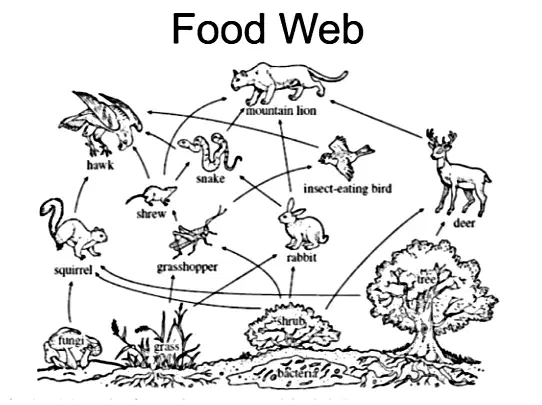
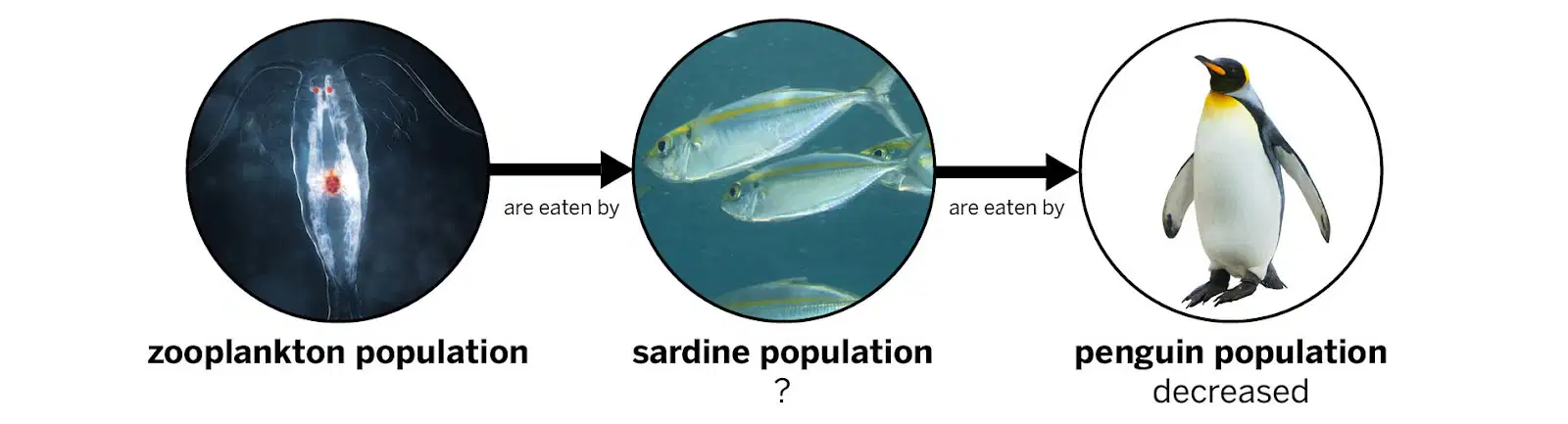
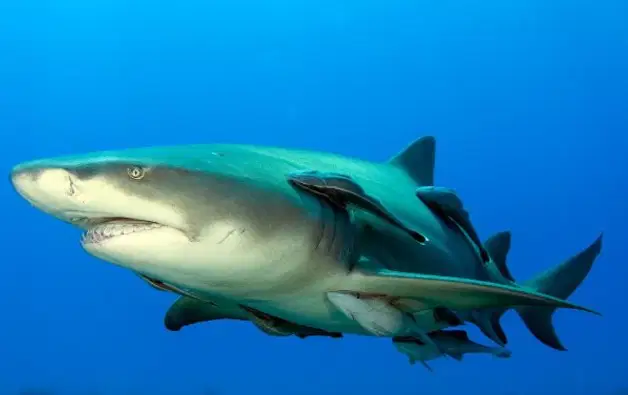
stay the same because a decrease in the penguin population does not affect the other organisms.
decrease because in one population causes a decrease in the sizes of all other populations in the ecosystem.
Increase because there are less penguins in the population consuming the sardine population
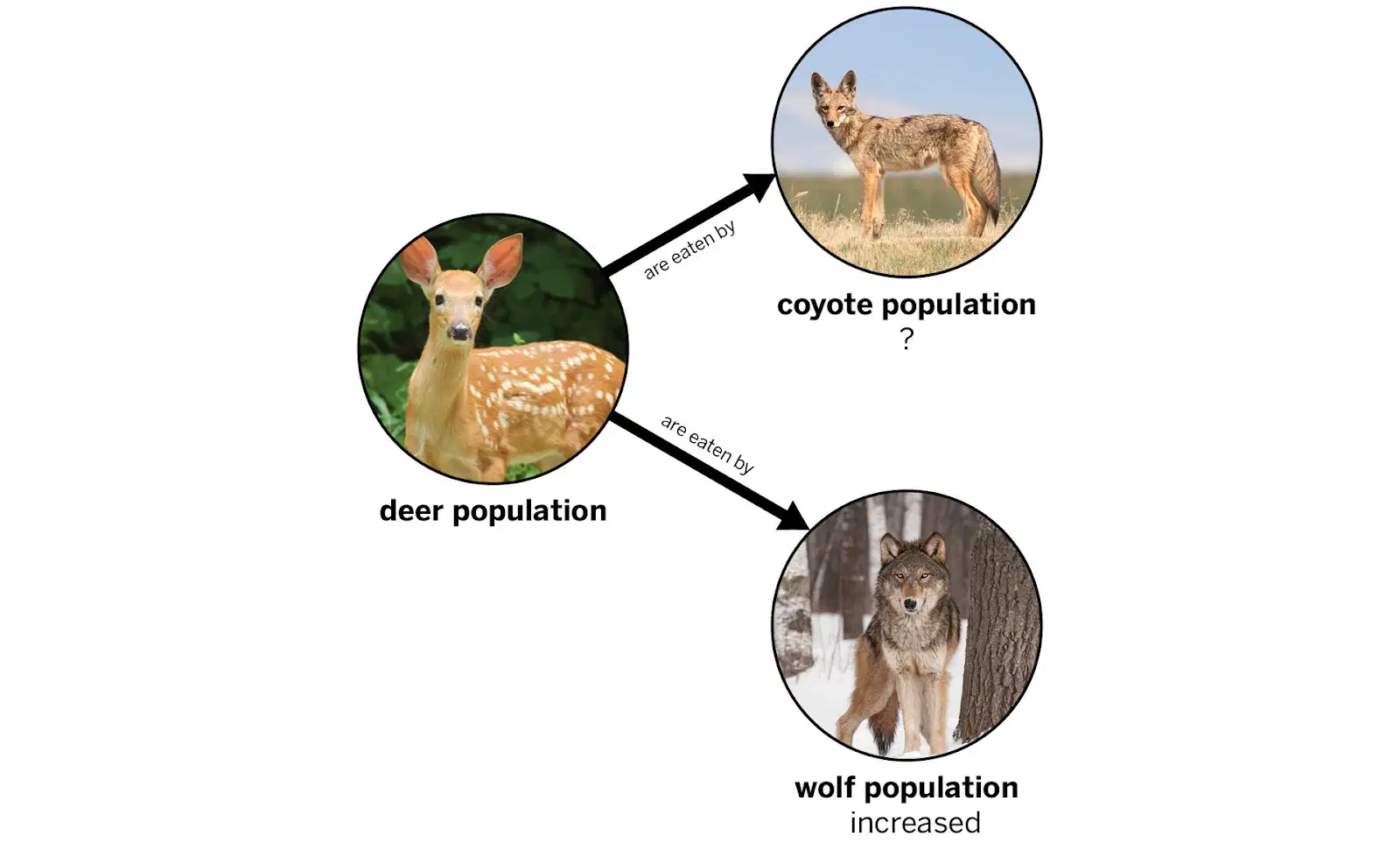
decrease because there will be less energy available to the coyote population from the smaller deer population.
increase because an increase in the size of any population leads to an increase in the sizes of all other populations in an ecosystem.
stay the same because the coyotes and wolves do not eat each other.