wayground logo

Free Printable Worksheets

Font size

S
M
L
XL
Worksheets

6th - Unit 2: Matter, Phase Changes, and Density Review

Total questions: 46

Worksheet time: 47mins
Name
Class
Date
1.
What is the formula for density?
a)
density = mass x volume
b)
density = mass / volume
c)
density = mass + volume
d)
density = mass - volume
2.
Frank has an eraser. It has a mass of 4g, and a volume of 2cm3. What is its density?
a)
8 g/cm3
b)
2 g/cm3
c)
1/2 g/cm3
d)
24 g/cm3
3.
Jack has a rock. The rock has a mass of 14g and a volume of 2cm3. What is the density of the rock?
a)
7 mL
b)
7 g/cm3
c)
28 g/cm3
d)
1/7 g/cm3
4.
Why do some substances float on water?
a)
they are warmer than water
b)
they are cooler than water
c)
they are more dense than water
d)
they are less dense than water
5.
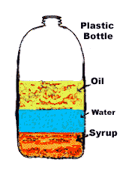
Which liquid is the least dense?
a)
oil
b)
water
c)
syrup 
d)
plastic bottle
6.
Look at this image.  Which object has the LOWEST density in water? How
a)
The Ping Pong Ball because it floats to the top 
b)
The bolt because it has sunk to the bottom
c)
The soda cap because it is not just full of air like the Ping Pong ball
7.
Why did the balloon come back down to the ground?
a)
The air around it pushed it down.
b)
The air inside cooled and became more dense forcing the balloon to descend. 
c)
The air inside the balloon heated up and the air was too hot to rise. 
d)
The balloon may have had a hole in it.
8.

What happens to air molecules when they are heated?

a)

they come together

b)

they seperate

c)

they don't move

d)

they stay the same.

9.

What happens to air molecules when they are cooled?

a)

They spread apart

b)

they become compacted

c)

they stay the same

d)

they move quickly

10.

Warm air is _____ dense than cool air.

a)

more

b)

less

c)

the same

11.
What units are used to measure mass?
a)
g
b)
cm3
c)
g/cm3
d)
cm3/g
12.
What two types of measurements make up DENSITY
a)
Mass and Volume
b)
Temperature and Mass
c)
Grams and Centimeters
d)
Volume and Weight
13.
True or False:  The density of a specific type of material never changes.  
a)
True
b)
False
14.

When measuring the volume of a liquid, what is the unit of measurement that is used?

a)

g

b)

mL

c)

cm3

d)

g/cm3

15.
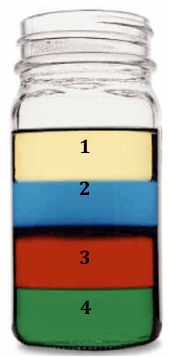
Put the liquids in order from most dense to least dense?
a)
4, 3, 2, 1
b)
1, 2, 3, 4
c)
3, 4, 2, 1, 
d)
4, 3, 1, 2
16.
When a particle changes from a solid to a liquid the process is called ..............
a)
condensation
b)
melting
c)
evaporation
d)
sublimation
17.
When particles lose energy and change from a gas to a liquid it is called ...........
a)
condensation
b)
melting
c)
evaporation
d)
dissolving
18.
How are liquids and solids different than gasses?
a)
Gasses have space between their particles.
b)
Only solids and liquids can be compressed.
c)
Solids hold the shape of the container they are in.
d)
Solids and liquids cannot be contained.
19.
How are liquids and solids different than gasses?
a)
Solids and liquids cannot be contained.
b)
Solids hold the shape of the container they are in.
c)
Solids hold their own shape.
d)
Only solids and liquids can be compressed.
20.
How are liquids and solids different than gasses?
a)
Solids and liquids do not have space between their particles.
b)
Only solids and liquids can be compressed.
c)
Solids hold the shape of the container they are in.
d)
Solids and liquids cannot be contained.
21.
In what way are liquids different than solids?
a)
Solid particles move faster than liquid particles.
b)
Liquids have no defined shape but solids do.
c)
Solids have a greater mass than liquids.
d)
Liquid particles never touch but solid particles always do.
22.

Ice is a good example of matter in what phase?

a)

Solid

b)

Liquid

c)

Gas

23.

Water vapor is an example of what phase of matter?

a)

Solid

b)

Liquid

c)

Gas

24.

What occurs when a liquid becomes a solid?

a)

Freezing

b)

Melting

25.

What occurs when a gas becomes a liquid?

a)

Melting

b)

Condensation

26.

What state of matter has its own shape and a definite volume?

a)

Solid

b)

Liquid

c)

Gas

27.

What state of matter takes the shape of its container and has a definite volume?

a)

Solid

b)

Liquid

c)

Gas

28.

What state of matter takes the shape of its container and doesn't have a definite volume?

a)

Solid

b)

Liquid

c)

Gas

29.

When water vapor turns back into a liquid, heat is

a)

Evaporated

b)

Condensed

30.

What happens when a liquid turns into a gas?

a)

Condensation

b)

Evaporation

31.

Particles move faster when the temperature is decreased. 

a)

True

b)

False

32.

Heating a substance causes kinetic energy to increase. 

a)

True

b)

False

33.

What Is Matter?

a)

Anything That has mass and takes up space.

b)

Anything that you can see or taste.

c)

What you can touch.

d)

you and go throught this.

34.
What Is Volume?
a)
How heavy something is.
b)
The amount of space taken up by and object.
c)
How a liquid flows.
d)
The international unit of measurement.
35.
Liquids and gases are similar because __________________________.
a)
they both take the shape of their container
b)
they both have their own shape
c)
liquids pour and gases don't
d)
liquids take the shape of the container but gases have their own shape
36.
Gas particles have the ________ kinetic energy because they move the fastest.
a)
least
b)
most
37.

The type of matter with the lowest heat energy and temperature.

a)

gas

b)

solid

c)

liquid

d)

plasma

38.
What phase of matter is shown in the diagram?
a)
solid
b)
liquid
c)
gas
d)
physical changes
39.

Which of the following describes liquids?

a)

definite shape, definite volume

b)

no definite shape, definite volume

c)

no definite shape, no definite volume

d)

no definite shape, no definite volume, electrically charged

40.
What is the main reason a substance changes from one state of matter to another?
a)
The substance turns into a different kind of matter.
b)
The substance's temperature changes.
c)
The substance's size changes. 
d)
The substance's shape changes. 
41.
When solid dry ice becomes a gas this is called
a)
sublimation
b)
deposition
c)
condensation
d)
evaporation
42.
A phase change when a gas becomes a solid is called 
a)
Sublimation
b)
Deposition
c)
Fusion
d)
condensation
43.
The drops of water that appear on the outside of a glass of cold juice on a warm day are an example of?
a)
sublimation
b)
condensation
c)
evaporation
d)
melting
44.

All matter is made of _________.

a)
energy 
b)
atoms 
c)
electrons 
d)
compounds 
45.

___________ combine together to form molecules.

a)

atoms

b)

compounds

c)

mixtures

d)

pikmon

46.

Which of the following is the largest?

a)

atom of carbon

b)

atom of uranium

c)

molecule of sugar

d)

hydrogen atom