
 Worksheets
Chemical Reactions Notes Quiz
Total questions: 92
Worksheet time: 46mins
What is a physical change?
A change in a substance that doesn’t change its identity
A change of a substance into another substance
A process where new bonds are formed between atoms
A change that involves energy but not matter
Which of the following is an example of a chemical change?
Boiling
Melting
Burning
Grinding
What occurs during a chemical reaction?
Substances change their state but not their identity
Substances collide with enough energy to form new bonds
Substances are mixed but remain the same
Substances lose energy and remain unchanged
Which statement is true about chemical reactions?
They do not have a change in energy
They do not have a change in matter
They do not involve new substances
They do not involve any collisions
According to collision theory, what must happen for a chemical reaction to occur?
Particles must collide with enough force.
Particles must be at rest.
Particles must be in a vacuum.
Particles must be heated.
What does the rate of a chemical reaction depend on?
The frequency of the collisions.
The color of the reactants.
The size of the container.
The temperature of the room.
What is a chemical reaction associated with?
Physical change
Chemical change
No change
Biological change
Which of the following is evidence of a chemical reaction?
Energy change in the system
Shape change
Size change
Texture change
What is an example of energy change in a chemical reaction?
Release of sound
Release of light
Release of pressure
Release of magnetism
What is the term for the sudden appearance of a solid in a chemical reaction?
Solvent
Solute
Precipitate
Solution
What does the Law of Conservation of Mass state?
Matter can be created or destroyed.
Matter can only change forms.
Mass of reactants is less than mass of products.
Mass of products is always zero.
In a chemical reaction, what is the relationship between the mass of reactants and the mass of products?
Mass of reactants is greater than mass of products.
Mass of reactants is less than mass of products.
Mass of reactants equals mass of products.
Mass of products is double the mass of reactants.
If there are 25 grams of reactants, how many grams of products should there be according to the Law of Conservation of Mass?
0 grams
12.5 grams
25 grams
50 grams
Why is learning to balance equations critical in chemistry?
To create new matter.
To ensure the mass of reactants equals the mass of products.
To destroy excess matter.
To increase the mass of products.
What do equations represent in chemistry?
Physical changes
Chemical reactions
Mathematical problems
Biological processes
How can chemical equations be written?
Only in formula form
Only in word form
In word form or formula form
In numerical form only
Which of the following is an example of a chemical equation in word form?
2H₂(g) + O₂(g) → 2H₂O(l)
Hydrogen gas and oxygen gas react to form liquid water
H₂O is water
CO₂ is carbon dioxide
What is the formula for the reaction between hydrogen gas and oxygen gas to form water?
H₂O + O₂ → H₂O₂
2H₂(g) + O₂(g) → 2H₂O(l)
H₂ + O → H₂O
2H₂O → 2H₂ + O₂
What are reactants in a chemical equation?
Ending substances; what is made
Starting substances; "ingredients"
Substances that yield products
Substances that separate reactants
What do products represent in a chemical equation?
Starting substances; "ingredients"
Substances that separate reactants
Ending substances; what is made
Substances that yield reactants
What does the " + " symbol indicate in a chemical equation?
Yields; produces
Separates one or more reactants or products
Indicates a chemical reaction
Represents the products
What does the arrow symbol (→) mean in a chemical equation?
Separates one or more reactants or products
Indicates a chemical reaction
Yields; produces
Represents the reactants
Chemical equation showing reactants and products:
H2 + O2 -> H2O
C + O2 -> CO2
N2 + H2 -> NH3
Na + Cl2 -> NaCl
What does the coefficient in a chemical equation represent?
The type of reaction
The number of each substance needed
The temperature of the reaction
The speed of the reaction
In the chemical equation 2Na(s) + Cl₂(g) → 2NaCl(s), what is the ratio of sodium to chlorine?
1:1
2:1
1:2
3:1
Which part of a chemical equation can change?
Subscripts
Coefficients
Chemical symbols
Reaction type
In a chemical equation, if only one molecule of a substance is needed, how is it represented?
By writing the number 1
By not writing any number
By writing the number 0
By writing the number 2
What does the notation (s) represent in a chemical equation?
Solid
Liquid
Gas
Aqueous
In a chemical equation, what does the notation (aq) mean?
Solid
Liquid
Gas
Aqueous
Which state of matter is represented by the notation (g) in a chemical equation?
Solid
Liquid
Gas
Aqueous
What does the notation (l) indicate in a chemical equation?
Solid
Liquid
Gas
Aqueous
What is the balanced chemical equation for the reaction between sodium and chlorine gas?
Na(s) + Cl₂(g) → NaCl(s)
2Na(s) + Cl₂(g) → 2NaCl(s)
Na(s) + 2Cl₂(g) → NaCl₂(s)
2Na(s) + 2Cl₂(g) → NaCl(s)
How many solid sodium atoms react with chlorine gas in the given equation?
1
2
3
4
What are the reactants in the chemical equation: LiCl + O₂ → LiClO₃?
Lithium chloride and oxygen gas
Lithium chlorate and oxygen gas
Lithium chloride and lithium chlorate
Oxygen gas and lithium chlorate
Why must equations be balanced in chemistry?
To keep from violating the Law of Conservation of Mass.
To make the equation look neat.
To ensure the equation is easy to read.
To increase the number of products.
What is used to balance chemical equations?
Coefficients
Subscripts
Exponents
Fractions
Why can coefficients be changed in a chemical equation?
Because they can be adjusted to balance the equation.
Because they are part of the chemical formula.
Because they represent the state of matter.
Because they indicate the temperature.
What is the first step in balancing chemical equations?
Change the coefficients
Write the equation for the reaction
Count the number of atoms
Reduce coefficients
When balancing equations, where should you put the symbols of each element?
In a row under the products
In a column under the reactants and products
In a circle around the equation
In a separate document
What should you do after counting the number of each atom on both sides of the equation?
Change the coefficients
Write it in your chart
Reduce the coefficients
Erase the equation
What is the purpose of changing the coefficients in a chemical equation?
To make the equation longer
To balance the number of each atom
To change the elements involved
To simplify the equation
What must be done with coefficients after balancing the equation?
Increase them
Reduce them as needed
Remove them
Double them
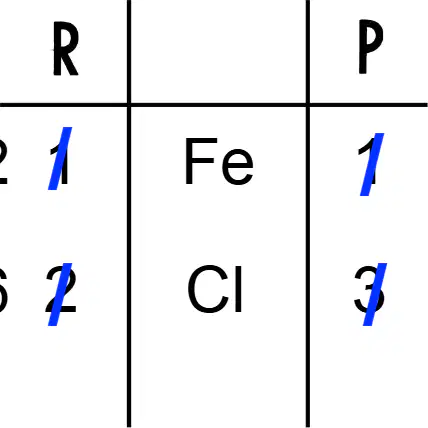
What is the balanced chemical equation for the reaction between iron (Fe) and chlorine (Cl₂) to form iron(III) chloride (FeCl₃)?
2Fe(s) + 3Cl₂(g) → 2FeCl₃(s)
Fe(s) + Cl₂(g) → FeCl₃(s)
3Fe(s) + 2Cl₂(g) → 3FeCl₃(s)
2Fe(s) + Cl₂(g) → FeCl₃(s)
In the balanced equation 2Fe(s) + 3Cl₂(g) → 2FeCl₃(s), what is the coefficient of Cl₂?
3
2
1
6
Why can't the coefficients 2, 3, and 2 in the balanced equation 2Fe(s) + 3Cl₂(g) → 2FeCl₃(s) be simplified further?
They are the lowest/most reduced they could be.
They are already in the simplest form.
Simplifying would change the reaction.
Simplifying would create a different compound.
What is the balanced chemical equation for the reaction between aqueous sodium hydroxide and aqueous calcium bromide?
2 NaOH(aq) + CaBr₂(aq) → Ca(OH)₂(s) + 2 NaBr(aq)
NaOH(aq) + CaBr₂(aq) → Ca(OH)₂(s) + NaBr(aq)
2 NaOH(aq) + 2 CaBr₂(aq) → Ca(OH)₂(s) + NaBr(aq)
NaOH(aq) + CaBr₂(aq) → 2 Ca(OH)₂(s) + NaBr(aq)
Which of the following is not a category of chemical reactions?
Synthesis
Decomposition
Photosynthesis
Combustion
Why do we classify chemical reactions into categories?
To make them more complex
To predict the products of a reaction
To increase the number of reactions
To make them harder to understand
Which of the following is a type of chemical reaction?
Single Replacement
Triple Replacement
Quadruple Replacement
Quintuple Replacement
What is formed when two or more reactants combine in a synthesis reaction?
A new compound
An element
A mixture
A solution
What is the general formula for a synthesis reaction?
A + B → AB
AB → A + B
A + B → C
AB + C → AC + B
What is produced when an element combines with oxygen?
An oxide
A salt
A base
An acid
What is formed when certain metal oxides combine with nonmetal oxides?
Salts
Acids
Bases
Oxides
What is produced in a decomposition reaction?
One simpler compound
Two or more simpler compounds
No change in compounds
A single complex compound
Which of the following is an example of a decomposition reaction?
Ca(OH)₂(s) → CaO(s) + H₂O(g)
H₂ + O₂ → H₂O
Na + Cl₂ → NaCl
C + O₂ → CO₂
What is required for most decomposition reactions to occur?
Light
Energy in the form of heat or electricity
Sound
Pressure
What is electrolysis?
The combination of substances by an electric current
The decomposition of a substance by an electric current
The synthesis of a compound using heat
The neutralization of acids and bases
What is combustion?
A process where a substance reacts with oxygen.
A process where a substance reacts with nitrogen.
A process where a substance reacts with hydrogen.
A process where a substance reacts with carbon dioxide.
What is often produced during combustion?
Energy in the form of heat and light.
Energy in the form of sound and light.
Energy in the form of heat and sound.
Energy in the form of light and electricity.
What is a hydrocarbon?
A compound made of carbon and hydrogen.
A compound made of carbon and oxygen.
A compound made of hydrogen and oxygen.
A compound made of nitrogen and hydrogen.
What are the products of the combustion of methane (CH₄)?
CO₂ and H₂O
CO and H₂
CO₂ and O₂
CO and H₂O
What is a single replacement reaction?
When two elements combine to form a compound.
When one element replaces another in a compound.
When a compound breaks down into two elements.
When two compounds exchange elements.
Which of the following is an example of a single replacement reaction?
2H₂ + O₂ → 2H₂O
NaCl + AgNO₃ → NaNO₃ + AgCl
2Al + 3Pb(NO₃)₂ → 3Pb + 2Al(NO₃)₃
H₂O + CO₂ → H₂CO₃
In a single replacement reaction, what type of solution do many reactions take place in?
Solid solution
Gaseous solution
Aqueous solution
Liquid solution
What do the most reactive metals produce when they react with water?
Metal oxides and oxygen
Metal hydroxides and hydrogen
Metal chlorides and chlorine
Metal sulfates and sulfur
What is a double replacement reaction?
A reaction where ions of two compounds exchange places to form two new compounds.
A reaction where a single compound breaks down into two or more elements.
A reaction where two elements combine to form a single compound.
A reaction where a compound reacts with oxygen to produce energy.
Which of the following is an example of a precipitate forming in a double replacement reaction?
NaCl(aq) + AgNO₃(aq) → AgCl(s) + NaNO₃(aq)
H₂(g) + O₂(g) → H₂O(l)
C(s) + O₂(g) → CO₂(g)
HCl(aq) + NaOH(aq) → NaCl(aq) + H₂O(l)
What is an insoluble gas in the context of double replacement reactions?
A gas that dissolves in water.
A gas that is seen as bubbles given off.
A gas that forms a solid precipitate.
A gas that reacts with oxygen.
What does it mean when a chemical reaction is described as reversible?
The reaction can proceed in both forward and reverse directions.
The reaction can only proceed in one direction.
The reaction cannot reach equilibrium.
The reaction is irreversible.
What indicates that a system is in equilibrium during a chemical reaction?
A single arrow
A double arrow
A triple arrow
No arrow
In the reaction 2SO₂(g) + O₂(g) ⇌ 2SO₃(g), what happens when the forward and reverse processes occur at the same rate?
The system is in equilibrium.
The reaction stops completely.
The reaction speeds up.
The reaction becomes irreversible.
What is chemical equilibrium?
A static process with visible changes
A dynamic process with no net change in reactants and products
A process where only products are formed
A process where only reactants are formed
At chemical equilibrium, how do the rates of the forward and reverse reactions compare?
The forward reaction is faster
The reverse reaction is faster
Both occur at the same rate
Neither reaction occurs
In the reaction A + B ⇌ AB at equilibrium, what is true about the formation of A, B, and AB?
A and B are forming faster than AB
AB is forming faster than A and B
A, B, and AB are forming at the same rate
No formation occurs
What does Le Chatelier's Principle state about a system at equilibrium when conditions change?
The system will increase the effect of the change.
The system will reduce the effect of the change.
The system will remain unchanged.
The system will stop reacting.
In the reaction A + B ⇌ AB, what happens if the forward reaction is favored?
[A + B] increases, [AB] decreases.
[A + B] decreases, [AB] increases.
Both [A + B] and [AB] increase.
Both [A + B] and [AB] decrease.
Which of the following is an example of a change (or stress) to a system at equilibrium?
Change in color.
Change in concentration.
Change in shape.
Change in size.
What happens to H₂CO₃ in the bloodstream during exercise according to Le Chatelier's Principle?
It decreases, lowering blood acidity.
It remains constant, maintaining blood pH.
It builds up, increasing blood acidity.
It converts to oxygen, increasing blood pH.
How does the body respond to increased acidity in the blood during exercise?
By slowing down breathing to retain CO₂.
By breathing faster to remove CO₂.
By increasing heart rate to circulate more blood.
By decreasing body temperature to reduce stress.
What happens to the equilibrium when a reactant (either A or B) is added?
Forward reaction favored
Reverse reaction favored
No change
Equilibrium shifts to the left
What is the response when a product (AB) is added to the equilibrium?
Forward reaction favored
Reverse reaction favored
No change
Equilibrium shifts to the right
What is the effect on equilibrium when a reactant (either A or B) is removed?
Forward reaction favored
Reverse reaction favored
No change
Equilibrium shifts to the right
What happens to the equilibrium when a product (AB) is removed?
Forward reaction favored
Reverse reaction favored
No change
Equilibrium shifts to the left
What is the effect of adding heat to an exothermic reaction?
It favors the forward reaction.
It favors the reverse reaction.
It has no effect.
It stops the reaction.
In an endothermic reaction, what happens when heat is added?
It favors the forward reaction.
It favors the reverse reaction.
It has no effect.
It stops the reaction.
Which type of reaction releases heat overall?
Endothermic
Exothermic
Neutral
Catalytic
Which type of reaction absorbs heat overall?
Exothermic
Endothermic
Neutral
Catalytic
What happens to the direction of a reaction if the pressure is increased in a gaseous system?
The reaction favors the direction with more gas molecules.
The reaction favors the direction with fewer gas molecules.
The reaction stops completely.
The reaction favors the direction with equal gas molecules.
If the pressure is decreased in a gaseous system, which direction will the reaction favor?
The reaction favors the direction with more gas molecules.
The reaction favors the direction with fewer gas molecules.
The reaction stops completely.
The reaction favors the direction with equal gas molecules.
What happens to the equilibrium of the reaction CaCO₃(s) ⇌ CaO(s) + CO₂(g) when pressure is changed?
Unaffected, because there aren’t gases on both sides.
Favors forward, because there are gases on both sides.
Favors reverse, because there are gases on both sides.
Unaffected, because there are equal moles of gas on each side.
In the reaction N₂(g) + 3H₂(g) ⇌ 2NH₃(g), what effect does an increase in pressure have?
Favors forward.
Favors reverse.
Unaffected.
Decreases the rate of reaction.
For the reaction H₂(g) + Cl₂(g) ⇌ 2HCl(g), why is the equilibrium unaffected by pressure changes?
Because there are equal moles of gas on each side.
Because there are no gases involved.
Because it favors the forward reaction.
Because it favors the reverse reaction.

