wayground logo

Free Printable Worksheets

Font size

S
M
L
XL
Worksheets

Unit 1 Quizzes

Total questions: 33

Worksheet time: 49mins

Name
Class
Date
1.
Which of the following is not evidence of a chemical reaction?
a)
Formation of a precipitate
b)
Production of gas
c)
Change in temperature
d)
Change in state of matter
2.
A chemical reaction is...
a)
when a substance is mixed with another substance
b)
when a substance undergoes a change to form a new substance
c)
when a substance is dissolved into another substance
d)
when a substance is heated or exposed to another substance
3.
Translate the following word equation: 
Liquid nitrogen and oxygen gas combine to form nitrogen monoxide gas. 
a)
N + O → NO
b)
N2 + O2 → N2O2
c)
N2(l) + O2(g) → NO(g)
d)
N(l)O2(g) → NO(g)
4.
Aqueous means...
a)
dissolved in water/solution
b)
water
c)
liquid
d)
plasma
5.
Mass cannot be ____ or _____.
a)
made, changed
b)
created, destroyed
c)
rearranged, unmade
d)
stagnant, unchanging
6.
Balance the following equation:
____MgO + ____H2O → ____Mg(OH)2
a)
1,1,1
b)
1,2,2
c)
2,3,4
d)
2,2,2
7.
What type of reaction is the following:
CH+ O→ CO2 + 2H2O
a)
double replacement
b)
single replacement 
c)
combustion
d)
synthesis
8.
A precipitate is...
a)
a solid that falls out of a liquid solution
b)
a reactant in a reaction
c)
a clear substance
d)
the mass of a product
9.
Predict the products of the following reaction: Pb(NO3)2 + 2KI → 
a)
PbI+ K(NO3)
b)
PbK + I(NO3)
c)
no reaction
d)
PbK(NO3) + I
10.
Which type of reaction requires the activity series?
a)
synthesis
b)
decomposition
c)
single replacement
d)
double replacement and single replacement
11.

What type of reaction is this?


CH4 + 2O2 --> 2H2O + CO2

a)

Combustion

b)

Synthesis

c)

Double Replacement

d)

Single Replacement

12.

What type of reaction is this?


Pb(NO3)2 + 2KI --> 2KNO3 + PbI2

a)

Double Replacement

b)

Single Replacement

c)

Synthesis

d)

Decomposition

13.

What coefficient should be placed in front of Oxygen (O2) to balance this equation?


Al + O2 --> Al2O3

a)

3

b)

2

c)

6

d)

1

14.

Which law states that Matter cannot be created or destroyed?

a)

Law of Conservation of Matter

b)

Law of Gravity

c)

Law of Equivalent Exchange

d)

Law of Matter ad Infinitum

15.

Which of the following could be an indication that a chemical reaction has occurred?

SELECT ALL THAT APPLY!!!

a)

Bubbles

b)

Precipitate Formation

c)

Change in Mass

d)

Change in Shape

e)

Change in Temperature

16.

What type of reaction is this?

4 Fe + 3 O2 --> 2 Fe2O3

a)

Synthesis

b)

Combustion

c)

Single Replacement

d)

Decomposition

17.

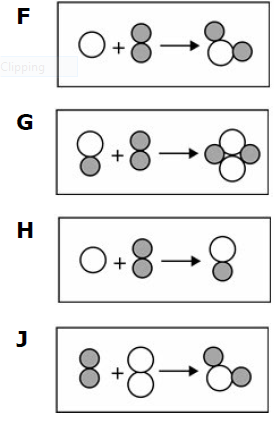
Which of the following models best demonstrates a balanced chemical equation?

a)

F

b)

G

c)

H

d)

J

18.

Why must chemical equations be balanced?

a)

So that the equation doesn't explode

b)

The reaction won't happen until it is balanced

c)

Based on the Law of Conservation of Matter, matter cannot be created or destroyed.

d)

Based on the Law of Conservation of Energy, energy cannot be created or destroyed.

19.

Balance this equation...

HgO --> Hg + O2

a)

It is balanced

b)

2HgO --> Hg + O2

c)

2HgO --> 2Hg + O2

20.

Which are the reactants in the following reaction?

2Mg + O2 ---> 2MgO

a)

Mg and O2

b)

MgO

c)

Mg and MgO

d)

O2 and MgO

21.

How many Nitrogen (N) atoms are in 4NH3?

a)

4

b)

1

c)

3

d)

12

22.

Is this equation balanced?

a)

Yes

b)

No

23.

What type of reaction does the following equation represent?


Cu (s) + Ag2SO4 (aq) --> CuSO4 (aq) + 2 Ag (s)

a)

synthesis

b)

decomposition

c)

single replacement

d)

double replacement

e)

combustion

24.
A teacher writes the equation representing the chemical reaction between hydrochloric acid and sodium on the board.HCl + Na → NaCl + H2The teacher states that the equation has not been balanced. Which of these correctly shows the products of this reaction after the equation has been balanced?
a)
Na2Cl + H2
b)
 2NaCl + H2
c)
NaCl + 2H2
d)
 2NaCl + 2H2
25.
The following reaction is an example of a 4NH3(g) + 5O2(g) → 4NO(g) + 6H2O(g)(i) displacement reaction (ii) combination reaction (iii) redox reaction (iv) neutralisation reaction
a)
(i) and (iv)
b)
(ii) and (iii)
c)
(i) and (iii)
d)
(iii) and (iv)
26.
Which among the following is(are) double displacement reaction(s)?(i) Pb + CuCl2 → PbCl2 + Cu (ii) Na2SO4 + BaCl2 → BaSO4 + 2NaCl (iii) C + O2 → CO2 (iv) CH4 + 2O2 → CO2 + 2H2O
a)
(i) and (iv)
b)
(ii) only
c)
(i) and (ii)
d)
(iii) and (iv)
27.
Which of the following are combination reactions?(i) 2KClO3⎯Heat⎯→ 2KCl + 3O2 (ii) MgO + H2O ⎯→ Mg(OH)2 (iii) 4Al + 3O2 ⎯→ 2Al2 O3 (iv) Zn + FeSO4 → ZnSO4 + Fe
a)
(a) (i) and (iii)
b)
(b) (iii) and (iv)
c)
(c) (ii) and (iv)
d)
(d) (ii) and (iii)
28.

Chemical formula of lime water is :

a)

CaO

b)

Ca(OH)2

c)

CaCO3

d)

CO2

29.
How many Hydrogen are in 4H2O?
a)
6
b)
8
c)
2
d)
4
30.
A chemical change in which two or more substances react to form a new substance is a ____________________________.
a)
decomposition reaction
b)
synthesis reaction
c)
double displacement reaction
d)
combustion reaction
31.

What type of reaction is represented by the following equation?


2H2 + O2 --> 2H2O

a)

synthesis

b)

combustion

c)

decomposition

d)

single replacement

32.

A reaction in which an acid reacts with a base to produce salt and water is known as a ____________________________.

a)

neutralization reaction

b)

redox reaction

c)

synthesis reaction

d)

decomposition reaction

33.

Which of the following is an example of a decomposition reaction?

a)

2H2 + O2 --> 2H2O

b)

CaCO3 --> CaO + CO2

c)

Mg + 2HCl --> MgCl2 + H2

d)

Na + Cl2 --> 2NaCl