
 Worksheets
Japan Exam
Total questions: 34
Worksheet time: 9hrs 30mins
Name
Class
Date
1.

Identify the location on the map
a)
Honshu
b)
Tokyo
c)
Hiroshima
d)
Nara
e)
Kyoto
2.
After they learned about Chinese writing, the Japanese
a)
changed their grammar to be more like Chinese.
b)
began speaking Chinese in everyday conversation.
c)
invented a new set of characters based on objects in Japan.
d)
used simplified Chinese characters for sounds in Japanese words.
3.
As a result of foreign influence, the Japanese began creating sculptures of
a)
Shinto kami.
b)
emperors.
c)
the Buddha.
d)
armored warriors.
4.
Which of these people would have ranked most highly in Heian Japan?
a)
one whose father was a court noble
b)
one who scored well on national tests
c)
one whose beauty was admired by poets
d)
one who paid the emperor money
5.
Why might life for a Japanese woman have been better in the 12th century than in the 17th century?
a)
As samurai culture developed, women's status declined.
b)
When the emperors regained power, women lost authority.
c)
As Buddhism took hold, women could not seek enlightenment.
d)
When the capital moved to Edo, women were denied government jobs.
6.
In Middle Ages Japan, the number of folds in a fan, the color of one's robes or the height of a gatepost in front of their home might inform you about…
a)
a person's occupation
b)
the family you belong too
c)
the religion followed in an area.
d)
the status of someone in society
7.
Which describes the type of relations the Chinese and the Japanese had from around 600 A.D. to 800 A.D.?
a)
The societies shared a common ancestor and thus believed they must work together at all times.
b)
The two kingdoms mostly ignored one another unless there was a need for some small interaction.
c)
The relationship between the Japanese and Chinese was complicated due to competition for resources.
d)
The cultures were friendly because the Japanese sought to model their culture after the Chinese.
8.
The _____ were highly skilled warriors in Japan and would rather commit _____ than to be taken as a prisoner of war.
a)
Daimyo; Bushido
b)
Shogun; Seppuku
c)
Samurai; Bushido
d)
Samurai; Seppuku
9.
Which of the following would NOT be considered a core idea of religion of Shinto
a)
Kami
b)
Nature
c)
Buddha
d)
Cleanliness
10.
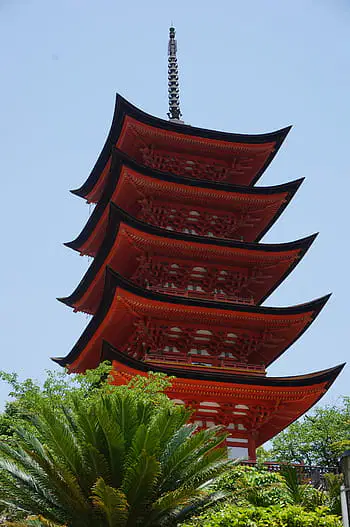
Below is a Japanese Pagoda, which of the following statements would the picture most likely support
a)
Japan supported a strong military
b)
The civil service system was working
c)
Japan had been in close contact and influenced by their neighbors
d)
The Shogun required that a large palace be built in his name
e)
The Mandate of Heaven had been followed by the king
11.

What was the primary role of the shogun in medieval Japan?
a)
The shogun served as a religious leader, focusing only on spiritual matters.
b)
The shogun was a military ruler who held the real political power, while the emperor remained a symbolic figure.
c)
The shogun was elected by the people and served as a democratic leader of Japan.
d)
The shogun had no political authority and only advised the emperor on minor military matters.
12.

Based on the chart, how did cultural diffusion shape medieval Japanese society?
Cultural diffusion : How one culture can influence another
a)
Japan rejected foreign influences and developed entirely independent cultural traditions.
b)
Japanese society was heavily influenced by Chinese and Korean ideas but modified them to create distinct traditions.
c)
Cultural diffusion had no impact on Japan’s writing system, religion, or government.
d)
Japan adopted Chinese culture completely without any adaptations of its own.
13.

Based on the chart, how did Japan’s geography influence its medieval society?
a)
Japan’s geography had little impact on its culture, economy, or military strategies.
b)
The mountainous terrain and limited farmland led Japan to rely on fishing and terrace farming for survival.
c)
Being an island nation made Japan completely isolated, with no cultural influences from other countries.
d)
Japan’s abundant natural resources made it self-sufficient, preventing the need for trade or territorial conflicts.
14.
A daimyo in medieval Japan was most like which person in medieval Europe?
a)
A king
b)
A knight
c)
A lord
d)
A bishop
15.

How did samurai armor differ from European knight armor?
a)
Samurai armor was designed for flexibility and mobility, while knight armor was heavier and more rigid.
b)
Samurai armor was made entirely of steel plates, making it identical to European knight armor.
c)
Samurai did not wear helmets, unlike European knights who used them for protection.
d)
Samurai armor was purely decorative and not intended for battle.
16.
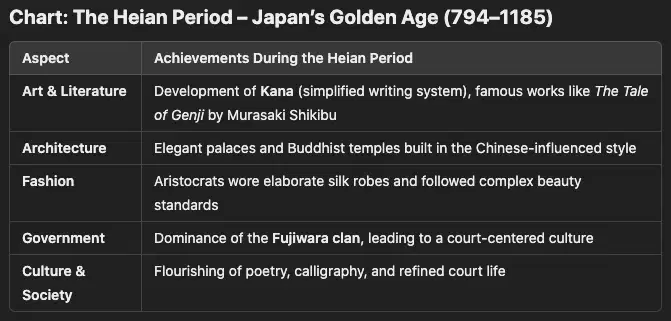
Based on the chart, why is the Heian Period considered a golden age of Japan?
a)
It was a time of military conquests that expanded Japan’s empire.
b)
The period saw a decline in cultural achievements and artistic expression.
c)
Art, literature, and refined court culture flourished, creating a lasting impact on Japanese society.
d)
The Heian government focused solely on economic reforms, ignoring artistic and cultural advancements.
17.
Which of these mattered most to a samurai who was following the code of Bushido?
a)
loyalty and honor
b)
learning and intellect
c)
beauty and gracefulness
d)
forgiveness and generosity
18.
The Heian period is called Japan’s golden age because of its?
a)
rich mines.
b)
foreign trade.
c)
military power.
d)
art and literature.
19.
Some of the original buildings of Heian-kyo were later rebuilt on the same sites. Where might a tourist go to see them?
a)
Nara
b)
Kyoto
c)
Tokyo
d)
Hiroshima
20.

Read these three facts about Heian-kyo. These facts show that the Japanese leaders in the late 700s valued
a)
natural beauty.
b)
political power.
c)
wealth and riches.
d)
peace and security.
21.
Which sentence below describes cultural diffusion?
a)
Warships and armies from Japan attacked Korea.
b)
Practices and beliefs spread from Korea to Japan.
c)
Written languages developed separately in Japan and Korea.
d)
Korea and Japan grew different crops because of different climates.
22.
What is one important way in which Prince Shotoku changed Japan?
a)
He turned it into an agricultural society.
b)
He divided power among the chiefs of clans.
c)
He increased contact with neighboring cultures.
d)
He introduced the craft of bronze and iron smithing.
23.
When Korean workers settled in Japan, how did they change the lives of the Japanese?
a)
They set up a new government over the country.
b)
They worked as slaves for middle-class families.
c)
They brought knowledge and skills from the mainland.
d)
They became the customers who bought Japanese crafts.
24.
Prince Shotoku’s creating ranks for government officials was based on
a)
Shinto ideas.
b)
Buddhist ideas
c)
Muslim ideas
d)
Confucian ideas
25.

The design of a Shinto temple would most likely draw attention to
a)
a code of moral rules.
b)
worship of foreign gods.
c)
the cycle of pain and suffering.
d)
respect for the beauty of nature.
26.

The dots on the timeline show about when Buddhism arrived in four different countries: India, Korea, China, and Japan. Based on the timeline and your knowledge, where did Buddhism arrive between 1 and 500 C.E.?
a)
India and Japan
b)
India and China
c)
Korea and Japan
d)
China and Korea
27.

Based on the chart, how did Chinese culture most significantly shape Japan’s development?
a)
Japan completely abandoned its native traditions in favor of Chinese customs.
b)
Japan adopted various elements of Chinese culture, such as Buddhism, Kanji, and government structures, while still maintaining its own unique traditions.
c)
Japanese rulers rejected Chinese influence, refusing to adopt any aspects of its culture.
d)
The introduction of Chinese culture led to Japan becoming a Chinese colony during the 1800s.
28.

Why was loyalty considered essential in samurai society during the Kamakura period?
a)
Samurai were encouraged to switch allegiances frequently to gain more power.
b)
Loyalty ensured stability in the feudal system by maintaining strong bonds between samurai and their lords.
c)
Samurai were independent warriors who did not follow any code of honor.
d)
The concept of Bushido discouraged loyalty and encouraged personal ambition.
29.

Based on the chart, which statement best describes a key similarity between European and Japanese feudalism?
a)
Both systems were controlled entirely by kings who had absolute power over their lands.
b)
Both had a warrior class (knights in Europe, samurai in Japan) that followed a strict code of conduct.
c)
European feudalism relied on a warrior class, while Japan had no such system.
d)
Japanese feudalism had no form of land ownership, while European feudalism relied heavily on land grants.
30.

Based on the chart, which statement best describes a key difference between European and Japanese feudalism?
a)
The Catholic Church had a major influence on Japanese feudalism, just as it did in Europe.
b)
European feudalism was based on Christianity, while Japanese feudalism was shaped by Buddhism and Shintoism.
c)
Samurai followed the same code of conduct as European knights, with no differences in their values.
d)
Both European kings and Japanese emperors held absolute power over their lands.
31.
In Buddhist teachings, how does meditation help lead to wisdom?
a)
by teaching the steps to a moral life
b)
by emptying the mind of distracting thoughts
c)
by providing a time to regret one's sins
d)
by encouraging the study of books by enlightened teachers
32.
A central teaching of Mahayana, the form of Buddhism that reached Japan, was that
a)
life on Earth is the only life.
b)
all people can reach nirvana.
c)
all buddhas hold false beliefs.
d)
only the material world is real.
33.
How can one tell whether a Japanese poem is a Haiku?
a)
by counting the syllables in each line
b)
by identifying the social class described
c)
by analyzing the symbols described
d)
by checking whether pairs of lines rhyme
34.
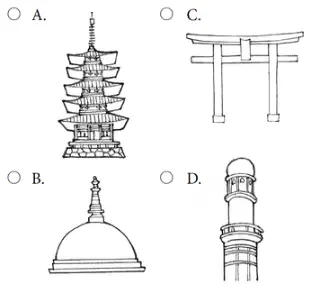
Which architectural style did Japanese Buddhists adopt for their temples?
a)
A
b)
B
c)
C
d)
D
100 %

