wayground logo

Free Printable Worksheets

Font size

S
M
L
XL
Worksheets

SBI4U Chapter 1 Test

Total questions: 62

Worksheet time: 50mins

Name
Class
Date
1.
Which has the greater EN: 
N or C?
a)
C
b)
N
2.
Put these in increasing order:
F, N, B
a)
B < N < F
b)
B < F < N
c)
N < F < B
d)
F < N < B
3.
Electronegativity is...
a)
how good an atom is at attracting electrons
b)
the ability of an atom to lose electrons
c)
the energy required to remove an electron from a specific atom
d)
how easy it is to make friends. 
4.
The element with the largest electronegativity in the halogens is - 
a)
At
b)
F
c)
Cl
d)
Br
5.
The element with the lowest electronegativity in Period 3 is - 
a)
Na
b)
Cl
c)
Ar
d)
Mg
6.
Elements closer to the noble gases have stronger attraction for electrons.
a)
True
b)
False
7.
Which of the following is the least electronegative element?
a)
oxygen
b)
potassium
c)
fluorine
d)
nitrogen
8.

Electronegativity (a)   as you go down a group.

9.

Which is the correct molecular structure for carbon dioxide CO2?

a)
b)
c)
d)
10.

H2O has how many covalent bonds?

a)

0

b)

1

c)

2

d)

3

11.

Match the following

a)

Covalent Bond

1.

Formed between two nonmetals

b)

Ionic Bond

2.

Formed between metal and nonmetal

c)

Lone Pair

3.

2 electrons not shared by atoms in a covalent compound

d)

Line

4.

How 2 bonding electrons are shown in a dot diagram

e)

Dots

5.

How lone pair electrons are shown in a dot diagram

12.
How many electrons should Lithium have around its Lewis dot model?
a)
1
b)
2
c)
3
d)
4
13.

How many total valence electrons are participating in bonding in the molecule above?

a)

8

b)

4

c)

2

d)

3

14.

The desire for an element to have 8 atoms in the valence energy level to achieve the most stable energy is known as

a)

Octet Rule

b)

Resonance

c)

Ionization energy

d)

Electronegativity

15.

What is the correct Lewis Dot Structure for ammonia NH3

a)
b)
c)
d)
16.
Which of the following is the correct Lewis structure for water?
a)
A
b)
B
c)
C
17.

To form a hydrogen bonding, Hydrogen needs to attract to the highly electronegative elements such us _____, _____, and ____

a)

chlorine, fluorine, and oxygen

b)

fluorine, oxygen, and sulfur

c)

fluorine, bromine, and oxygen

d)

fluorine, oxygen, and nitrogen

18.

Forces that holds atoms together within the molecule

a)

intermolecular forces

b)

intramolecular forces

19.

Dipole-Dipole forces are stronger than _______ and weaker than _________ interactions.

a)

london dispersion, ion-dipole

b)

hydrogen bonding, london dispersion

c)

ion-dipole, london dispersion

20.

Hydrogen bonding is a special case of __________.

a)

london dispersion

b)

ion-dipole

c)

dipole-dipole

21.

Which substance would have the weakest intermolecular forces of attraction?

a)

CH4

b)

NaCl

c)

H2O

d)

MgF2

22.

Intermolecular forces for: NH3

a)

Dispersion Force

b)

Dipole dipole

c)

Hydrogen bonding

23.

Molecules that stick to the same type of molecules.

a)

cohesion

b)

adhesion

c)

hydrophilic

d)

hydrophobic

24.

Capillary action is....

a)

adhesion

b)

cohesion

c)

change in matter (heat of fusion)

d)

both adhesion and cohesion

25.
Which is the pH of the weakest base?
a)
13
b)
11.1
c)
8.5
d)
6.2
26.
A change of one unit on the pH scale represents a tenfold increase in the concentration of hydrogen ions.  
How much greater acidity is there in tomatoes (4.2) vs rainwater (6.2)?
a)
2 times
b)
4 times
c)
10 times
d)
100 times
27.

What is a buffer?

a)

an acid

b)

a base

c)

a weak acid or base

d)

an emulsifier

28.

Oil and water don't mix because oil is

a)

hydrophilic

b)

hydrophobic

c)

an emulsifier

d)

a buffer

29.
This molecule is a(n):
a)
Carbohydrate
b)
Triglyceride
c)
Amino Acid
d)
Unsaturated Fatty Acid
30.
This molecule would be classes as a(n):
a)
Carbohydrate
b)
Amino Acid
c)
Lipid
d)
Nucleic Acid
31.
This carbohydrate would be classed as a:
a)
Hexose
b)
Pentose
c)
Ketose
d)
DiSaccharide
32.
A molecule with the molecular formula C12H22O11 would most likely be a(n):
a)
Carbohydrate
b)
Lipid
c)
Amino Acid
d)
Nucleic Acid
33.
The bond linking these two monomers is called a:
a)
Glycosidic Linkage
b)
Ester Bond
c)
Peptide Bond
d)
Hydrogen Bond
34.
The position of the carbonyl group makes this molecule a(n):
a)
Lipid
b)
Aldehyde
c)
Ketone
d)
Carboxylic Acid
35.
The circled functional group is a(n):
a)
Carboxyl
b)
Carbonyl
c)
Amine
d)
Hydroxyl
36.
Cellulose s a polymer made from:
a)
Alpha Glucose
b)
Beta Glucose
c)
Ribose
d)
Amino Acids
37.
Many hormones are made from modifying
a)
Cholesterol
b)
Phospholipids
c)
Glucose
d)
Chitosan
38.
The structures in this protein labelled as C and D are representative of which level of protein structure?
a)
Primary Structure
b)
Secondary Structure
c)
Tertiary Structure
d)
Quaternary Structure
39.
The structures in this protein labelled as C and D are typically called
a)
Beta-Pleated Sheet
b)
Alpha Helix
c)
DiSulphide Bridge
d)
Amadoori Compounds
40.
This monomer links together to form:
a)
Lipids
b)
Polysaccharides
c)
Proteins
d)
Nucleic Acids
41.
Glycerol bonds to 3 fatty acids to form:
a)
Phospholipids
b)
Triglycerides
c)
Polypeptide Chains
d)
Cholesterol
42.
Based on its overall structure the triglyceride shown would be:
a)
Polar
b)
Non-Polar
43.
The process of breaking peptide bonds to release single amino acids is called:
a)
Dehydration Synthesis
b)
Hydrolysis
c)
Condensation
d)
Oxidative Phosphorylation
44.
What is the monomer of nucleic acids?
a)
Glycerol
b)
Monosaccharides
c)
Amino Acids
d)
Nucleotides
45.

Which of the following is NOT part of a nucleotide?

a)

Nitrogenous Base

b)

Phosphate Group

c)

Pentose Sugar

d)

Fatty Acid

46.

What sugar is found in RNA?

a)

Ribose

b)

Deoxyribose

c)

Glucose

d)

Galactose

47.

Which base is ONLY found in DNA?

a)

Cytosine

b)

Guanine

c)

Thymine

d)

Adenine

48.

Which number represents a nucleotide?

a)

1

b)

2

c)

3

d)

4

49.
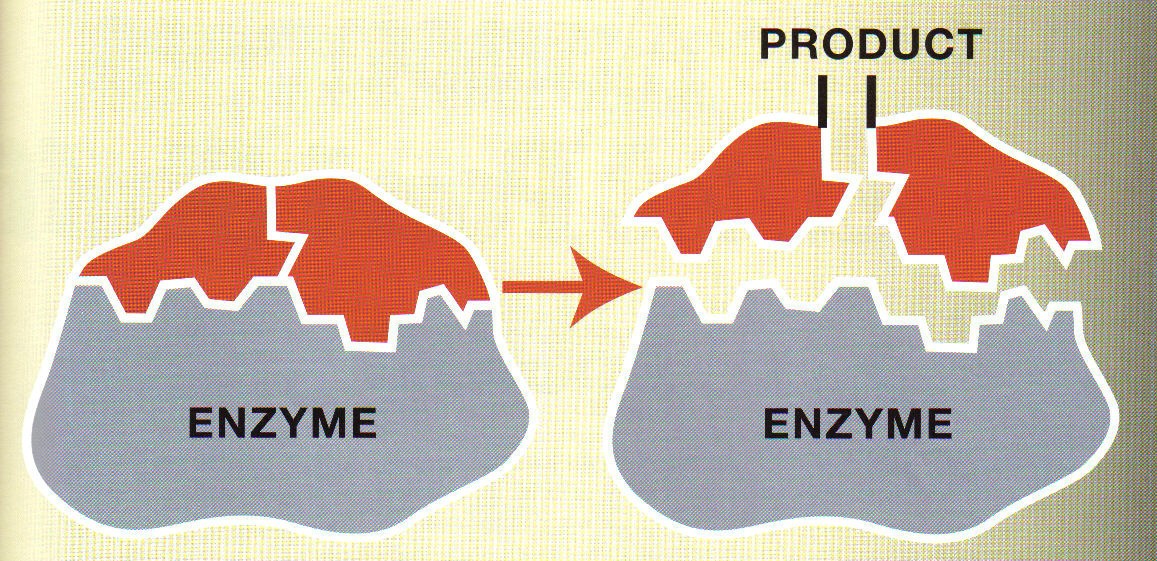
This reaction shows a(n) ____________ reaction
a)
Catabolic
b)
Anabolic
c)
Dehydration Synthesis
d)
Halogenation
50.
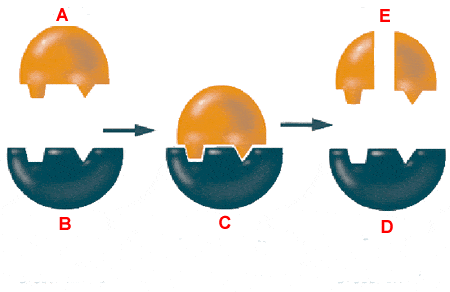
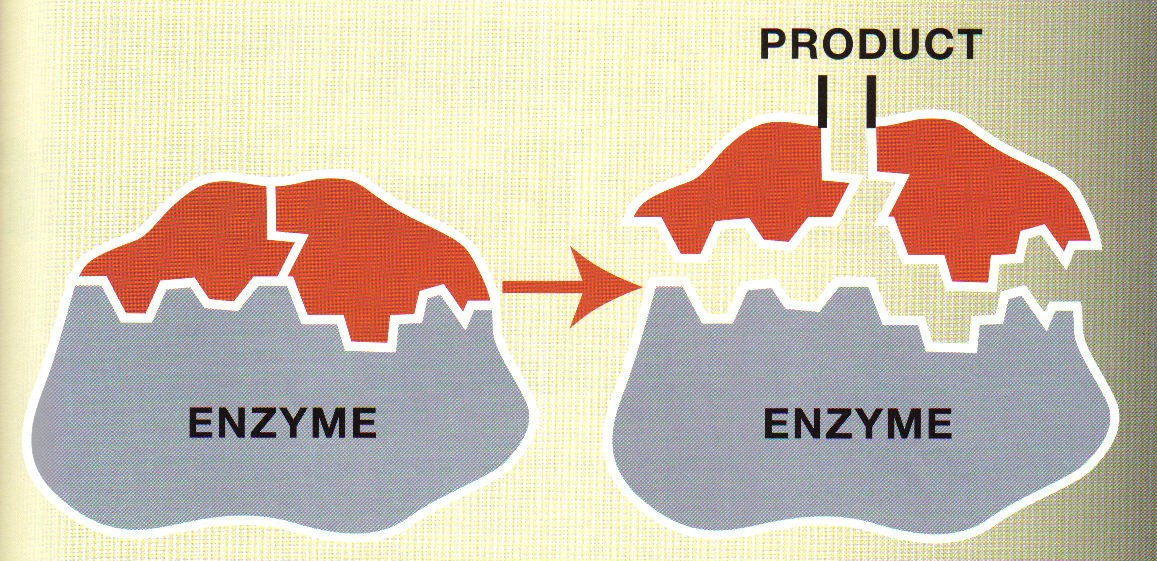
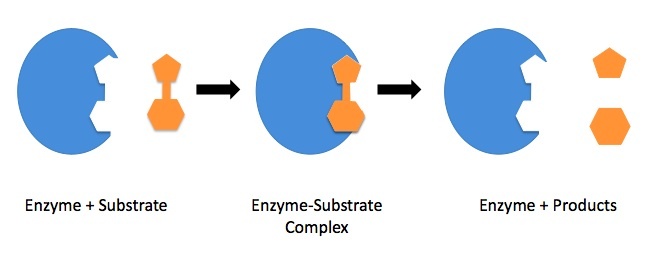
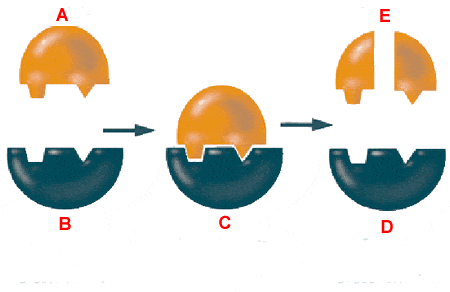
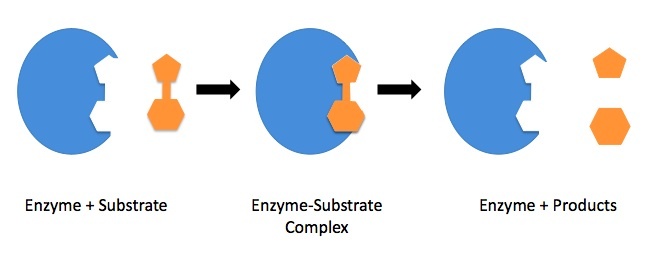
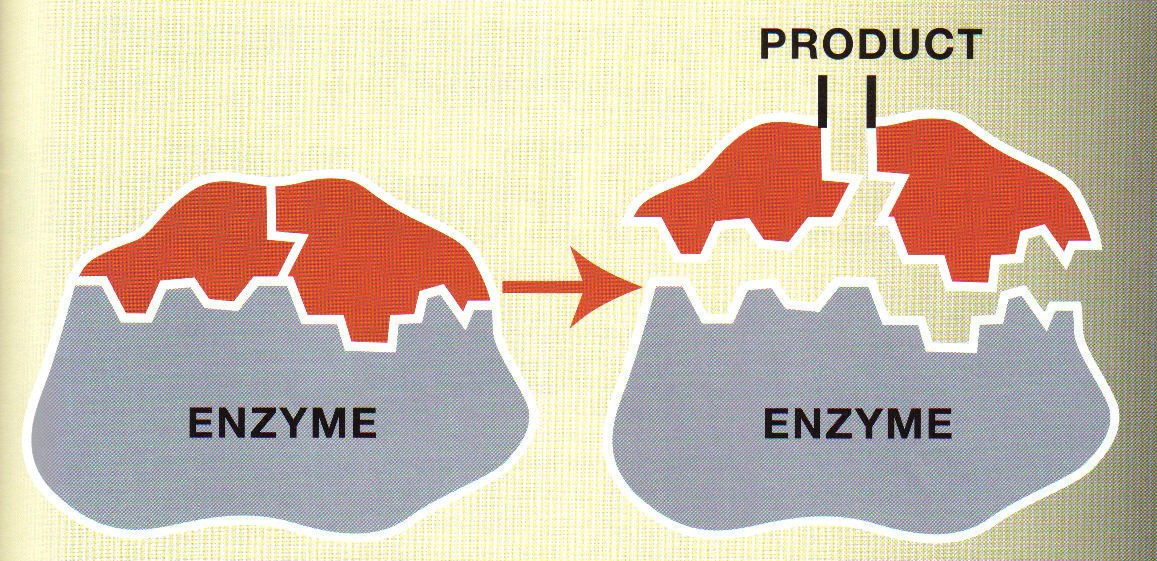
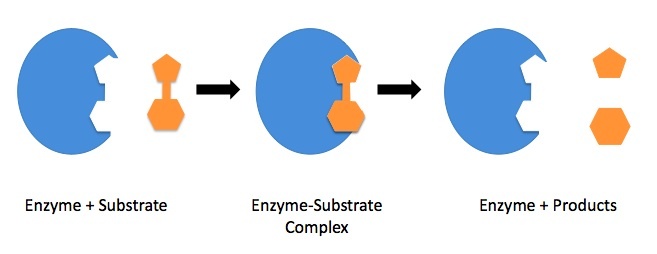
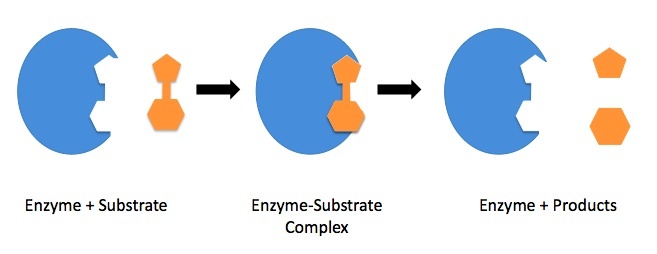
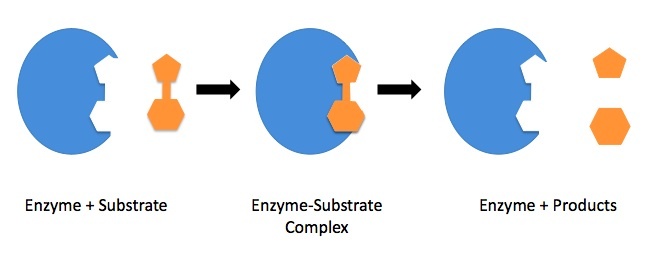
The area that the substrate fits into on the enzyme is called the:
a)
Active Site
b)
Allosteric Site
c)
DiSulphide Bridge
d)
β-Pleated Sheet
51.
The current model of enzyme action is referred to as the:
a)
Induced Fit Model
b)
Lock & Key Model
c)
Singer-Nicolson Model
d)
Davson-Danielli Model
52.
Enzymes catalyze reactions by ___________ Activation Energy.
a)
Increasing
b)
Decreasing
53.
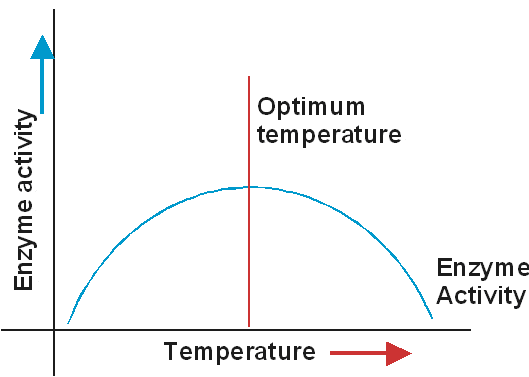
At high temperatures enzyme activity declines because of:
a)
Denaturation
b)
Decreased Kinetic Motion
c)
Increased H-Bonding
d)
Dissociation of Ionic Compounds
54.
Most enzymes have the ending:
a)
-ase
b)
-ose
c)
-ic acid
d)
-ate
55.
The molecule an enzyme is working on is called the:
a)
Substrate
b)
Solvent
c)
Allosteric Inhibitor
d)
CoEnzyme
56.
When a molecule can occupy the same active site as the substrate, a situation called __________________ can result
a)
Competitive lnhibition
b)
Allosteric Regulation
c)
Non-Competitive Inhibition
d)
Feedback Inhibition
57.
A molecule binds to an enzyme and opens the active site so it can bind to the substrate. This is called:
a)
Allosteric Activation
b)
Allosteric Inhibition
c)
Competitive Activation
d)
Competitive Inhibition
58.
A molecule binds to an enzyme and decreases the ability of the active site to bind to the substrate. This is called:
a)
Allosteric Activation
b)
Allosteric Inhibition
c)
Competitive Activation
d)
Competitive Inhibition
59.
Molecules that bind to enzymes and enhance an enzyme's ability are called:
a)
CoFactors
b)
CoEnzymes
c)
Allosteric Inhibitors
d)
Allosteric Activators
60.
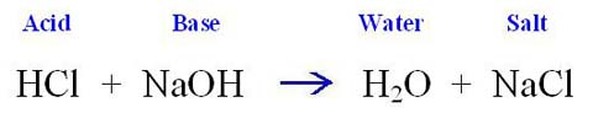
This type of reaction is a:
a)
Dehydration Synthesis
b)
Neutralization
c)
RedOx Reaction
d)
Phosphorylation
61.
A reaction where electrons are moved around is a:
a)
Neutralization
b)
Hydrolysis
c)
RedOx Reaction
d)
Phosphorylation
62.
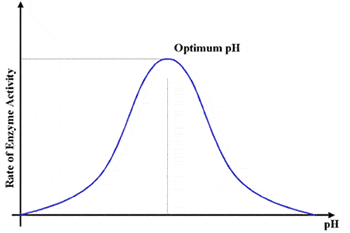
Which explanation best fits the graph for pH's effect on an enzyme?
a)
As the pH gets closer to neutral more H-Bonds are broken
b)
Larger numbers of H+ & OH- ions distort the active site
c)
There are more collisions between substrates and active sites near the optimal pH
d)
Low pHs cause more H-Bonds to happen near the active site