
 Worksheets
Q3 Exam Review
Total questions: 68
Worksheet time: 34mins
Name
Class
Date
1.
A gas in the earth's atmosphere that absorbs heat leaving the earth's surface.
a)
Gasoline
b)
Greenhouse gas
c)
Laughing gas
d)
Gas-x
2.
Energy that cannot be replaced in our lifetime is
a)
Renewable
b)
Nonrenewable
c)
Natural
3.
Which is NOT an alternative energy source?
a)
Solar
b)
Bioenergy
c)
Petroleum
d)
Wind
4.
What are the three main components of a water tower?
a)
Pump, tank, distribution system
b)
Pump, solar panel, barometer
c)
Reservoir, river, filter
d)
Pump, filter, reservoir
5.
What 1969 event sparked interest in reducing water pollution?
a)
Gulf Oil Spill
b)
Cuyahoga River Fire
c)
Sewage leak into Chesapeake Bay
6.
What is the largest source of water pollution?
a)
Farmland runoff
b)
Oil spills
c)
Ship repair
d)
Offshore drilling
7.
All ocean pollutants are caused by humans.
a)
True
b)
False
8.
Anything dumped into the ocean dilutes/spreads until it is no longer a problem.
a)
True
b)
False
9.
An example of point source pollution would be:
a)
Algae bloom
b)
Sediment
c)
Farm pesticides
d)
A leaking landfill
10.
Which is a common non-chemical pollutant?
a)
Heat
b)
Garbage
c)
Sediment
d)
All of the above
11.
Artesian wells do not require a pump.
a)
True
b)
False
12.
Untreated sewage returning to a body of water can lead to which problem?
a)
Dead zones caused by algae blooms
b)
Diseases
c)
Both A and B
d)
Neither A or B
13.
A pollution source that cannot be traced to a single point because comes from many sources is ___________
a)
Thermal
b)
Point source pollution
c)
Toxic
d)
Nonpoint source pollution
14.
What type of energy do water towers need to distribute water?
a)
Kinetic
b)
Thermal
c)
Nuclear
d)
Potential
15.
Water towers use pumps to get water to the homes of people in the community.
a)
True
b)
False
16.
Desaltification is the process of removing salt from sea water to make it fresh water.
a)
True
b)
False
17.
What percentage of the earth is freshwater?
a)
7%
b)
3%
c)
25%
d)
97%
18.
The water and human wastes that are washed down sinks, toilets, and showers.
a)
Sewage
b)
Sediment
c)
Thermal pollution
d)
Gross
19.
Small, solid pieces of material that come from rocks or the remains of organisms
a)
Sewage
b)
Sediment
c)
Thermal pollution
20.
A type of pollution caused by factories and power plants releasing super heated water into bodies of water.
a)
Thermal pollution
b)
Sewage
c)
Sediment
21.
What is the term for water stored underground in permeable rock?
a)
Lake
b)
Reservoir
c)
Aquifer
d)
Pond
22.
Which industry uses the most freshwater globally?
a)
Manufacturing
b)
Transportation
c)
Domestic use
d)
Agriculture
23.
What is the primary challenge of desalination?
a)
High cost
b)
Low efficiency
c)
Environmental harm
d)
Limited technology
24.
What is a potential solution to encourage water conservation?
a)
Subsidizing water
b)
Banning water usage
c)
Increasing water prices
d)
Decreasing water prices
25.
All minerals have the same characteristics.
a)
True
b)
False
26.
A mineral deposit does not have to be valuable to be considered ore.
a)
True
b)
False
27.
Humans use minerals for (check all that apply):
a)
Electronics
b)
Cars
c)
Jewelry
d)
Nothing
28.
There are many foods that contain multiple minerals.
a)
True
b)
False
29.
Which is not a drawback of wind energy?
a)
High initial cost
b)
Danger to wildlife
c)
Spoils the scenery
d)
Smelly
30.
_____________ power is electricity produced by flowing water.
a)
Solar
b)
Hydroelectric power
c)
Bioenergy
d)
Wind
31.
__________is the energy generated from the sun by using panels to capture its energy.
a)
Wind
b)
Nuclear
c)
Hydroelectric
d)
Solar
32.
Wood is a nonrenewable resource.
a)
True
b)
False
33.
A group of non-renewable resources, called ______________, include coal, oil, and natural gas.
a)
Fossils
b)
Energy
c)
Fossil fuels
34.
Coal comes from...
a)
animals that died millions of years ago.
b)
plants in and around swamps that died millions of years ago.
c)
a factory.
d)
burning fossil fuels.
35.
________ is how fossil fuels got their energy.
a)
Sunlight
b)
Electricity
c)
Fire
36.
What is one disadvantage of using fossil fuels?
a)
They do not produce much heat.
b)
They are difficult to use.
c)
They are nonrenewable resources.
d)
They produce more water than other resources.
37.
Why has the use of natural gas increased in recent decades?
a)
It produces less CO2 than other fossil fuels
b)
It is cheaper and easier to access and process than other fossil fuels
c)
Both A and B
d)
It has actually decreased
38.
Nuclear energy is renewable.
a)
True
b)
False
39.
What country has the highest percentage of the world's uranium?
a)
Canada
b)
Australia
c)
Germany
d)
Russia
40.
Climate change is a sudden or gradual change in Earth's climate.
a)
True
b)
False
41.
Energy rich substance formed from the remains of organisms:
a)
Fossil fuel
b)
Sea beds
c)
Global warming
d)
Greenhouse effect
42.
"Other gasses" contribute to .1% of our atmosphere. What percent of those other gasses are carbon dioxide?
a)
4%
b)
78%
c)
.01%
d)
94%
43.
What percentage of the Earth's carbon is locked up as inorganic carbonates in the crust and mantle?
a)
60%
b)
70%
c)
80%
d)
50%
44.
What process do plants use to convert carbon dioxide into organic compounds?
a)
Respiration
b)
Photosynthesis
c)
Combustion
d)
Fermentation
45.
Explain the difference between weather and climate:
a)
Weather is short term, climate is weather over a long period of time.
b)
There is no difference.
c)
Weather is long term, climate is immediate.
d)
Weather is always the same, climate changes,
46.
The average temperature of the surface of Earth has increased approximately 1°C in the past century. Which reason best explains this increase in temperature?
a)
Lower levels of o-zone in the atmosphere
b)
Higher levels of carbon dioxide and other greenhouse gases in the atmosphere
c)
Lower levels of nitrogen in the atmosphere
d)
Higher levels of oxygen in the atmosphere
47.
What is the earth's largest carbon sink?
a)
The ocean
b)
The atmosphere
c)
Plants
d)
Humans
48.
How do scientists use ice cores to track weather patterns over time?
a)
The air bubbles contain gasses they can study
b)
The layers
c)
When they melt they contain ancient germs and organisms to study
d)
They don't study ice cores.
e)
Both A and B
49.
What is Relative Age?
a)
the age of a rock compared to the ages of other rocks
b)
the age of a human compared to the age of a rock
c)
the age of a fish compared to the age of a human
50.
What do geologists use to determine the relative ages of sedimentary rock layers?
a)
Law of Sedimentary Rock
b)
Fossil Record
c)
Law of Superposition
d)
Law of Rocks
51.
Absolute Age: it is the number of years that have passed since a certain rock formed
a)
True
b)
False
52.
Fossils are:
a)
The remains of any object
b)
The preserved remains of an organism that lived in the past
c)
Anything older than 1 million years
53.
What is a gap in the geologic record?
a)
Variation
b)
Fossil decay
c)
Striations
d)
Unconformity
54.
What is the process in which the nuclei of a radioactive elements breakdown, releasing fast moving energy?
a)
Radioactive fossilization
b)
Radioactive decay
c)
Radioactive atoms
55.
What do geologist use Radioactive Dating for?
a)
To determine the absolute ages of rocks
b)
To determine the relative ages of rocks
56.
How old is the Earth?
a)
4.6 billion years
b)
2.5 million years old
c)
156,000 years
d)
4.8 million years
57.
The biggest time period into which scientists have divide the time between the formation of the Earth and now is called:
a)
Periods
b)
Epochs
c)
Eons
d)
Eras
58.
Scientists were able to estimate the age of the Earth by studying:
a)
trees
b)
stars
c)
fossils
d)
rocks
59.
What are eons divided into?
a)
eras
b)
epochs
c)
periods
60.
Dinosaurs lived in which era
a)
Mesozoic
b)
Cenozoic
c)
Paleozoic
61.
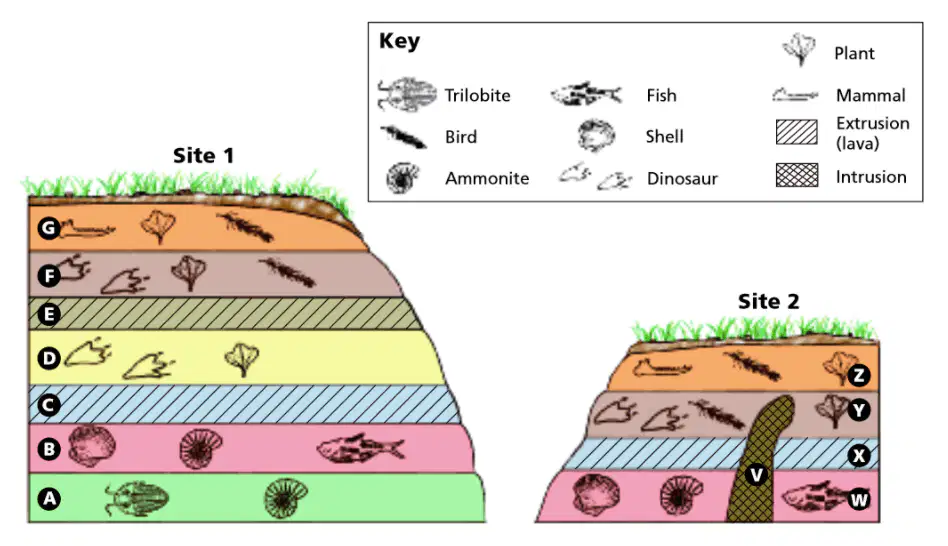
Which layer is the oldest?
a)
A
b)
G
c)
X
d)
Z
62.
What is the next smallest division of time after eras in the geological timescale?
a)
Eon
b)
Epoch
c)
Age
d)
Period
63.
What determines when an era or period begins or ends?
a)
A certain amount of time
b)
A certain event such as an asteroid
64.
What is the main purpose of the geologic time scale?
a)
To organize the major eras of Earth's history
b)
To compete with other, non-geologic time scales
c)
To compare very short and very long periods of time
d)
To help understand that the planet is really old
65.
Some of the dates on a Geological Timeline are approximates (estimates) predicted by scientists who study the history of the Earth.
a)
True
b)
False
66.
Which is the oldest era?
a)
Precambrian
b)
Paleozoic
c)
Mesozoic
d)
Cenozoic
67.
According to the law of superposition, the oldest fossils are found
a)
At the top of the rock layers
b)
Near the bottom of the rock layers
c)
Somewhere in the middle
68.
A __________ shows the order in which events have occurred.
a)
timeline
b)
age
c)
eon
100 %

