wayground logo

Free Printable Worksheets

Font size

S
M
L
XL
Worksheets

Unit 7 Test Review - Earth's Structure and Rock Cycle

Total questions: 65

Worksheet time: 43mins
Name
Class
Date
1.
This sphere includes the continents, the ocean floor, all the rocks on the surface, and all of the sand in the deserts. 
a)
Hydrosphere 
b)
Biosphere 
c)
Atmosphere 
d)
Geosphere 
2.
Composed of all the water on or near the earth
a)
Hydrosphere 
b)
Biosphere 
c)
Atmosphere 
d)
Geosphere 
3.
This sphere is composed of all the living things 
a)
Hydrosphere 
b)
Biosphere 
c)
Atmosphere 
d)
Geosphere 
4.
Body of air surrounding our planet. 
a)
Hydrosphere 
b)
Biosphere 
c)
Atmosphere 
d)
Geosphere 
5.
When dead plants decompose and nitrogen is returned to the soil, the interaction is between which two spheres? 
a)
The biosphere and atmosphere 
b)
The atmosphere and geosphere 
c)
The geosphere and atmosphere 
d)
The biosphere and geosphere 
6.
Water evaporating from the surface of a lake moves from the...
a)
Atmosphere to the geosphere 
b)
Geosphere to the hydrosphere 
c)
Hydrosphere to the atmosphere 
d)
Atmosphere to the hydrosphere 
7.
When carbon dioxide dissolves from the air into the ocean- the interaction is between...
a)
The atmosphere and geosphere 
b)
The atmosphere and hydrosphere 
c)
The atmosphere and biosphere 
d)
The atmosphere and atmosphere 
8.
When a plants takes carbon dioxide from the air which two spheres are interacting? 
a)
Biosphere and atmosphere 
b)
Geosphere and atmosphere 
c)
Hydrosphere and atmosphere 
d)
Atmosphere and atmosphere 
9.
When volcanoes erupt, dust and ash particles spread through much of the air blocking the sun.  Which two spheres are interacting? 
a)
Hydrosphere and atmosphere 
b)
Geosphere and atmosphere 
c)
Biosphere and atmosphere 
d)
Atmosphere and atmosphere 
10.
When plants draw nutrients from the soil, the interaction is between which two spheres? 
a)
The atmosphere and the geosphere 
b)
The geosphere and the hydrosphere 
c)
The hydrosphere and atmosphere 
d)
The biosphere and the geosphere 
11.

Wind can carry seeds to new places, so more plants can grow.

a)

Atmosphere and Biosphere

b)

Hydrosphere and Biosphere

c)

Atmosphere and Geosphere

d)

Geosphere and Biosphere

12.

Which sphere does the picture best represent?

a)

geosphere

b)

atmosphere

c)

hydrosphere

d)

biosphere

13.

Which sphere does the picture best represent?

a)

geosphere

b)

atmosphere

c)

hydrosphere

d)

biosphere

14.

Which sphere does the picture best represent?

a)

geosphere

b)

atmosphere

c)

hydrosphere

d)

biosphere

15.

Which sphere does the picture best represent?

a)

geosphere

b)

atmosphere

c)

hydrosphere

d)

biosphere

16.

Which group of things is part of the hydrosphere?

a)

oxygen, nitrogen, helium, and pollutants

b)

sand, hills, ash, gravel, lava

c)

rivers, steam, ice cubes, ponds, fog, rain

d)

sunflowers, coral, mice, snakes, mold, humans

17.

Scientists model the Earth system by dividing it into what four parts?

a)

sun, land, water, living things

b)

air, water, surface, inner core

c)

air, fire, water, ice

d)

land, water, living things, air

18.

Which group of things is part of the biosphere?

a)

air, invisible gases, ash, water droplets, aerosols

b)

trees, cells, elephants, algae, mosses, lizards, sharks

c)

rocks, soil, mountains, dirt, sand, volcanoes

d)

lakes, oceans, clouds, rain, hail, sleet, snow, water vapor

19.

A volcano erupts, sending ash and gases into the air and sending lava into a surrounding forest. What spheres are affected by this natural disaster?

a)

Geosphere

b)

Atmosphere

c)

Biosphere

d)

Hydrosphere

20.

A hurricane sweeps across the ocean and onto land, damaging the houses of the people who live along the coast. What spheres are affected by this natural disaster?

a)

Biosphere

b)

Hydrosphere

c)

Geosphere

d)

Atmosphere

21.

a extremely hot liquid layer of molten iron and nickel that surrounds the inner core of Earth

a)

crust

b)

mantle

c)

inner core

d)

outer core

22.

thick layer made up of iron and magnesium, solid material between Earth's crust and core.

a)

outer core

b)

mantle

c)

inner core

d)

crust

23.

a dense and hot sphere of solid iron and nickel at the center of Earth

a)

outer core

b)

inner core

c)

mantle

d)

crust

24.
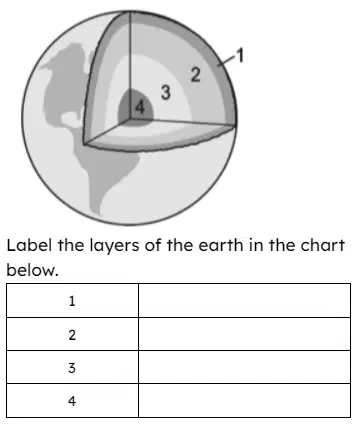
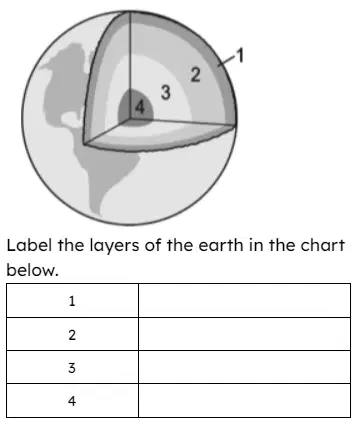
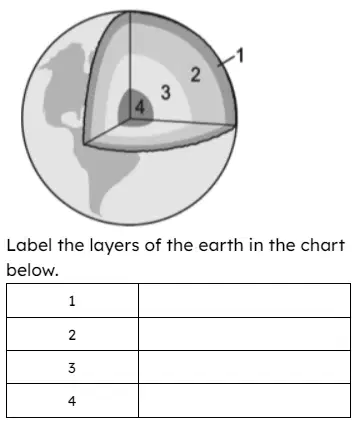
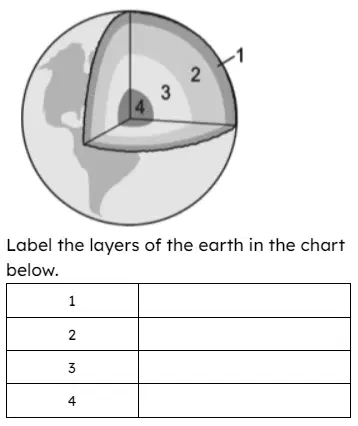
Select the term from the drop down box that belongs in 1 on the chart.
a)
inner core
b)
mantle
c)
outer core
d)
crust
25.
Select the term from the drop down box that belongs in 2 on the chart.
a)
inner core
b)
mantle
c)
outer core
d)
crust
26.
Select the term from the drop down box that belongs in 3 on the chart.
a)
inner core
b)
mantle
c)
outer core
d)
crust
27.
Select the term from the drop down box that belongs in 4 on the chart.
a)
inner core
b)
mantle
c)
outer core
d)
crust
28.
Which of the following most likely causes Earth’s inner core to be a solid?
a)
The pressure at the core is very high.
b)
The metals in the core are very high.
c)
The temperature of the core is very low.
d)
The chemicals in the core are very reactive.
29.
The table describes each of Earth's layers. Layer D is most likely which of the following?
a)
crust
b)
mantle
c)
outer core
d)
inner core
30.

Liam is creating a model of the Earth for his science project. Which material would best represent the Earth's crust in his model?

a)

Soft clay

b)

Hard plastic

c)

Thin cardboard

d)

Liquid water

31.

Emma and Charlotte are working on a school project to create a model of the Earth’s mantle. Which material would be the most appropriate to represent its thick, semi-solid consistency?

a)

Jelly or gelatin

b)

Ice cubes

c)

Metal

d)

Sand

32.

Harper is conducting a science experiment to understand the Earth's layers. What material could she use to model the Earth's outer core?

a)

Frozen Water

b)

Chocolate Bar

c)

Oil or syrup

d)

Gummy bears

33.

Arjun and Daniel are working on a science project to model the Earth's inner core. Which material would work best for their model?

a)

A rubber ball

b)

A solid ball of metal

c)

A block of ice

d)

A marshmallow

34.

Abigail is conducting a science experiment to demonstrate the Earth's mantle’s ability to flow slowly over time. Which material would best represent this characteristic?

a)

Liquid syrup

b)

Kinetic Sand

c)

Ice

d)

Fruit Snack

35.
What is the correct order (starting from the surface) of Earth's layers?
a)
crust, mantle, inner core, outer core
b)
mantle, outer core, inner core, crust
c)
inner core, outer core, mantle, crust
d)
crust, mantle, outer core, inner core
36.
Earth's inner core is
a)
a layer of hot rock
b)
a solid ball of iron and nickel
c)
a layer of liquid iron and nickel
d)
a layer of rock that forms Earth's outer skin
37.
How does temperature change as you move from the crust to the core?
a)
it gets cooler
b)
it gets hotter
c)
it stays the same
d)
the core is frozen
38.

Which layer of the Earth is the thinnest?

a)

Crust

b)

Mantle

c)

Outer core

d)

Inner core

39.
Pressure ______________________ as you go deeper into the Earth
a)
increases
b)
decreases 
c)
goes up or down depending on the layer
d)
stays the same
40.

Which layer of Earth is responsible for the Earth's magnetic field?

a)

crust because it protects the Earth

b)

mantle because of the convection currents

c)

inner core because it is solid

d)

outer core because the liquid material is spinning around the inner core, creating a magnet

41.

According to the diagram, what process is shown by letter A?

a)

extrusion

b)

erosion

c)

crystallization

d)

intrusion

42.

According to the diagram, what process is shown by letter B?

a)

compaction & cementation

b)

weather & erosion

c)

heat & pressure

d)

melting

43.

Limestone is a sedimentary rock. During the rock cycle, limestone is changed into marble, a metamorphic rock. The processes that act on limestone and change it into marble are

a)

weather and erosion

b)

heat and pressure

c)

compacting and cementing

d)

melting, cooling, and hardening

44.

Which of the following lists the steps an igneous rock undergoes in order to become a sedimentary rock, in the correct order?

a)

Deposition, erosion, melting, cooling

b)

Erosion, weathering, eruption, cooling

c)

Dissolving, deposition, cooling, fracture

d)

Weathering, erosion, deposition, cementation

45.

This is the continuous process of rock changing from one type to another.

a)

Igneous rocks

b)

Sedimentary rocks

c)

Metamorphic rocks

d)

Rock Cycle

46.

Any rock that forms from another rock as a result of changes in heat or pressure (or both) is a:

a)

chemical rock

b)

igneous rock

c)

sedimentary rock

d)

metamorphic rock

47.
True/False: Igneous rocks can only turn into metamorphic rocks.
a)
True
b)
False
48.

Rocks that form from colling magma inside Earth?

a)

Igneous intrusive

b)

Igneous extrusive

c)

Metamorphic foliated

d)

Metamorphic nonfoliated

49.

Which rock is formed form the cooling of volcanic ash on Earth's surface?

a)

intrusive igneous

b)

foliated metamorphic

c)

extrusive igneous

d)

organic sedimentary

50.
The name rock is given when it is broken down into smaller pieces.
a)
texture
b)
weathering
c)
sediment
d)
erosion
51.
What are the 3 major types of rocks?
a)
Igneous, Metamorphic, Sedimentary
b)
Metamorphic, Igneous, Cementation
c)
magma, lava, crystals
52.
The process when rocks break into smaller pieces due to exposure to natural elements is called
a)
erosion
b)
weathering
c)
sediments
53.
This rock was formed by smaller pieces of rock that settled at the bottom of a lake millions of years ago. What type of rock is this?
a)
Sedimentary
b)
Igneous
c)
Metamorphic
54.
This rock started as molten magma. What type of rock is this?
a)
Sedimentary
b)
Igneous
c)
Metamorphic
55.
This rock was another type of rock that was heated and compressed over time. What type of rock is this?
a)
Sedimentary
b)
Igneous
c)
Metamorphic
56.
This rock was formed when molten rock cooled into a solid. What type of rock is it?
a)
Igneous Rock
b)
Metamorphic Rock
c)
Sedimentary Rock
57.
Which type of rock is formed from INTENSE heat and pressure?
a)
igneous
b)
sedimentary
c)
metamorphic
58.
What process is used to form sedimentary rocks?
a)
Lava cools and hardens to form a rock.
b)
Weathering, Erosion, Deposition, Compaction, Cementation
c)
Extreme heat and pressure from inside the Earth turn rocks into new rocks.
d)
Magma trapped under the Earth's surface cools and solidifies.
59.

What is letter A?

a)

Igneous Rock

b)

Sedimentary Rock

c)

Metamorphic Rock

d)

Minerals

60.

What is letter B?

a)

Igneous Rock

b)

Sedimentary Rock

c)

Metamorphic Rock

d)

Minerals

61.

This image shows the rock cycle.

Which event most likely occurs at point V?

a)

cooling

b)

erosion

c)

heating

d)

melting

62.

Which statement best describes the formation of metamorphic rocks?

a)

Magma cools and crystallizes slowly beneath Earth’s surface.

b)

Liquid lava erupts from a volcano and cools quickly at Earth’s surface.

c)

Sand and gravel are deposited at the mouth of a river and, over time, form layers that solidify into rock.

d)

Ancient sandstone beaches become buried deep beneath Earth’s surface, where they are exposed to extreme heat and pressure.

63.

Which missing rock type is the arrow pointing at?

a)

Igneous

b)

Sedimentary

c)

Metamorphic

64.

Which missing rock type is the arrow pointing at?

a)

Igneous

b)

Sedimentary

c)

Metamorphic

65.

Which missing rock type is the arrow pointing at?

a)

Igneous

b)

Sedimentary

c)

Metamorphic