wayground logo

Free Printable Worksheets

Font size

S
M
L
XL
Worksheets

Electricity & Magnetism Review Assessment

Total questions: 63

Worksheet time: 1hrs 21mins

Name
Class
Date
1.
An example of a conductor is :
a)
a glass paperweight
b)
a plastic cap
c)
a metal screw
d)
a wooden handle
2.
An example of an insulator is:
a)
iron
b)
silver
c)
copper wire
d)
rubber
3.
An electrical current produces a(n):
a)
magnetic field
b)
magnetic domains
c)
electrical resistance
d)
both b& c are correct
4.
The buildup of charges on an object is called:
a)
positive charge
b)
static charge
c)
negative charge
d)
static discharge
5.
What charge does an electron have?
a)
negative (-)
b)
positive (+)
c)
neutral or no charge (0)
6.
The picture shows an electrical circuit. This circuit is a series circuit because: 
a)
It has 3 light bulbs.
b)
The same current flows through all three light bulbs.
c)
It uses a single battery.
d)
The electrical current is divided between the three light bulbs.
7.
Which of the following is shown in the picture?
a)
Electromagnet
b)
Electric generator
c)
Electric motor
d)
Transformer
8.
Why are metals useful for making electrical wire?
a)
Metals do not bend.
b)
Metals hold much heat.
c)
Metals are insulators.
d)
Metals are conductors.
9.
Which of these causes electrically charged objects to attract or repel each other?
a)
An equal number of protons.
b)
An equal number of electrons.
c)
An unequal number of electrons.
d)
An unequal number of molecules.
10.
Which of the following materials allows charges to flow easily?
a)
wood
b)
an electrical insulator
c)
glass
d)
an electrical conductor
11.
Which of the following statements describes the interaction between magnetic poles?
a)
Like poles repel each other, and opposite poles attract each other.
b)
Like poles attract each other, and opposite poles repel each other.
c)
Opposite poles repel each other.
d)
Like poles attract each other.
12.
The process of transferring charge by touching or rubbing 
a)
Induction 
b)
Conduction 
c)
Friction 
d)
Conductor 
13.
The rearrangement of electrons on a neutral object caused by a nearby charged object 
a)
Induction 
b)
Conduction 
c)
Friction 
d)
Conductor 
14.
Electric current that flows in only one direction. 
a)
Voltage 
b)
Direct Current 
c)
Alternating Current
d)
Series Circuit 
15.
The flow/movement of electric charges 
a)
Voltage
b)
Resistance 
c)
Current 
d)
Circuit 
16.
A closed path that electric current follows 
a)
Voltage
b)
Current
c)
Resistance 
d)
Circuit
17.
The tendency for a material to oppose the flow of electrons, changing electrical energy into thermal energy and light.
a)
Voltage
b)
Current
c)
Resistance
d)
Circuit 
18.
The current has only has one loop to flow through in this circuit. 
a)
Series Circuit 
b)
Parallel Circuit 
19.
This circuit contains two or more branches for current to move through. 
a)
Series Circuit 
b)
Parallel Circuit 
20.

What is the symbol for resistance

a)

𝝮

b)

A

c)

V

d)

W

21.
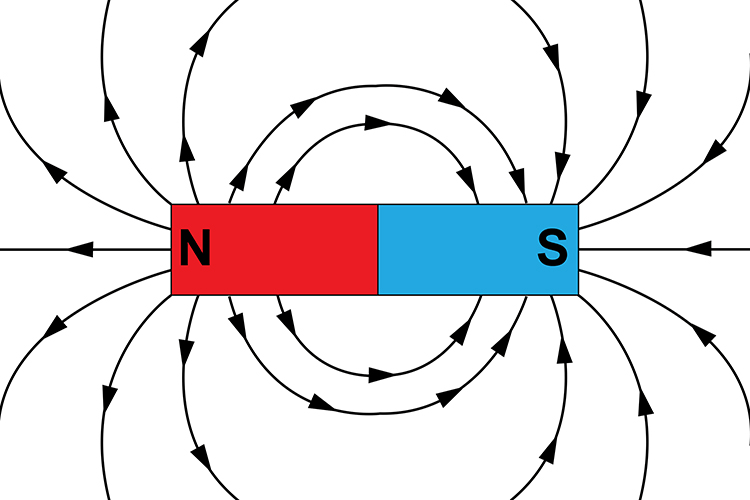
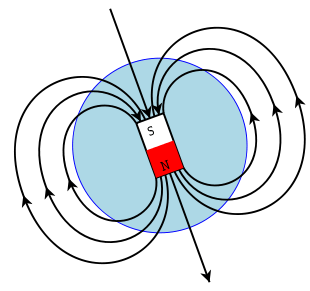
What do the lines around this magnet represent?
a)
North Pole
b)
South Pole
c)
Magnetic Declination
d)
Magnetic Field
22.
In un-magnetized materials the domains are __________ aligned.
a)
super
b)
slightly
c)
randomly
d)
always
23.
The strongest part of a magnet is...
a)
the bars.
b)
the force field.
c)
the poles. 
d)
the middle.
24.

How can a wire become magnetic?

a)

point it north

b)

add a resistor

c)

heat it up

d)

run a current through it

25.
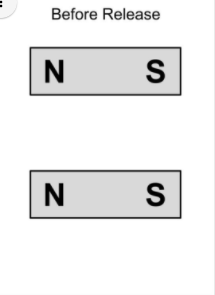
Magnets that are arranged like this will _______. 
a)
move away from each other (repel)
b)
move towards each other (attract)
26.

What is the result of cutting a magnet in half?

a)

The magnet ceases to function.

b)

The magnet is split into a north and a south pole.

c)

Each piece will have its own north and south poles.
27.
Magnets can interact without touching.
a)
True
b)
False
28.
What happens when two north poles of a magnet are placed together?
a)
they repel
b)
they attract
c)
they cancel each other out
d)
the strength of the magnet is doubled
29.

The area of magnetic force around a magnet is known as its _____________.

a)

magnetic field

b)

magnetic declination

c)

magnetic fan lines

d)

magnetic tan lines

30.

A ________ is a device that has a magnet on a needle that spins freely. It is used for navigation because its needle usually points north.

a)

calculator

b)

ruler

c)

compass

d)

map

31.
Which way will the magnets move after they are released?
a)
Towards each other
b)
Away from each other
c)
Not enough information
32.
The energy something has because it is moving
a)
kinetic energy
b)
potential energy
c)
magnetic energy
d)
force
33.
Which picture has the most potential energy?
a)
Picture A
b)
Picture B
34.
The energy that is stored in an object or system
a)
kinetic energy
b)
potential energy
c)
magnetic energy
d)
force
35.
How is energy being transferred in the scenario shown below?
a)
Potential --> Kinetic
b)
Kinetic --> Potential
c)
Kinetic --> Kinetic
d)
Neither
36.

The two poles on a magnet are...

a)

positive and negative

b)

north and south

c)

east and west

d)

up and down

37.

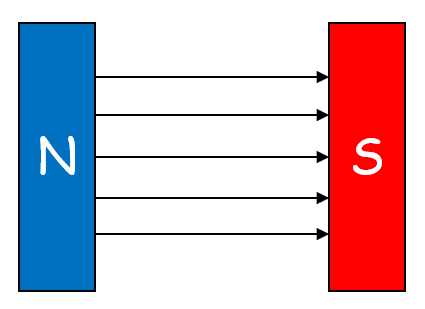
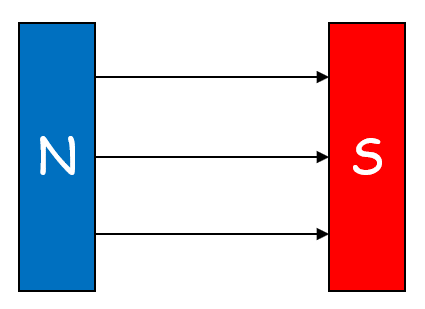
Select the diagram with the weakest magnetic field
a)
b)
c)
38.

Where is the magnetic field the strongest around a bar magnet?

a)

far away from the magnet

b)

at the side of the magnet

c)

at the poles

d)

above the magnet

39.

The Earth has a magnetic field because the (a)   of the Earth is made of iron and nickel.

40.
What do magnets stick to?
a)
copper
b)
wood
c)
iron
d)
plastic
41.

The place on a magnet where the force it exerts is the strongest is called

a)

a magnetic pole

b)

a magnetic field line

c)

a domain

42.

What are the two magnetic forces?

a)

attraction

b)

equilibrium

c)

magnetic acceleration

d)

repulsion

43.
True or False: A magnetic field is invisible.
a)
True
b)
False
44.
Which of these is attracted to a magnet?
a)
iron nail
b)
copper penny
c)
piece of paper
d)
notebook
45.
What characteristics do magnetic substances have?
a)
They can give you a "shock" when you touch them
b)
They can push or pull objects without touching them
c)
They are always black and cold to touch
d)
They fall faster than other objects when you drop them
46.
Earth's magnetic field and a bar magnet attract particles to the same locations. Where are they?
a)
The middle
b)
All around the outside
c)
The north and south poles
d)
First to the middle, then to the ends
47.
Why does a compass needle point north?
a)
The compass is a bar magnet
b)
Because north is up
c)
Because it's magic
d)
It lines up with the Earth's magnetic field
48.
What kind of magnet can be turned on and off?
a)
refridgerator magnet
b)
electromagnet
c)
magnetite
d)
iron
49.
How many poles does a magnet have?
a)
1
b)
2
c)
3
d)
4
50.
What is an electromagnet?
a)
a magnet that creates an electric current
b)
a magnet created by an electric current
c)
a magnet that has an electric charge
d)
an electric charge that is magnetic
51.
2 ways to increase the magnetic force of an electro-magnet
a)
Increase the current flow, reduce the number of coils
b)
Increase the voltage, decrease the number of coils
c)
Increase the number of coils and the current flow
d)
Spread out the coils, replace iron core with rubber.
52.
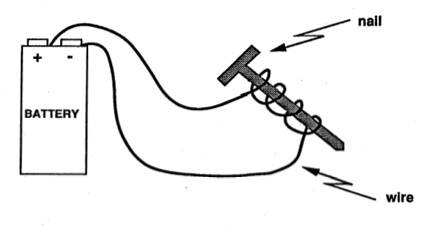
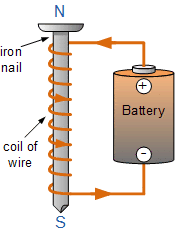
This is a picture of a simple electromagnet. How can the electromagnet be made stronger?
a)
Add more coils of wire to the nail.
b)
Use a smaller battery.
c)
Reverse the poles of the magnet.
d)
Remove all the coils and the nail.
53.

What is magnetic force?

a)

A force exerted by electrically charged particles

b)

A force exerted by magnets that can be felt by objects near a magnet

c)

A force exerted by magnets that makes an object become electrically charged

d)

A force exerted by a magnet only when it physically touches an object

54.
If you cut a magnet in half, what happens to the poles?
a)
One half gets the North Pole, the other half gets the South Pole
b)
Both halves get only a North Pole
c)
Both halves get only a South Pole
d)
Both halves get a North pole and a South Pole
55.

What are the components of the electromagnets?

a)

battery, wire and bulb

b)

battery , copper wire and paper clips

c)

battery, copper wire and iron nail

d)

battery, wire and aluminum

56.

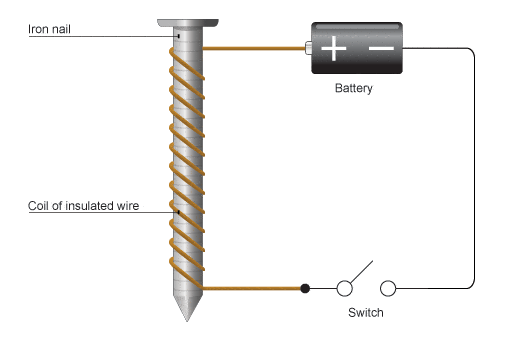
What would happen if you took one end of the wire off the battery?

a)

The nail will be a magnet.

b)

The nail would no longer be a magnet

c)

Nothing will happened.

d)

The nail will heats up.

57.

Which part of the electromagnets turned into a magnet when electricity flows through a coiled wire?

a)

Battery

b)

Copper wire

c)

Iron Nail

d)

Bulb

58.

How can the strength of an electromagnet be increased? (mark all that apply)

a)

increase the current flowing through the coil

b)

increase the number of coils

c)

add an amplifier to it

d)

put iron core inside the coil

59.
In order for an electromagnet to be formed, an __________ current must pass through a coil of __________ wrapped around an ________ core.
a)
wire, iron, electric
b)
electric, wire, iron
c)
iron, electric, wire
d)
excited, hair, apple
60.

Which electromagnet is stronger?

a)

A

b)

B

61.
What is most likely to happen when the switch is closed?
a)
A magnetic field should be produced
b)
The nail will rust
c)
The battery will explode
d)
The wire will catch on fire
62.

What is the role of the battery in the electromagnet?

a)

It provides light energy for the electromagnet.

b)

It provides magnetic field for the electromagnet.

c)

It provides sound energy for the electromagnet.

d)

It provides the power source for the electromagnet.

63.

Electronic devices create magnetic fields because they

a)

are magnets

b)

are compasses

c)

have moving particles with electric charge