wayground logo

Free Printable Worksheets

Font size

S
M
L
XL
Worksheets

Yr 10 Physics Ch 9 Pearson - Full Review Quiz 60 Q's

Total questions: 60

Worksheet time: 2hrs 4mins

Name
Class
Date
1.
What is the formula to calculate speed?
a)
S = t/d
b)
S = d/t
c)
S = d x t
d)
S = t x d
2.
What is speed?
a)
how far you go
b)
how much distance is covered over a period of time
c)
how fast you accelerate
d)
the change in the location of a object
3.
According to the graph how far does the person travel in the first 5 seconds?
a)
2 m
b)
10 m
c)
0 m
d)
5 m
4.
What is the person doing from 5 seconds to 10 seconds?
a)
Walking 
b)
Running
c)
Standing Still 
d)
Walking Fast
5.

A runner races in the 100 meter dash. It takes her 10 seconds to finish. What is her average speed?

a)

10 m/s

b)

1000 m/s

c)

100 seconds

d)

10 seconds

6.
What is the speed of a car that travels 400 m in 20 minutes?
a)
20 mi/hr
b)
20 m/min
c)
800 m/min
d)
200 mi/hr
7.

The unit we use to measure acceleration is ___.

a)

m/s

b)

m

c)

s

d)

m/s2

8.

The unit we use to measure speed is ___.

a)

m/s

b)

m

c)

s

d)

m/s2

9.

The graph shows

a)

positive velocity that's getting faster

b)

negative velocity that's getting faster

c)

negative velocity that's getting slower

d)

positive velocity that's getting slower

10.

The graph shows

a)

positive velocity that's getting faster

b)

negative velocity that's getting faster

c)

negative velocity that's getting slower

d)

positive velocity that's getting slower

11.

The graph shows

a)

positive velocity that's getting faster

b)

negative velocity that's getting faster

c)

negative velocity that's getting slower

d)

positive velocity that's getting slower

12.

The graph shows

a)

positive velocity that's getting faster

b)

negative velocity that's getting faster

c)

negative velocity that's getting slower

d)

positive velocity that's getting slower

13.
Which runner had a head start?
a)
A
b)
B
c)
C
d)
None of them
14.

What type of force is this man using to push his grocery cart?

a)

Normal Force

b)

Gravity

c)

Air Resistance

d)

Applied Force

15.

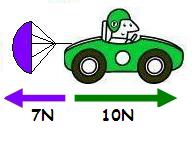
What is the net force?

a)

3 N

b)

3 N, right

c)

17 N, right

d)

3 N, left

16.
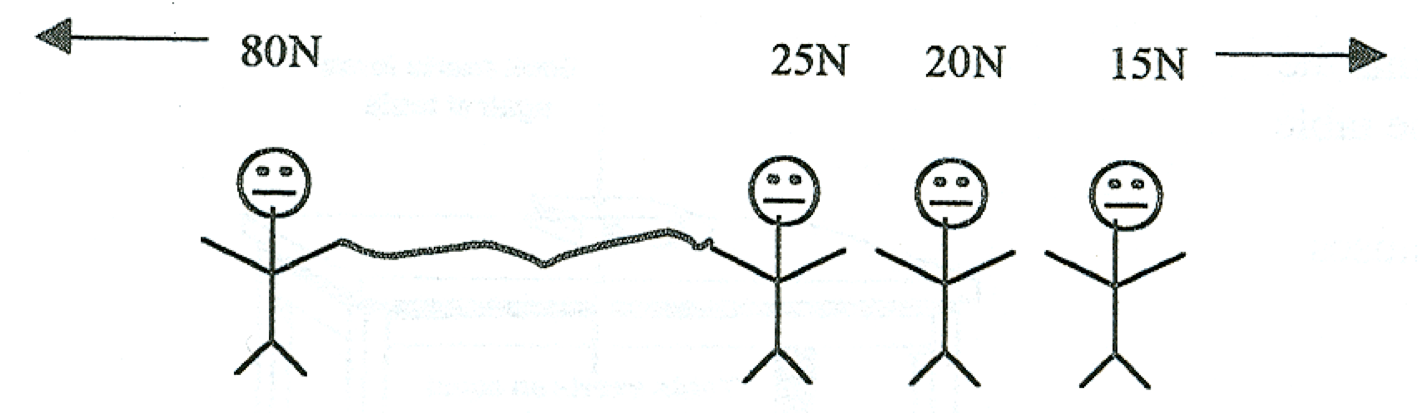
Who wins the tug of war with what net force?
a)
The person on the left with 20 N
b)
The person on the left with 80 N
c)
The people on the right with 20 N
d)
The people on the right with 100 N
17.
What is the net force?
a)
20 N 
b)
0 N 
c)
400 N 
d)
40 N 
18.

What is the unit to MEASURE force?

a)

Kilogram

b)

Meter

c)

Pounds

d)

Newton

19.

A ____________ is a push or a pull on an object.

a)

friction

b)

force

c)

magnet

d)

gravity

20.
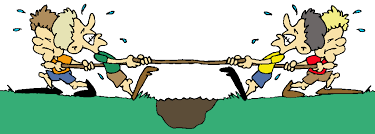
If these teams are pulling with the same amount of force what will happen?
a)
The boy in blue will win.
b)
They will not move at all.
c)
The boy in red will win.
d)
Both will fall down.
21.
The sum of all forces acting on an object.
a)
Contact Force
b)
Balanced Force
c)
Unbalanced Force
d)
Net Force
22.
What will cause an object to move?
a)
Applied forces
b)
Balanced forces
c)
Unbalanced forces
23.
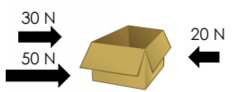
Calculate the Net Force. 
a)
60N, Left 
b)
40N, Right 
c)
0N
d)
60N, Right
24.
This type of force resist motion between two surfaces that are pressed together
a)
contact
b)
gravity
c)
friction
25.

If both forces are going in the same direction you should______ those forces

a)

Add

b)

Subtract

c)

Divide

d)

Multiply

26.

When forces are going in the opposite direction of each other you should do what do find the net force

a)

Subtract

b)

Add

c)

Divide

d)

Multiply

27.
If a 10 kilogram object accelerates suddenly at 15 m/s^2, how much force was applied to the object?
a)
150 Newtons
b)
15 Newtons
c)
150 kilograms
d)
100 kilograms
28.
If a force of 50 Newton's was applied to an object with a mass of 500 grams, what will the object's acceleration be?
a)
10 m/s^2
b)
.1 m/s^2
c)
100 m/s^2
d)
1 m/s^2
29.
If a force of 26 N is exerted on two balls, one with a mass of 0.52 kg and the other with a mass of 0.78 kg, which ball will have the greater acceleration?  (F=ma)
a)
The one with a mass of .78 kg will have the greatest acceleration.
b)
The one with a mass of .52 kg will have the greatest acceleration.
c)
They will both accelerate at the same rate.
30.
A 20 kg bike accelerates at 10 m/s2.  what was the force?
a)
25 Newtons
b)
20 Newtons
c)
200 Newtons
d)
10 Newtons
31.
A force of 250 N is applied to an object that accelerates at a rate of 5 m/s2.  What is the mass of the object? To solve this problem you must do - 
a)
250 ÷ 5
b)
5 ÷ 250
c)
250 x 5
32.
A 5 kg block is pulled across a table by a net force of 32 N. Calculate the acceleration of the object. To solve this problem you must do - 
a)
32 ÷ 5
b)
5 ÷ 32
c)
32 x 5
33.
A skier needs to apply a force of 132 N to accelerate at a rate of 2 m/s2. What is the mass of the skier? To solve this problem you must do - 
a)
132 ÷ 2
b)
2 ÷ 132
c)
132 x 2
34.
A skier needs to apply a force of 132 N to accelerate at a rate of 2 m/s2. What is the mass of the skier? The answer to this question is most likely (HINT: Look at the units!!!) - 
a)
66 N
b)
66 m/s2
c)
66 kg
35.
The masses of four objects are given in this table. If all objects are struck with the same amount of force, which one will have the greatest acceleration?
a)
Object 1
b)
Object 2
c)
Object 3
d)
Object 4
36.

In the unit we used the equation

EGP = m x g x d

The quantity with units of joules is

a)

EGP

b)

F

c)

d

d)

g

37.

In the unit we used the equation

EGP = m x g x d

The quantity with a value that does not change while we are on the Earth's surface is

a)

EGP

b)

F

c)

d

d)

g

38.

EGP (J) = Weight (N) x change in height (m):

A weight of 500N is placed up 1.5m higher than the floor. What is the GPE (J)?

a)

500J

b)

750N

c)

750J

d)

600J

39.

a 2kg object is raised 2m, what is the change in GPE? Hint: m x g x h. (g = 10)

a)

40J

b)

40N

c)

40kg

d)

40m

40.

mass = 450kg, gravity = 10N/kg, height = 12m. Calculate GPE. (mgh)

a)

472J

b)

54,000N

c)

54,000J

d)

5,400J

41.

Which energy store decreases as an object falls?

a)

Gravitational

b)

Kinetic

c)

Checmial

d)

Magnetic

42.

Total energy = 200J
Useful energy = 20J

Workout the efficiency of this lightbulb.
 efficiency = useful enegytotal energy in ×100efficiency\ =\ \frac{useful\ enegy}{total\ energy\ in}\ \times100  

a)

100%

b)

80%

c)

40%

d)

10%

43.

Total energy = 350J
Useful energy = 70J

Workout the efficiency of this iphoneX.
 efficiency = useful energytotal energy in ×100%efficiency\ =\ \frac{useful\ energy}{total\ energy\ in}\ \times100\%  

a)

100%

b)

80%

c)

40%

d)

20%

44.

When a golf club hits a golf ball, not all of the club's energy is transferred to the ball. Which of the following does NOT represent that energy loss?

a)

sound

b)

mgh

c)

heat

d)

elastic distortion

45.

A car transfers 100 J of chemical energy in order to gain 50 J of kinetic energy. The efficiency of the car is

a)

20%

b)

0.5%

c)

50%

d)

200%

46.

What are Equations for Gravitational Potential Energy?

a)

Gravitational Potential Energy = Mass x Gravitational Field Strength x Height

b)

Gravitational Potential Energy = Weight x Height

c)

Gravitational Potential Energy = Mass x Gravitational Field Strength / Height

d)

Gravitational Potential Energy = Weight / Height

47.

Gravitational Potential Energy (Ep) is...

a)

the energy stored in a stretched object

b)

the energy stored in an electrically charged object

c)

the energy stored in a frozen object

d)

the energy stored in a raised object

48.

The formula for calculating gravitational potential energy is...

a)

1/2 x mass2 x gravitational field strength x height

b)

mass x gravitational field strength x height

c)

1/2 x mass x gravitational field strength x height

d)

mass x gravitational field strength x height2

49.

The most GPE is at

a)

a

b)

b

c)

c

d)

d

50.

The least amount of potential energy is at

a)

a

b)

b

c)

c

d)

d

51.

A 11kg baby crawls across the yard at 2 m/s. What is his kinetic energy?

a)

KE = 11 x 1/2 + 22

b)

KE = 0.5 x 11 x 22

c)

KE = 0.5 x 2 x 112

d)

KE = 1/2 + 0.5 + 112

52.

A 11kg baby crawls across the yard at 2 m/s. What is her kinetic energy?

a)

44 J

b)

11 J

c)

16 J

d)

22 J

53.
Calculate the KE of a moving 4 kilogram object traveling at a velocity of 3 m/s.
a)
18 J
b)
36 J
c)
12 J
d)
6 J
54.
How much KE does a moving 6 kilogram object have if it moves with a velocity of 3 m/s?
a)
27 J
b)
18 J
c)
9 J
d)
2 J
55.
A moving 10 kilogram object has 20 Joules of KE. What is its velocity?
a)
2 m/s
b)
4 m/s
c)
200 m/s
d)
10 m/s
56.
What is the mass of a moving object that has 100 Joules of KE and moves at a velocity of 2 m/s?
a)
50 kg
b)
200 kg
c)
25 kg
d)
100 kg
57.
As mass increases, KE ...
a)
increases
b)
decreases
c)
stays the same
58.
Which has a greater impact on KE?
a)
mass
b)
velocity
59.
The Law of Conservation of Energy states that
a)
energy cannot be created nor destroyed, only transformed or transferred
b)
energy can be destroyed but not created
c)
energy can be created but not destroyed
60.

The picture below shows John, Mark, and Erica on an elevator. The elevator is moving down from the 10th floor of a building to the 1st floor of the building.


John's mass is 78 kilograms, Mark's mass is 31 kilograms, and Erica's mass is 54 kilograms. At any given moment when they are moving down with the elevator, which of the following statements is true?

a)

John has the most kinetic energy, and Mark has the least kinetic energy.

b)

Mark has the most kinetic energy, and Erica has the least kinetic energy.

c)

Mark has the most kinetic energy, and John has the least kinetic energy.

d)

Erica has the most kinetic energy, and Mark has the least kinetic energy.