wayground logo

Free Printable Worksheets

Font size

S
M
L
XL
Worksheets

Plate Tectonics, Plate Boundaries and Earth's Topography

Total questions: 100

Worksheet time: 2hrs 54mins

Name
Class
Date
1.
Look at the image. The South American and Nasca plate are moving together. Which type of boundary is this? 
a)
divergent
b)
convergent
c)
transform fault
2.
When molten rock reaches the Earth's surface, comes out and begins to cool, it is known as
a)
lava
b)
mantle
c)
magma
d)
crater
3.
The movement of Earth's crust along plate boundaries produces
a)
earthquakes
b)
volcanoes
c)
moutains
d)
All of these options. 
4.
What causes tectonic plates to move?
a)
ocean currents
b)
convection currents in the mantle
c)
volcanoes
d)
the Coriolis Effect
5.
What is subduction?
a)
one plate collides with another
b)
one plate destroys another
c)
one plate goes beneath another
d)
one plate divides another
6.
What is the shaking of the Earth’s crust caused by a release of energy?
a)
Earthquake
b)
Epicenter
c)
Fault
d)
Plate
7.

What are the puzzle pieces of the Earth's surface called?

a)

Tectonic plates

b)

Subductions

c)

Earthquakes

d)

Convergents

8.

What type of boundary is shown in the diagram?

a)

Divergent

b)

Convergent

c)

Transform

d)

Transdermal

9.

A boundary that doesn't create or destroy crust is called a:

a)

Transform Boundary

b)

Convergent Boundary

c)

Divergent Boundary

d)

Rift Valley

10.

In what type of boundary is the only feature created going to be Mountains?

a)

Oceanic to Oceanic Convergence

b)

Oceanic to Continental Convergence

c)

Rift Valleys

d)

Continental to Continental Convergence

11.
Which type of wave arrives to a point first?
a)
Primary Waves (P-Waves)
b)
Secondary Waves (S-Waves)
c)
Rayleigh Waves
d)
Love Waves
12.
This is the area beneath the Earth's surface where the earthquake begins
a)
epicenter
b)
focus
c)
fault line
d)
tectonic plate
13.
Which body wave is pictured?
a)
P-Wave
b)
S-Wave
c)
Rayleigh Wave
d)
Love Wave
14.
What type of volcano is this? It has been created with layers of cooled lava. 
a)
Shield
b)
Cinder cone
c)
Composite
15.
Which type of volcano has a steep cone-shaped hill or mountain made with only pyroclastic flow? 
a)
Cinder cone volcano
b)
Shield volcano
c)
Composite volcano
d)
Earthquake
16.
This is the driving force behind the movement of tectonic plates.
a)
Mantle convection currents
b)
Oceanic convection currents
c)
Atmospheric convection currents
d)
Solar convection currents
17.

Where are the youngest rocks on Earth found?

a)

Along mid-ocean ridges

b)

Along transform boundaries

c)

On the edges of the continents

d)

Near ocean trenches

18.

This type of boundary creates rift zones and shallow earthquakes

a)

Transform

b)

Continental-Continental Convergent

c)

Divergent

d)

Oceanic-Continental Convergent

19.

P waves travel faster than S waves

a)

True

b)

False

20.

Only P waves travel through the inner core.

a)

True

b)

False

21.
We use this tool to measure seismic waves during earthquakes
a)
Seismographs
b)
magnitude
c)
actual magnitude
d)
sonograph
22.
P Waves travel through...
a)
Solids
b)
Liquids
c)
Both
23.
These are the secondary, or second waves to be released. They cannot travel through the liquid outer core
a)
S waves
b)
Surface Waves
c)
P waves
24.
Which city is closest to the epicenter?  
a)
A
b)
B
c)
C
25.
Which body wave is pictured?
a)
P-Wave
b)
S-Wave
c)
Rayleigh Wave
d)
Love Wave
26.

Only P waves travel through liquids.

a)

True

b)

False

27.

Which location is farther from the epicenter? The first big bump is the P waves and the second big bump is the S waves.

a)

Seismogram B (top)

b)

Seismogram C (bottom)

28.
Mountains that are formed by the folding up of rock layers due to the collision of two plates
a)
Folded Mountains
b)
Dome Mountains
c)
Fault-Block Mountains
d)
Volcanic Mountains
29.
Mountains that are formed by pressure when magma pushes upward, causes land to bulge upward
a)
Folded Mountains
b)
Dome Mountains
c)
Fault-Block Mountains
d)
Volcanic Mountains
30.
Mountains created by movement of broken pieces of crust; some push upward others slide downward
a)
Folded Mountains
b)
Dome Mountains
c)
Fault-Block Mountains
d)
Volcanic Mountains
31.
The dense, solid center of Earth, made of iron and nickel.
a)
Inner Core
b)
Mantle
c)
Crust
d)
Outer Core
32.
The hot, liquid layer of Earth, made of iron and nickel.
a)
Inner Core
b)
Mantle
c)
Crust
d)
Outer Core
33.

Which layer of Earth is a liquid?

a)

Mantle

b)

Inner Core

c)

Crust

d)

Outer Core

34.

Why is the Earth's inner core solid?

a)

Peer Pressure

b)

High Pressure

c)

Extreme Heat

d)

Composition

35.

Alfred Wegner's continental drift hypothesis stated that at one time in Earth's history, all the continents joined together to form...

a)

Three Supercontinents

b)

One Supercontinent

c)

Two Supercontinents

d)

Eleven Supercontinents

36.

What was the name of the super continent that existed about 250 million years ago?

a)

Lurasia

b)

Taiga

c)

Clubber Lang

d)

Pangaea

37.

One piece of evidence that supports Alfred Wegner's hypothesis is that...

a)

fossils of the same species are found on different continents.

b)

the same magnetic directions exist on different continents.

c)

land bridges still exist that connect major continents.

d)

major land rivers on different continents match

38.

What type of plate boundary occurs when two plates move past each other without destroying or producing new crust?

a)

convergent

b)

preform

c)

transform

d)

divergent

39.

New crust is formed at what types of boundaries?

a)

convergent boundaries

b)

transform boundaries

c)

Papa John's boundaries

d)

divergent boundaries

40.

What forms when one oceanic plate is forced beneath another plate?

a)

an ocean ridge

b)

a subduction zone

c)

a TGI Friday's

d)

an ocean basin

41.

What is the minimum number of seismic stations needed to determine the location of an earthquake's epicenter?

a)

One

b)

Thirty-seven

c)

Two

d)

Three

42.

The Hawaiian islands have formed as the Pacific plate moves over...

a)

a subduction zone

b)

an ocean ridge

c)

the Aleutian plate

d)

a hot spot

43.
Which of the following is NOT a type of chemical weathering?
a)
water
b)
carbon dioxide
c)
ice wedging
d)
living organisms secreting acid to break down rocks
44.
What is weathering?
a)
The process by which
water, ice, wind or gravity
moves fragments of rock
and soil.
b)
The process by which
water, ice, wind or gravity
deposit rock sediments
and soil in a new place.
c)
The breaking down of
Earth’s crust into smaller
and smaller pieces.
45.
The diagrams  shows a natural process that weathers rock.
 Which statement best explains why this process results in weathering?
a)
frozen water acts as a solute
b)
water expands when it freezes
c)
the mass of water increases when it freezes
d)
frozen water dissolves most types of rock
46.

What is the process of moving sediments from location to another?

a)

Deposition

b)

Erosion

c)

Weathering

d)

Compaction

47.
What is the profile view to Topographic Map #1? 
a)
A
b)
B
c)
C
d)
D
48.
What is the profile view to Topographic Map #2?
a)
B
b)
C
c)
D
d)
E
49.
What is the elevation of point B? (Contour interval is 100m)
a)
800 ft
b)
850 ft
c)
900 ft
d)
1000 ft
50.
What is the elevation at sea level?
a)
0
b)
100m
c)
20m
d)
3000m
51.
What is the elevation of Y?
a)
Between 120-140 meters
b)
Between 100-120 meters
c)
Between 140-160 meters
d)
Between 80-100 meters
52.
What feature is formed at B?
a)
river
b)
rift valley
c)
sink hole
d)
mountain
53.
How many mountain tops does this map have?
a)
one
b)
two
c)
three
d)
four
54.
In which direction is Mill River flowing?
a)
Southeast
b)
Southwest
c)
Northeast
d)
Northwest
55.
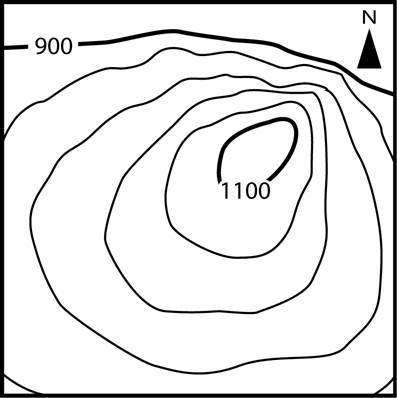
Provided is a topographic map of a hill with contour lines drawn showing elevation in meters.
The steepest slope on this hill can be found on the side that is facing which direction?
a)
Southwest
b)
Northeast
c)
Northwest
d)
Southeast
56.
What is the change in elevation from point X to the top of the hill in the topographic map shown?
a)
303 m
b)
203 m
c)
250 m
d)
253 m
57.
What is the most likely elevation of the mountain peak? (Contour interval is 100 m)
a)
1550  meters
b)
 1652 meters
c)
1500 meters
d)
1700 meters
58.

Which hill is steeper?

a)

A

b)

B

59.

What is the contour interval?

a)

5

b)

10

c)

100

d)

500

60.
What kind of plate boundary is shown here?
a)
divergent
b)
convergent
c)
transform
d)
strike slip
61.

What is the theory that explains how the Earth's lithosphere is divided into several large and small plates that move and interact with each other?

a)

Continental Drift

b)

Pangaea

c)

Plate Tectonics

d)

Seafloor Spreading

62.

Which type of plate boundary occurs when two plates slide past each other horizontally?

a)

convergent plate boundary

b)

divergent plate boundary

c)

subduction plate boundary

d)

transform plate boundary

63.

What is the term for the shaking or trembling of the Earth's surface caused by the sudden release of energy in the Earth's crust?

a)

ground shaking

b)

tremor

c)

seismic activity

d)

earthquake

64.

What is the energy source for convection currents in the asthenosphere?

a)

Geothermal heat

b)

Heat from the sun that permeates through earth's crust

c)

Heat from the core

d)

Earth's magnetic field

65.

Which type of crust is denser; continental crust or oceanic crust?

a)

Continental crust

b)

Oceanic Crust

66.

Why does oceanic crust subduct below continental crust?

a)

Continental crust is denser than oceanic crust

b)

Oceanic crust is more drawn to earth's iron core

c)

Oceanic crust is denser than continental crust

d)

Oceanic crust is further below continental crust so it's the first to subduct

67.

Which of these is not a geological event due to the movement of tectonic plates?

a)

Deltas forming

b)

Volcanoes

c)

Earthquakes

d)

Mountain forming

68.

Why do volcanoes form at subduction zones and not other boundaries?

a)

Convergent boundaries produce infant volcanoes that are destroyed before they can release magma.

b)

At subduction zones the dense oceanic crust melts, becomes less dense, and rises to the surface as hot magma

c)

Transform boundaries are when tectonic plates slide past each other creating too much energy that would destroy volcano formation

69.

Which of these observations DO NOT support continental drift theory

a)

The continents seem to fit together well

b)

The same fossils are found on different continents

c)

Different landforms are found on different continents

d)

The continents are still moving a few centimeters each year

70.
Created by a divergent boundary.
a)
Rocky Mountains
b)
Mariana Trench
c)
Mid Atlantic ridge
71.
Mountains form from ...
a)
plates sliding past one another
b)
collision of plates
c)
plates moving away from each other
72.
Which of the following is where one plate slides under another plate?
a)
submarine zone
b)
divergence zone
c)
subduction zone
d)
lower zone
73.
Two tectonic plates collide at a _______ plate boundary.
a)
convergent
b)
divergent
c)
transform
74.
What type of boundary is the SAN ANDREAS FAULT on?
a)
Covergent
b)
Transformers
c)
Divergent
d)
Transform
75.
What is the name of the plate boundary that slides past each other?
a)
Divergent
b)
Convergent
c)
Transform
d)
Mr. C the Slide Man
76.
Which of these events can ONLY happen on a DIVERGENT BOUNDARY?
a)
Rift Valley
b)
Mountain
c)
A peninsula
d)
An Insanely complex, long answer that you will click out of instinct. 
77.

Which layer is INCORRECTLY matched to the main state of matter it contains?

a)

Crust = solid

b)

Mantle = solid

c)

Outer Core = solid

d)

Inner Core = solid

78.

Which layer is represented by the yellow layer?

a)

inner core

b)

outer core

c)

mantle

d)

crust

79.
Which statement is correct?
a)
As you move up through the layers, the pressure increases.
b)
As you move down through the layers pressure increases.
c)
As you move down through the layers, pressure decreases.
d)
As you move up down through the layers, pressure remains the same.
80.

Where do convection cycles happen?

a)

core

b)

mantle

c)

crust

81.

Convection cycles move in the mantle. How does this affect the crust?

a)

crust has no motion

b)

crust moves in random direction

c)

crust moves in same direction convection cycle moves

82.

If magma decreases in temperature (cooler) what will happen to the magma?

a)

It will move down (sink)

b)

It will rise up (float)

83.
What is the heat source for convection in the mantle?
a)
the Crust
b)
the Mantle
c)
the Core
84.

The heat from our core comes from (pick all that apply)

a)

Friction between particles in the core

b)

Leftover energy caused from the collision of the rocks that formed Earth

c)

Radioactive decay of heavy elements located in the core

d)

The sun's electromagnetic waves entering the core

85.

The site at which an oceanic plate is sliding under a continental plate

a)

Trench

b)

Subduction Zone

c)

Tectonic Movement

d)

Continental Drift

86.

The deepest part of the ocean

a)

Mariana Trench

b)

Earthquakes

c)

Hotspot Volcanoes

d)

Pacific Ring of Fire

87.

Region around the Pacific Ocean where most of the volcanoes and earthquakes on Earth occur regularly

a)

Mountains

b)

Pacific Ring of Fire

c)

Mariana Trench

d)

Asthenosphere

88.
What is the outermost layer of earth?
a)
inner core
b)
outer core
c)
mantle
d)
crust
89.

Which layer of Earth do scientists believe is most likely made of solid matter?

a)

Crust

b)

Mantle

c)

Outer Core

d)

Inner Core

90.
Which layer of earth is molten?
a)
inner core
b)
outer core
c)
crust
d)
lithosphere
91.
What is the change in elevation from point X to the top of the hill in the topographic map shown?
a)
303 m
b)
203 m
c)
250 m
d)
253 m
92.
Determine the contour interval
a)
10 m
b)
20 m
c)
50 m
d)
100 m
93.
Find the contour interval:
a)
5 ft
b)
10 ft
c)
20 ft
d)
25 ft
94.

_______________ is the distance between contour lines that represent the difference in elevation points.

a)

topography

b)

topographic map

c)

contour lines

d)

contour intervals

95.

______________________ is the study of Earth's shapes and features.

a)

interval

b)

topography

c)

elevation

d)

contour

96.

_______________ is a 2-D map that shows the elevation and elevation changes of the land in an area.

a)

contour lines

b)

relief

c)

topographic map

d)

elevation

97.
Which seismic wave does a seismograph detect first?  
a)
P Wave
b)
S Wave
c)
Surface Wave
98.

Which seismogram represents a city that is far from the epicenter of an earthquake?

a)

New York, NY

b)

Nome, Alaska

c)

Guadalajara, Mexico

d)

All the same distance away

99.
The epicenter of an earthquake is
a)
The point below the surface where rock begins to break and the first motion occurs
b)
The seismic station closest to the earthquake
c)
The place where the greatest damage occurs
d)
The point on the surface directly above the focus
100.
An instrument that detects and measures earthquakes is a 
a)
seismogram
b)
focus seismic map
c)
focus
d)
seismograph