
 Worksheets
PAP Chemistry - 9 weeks Test Review
Total questions: 100
Worksheet time: 50mins
The two most important properties of all matter are
the ability to carry an electric current well and to hold electric charge.
taking up space and having mass.
being brittle and hard.
being malleable and ductile.
2. A compound is
a. a pure substance that cannot be broken down into simpler, stable substances.
b. a substance, made of two or more atoms that are chemically bonded, that can be broken down into simpler, stable substances.
c. the smallest unit of matter that maintains its chemical identity.
d. any substance, whether it is chemically bonded or not.
A measure of the quantity of matter is
density
weight
volume
mass
Noble gases are in Group 18, and are best known because they are
unreactive.
excellent conductors.
rare.
lanthanides.
A state of matter in which a material has no definite shape but has a definite volume is the ____ state.
gas
liquid
plasma
solid
If a mixture is uniform in composition, it is said to be
homogeneous
chemically bonded
heterogeneous
a compound
If a mixture is not uniform throughout, it is called
homogeneous
heterogeneous
chemically bonded
a solution
Which of the following is an example of a homogeneous mixture?
air
orange juice
raw milk
marble
A nonmetal is usually
brittle
malleable
a good conductor
used to make jewelry
10. Metalloids are often
unreactive.
semiconductors.
lanthanides.
from outer space.
Which of the following observations is qualitative?
A chemical reaction was complete in 2.3 seconds.
The solid had a mass of 23.4 grams.
The pH of a liquid was 5.
Salt crystals formed as the liquid evaporated.
All of the following are examples of units except
mass.
kilometer.
gram.
ounce.
The SI base units for length and time are
centimeter and second.
meter and hour.
centimeter and hour.
meter and second.
The SI base unit for mass is the
gram.
cubic centimeter.
meter.
kilogram.
The SI base unit for time is the
day.
hour.
minute.
second.
Which of these is a measure of the amount of material?
density
weight
volume
mass
Which pair of quantities determines the density of a material?
mass and weight
volume and weight
volume and concentration
volume and mass
The density of pure diamond is 3.5 g/cm³. What is the volume of a diamond with a mass of 0.25 g?
0.071 cm³
0.875 cm³
3.75 cm³
14 cm³
A numerical result is said to have good precision if
it agrees closely with an accepted value.
repeated measurements agree closely.
it has a small number of significant figures.
it is a large whole number.
A chemist obtained the values 5.2246 g, 5.2353 g, and 5.2501 g for the mass of a sample. Without knowing the true mass of the sample, it can be said that these values have
good precision.
good accuracy.
poor precision.
poor accuracy.
The average distance between the Earth and the moon is 386 000 km. Expressed in scientific notation, this distance is written as
386 x 10³ km.
39 x 10⁴ km.
3.9 x 10⁵ km.
3.86 x 10⁵ km.
In the equation density = mass/volume, mass divided by volume has a constant value. This means that the
equation graphs as a straight line.
variables mass and volume are inversely proportional.
equation graphs as a hyperbola.
product of mass and volume is a constant.
The nucleus of an atom has all of the following characteristics except that it
is positively charged.
is very dense.
contains nearly all of the atom's mass.
contains nearly all of the atom's volume.
Most of the volume of an atom is occupied by the
nucleus
nuclides
electrons
protons
The smallest unit of an element that can exist either alone or in combination with other such particles of the same or different elements is the
electron
proton
neutron
atom
The most common form of hydrogen has
no neutrons.
one neutron.
two neutrons.
three neutrons.
All isotopes of hydrogen contain
one neutron.
two electrons.
one proton.
two nuclei.
Chlorine has atomic number 17 and mass number 35. It has
17 protons, 17 electrons, and 18 neutrons.
35 protons, 35 electrons, and 17 neutrons.
17 protons, 17 electrons, and 52 neutrons.
18 protons, 18 electrons, and 17 neutrons.
Carbon-14 (atomic number 6), the radioactive nuclide used in dating fossils, has
6 neutrons
8 neutrons
10 neutrons
14 neutrons
Neon-22 contains 12 neutrons. It also contains
12 protons.
22 protons.
22 electrons.
10 protons.
For electromagnetic radiation, c (the speed of light) equals
frequency minus wavelength
frequency plus wavelength
frequency divided by wavelength
frequency times wavelength
Max Planck proposed that a hot object radiated energy in small, specific amounts called
quanta
waves
hertz
electrons
The emission of electrons from metals that have absorbed photons is called the
interference effect.
photoelectric effect.
quantum effect.
dual effect.
The electron in a hydrogen atom has its lowest total energy when the electron is in its
neutral state.
excited state.
ground state.
quantum state.
Which model of the atom explains why excited hydrogen gas gives off certain colors of light?
the Bohr model
Rutherford's model
de Broglie model
Planck's theory
A three-dimensional region around a nucleus where an electron may be found is called a(n)
spectral line
electron path
orbital
orbit
An orbital that can never exist according to the quantum description of the atom is
3d
8s
6d
3f
The letter designations for the first four sublevels with the maximum number of electrons that can be accommodated in each sublevel are
s:2, p:4, d:6, and f:8.
s:1, p:3, d:5, and f:7.
s:2, p:6, d:10, and f:14.
s:1, p:2, d:3, and f:4.
The number of orbitals for the d sublevel is
1.
3.
5.
7.
How many electrons can occupy the s orbitals at each energy level?
two, if they have opposite spins
two, if they have the same spin
one
no more than eight
How many electrons are needed to completely fill the fourth energy level?
8
18
32
40
The statement that an electron occupies the lowest available energy orbital is
Hund's rule.
the Aufbau principle.
Bohr's law.
the Pauli exclusion principle.
Two electrons in the 1s orbital must have different spin quantum numbers to satisfy
quantum rule.
the magnetic rule.
the Pauli exclusion principle.
the Aufbau principle.
The sequence in which energy sublevels are filled is specified by
the Pauli exclusion principle.
the orbital rule.
Lyman's series.
the Aufbau principle.
The element with electron configuration 1s² 2s² 2p⁶ 3s² 3p² is
Mg (Z = 12)
C (Z = 6)
S (Z = 16)
Si (Z = 14)
What is the electron configuration for nitrogen, atomic number 7?
1s² 2s² 2p³
1s² 2s³ 2p²
1s² 2s³ 2p¹
1s² 2p² 3p¹
The electron notation for aluminum (atomic number 13) is
1s² 2s² 2p³ 3s² 3p³ 3d¹.
1s² 2s² 2p⁶ 3s² 2d¹.
1s² 2s² 2p⁶ 3s² 3p¹.
1s² 2s² 2p⁶.
What are the radioactive elements with atomic numbers from 90 to 103 called?
the noble gases
the lanthanides
the actinides
the rare-earth elements
What are the elements with atomic numbers from 58 to 71 called?
the lanthanides
the noble gases
the actinides
the alkali metals
Elements in a group or column in the periodic table can be expected to have similar
atomic masses.
atomic numbers.
numbers of neutrons.
properties.
Elements to the right side of the periodic table (p-block elements) have properties most associated with
gases.
nonmetals.
metals.
metalloids.
How many electrons does bromine have in its outermost energy level?
7
17
18
35
To what group does magnesium belong?
Group 2
Group 3
Group 5
Group 12
The elements in Group 1 are also known as the
alkali metals.
rare-earth series.
Period 1 elements.
actinide series.
The number of valence electrons in Group 1 elements is
1.
2.
8.
equal to the period number.
For groups 13 through 18, the number of valence electrons is equal to the group number
plus 1.
plus the period number.
minus the period number.
minus 10.
If a material can be shaped or extended by physical pressure, such as hammering, which property does the material have?
conductivity
malleability
ductility
luster
An atom is
the smallest unit of matter that maintains its chemical identity.
the smallest unit of a compound.
always made of carbon.
smaller than an electron.
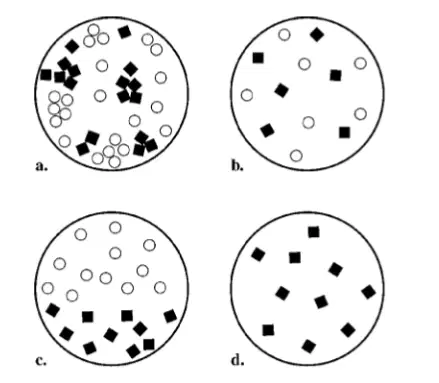
Which part of the illustration below shows the particles in a heterogeneous mixture?
a
b
c
d
A mixture is:
a combination of pure substances bonded chemically.
any substance with a uniform composition.
a blend of any two or more kinds of matter, as long as each maintains its own unique properties.
any group of elements that are chemically bonded to one another.
The vertical columns on the periodic table are called:
periods.
rows.
groups.
elements.
The horizontal rows on the periodic table are called:
actinides
families
elements
periods
The quantity of matter per unit volume is:
mass
weight
inertia
density
The liter is defined as:
1000 m³
1000 cm³
1000 g³
1000 c³
The density of aluminum is 2.70 g/cm³. What is the mass of a solid piece of aluminum with a volume of 1.50 cm³?
0.556 g
1.80 g
4.05 g
4.20 g
What is the density of 37.72 g of material whose volume is 6.80 cm³?
0.180 g/cm³
5.55 g/cm³
30.9 g/cm³
256. g/cm³
100 milliliters is equivalent to:
1 hectoliter
1 microliter
1 centiliter
1 deciliter
0.25 g is equivalent to
250 kg.
250 mg.
0.025 mg.
0.025 kg.
0.05 cm is the same as
0.000 05 m.
0.005 mm.
0.05 m.
0.5 mm.
A measurement that closely agrees with an accepted value is best described as
precise.
reproducible.
significant.
accurate.
Two variables are directly proportional if their ____ has a constant value.
sum
difference
quotient
product
Two variables are inversely proportional if their ____ has a constant value.
sum
difference
product
quotient
The electrostatic attraction between positively charged nuclei and negatively charged electrons permits two atoms to be held together by a(n)
chemical bond.
London force.
neutron.
ion.
If two covalently bonded atoms are identical, the bond is
nonpolar covalent.
polar covalent.
dipole covalent.
coordinate covalent.
When atoms share electrons, the electrical attraction of an atom for the shared electrons is called the atom's
electron affinity.
electronegativity.
resonance.
hybridization.
If the atoms that share electrons have an unequal attraction for the electrons, the bond is called
nonpolar.
polar.
ionic.
dipolar.
What are shared in a covalent bond?
ions
Lewis structures
electrons
dipoles
Nonpolar covalent bonds are not common because
one atom usually attracts electrons more strongly than the other.
ions always form when atoms join.
the electrons usually remain equally distant from both atoms.
dipoles are rare in nature.
The B—F bond in BF₃ (electronegativity for B is 2.0; electronegativity for F is 4.0) is
polar covalent.
ionic.
nonpolar covalent.
metallic.
The percentage ionic character and the type of bond in Br₂ (electronegativity for Br is 2.8) is
0%; nonpolar covalent.
100%; polar covalent.
0%; pure ionic.
100%; pure ionic.
A neutral group of atoms held together by covalent bonds is a
molecular formula.
chemical formula.
polyatomic ion.
molecule.
The electron configuration of nitrogen is 1s² 2s² 2p³. How many more electrons does nitrogen need to satisfy the octet rule?
1
3
5
8
What group of elements satisfies the octet rule without forming compounds?
halogen
noble gas
alkali metal
alkaline-earth metal
In drawing a Lewis structure, each nonmetal atom except hydrogen should be surrounded by
2 electrons.
4 electrons.
8 electrons.
10 electrons.
How many extra electrons are in the Lewis structure of the phosphate ion, PO₄³⁻?
0
2
3
4
How many electrons must be shown in the Lewis structure of the hydroxide ion, OH⁻?
1
8
9
10
A chemical bond formed by the attraction between positive ions and surrounding mobile electrons is a(n)
nonpolar covalent bond.
ionic bond.
polar covalent bond.
metallic bond.
Compared with nonmetals, the number of valence electrons in metals is generally
smaller.
greater.
about the same.
almost triple.
For the f sublevel, the number of orbitals is
5
7
9
18
The main energy level that can hold only two electrons is the
first.
second.
third.
fourth.
The atomic sublevel with the next highest energy after 4p is
4d.
4f.
5p.
5s.
The electron configuration for the carbon atom (C) is 1s² 2s² 2p². The atomic number of carbon is
3.
6.
11.
12.
If an element has an octet of electrons in its highest main energy level, there are electrons in this level.
10
32
How many valence electrons are in an atom of magnesium?
2
3
4
5
How does calcium obey the octet rule when reacting to form compounds?
It gains electrons.
It gives up electrons.
It does not change its number of electrons.
Calcium does not obey the octet rule.
What is the charge on the strontium ion?
2–
1–
1+
2+
How many electrons does nitrogen gain in order to achieve a noble-gas electron configuration?
1
2
3
4
The electron configuration of a fluoride ion, F⁻, is ____.
1s²2s²2p⁵
the same as that of a neon atom
1s²2s²2p⁶3s¹
the same as that of a potassium ion
Which of the following occurs in an ionic bond?
Oppositely charged ions attract.
Two atoms share two electrons.
Two atoms share more than two electrons.
Like-charged ions attract.
Which of the following is NOT a characteristic of most ionic compounds?
They are solids.
They have low melting points.
When melted, they conduct an electric current.
They are composed of metallic and nonmetallic elements.

