Wayground logo

Free Printable Worksheets

Font size

S
M
L
XL
Worksheets

Semester 2 Interim Review

Total questions: 40

Worksheet time: 56mins

Name
Class
Date
1.
1. Which scenario would cause a covalent bond to form?
a)
Two atoms share electrons so they can fill their outer shells
b)
The constant motion of electrons and the creation of charge imbalances bonds two molecules together
c)
A hydrogen atom with a slight positive charge is attracted to a negative charge of another molecule or atom
d)
One atom loses one or more electrons and the other atom gains one or more electrons
2.
2. Which scenario would cause a ionic bond to form?
a)
Two atoms share electrons so they can fill their outer shells
b)
The constant motion of electrons creates the bond between two negatively charged ions
c)
One atom loses valence electrons and another atom gains valence electrons.
d)
Both atoms lose one or more electrons
3.
4. Which of the following best describes the difference between a cation and an anion?
a)
Anions are positively charged and cations are negatively charged.
b)
Cations are metallic and anions are gaseous.
c)
Cations are positively charged and anions are negatively charged.
d)
Cations are gaseous and anions are metallic
4.
5. Decide whether the following compound is ionic or covalent?
a)
ionic
b)
covalent
5.
6. Decide whether the following compound is ionic or covalent?
a)
ionic
b)
covalent
6.
7. Chose the correct name for the following compound & identify if it is ionic or covalent.
a)
Potassium Sulfide; Covalent
b)
Dipotassium monosulfide; Ionic
c)
Dipotassium monosulfide; Covalent
d)
Potassium Sulfide; Ionic
7.
8. Chose the correct name for the following compound & identify if it is ionic or covalent.
a)
Potassium chloride; Covalent
b)
Monophosphorus trichloride; Covalent
c)
Phosphorous trichloride; Covalent
d)
Potassium chloride; Ionic
8.
10. Chose the correct name for the following compound & identify if it is ionic or covalent.
a)
Strontium phosphide; Covalent
b)
Strontium phosphide; Ionic
c)
Tristrontium diphosphide; Ionic
d)
Tristrontium diphosphide; Covalent
9.
12. Name the cation in the following compound:
a)
Sodium
b)
Chloride
10.
13. Name the anion in the following compound:
a)
Potassium
b)
Oxygen
11.
14. What is the ion number and charge of the following element: Barium
a)
-1
b)
+2
c)
-2
d)
+1
12.
15. What is the ion number and charge of the following element: Argon
a)
-1
b)
+2
c)
+1
d)
0
13.
16. What is the ion number and charge of the following element: Nitrogen
a)
+3
b)
+2
c)
-3
d)
-4
14.
17. What is the ion number and charge of the following element: Sulfur
a)
-3
b)
+2
c)
-3
d)
-2
15.
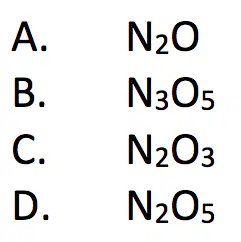
18. Which of the following is the chemical formula for the following compound: Dinitrogen trioxide
a)
A
b)
B
c)
C
d)
D
16.
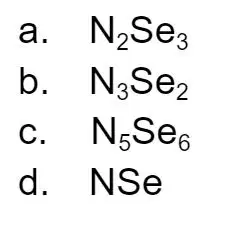
19. Which of the following is the chemical formula for the following compound: Trinitrogen diselenide
a)
A
b)
B
c)
C
d)
D
17.
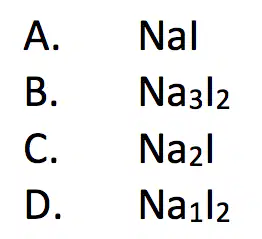
20. Which of the following is the chemical formula for the following compound: Sodium iodide
a)
A
b)
B
c)
C
d)
D
18.
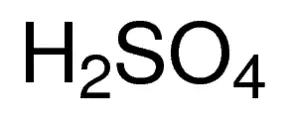
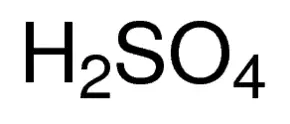
21. How many elements are in sulfuric acid?
a)
2
b)
3
c)
4
d)
6
19.
22. How many atoms are in sulfuric acid?
a)
2
b)
6
c)
7
d)
4
20.

The process by which nuclei having small masses are combined to form a single larger nucleus is called nuclear ____.

a)

fusion

b)

fission

c)

reactivity

d)

waste

21.

Solve this equation for beta decay.

614C = ___ + -10e

a)

410Be

b)

714N

c)

210He

d)

613C

22.
Solve this equation for alpha decay.
85209At = ___ + 24He
a)
83205Bi
b)
86209Rn
c)
81207Tl
d)
85208At
23.
After the third half-life, how much of the sample is left?
a)
1/2
b)
1/3
c)
1/16
d)
1/8
24.
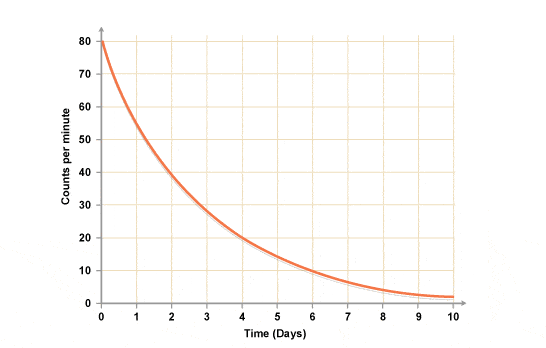
what's the half life of this substance?
a)
1 day
b)
2 days
c)
3 days
d)
4 days
25.
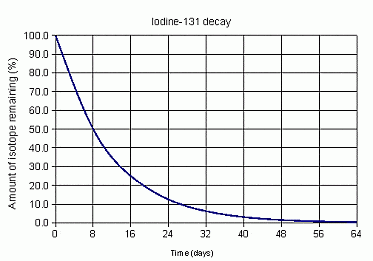
What is the half-life of iodine-131?
a)
32 days
b)
8 days
c)
16 days
d)
24 days
26.

The % of the parent isotope remaining after 2 Half Lives.

a)

50%

b)

25%

c)

12.5%

d)

6.25%

27.

Barium-122 has a half-life of 2 minutes. A fresh sample weighing 80 g was obtained. If it takes 10 minutes to set up an experiment using barium-122, how much barium-122 will be left when the experiment begins?

a)

40 g

b)

20 g

c)

5 g

d)

2.5 g

28.

Which element is not a metal?

a)

H

b)

Mg

c)

Al

d)

Be

29.
Which is an alkali metal?
a)
Magnesium
b)
Iron
c)
Sodium
d)
Europium
30.
How many Valance electrons does Iodine Have?
a)
6
b)
16
c)
7
d)
17
31.
Which elements have the most similar chemical properties?
a)
K and Na
b)
K and Ca
c)
K and Cl
d)
K and S
32.

What is the mass number of this atom?

a)

1

b)

3

c)

4

d)

7

33.

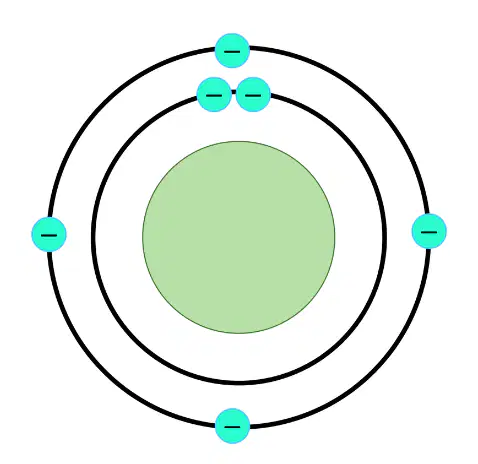
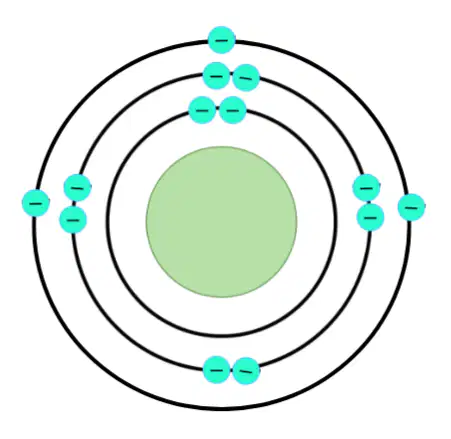
What element is represented by the Bohr model shown?

a)

Silicon

b)

Carbon

c)

Sodium

d)

Oxygen

34.

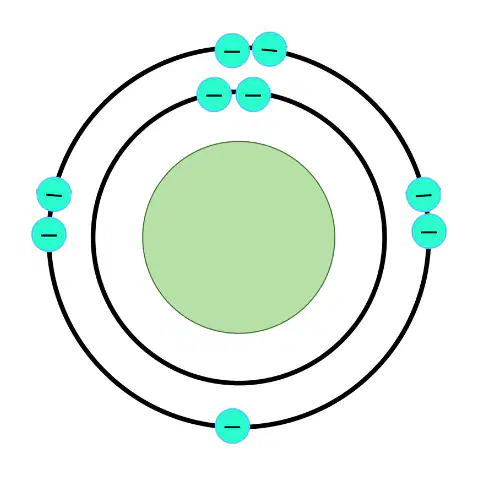
What element is represented by the Bohr model shown?

a)

Aluminum

b)

Galium

c)

Nitrogen

d)

Lithium

35.

What element is represented by the Bohr model shown?

a)

Sulfur

b)

Phosphorous

c)

Fluorine

d)

Helium

36.
How many protons does this isotope of titanium have?
a)
48
b)
22
c)
26
d)
70
37.

An atom of phosphorus has an atomic number of 15 and a mass number of 31. How many neutrons does it contain?

a)

15

b)

16

c)

31

d)

46

38.
What is the name of the pictured isotope?
a)
Copper-29
b)
Copper-63
c)
Copper-34
d)

Copper-92

39.

How many neutrons are in the isotope shown?

a)

29

b)

63

c)

34

d)

92

40.

What is the difference between the following atoms of iron: Fe58 and Fe56?

a)

Fe58 has more protons than Fe56

b)

Fe58 has more neutrons than Fe56

c)

There is no difference between the atoms

d)

Fe58 has less electrons than Fe56