
Font size
 Worksheets
Air Masses and Weather Test Review
Total questions: 36
Worksheet time: 18mins
What is an air mass?
A small pocket of air with varying temperature and humidity
A large "bubble" of air with the same temperature and humidity
A cloud formation with different temperatures
A type of wind pattern
What is a source region?
The area where a storm originates
The geographic area where an air mass originates
The location of the highest temperature
The place where rain is most frequent
Which air mass forms in warm regions and has warmer air?
Arctic (A)
Tropical (T)
Polar (P)
Continental (c)
What type of air mass forms over ice-covered regions and is very cold?
Tropical (T)
Maritime (m)
Arctic (A)
Continental (c)
Which air masses are especially important for New York?
cP and mT
m and c
T and A
P and T
What happens when two or more air masses collide?
They create hurricanes
They create different types of fronts
They cause earthquakes
They form tornadoes
What weather is associated with cold fronts?
Calm and sunny
Rapid changes, thunderstorms, heavy rain
Hot and dry
Snow and ice
Where does rain typically occur in relation to a cold front?
Behind the cold front
Along the cold front
Far ahead of the cold front
Nowhere near the cold front
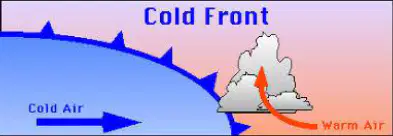
Diagram showing cold front with cold air pushing warm air upward.
Cold air moves parallel to warm air
Warm air moves parallel to cold air
Cold air pushes warm air downward
Cold air pushes warm air upward
What is a warm front?
The boundary where a cold air mass moves into a warm air mass.
The boundary where a warm air mass moves into a cold air mass.
The boundary where two cold air masses meet.
The boundary where two warm air masses meet.
What symbol is used to represent a warm front on a weather map?
Triangles
Squares
Small semi-circles
Stars
What is a stationary front?
A boundary between two air masses that are moving rapidly.
A boundary between two air masses that are not moving much.
A boundary between two air masses that are moving in opposite directions.
A boundary between two air masses that are moving in the same direction.
What type of weather is associated with stationary fronts?
Clear and sunny conditions.
Prolonged periods of cloudy, rainy, or overcast conditions.
Hot and dry conditions.
Cold and snowy conditions.
Where does precipitation occur in relation to a stationary front?
Far away from the front.
Only on the warm side of the front.
Along the front.
Only on the cold side of the front.
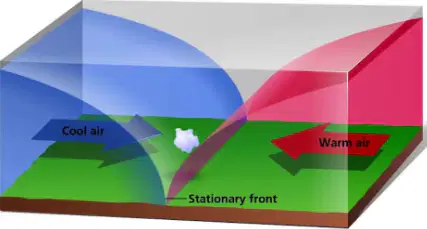
What does the diagram of a stationary front typically show?
Warm air moving over cold air.
Cold air moving over warm air.
Warm air and cold air moving into each other and staying still.
Warm air and cold air moving away from each other.
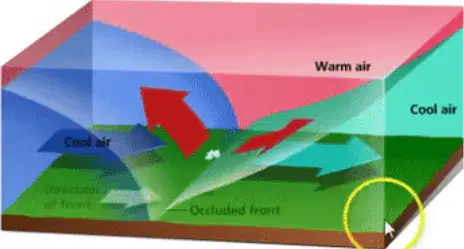
What is an occluded front?
Formed when two warm air masses lift a cold air mass into the air.
Formed when two cold air masses lift a warm air mass into the air.
Formed when a warm air mass and a cold air mass meet and stay stationary.
Formed when a single air mass moves over a mountain range.
Where does rain occur in an occluded front?
Behind the front
On the front
Ahead of the front
Above the front
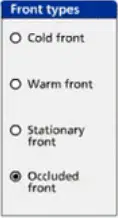
Which of the following is NOT a type of front shown in the diagram?
Cold front
Warm front
Stationary front
High-pressure front
What does a surface weather map display?
Only temperature
Only wind speed
Temperature, pressure, wind speed and direction, and precipitation
Only precipitation
What do close isobars on a weather map indicate?
Calm weather
Strong winds
High temperature
Heavy rainfall
What do low and high pressure systems indicate on a weather map?
Temperature changes
Stormy and nice areas
Wind speed variations
Precipitation levels
How are cold fronts represented on a weather map?
Red lines with semicircles
Blue lines with triangles
Green lines with squares
Yellow lines with circles
How are warm fronts represented on a weather map?
Red lines with semicircles
Blue lines with triangles
Green lines with squares
Yellow lines with circles
In which direction do all storms move on a weather map of the USA?
Southwest
Northwest
Southeast
Northeast
What type of weather is typically associated with low pressure systems?
Clear skies and calm weather
Cloudy, rainy, or stormy weather
Hot and dry weather
Snowy and cold weather
In which direction do winds circulate in a low pressure system?
Clockwise and outward
Counterclockwise and inward
Clockwise and inward
Counterclockwise and outward
In which direction do winds circulate in a high pressure system?
Counterclockwise and inward
Clockwise and outward
Counterclockwise and outward
Clockwise and inward
What is the typical weather condition for a low pressure system?
Clear skies
Rain, storms, or overcast conditions
Hot and sunny
Snowy and cold
In the Northern Hemisphere, how do winds move in a low pressure system?
Clockwise and outward
Counterclockwise and inward
Clockwise and inward
Counterclockwise and outward
In the Northern Hemisphere, how do winds move in a high pressure system?
Counterclockwise and inward
Clockwise and outward
Counterclockwise and outward
Clockwise and inward
What type of weather is typically associated with a warm front?
Snow and ice
Hot and dry conditions
Clear skies and calm weather
Cloudy skies with light rain or drizzle
What symbol is used to represent a cold front on a weather map?
Stars
Small semi-circles
Squares
Triangles
Which of the following is a characteristic of a high-pressure system?
Cloudy and rainy weather
Strong winds and storms
Clear skies and fair weather
Heavy snowfall

Cold front

Warm front

Occluded front

Stationary front

Match the air mass to the correct air conditions.
mP
Cold and Humid Air
mT
Warm and Humid Air
cP
Cold and Dry Air
cT
Warm and Dry Air
Maritime Tropical air mass with warm, moist air that forms over tropical oceans

