Wayground logo

Free Printable Worksheets

Font size

S
M
L
XL
Worksheets

Unit 5 Nervous System Test Review

Total questions: 45

Worksheet time: 26mins

Name
Class
Date
1.
What is the primary function of the nervous system?
a)
Thinking
b)
Movement
c)
Internal physiological processes
d)
All of the above
2.
How does the nervous system integrate sensory input and produce a motor response?
a)
By storing information
b)
By transmitting information to other parts of the body
c)
By processing and integrating the information, then producing a motor response
d)
By processing sensory input without producing a motor response
3.
What are the two main types of cells found in the nervous system?
a)
Neurons and muscles
b)
Neurons and bones
c)
Neurons and neuroglia
d)
Neuroglia and muscles
4.
What is the role of neuroglia in the nervous system?
a)
To communicate with other cells
b)
To support and protect neurons
c)
To produce electrical impulses
d)
To store information
5.
What are neurotransmitters and how do they play a role in the nervous system?
a)
Chemical messengers that transmit electrical impulses from one neuron to another
b)
Electrical impulses that transmit information from one neuron to another
c)
Structures that support and protect neurons
d)
None of the above
6.
What are the two major divisions of the nervous system?
a)
Sensory and motor
b)
Central and peripheral
c)
Autonomic and somatic
d)
Sympathetic and parasympathetic
7.

Gray matter within the cerebral cortex is mainly made up of what neuronal structure?

a)

neural cell bodies

b)

axons and their myelin sheaths

c)

satellite cells

d)

oligodendrocytes

8.

White matter within the cerebrum is mainly made up of what neuronal structure?

a)

neural cell bodies

b)

axons and their myelin sheaths

c)

satellite cells

d)

oligodendrocytes

9.
What organs are included in the central nervous system?
a)
Cranial and spinal nerves
b)
Sensory receptors
c)
Brain and spinal cord
d)
Muscles and glands
10.
What is the sensory (afferent) division of the PNS responsible for?
a)
Conducting impulses from the CNS to effectors
b)
Bringing information into the CNS with sensory receptors
c)
Controlling cardiac muscle, smooth muscle, and various glands
d)
Controlling skeletal muscles
11.
What is the motor (efferent) division of the PNS responsible for?
a)
Controlling skeletal muscles
b)
Bringing information into the CNS with sensory receptors
c)
Conducting impulses from the CNS to effectors
d)
Controlling cardiac muscle, smooth muscle, and various glands
12.
What is the main difference between the somatic and autonomic nervous systems?
a)
Somatic is involuntary while autonomic is voluntary
b)
Somatic controls cardiac muscle, smooth muscle, and various glands while autonomic controls skeletal muscles
c)
Somatic is responsible for integration of information and decision-making while autonomic is responsible for bringing information into the CNS with sensory receptors
d)
Somatic is voluntary while autonomic is involuntary
13.
What are the three main regions of a neuron?
a)
Nucleus, mitochondria, Golgi apparatus
b)
Dendrites, myelin sheath, axon
c)
Cell body, dendrites, axon
d)
Sensory, interneurons, motor
14.
What is the function of dendrites in a neuron?
a)
Conduct impulses away from the cell body
b)
Store genetic material
c)
Receive input from other neurons
d)
Release neurotransmitters
15.
What is the function of myelin sheaths in neurons?
a)
Increase the conduction speed of nerve impulses
b)
Store genetic material
c)
Receive input from other neurons
d)
Release neurotransmitters
16.
Which type of neuron conducts impulses from the CNS to peripheral effectors, such as muscles or glands?
a)
Sensory (afferent) neuron
b)
Interneuron
c)
Motor (efferent) neuron
d)
Unipolar neuron
17.
Which of the following is not a function of neuroglia cells?
a)
Generate nerve impulses
b)
Fill spaces
c)
Structurally support neurons
d)
Insulate neurons
18.
How many types of neuroglia cells are there in the CNS?
a)
2
b)
3
c)
4
d)
5
19.
What is the function of the nodes of Ranvier in myelinated axons?
a)
To allow sodium ions to enter the neuron
b)
To allow potassium ions to leave the neuron
c)
To increase the surface area of the neuron
d)
To allow the impulse to jump from one node to the next, increasing the speed of impulse conduction
20.
What is the functional connection between two neurons called?
a)
Dendrite
b)
Synapse
c)
Axon
d)
Terminal
21.
Which neuron releases neurotransmitters into the synapse?
a)
Postsynaptic neuron
b)
Dendritic neuron
c)
Interneuron
d)
Presynaptic neuron
22.
Which neuron receives input at the synapse?
a)
Presynaptic neuron
b)
Interneuron
c)
Postsynaptic neuron
d)
Dendritic neuron
23.
What happens when an impulse reaches the synaptic knob of a presynaptic neuron?
a)
The synaptic cleft closes
b)
The postsynaptic neuron sends a message
c)
Synaptic vesicles release neurotransmitter molecules
d)
The axon repolarizes
24.
Is synaptic transmission a one-way or two-way process?
a)
One-way, from presynaptic neuron to postsynaptic neuron
b)
Two-way, between presynaptic and postsynaptic neurons
c)
One-way, from postsynaptic neuron to presynaptic neuron
d)
Two-way, but only in certain neurons
25.

Which structure is the link between the brain and the endocrine system (hormone production) in order to control homeostasis?

a)

brain stem

b)

thalamus

c)

hypothalamus

d)

cerebrum

26.
The process by which the nervous system combines and interprets information from various sources, allowing for the creation of responses to stimuli.
a)
integration
b)
autonomic
c)
satellite cell
d)
action potential
e)
stimulus
27.
The cell body of a neuron, containing the nucleus and other organelles.
a)
soma
b)
autonomic
c)
satellite cell
d)
action potential
e)
stimulus
28.
The division of the peripheral nervous system that controls the involuntary functions of smooth muscle, cardiac muscle, and glands.
a)
autonomic
b)
satellite cell
c)
action potential
d)
stimulus
e)
ions
29.
A change in the internal or external environment that elicits a response from an organism.
a)
stimulus
b)
autonomic
c)
satellite cell
d)
action potential
e)
ions
30.
A type of neuroglia that surrounds/protects the cell bodies of neurons of the PNS.
a)
satellite cell
b)
autonomic
c)
action potential
d)
stimulus
e)
ions
31.
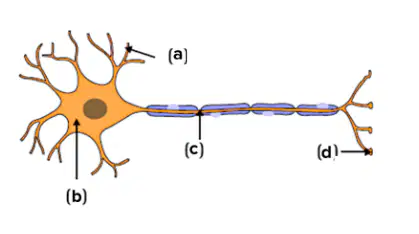
A =
a)
Axon
b)
Axon Terminal/Synaptic Knob
c)
Cell Body
d)
Dendrite
32.
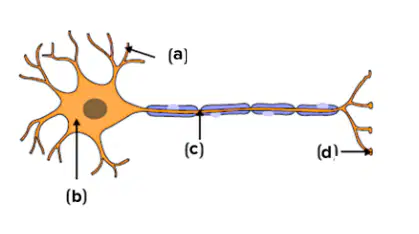
B =
a)
Axon
b)
Axon Terminal/Synaptic Knob
c)
Cell Body
d)
Dendrite
33.
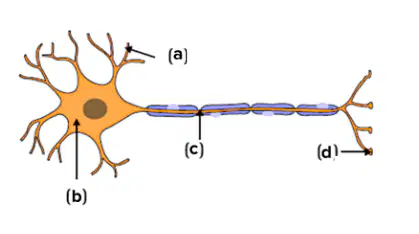
C =
a)
Axon
b)
Axon Terminal/Synaptic Knob
c)
Cell Body
d)
Dendrite
34.
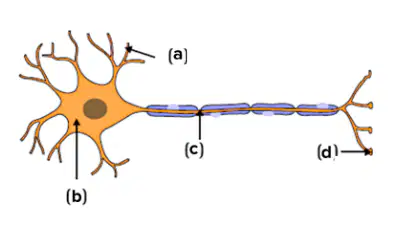
D =
a)
Axon
b)
Axon Terminal/Synaptic Knob
c)
Cell Body
d)
Dendrite
35.

What is the role of the corpus callosum?

a)

The corpus callosum is responsible for regulating heart rate.

b)

The corpus callosum connects the left and right hemispheres of the brain.

c)

The corpus callosum is a protective layer that surrounds the brain.

d)

The corpus callosum is involved in the production of red blood cells.

36.

The left hemisphere of the brain controls the right side of the brain and vise versa.

a)

True

b)

False

37.
Which letter on the illustration represents the temporal lobe? 
a)
A
b)
B
c)
C
d)
D
38.

Which letter on the illustration represents the frontal lobe? 

a)
A
b)
B
c)
C
d)
D
39.
Which letter on the illustration represents the parietal lobe? 
a)
A
b)
B
c)
C
d)
D
40.
Which letter on the illustration represents the occipital lobe? 
a)
A
b)
B
c)
C
d)
D
41.

What is the function of the cerebellum in the brain?

a)

Regulating body temperature

b)

Coordinating voluntary movements, balance, and posture

c)

Storing long-term memories

d)

Producing hormones

42.
Identify the structure in green.
a)
brainstem
b)
spinal cord
c)
corpus callosum
d)
thalamus
43.

What is the correct order of the meningeal layers from deep to superficial?

a)

Pia mater, dura mater, arachnoid

b)

Dura mater, arachnoid, pia mater

c)

Arachnoid, pia mater, dura mater

d)

Pia mater, arachnoid, dura mater

e)

Dura mater, pia mater, arachnoid

44.

What is the primary function of cerebrospinal fluid (CSF)?

a)
  • A) Act as a shock absorber

b)
  • B) Provide nutrients to the brain

c)
  • C) Remove waste from the brain

d)
  • D) All of the above

45.

Which structure receives all ascending sensory tracts and relays the signals to the correct part of the brain?

a)

brain stem

b)

thalamus

c)

hypothalamus

d)

cerebrum

e)

cerebellum