
Font size
 Worksheets
03/16/25, PS.6.1.3 Pure Substances
Total questions: 30
Worksheet time: 30mins
Into which state of matter will the metals transform when they reach their melting points?
gas
liquid
plasma
solid
A brick is cut into small pieces. Which physical property do the small pieces have in common with the brick from which they came?
density
length
shape
mass
Lucy wanted to determine the density of a colorful stone that she had picked up on the beach. Which two properties must Lucy measure in order to calculate the density of the stone?
size and shape
mass and volume
mass and temperature
composition and texture
A raw egg will float in concentrated salt water but sink in tap water. What can a person conclude from this observation?
A. A raw egg has the same density as salt water.
B. A raw egg, salt water, and tap water have the same density.
C. A raw egg is less dense than salt water but more dense than tap water.
D. A raw egg is less dense than tap water but more dense than salt water.
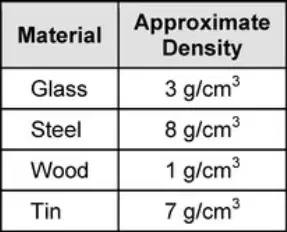
Which material is most likely to sink the fastest in water?
wood
tin
steel
glass
Which statement is correct about all of these physical properties?
A. They involve a change in the state of matter.
B. They involve the production of new substances.
C. They can be measured only after a change in state.
D. They are independent of the amount of the sample present.
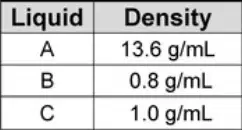
Which illustration correctly shows how these liquids would appear if they were poured slowly into a cylinder?

A. [Image of B, C, A]

B. [Image of A, B, C]

C. [Image of C, B, A]

D. [Image of A, C, B]
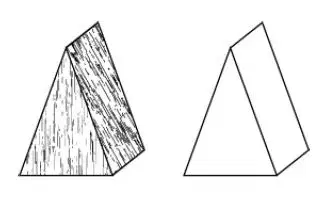
The two objects shown below are the same size and shape. However, one object is made of wood, and the other is made of plastic. With no other information, what can be concluded about the objects?
Both objects have the same density.
Both objects have the same mass.
Both objects have the same volume.
Both objects have the same weight.
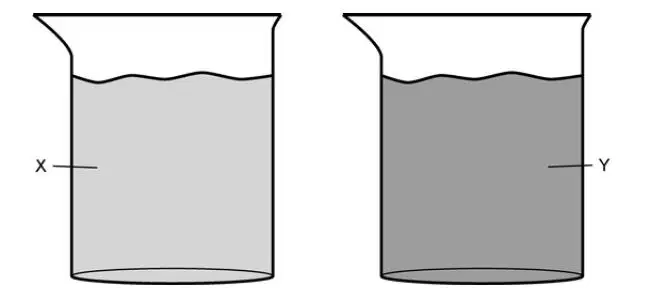
The diagram shows two containers with two different substances, X and Y. If substance X has a density that is double the density of substance Y, then
substance Y will float on top of substance X.
substance X will float on top of substance Y.
substance X will dissolve in substance Y.
substance Y will react with substance X.
What is the term used to describe the temperature at which a solid becomes a liquid?
sublimation point
melting point
condensing point
boiling point
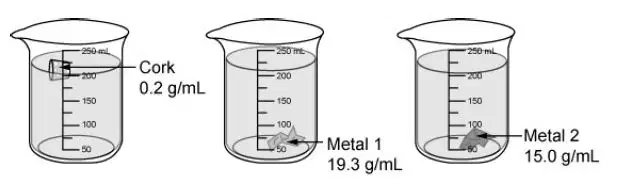
If water has a density of 1.0 g/mL, then what can Mario determine from his experiment?
Cork floats because it has a lower density than water, so objects with a density less than 1.0 g/mL will float on water.
Objects with a density of 15.0 g/mL or greater will always sink in water because it has the highest density of any liquid.
Cork always floats because it is from nature, and man-made objects will always sink.
Objects that do not absorb water will always float because they are always less dense.

If the density of water is 1 gram per milliliter (g/mL), which of the following could be the density of the wooden stick to the nearest hundredth?
0.56 g/mL
1.20 g/mL
1.56 g/mL
2.00 g/mL

Jordan put four objects into a tank of water, as shown below. What can he conclude about the objects?
The marble is the least dense.
The balloon is less dense than water.
The egg and the marble have the same density.
The balloon and the ice have the same density.
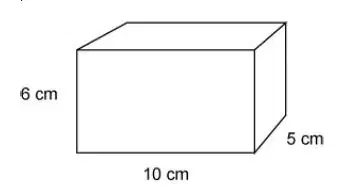
Owen wanted to determine the density of a wooden block, so he measured the sides of the block. What other measurement does Owen need to calculate the density of the block?
its mass
its volume
its surface area
its number of sides
Water, with nothing dissolved in it, will freeze at which temperature?
0°C
32°C
100°C
212°C
Which property of a substance most likely affects whether it will float or sink?
color
density
odor
texture
Which property is dependent on the amount of matter present?
color
mass
boiling point
melting point
In chemistry, how are the density and solubility of a substance similar?
They are independent of the amount of substance present.
They depend on the amount of substance present.
They decrease as the substance is heated.
They cannot be measured.
Which property would most likely remain constant in different samples of the same material?
density
mass
shape
volume
If an object floats in water, which statement must be true?
The object has a high solubility.
The object is less dense than water.
The object is more dense than water.
The object has a very large surface area.
Which property of an object changes when the size of the object changes?
mass
density
solubility
melting point
The melting point of a 5-gram sample of wax is 50°C. What is the melting point of a 10-gram sample of the same type of wax?
50°C
100°C
150°C
200°C
There are two pots of water. Pot 2 has double the amount of water as pot 1. If pot 1 boils at 100°C, at which temperature does pot 2 boil?
100°C
150°C
200°C
250°C
How is the density of a substance affected when its mass and volume are increased?
The density increases.
The density decreases.
The density becomes zero.
The density remains the same.
Which physical property would differ between a 400-gram sample of solid elemental titanium and a 600-gram sample of solid elemental titanium?
melting point
boiling point
density
volume
What happens to the temperature of a pure substance as it changes state?
It increases.
It decreases.
It remains constant.
It increases or decreases, depending upon the situation.
Which term best identifies the relationship between the mass and volume of a substance?
density
freezing
melting
solubility
What is the density of any pure substance?
the amount of mass per volume
the amount of volume per mass
the total mass per weight
the total weight per mass
Which factors are used to determine the density of an object?
mass and speed
mass and volume
weight and length
volume and weight
A given sample of gold has a density of 19.32 g/cm³. If the sample of gold is cut in half, what will most likely happen to the density of the gold?
The density will increase.
The density will decrease.
The density will stay the same.
The density will randomly change.

