
 Worksheets
General Physics 2 Quiz
Total questions: 100
Worksheet time: 2hrs 46mins
Which of the following will NOT affect the induced emf in a circuit?
Strength of the magnet
Number of turns in a coil
The loads connected to the circuit
Motion between the magnet and the coil
In which direction does conventional current flow?
Negative to positive
Negative to negative
Positive to positive
Positive to negative
According to the right-hand rule, if a magnetic field is thrusted downwards and the magnetic field is towards the left, what is the direction of the current produced in the loop?
Upward
Downward
Into the page
Out of the page
A current is induced on a loop as a magnet moves inside a coil in the diagram on the right. What happens to the current when the magnet is pulled out?
The current stops.
The current reverses.
The current increases.
The current moves outside the loop
Magnetic field lines having magnitude 1.4 T pass through a surface having area 6.0 m2. The field lines make an angle of 40⁰ with the plane of the surface. What is the magnetic flux passing through the surface?
1.35 Wb
2.71 Wb
5.08 Wb
6.43 Wb
A coil has 400 turns of area 48 cm2. It flips from vertical position (0⁰) to horizontal position (90⁰) in a time of 0.05 s. What is the induced emf if the constant B-field is 5 mT?
0.080 V
0.192 V
9.60 × 10⁻³ V
4.80 × 10⁻⁴ V
A 0.80 m length of wire moves at a constant speed of 8 m/s in at 120⁰ with a 0.5T B-Field. What is the magnitude of the induced emf in the wire?
0.1 V
0.4 V
1.6 V
2.8 V
A higher value of _______ signifies a higher value of energy in a wave.
Amplitude
Wavelength
Period
Wave speed
A sound wave is able to travel through the air at a speed of 300 m/s and a frequency of 15,000 Hz. What is its wavelength?
0.2 m
0.02m
50 m
4,500,000 m
What is the energy of a photon from the red color of the visible light spectrum, if it came from the red part of the visible light spectrum (λ = 700 nm)?
2.84 × 10⁻¹⁹ J
1.06 × 10-36 J
1.39 × 10⁻³¹ J
4.64 × 10⁻³¹ J
A light ray approaches a mirror at an angle of 40 ̊ with the mirror’s surface. What is the angle of reflection?
40⁰
50⁰
100⁰
130⁰
A light wave traveling in air hits an amber plate at an angle of incidence of 60º. If the angle of refraction is 34º, what is the speed of light in the amber?
1.86 × 10^3 m/s
4.64 × 10^8 m/s
1.94 × 10^8 m/s
4.64 × 10^10 m/s
A red laser light flashes an incident ray from air to water at an angle of 45⁰ to hit a targeted fish. What is the angle of refraction?
29.58⁰
32.05⁰
38.67⁰
42.51⁰
When light passes through a water droplet and disperses, which color of light is deviated the most from its path?
red
blue
green
violet
The index of refraction of a specific glass is 1.74. The approximate critical angle for total internal reflection to happen in this glass-air pair is _______.
22⁰
30⁰
35⁰
48⁰
At what angle must an analyzing filter be oriented so that the resulting intensity will 50% of its original value?
30⁰
45⁰
60⁰
75⁰
Why is “AMBULANCE” spelled backwards in front of ambulances?
So that it can be read by people passing by
So that it can be read by oncoming vehicles
So that it can be read from a car’s rear-view mirror
So that it can be read above, from the scope of rescue helicopters
What happens to your eyesight when you go underwater?
Shift to far sighted
Shift to near sighted
No change
Shifting between near and far sighted
What are mirrors that is reflective on one side and transparent from the other?
Plane mirrors
Concave mirrors
Convex mirrors
One-way mirrors
If you stand in front of two large adjacent plane mirrors angled at 60 ̊, how many images will you see?
One
Two
Five
Six
At what angle should you configure two adjacent mirrors to see four images of the same object?
60⁰
72⁰
90⁰
120⁰
What is the type and orientation of the image produced?
Real and upright
Real and inverted
Virtual and upright
Virtual and inverted
What is the size and image position of the image produced?
Enlarged and at C
Diminished and at C
Same size and at C
No image formed
The images formed by a convex mirror are always _______.
Virtual, upright, and enlarged
Virtual, inverted, and enlarged
Virtual, upright, and diminished
Virtual, inverted, and diminished
At which location should an object be placed in front of a converging mirror to produce an upright image?
at C
between C and F
at F
between F and V
Who is the Dutch physicist asserted that the wavefronts from an origin that propagates towards a direction are the primordial source new and secondary wavelets?
J.J Thompson
Thomas Young
Christian Huygens
Hans Christian Oersted
Which of the following phenomenon is NOT evident in thin-films interference?
Light reflected in a soap bubble
Color patterns in the gasoline on water.
Anti-reflection coatings on camera lenses.
Providing high-speed data connection across establishments using fiber-optic cable.
Which of the following correctly describes an inertial frame of reference?
Accelerating
Increasing force
Moving with constant speed
Travelling with constant velocity
When an object’s speed closely approaches to the speed of light, which among the following effects will NOT take place?
Time dilation
Length contraction
Momentum will vary with gamma
Velocity undergoes superposition
Which of the following statements reflect the postulates of relativity? I. The laws of physics are the same in every inertial frame of reference. II. The speed of light in vacuum is the same in all inertial frames. III. The velocity of sound in the universe is invariant.
I and II
II and III
I and III
I, II, and III
Describe what is meant by the sentence, “Simultaneity is not absolute.”
The speed of light is constant across all frames of reference.
Events are observed to be simultaneous in every frame of reference.
The laws of physics differ across different inertial frames of reference.
Events may not be observed as simultaneous in every frame of reference.
The muon particle (μ-) has a half-life of 2.20×10⁻⁶ s. Most of these are produced in the atmosphere, about 5 – 20 kilometers from the surface of the Earth. If the speed of light is at 0.999c and its ‘relativistic’ half-life value is 4.928×10⁻⁵ s. Calculate the distance before half-decayed and express it in kilometers.
4.9 km
9.2 km
14.8 km
20.5 km
Starship "Alpha" is traveling at 0.8c (γ = 5/3) with respect to the identical starship "Beta." Each starship has rest length 12,000 m. The ship's engineer aboard the "Beta" measures the length of the "Alpha" as it passes by his window. What result should he get?
6,000 m
7,200 m
8,000 m
8,800 m
If a hypothetical vehicle manages to have a speed of 5,830,000 m/s records a time interval of exactly 1 second in the electronic clock aboard, how long would the same time interval appear to observers on Earth?
1.00018 s
1.0018 s
1.018 s
1.18 s
What happens to the mass number and atomic number of an element when it emits beta radiation?
The mass number increases by 1 and the atomic number decreases by 1.
The mass number decreases by 1 and the atomic number increases by 1.
The mass number stays the same but the atomic number increases by 1.
The mass number increases by 1 but the atomic number stays the same.
A photon of light has a wavelength of 580 nm. Calculate its energy.
3.43 × 10⁻¹⁹ J
1.28 × 10⁻³⁰ J
3.43 × 10-37 J
1.28 × 10-48 J
What is the frequency of a orange light having a wavelength of 6.00 × 10⁻⁶ mm?
5.00 × 10^15 Hz
5.00 × 10^16 Hz
5.00 × 10^14 Hz
5.00 × 10^13 Hz
The following statements tell the basic characteristics of a photon EXCEPT _______.
Photons carry the energy in an electromagnetic wave.
Photons could behave both as waves and as particles.
Photons move at a speed of 299,792,458 m/s in a vacuum.
The energy of a photon is proportional to both its frequency and wavelength.
What is the Heisenberg Uncertainty principle?
It explains that the energy of a system is always constant and unchanging.
It states that the energy in the universe could neither be created nor destroyed.
It suggests that light and sound waves, under certain conditions, can travel at the same speed.
It asserts that it is impossible to determine both a photon’s position and momentum at a certain point in time.
The process of spontaneous emission of radiation is called _______.
Half-life
Radioactivity
Decay
Nuclear fission
Which one of the following can be done to shorten the half-life of the radioactive decay of a sample of uranium-238?
Heat up the sample.
Freeze up the sample.
Pressurize the sample.
None of the above.
What is the maximum kinetic energy of ejected electrons subjected to a photoelectric effect experiment with 4.0 V as potential difference?
1.0 eV
2.0 eV
3.0 eV
4.0 eV
What happens to the half-life of a radioactive substance as it decays?
It increases
It decreases
It remains constant
It increases and decreases
The beta decay of cesium-137 has a half-life of 30 years. How many years must pass to reduce a 25mg sample of cesium 137 to 8.7 mg?
3.2
32
46
50
A certain radioactive sample has a half-life of 32 mins. What part of the sample is left after 24 mins?
0.48
0.59
0.71
0.75
Phosphorus-33 is an isotope used for its applications on molecular biology and has a half-life of 25 days. How long will it take for Phosphorus-33 to retain one-fourth of its original mass?
12.5 days
20 days
25 days
50 days
What is the decay constant for Plutonium-239 with a half-life of 5 hours?
0.03 per hour
0.14 per hour
0.31 per hour
10 per hour
How would increasing the temperature of a radioactive sample affect its half-life?
The half-life would fluctuate, depending on the environmental conditions
The half-life would remain the same, as the decay rate is independent of temperature.
The half-life would increase because the atoms achieve a higher kinetic energy at higher temperatures.
The half-life would decrease because the atoms from different energy levels are being shuffled after the temperature increase.
What is the relationship between the frequency and wavelength of a wave?
Frequency and wavelength are independent of each other
Frequency is equal to wavelength
Frequency is inversely proportional to wavelength
Frequency is directly proportional to wavelength
In a photoelectric effect experiment, what happens to the kinetic energy of ejected electrons if the frequency of the incident light is increased?
The kinetic energy remains the same
The kinetic energy decreases
The kinetic energy becomes zero
The kinetic energy increases
What is the effect on the magnetic flux through a loop if the area of the loop is doubled while keeping the magnetic field strength constant?
The magnetic flux halves
The magnetic flux quadruples
The magnetic flux doubles
The magnetic flux remains the same

When a conductor is moved to cut through the magnetic flux, an _______________ is produced.
induced current
electromotive force
electromagnetic induction
internal resistance
The production of electric current by a changing magnetic field is called ____________________________________.
induced current
electromotive force
electromagnetic induction
internal resistance

____________law states that the direction of the induced current is such that it always _______ ___ the change producing it.
Lenz's Law, oppose
Faraday's Law, oppose
Lez's Law, follow
Faraday's Law, follow
Faraday’s Law states that the magnitude of the induced e.m.f. is _________________ to the rate of change of magnetic flux linkage with the solenoid.
equal
inversely proportional
directly proportional
The d.c generator and a.c generator make use of electromagnetic induction to produce _______________________
force
electricity
energy
power
Which device uses slip rings?
a cathode-ray tube
a d.c. generator
an a.c. generator
a solenoid
Which of the following increases frequency of AC?
increasing number of turns on the coil
using a stronger magnet
rotating the coil faster
increase area of the coil
No EMF is induced when?
When the wire is not moving
When the wire is parallel to magnetic field direction
When no lines are cut by the wire
all of the above

In the given figure, which of the following holds TRUE?
The angle of incidence is 10°.
The angle of incidence is 80°.
The angle of reflection is 10°.
The angle of reflection is 90°.
In a ray diagram, which term refers to the distance from the vertex to the center of curvature?
focal point
focal length
radius of curvature
diameter

In the ray diagram shown, which set of descriptions of the image formed is completely accurate?
The image is minimized, inverted, and real.
The image is magnified, inverted, and real.
The image is minimized, inverted, and virtual.
The image is magnified, inverted, and virtual.

In the ray diagram shown, which set of descriptions of the image formed is completely accurate?
The image is minimized, upright, and real.
The image is magnified, inverted, and real.
The image is minimized, upright, and virtual.
The image is magnified, inverted, and virtual.
In ray diagram for concave mirrors, if an incident ray passes through the focal point, how does the reflected ray look like?
It reflects back on itself.
The reflected ray bounces vertically upward.
The reflected ray will be parallel to the principal axis.
The reflected ray gets projected vertically downward.
Which of the following correctly describes the image characteristics formed in plane mirrors?
virtual, upright, diminished
virtual, upright, same size
real, inverted, diminished
real, upright, same size
In ray diagrams for spherical mirrors, which term refers to the distance between the mirror and the focal point?
focal length
principal axis
radius of curvature
vertex
For convex mirrors, what will be the resulting reflected ray an incident ray that that travels parallel to the principal axis?
The reflected ray will pass through the focal point.
The extension of the reflected ray will pass through the focal point.
The reflected ray will pass through the center of curvature.
The extension of the reflected ray will pass through the center of curvature.

For concave mirrors, what are the image characteristics for an object placed between the center of curvature and focal point?
enlarged, inverted, real
enlarged, inverted, virtual
diminished, inverted, real
diminished, upright, virtual

The diagram shows a ray of light going from medium A into medium B. Which one of the following statements cannot be correct?
A is air and B is glass.
A is water and B is vacuum.
A is water and B is air.
A is glass and B is vacuum.

A ray of light is shone on a rectangular glass block as shown. Identify A, B and C.
A = Refracted ray, B = Incident ray, C = Normal
A = Incident ray, B = Refracted ray, C = Normal
A = Normal, B = Refracted ray, C = Incident ray
A = Refracted ray, B = Angle of incidence, C = Angle of refraction

When a drinking straw is placed in a container of water so that it is partly submerged, it appears bent because of
apparent depth
Snell's Law
Refraction
lateral inversion

The diagram shows a ray of light AB striking the interface of medium X and medium Y. BC is the refracted ray. Which one of the following statements is correct?
Medium X is optically less dense than Y and ray BC travels faster than AB.
Medium X is optically denser than Y and ray BC travels slower than AB.
Medium X is optically denser than Y and ray BC travels faster than AB.
Medium X is optically less dense than Y and ray BC travels slower than AB.
When light passes from one medium into another, refraction occurs. This is because of
reflection of light.
a change in color of the light.
a change in velocity of the light.
the absorption of light.
A light ray does not bend at a boundary between two media of different optical densities if its angle of incidence is
180o
45o
0o
90o
The best definition of refraction is ____.
passing through a boundary
changing direction when crossing a boundary
changing speed at a boundary
bouncing off a boundary
When light travels from air into water, the light bends ____________.
towards the normal line
away the normal line
perpendicular to the normal line
in an odd shape
A light ray is incident on a glass block as shown. Identify the correct statement.
The glass block is optically denser than the medium outside and the ray bends towards the normal.
The glass block is optically less dense than the medium outside and the ray bends away from the normal.
The glass block is optically denser than the medium outside and the ray bends away from the normal.
The glass block is optically less dense than the medium outside and the ray bends towards the normal.
When light travels from air into water, the light bends ____________.
away the normal line
perpendicular to the normal line
in an odd shape
towards the normal line
The best definition of refraction is ____.
passing through a boundary
changing speed at a boundary
bouncing off a boundary
changing direction when crossing a boundary
A ray of light parallel to the optic axis of a concave mirror is reflected back
through the center of the sphere.
through the focal point.
parallel to the optic axis.
as if it came from the focal point.
The back surfaces of automobile/motorcycle headlights are curved
because inverted, real images of filaments shine brighter.
to concentrate light in one direction.
for structural reasons not related to optics
to get multiple images of the filament.
Where is the image located when an object is placed 30 cm from a convex mirror with a focal length of 10 cm?
7.5 cm in back
15 cm in back
30 cm in back
7.5 cm in front
The critical angle for total internal reflection at an air-water interface is approximately 48degrees. In which of the following situations will total internal reflection occur?
light incident in water at 40 degrees
light incident in water at 55 degrees
light incident in air at 40 degrees
light incident in air at 55 degrees
A diverging lens has a focal length of 10 cm. Where is the image located when an object is placed 30 cm from the lens?
7.5 cm on the near side
15 cm on the near side
30 cm on the near side
7.5 cm on the far side

The concave spherical mirror of radius r shown above has focal point F and center of curvature C. An object is placed at a distance 2r from the mirror. Where will the image be formed?
Between C and the object
To the right of the object
Between F and the mirror
To the left of the mirror
Between F and C
A physics student places an object 6.0 cm from a converging lens of focal length 9.0 cm. What is the magnitude of the magnification of the image produced?
0.6
2.0
3.6
3.0
1.5
An object is placed in front of a converging thin lens at a distance from the center of the lens equal to half the focal length. Compared to the object, the image is
upright and smaller
inverted and smaller
upright and larger
inverted and the same size
inverted and larger

Which of the rays shown above is correct for this diverging mirror?
1
2
3
4
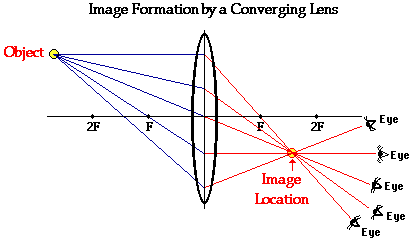
Which lens represents the path light takes through a diverging lens?


The above lens is a type of ___.
diverging lens
converging lens
divergent lens
convergent lens

What type of lens is used in the shown instrument?
concave lens
convex lens
reflection lens
reduction lens
If an object is placed at a point 2F infront of a converging lens, Which of the following will describe the image correctly ?
Real
Inverted
Same Size
Beyond 2F
A dentist uses a small dental mirror to help magnify teeth in your mouth. What type of mirror is this?
a convex mirror
a concave mirror
a convex lens
a concave lens
If the angle of incidence is 25 degrees, the angle of reflection is
20 degrees
25 degrees
50 degrees
90 degrees
Light sometimes behave as a particle. It is called__.
proton
photon
neutron
electron

