
Font size
 Worksheets
Levels of Biosphere
Total questions: 70
Worksheet time: 43mins
A group of the same organisms living together in the same place at the same time is:
An organism
A population
A community
A biome
What are groups of different populations living togther in the same place at the same time called?
An organism
A population
A community
A biosphere
What is it called when you have groups of different populations along with their abiotic factors?
An organism
A population
A community
An ecosystem
Together, all the ecosystems on Earth form...
a community.
a biome.
a biosphere.
an Earthsphere.
What is a group of ecosystems that share similar climates and types of organisms called?
A community
A biome
An ecosystem
A biosphere
The organisms in a community, as well as all of the nonliving aspects of the environment are a(n):
Population
Community
Habitat
Ecosystem
Living factors or organisms that affect an ecosystem are
abiotic factors
species
trophic level
biotic factors

What are the biotic factors in this image?
sunlight, elephants, and grasses
sunlight, water, and air
elephants, plants, trees

What are the abiotic factors in this image?
water, sunlight, dirt, air
birds and plants
water, plants, and birds
An ecosystem contains living and nonliving things.
True
False
Which of the following is a population?
hawks, barred owls, and eagles on NC coast
mountain stream
all the frogs in a pond
blue-tailed skinks (lizards) around a barn

What level of organization can be seen here?
Species
Population
Community
Ecosystem

Which of the following levels of organization is the most complex?
organism
population
community
ecosystem
Which of the following levels of organization is the most complex?
organism
population
community
ecosystem

All the individuals of one species in a given area is called a ______________. A herd of zebras would be an example.
Population
Community
Non-living
Organism

The total sum of all the populations of living things within an area that interact with one another is called_________. Zebra, elephants, and giraffes would be an example
Biosphere
Population
Community
Organism
An _____________ is an interwoven system of biotic and abiotic factors.
Species
Ecosystem
Microscope
Zoo

Which level of organization is depicted in this image?
Population
Community
Ecosystem
Biome
Biosphere

Which level of organization is depicted in this image?
Population
Community
Ecosystem
Biome
Biosphere

Which level of organization is depicted in this image?
Population
Community
Ecosystem
Biome
Biosphere

Which level of organization is depicted in this image?
Population
Community
Ecosystem
Biome
Biosphere

Which level of organization is depicted in this image?
Population
Community
Ecosystem
Biome
Biosphere
Which definition best fits the term biosphere?
A group or organisms of the same species that live in the same area and interact with one another.
A group of many populations (of different species) that live and interact with one another
A group of populations of many different species that live and interact with both one another and all of the abiotic factors in their environment.
A set of different ecosystems that acer connected by similar geographic features and share the same or similar climate.
Anywhere on earth that life exists.
Which definition best fits the term biome?
A group or organisms of the same species that live in the same area and interact with one another.
A group of many populations (of different species) that live and interact with one another
A group of populations of many different species that live and interact with both one another and all of the abiotic factors in their environment.
A set of different ecosystems that acer connected by similar geographic features and share the same or similar climate.
Anywhere on earth that life exists.
Which definition best fits the term ecosystem?
A group or organisms of the same species that live in the same area and interact with one another.
A group of many populations (of different species) that live and interact with one another
A group of populations of many different species that live and interact with both one another and all of the abiotic factors in their environment.
A set of different ecosystems that acer connected by similar geographic features and share the same or similar climate.
Anywhere on earth that life exists.
Which definition best fits the term community?
A group or organisms of the same species that live in the same area and interact with one another.
A group of many populations (of different species) that live and interact with one another
A group of populations of many different species that live and interact with both one another and all of the abiotic factors in their environment.
A set of different ecosystems that acer connected by similar geographic features and share the same or similar climate.
Anywhere on earth that life exists.
Which definition best fits the term Population?
A group or organisms of the same species that live in the same area and interact with one another.
A group of many populations (of different species) that live and interact with one another
A group of populations of many different species that live and interact with both one another and all of the abiotic factors in their environment.
A set of different ecosystems that acer connected by similar geographic features and share the same or similar climate.
Anywhere on earth that life exists.
Which definition best fits the term biotic?
The study of the interactions between animals and their environment
Factors in the environment that are considered not alive
the environment in which an organism lives.
Factors in the environment that are considered living or the remains of living things
The role a species plays in the ecosystem.
Which of the following are all abiotic?
Temperature, Light, Rain, Gravity, Heat
Water, Fish, Insects, Lily Plants
Dogs, Meat, Cats, Catnip
Lion, Pride Rock, Warthog, Meerkat
Which of the following are all biotic?
Temperature, Light, Rain, Gravity, Heat
Water, Fish, Insects, Lily Plants
Dogs, Meat, Cats, Catnip
Lion, Pride Rock, Warthog, Meerkat
The study of the interactions between animals and their environment
Ecology
Environment
Symbiosis
Community
A living organism that shapes its environment
biotic factor
abiotic factor
consumer
producer
A nonliving condition or thing, such as climate or habitat, that influences or affects an ecosystem and the organisms in it.
biotic factor
abiotic factor
parasite
organism
A biological community of interacting organisms and their physical environment
ecosystem
community
food chain
biodiversity
A group of individuals of one species that occupies a particular geographic area
community
population
organism
biodiversity
An interacting group of various species in a common location
population
species
community
competition

The portion of the planet in which living things are found
ecosystem
biosphere
biome
atmosphere
A community of organisms and their abiotic environment.
Environment
Biosphere
Ecosystem
Community
The prefix BIo- means?
Before, ahead of time
life, living
house
before, ahead of time
An ecosystem comprising the ENTIRE EARTH and the organisms that inhabit it.
Biosphere
Biome
Abiotic
Ecoregion
Which of the following are all biotic?
Temperature, Light, Rain, Gravity, Heat
Water, Fish, Insects, Lily Plants
Dogs, Meat, Cats, Catnip
Lion, Pride Rock, Warthog, Meerkat
Which of the following are all abiotic?
Temperature, Light, Rain, Gravity, Heat
Water, Fish, Insects, Lily Plants
Dogs, Meat, Cats, Catnip
Lion, Pride Rock, Warthog, Meerkat
Which definition best fits the term habitat?
The study of the interactions between animals and their environment
Factors in the environment that are considered not alive
the environment in which an organism lives.
Factors in the environment that are considered living or the remains of living things
The role a species plays in the ecosystem.
An organism’s habitat is where it lives.
True
False
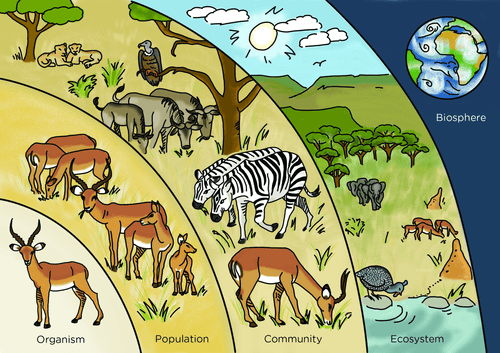
The living world is organized in levels. Biotic and abiotic factors also can be arranged into levels of biological organization. Put the words below in order from the least complex to the most complex
Community, Organism, Biome, Population, Biosphere, Ecosystem
Organism, Population, Community, Ecosystem, Biome, Biosphere
Organism, Biome, Population, Community Biosphere, Ecosystem
What are the abiotic factors in this image?
water, sunlight, dirt
birds, plants, predators
water, plants, parasites
oxygen, water, grasses
A student walks the schoolyard and observes that there are many living things such as different plants and animals. She notices that moss grows in moist shady areas but did not see any in the open yard where its sunny. What is the best explanation for her observation?
Different habitats support different plants and animals
All plants and animals can live in any environment
Schoolyards are not able to sustain living things
Schoolyards are the only places where moss can grow.

In the ocean
Habitat
Microhabitat

A coral reef in the ocean
Habitat
Microhabitat
An example of a microhabitat is:
A pile of dead logs.
A patch of dry weeds.
Lichen growth on a rock.
The Tundra.

What is a microhabitat?
A small habitat that differs from the larger.
A small habitat that is exactly like the larger habitat surrounding it.
What is a habitat?
A place where an animal or a plant lives
A kind of plant
A type of animal
A mountain range
What are micro habitats?
Artificial habitats created by humans
Large ecosystems like oceans and deserts
Small spaces where a bunch of plants and animals live
A type of habitat found only in mountains

Mountains
Habitat
Microhabitat

Tree Stump
Habitat
Microhabitat

Desert
Habitat
Microhabitat
Tree Stump
Habitat
Microhabitat

A forest
Habitat
Microhabitat

Inside a cactus
Habitat
Microhabitat

Beneath a rock
Habitat
Microhabitat

Cave
Habitat
Microhabitat

Prairie
Habitat
Microhabitat

A little house on a prairie
Habitat
Microhabitat

