
 Worksheets
Understanding Electricity Concepts
Total questions: 65
Worksheet time: 39mins
What is the total resistance in a series circuit with three resistors of 2Ω, 3Ω, and 5Ω?
7Ω
5Ω
10Ω
8Ω
In a parallel circuit, if one branch has a resistance of 4Ω and another has 6Ω, what is the total resistance?
3Ω
10Ω
1Ω
2.4Ω
What happens to the total current in a series circuit if an additional resistor is added?
The total current remains the same.
The total current increases.
The total current fluctuates.
The total current decreases.
In a parallel circuit, how does the voltage across each branch compare to the total voltage?
The voltage across each branch is equal to the total voltage.
The voltage across each branch is half of the total voltage.
The voltage across each branch is zero.
The voltage across each branch varies and is less than the total voltage.
What is the formula for calculating total resistance in a series circuit?
R_total = R1 * R2 * R3 * ... * Rn
R_total = 1/(1/R1 + 1/R2 + 1/R3 + ... + 1/Rn)
R_total = R1 - R2 - R3 - ... - Rn
R_total = R1 + R2 + R3 + ... + Rn
How does adding more branches in a parallel circuit affect the total current?
The total current remains constant regardless of the number of branches in a parallel circuit.
Adding more branches has no effect on the total current in a parallel circuit.
Adding more branches increases the total current in a parallel circuit.
Adding more branches decreases the total current in a parallel circuit.
What is the main advantage of using parallel circuits over series circuits?
Lower resistance in the circuit.
Higher current flow through each component.
Easier to troubleshoot individual components.
Increased reliability and consistent voltage across components.
What is the purpose of a fuse in an electrical circuit?
To store electrical energy for later use.
To increase the voltage in the circuit.
To enhance the circuit's efficiency.
The purpose of a fuse in an electrical circuit is to protect the circuit from overcurrent by breaking the circuit when the current exceeds a safe level.
According to Ohm's Law, what is the relationship between voltage, current, and resistance?
Voltage (V) = Resistance (R) / Current (I)
Current (I) = Voltage (V) + Resistance (R)
Resistance (R) = Voltage (V) - Current (I)
Voltage (V) = Current (I) * Resistance (R)
If a circuit has a voltage of 12V and a resistance of 3Ω, what is the current flowing through the circuit?
4A
2A
6A
8A
What is the effect of increasing the resistance in a circuit on the current, assuming voltage remains constant?
Increasing resistance causes the current to fluctuate.
Increasing resistance increases the current.
Increasing resistance decreases the current.
Increasing resistance has no effect on the current.
What safety equipment should be used when working with electrical circuits?
Rubber boots
Safety helmet
Ear protection
Insulated gloves, safety goggles, insulated tools, first aid kit, fire extinguisher
What is the unit of measurement for electrical power?
ohms
volts
watts
amperes
How can you measure the voltage across a component in a circuit?
Use an ammeter to measure the voltage.
Connect a voltmeter in series with the component.
Connect a voltmeter in parallel with the component.
Measure the voltage with a multimeter set to current mode.
What is the difference between direct current (DC) and alternating current (AC)?
DC flows in one direction; AC changes direction periodically.
AC flows in one direction; DC changes direction periodically.
DC is used in household appliances; AC is used in batteries.
DC is more efficient than AC for long-distance transmission.
In a combination circuit, how do you determine the total resistance?
Total resistance is always equal to the highest resistor value.
Total resistance is calculated by combining series and parallel formulas.
Total resistance is calculated by adding all resistors together without any formulas.
Total resistance is determined by the voltage across the circuit.
What is the role of a circuit breaker in electrical safety?
The role of a circuit breaker in electrical safety is to protect circuits from overloads and short circuits by interrupting the electrical flow.
To store electrical energy for later use.
To increase the voltage in a circuit.
To provide a constant flow of electricity.
What happens to the brightness of bulbs in a series circuit if one bulb burns out?
Only the burned-out bulb goes dark.
The brightness of the remaining bulbs increases.
The brightness of all bulbs goes to zero.
The brightness of the remaining bulbs stays the same.
How do you calculate the total power consumed in a circuit with multiple devices?
Total power is the sum of the power ratings of all devices.
Total power is calculated by multiplying the voltage by the current of the circuit.
Total power is the average power rating of all devices combined.
Total power is the maximum power rating of any single device.
What is the significance of grounding in electrical safety?
Grounding can cause electrical fires if not done properly.
Grounding increases the voltage in electrical systems.
Grounding is crucial for preventing electric shock and equipment damage by providing a safe path for fault currents.
Grounding is only necessary for high-voltage equipment.
Which of the following is the unit for current?
Volt (V)
Watt (W)
Ampere (A)
Ohm (Ω)
Which of the following is the unit for potential difference?
Volt (V)
Watt (W)
Ampere (A)
Ohm (Ω)
Which of the following is the electric charge that flows around in a circuit?
Protons
Neutrons
Ions
Electrons
A voltmeter can be used to measure ....
potential difference
resistance
electrical energy
current
The magnitude of the current is measured with a device called ..
ammeter
voltmeter
dynamometer
thermometer
If the battery produced 12.6 Volts and what would the current flow be for a 6 Ohm resistor?
2.1 A
3.1 A
1.5 A
0.3 A
How many Volts would we need to produce a current flow of 8 Amps through a 6 Ohm resistor
48 V
28 V
2.5 V
0.75 V

Which of the following statements is Kirchoff's first law?
the sum of the currents entering any junction in an electric circuit must equal the sum of the currents leaving that junction
the sum of the charges entering any junction in an electric circuit must equal the sum of the charges leaving that junction
the sum of the emfs entering any junction in an electric circuit must equal the sum of the pds leaving that junction
none of these
What size resistor would produce a current flow of 5 Amps with a battery voltage of 12.6 volts
2.52 ohm
1.89 ohm
0.39 ohm
2.25 ohm
A diode is...
a device that allows the flow of electric current in one direction only
a device that prevents damage to other components in a circuit
can produce simple sounds when there is a current in it
can produce light when there is a current in it
A thermistor is a digital sensor that can measure ......
pressure
humidity
pH level
temperature
A smartphone is being charge by 110 V of mains electricity with current of 2 A for 30 minutes.
792 KJ
3 KJ
396 KJ
198 KJ


Which of these will repel each other?
Negatively charged balloon and positively charged sphere.
Negatively charged balloon and neutral sphere.
Negatively charged balloon and negatively charged sphere.
Negatively charged balloon and neutral wall.
Electrons flow in the same direction as the current.
True
False
What is the main difference between AC and DC current?
AC is safer than DC
DC is used in household appliances
AC changes direction periodically; DC flows in one direction.
AC is always more efficient than DC
Which type of current is typically used in household outlets?
Pulsating Current
Direct Current (DC)
High Voltage Current
Alternating Current (AC)
What does AC stand for in electrical terms?
Alternating Charge
Analog Current
Alternating Current
Active Current
What does DC stand for in electrical terms?
Dynamic Circuit
Distributed Current
Dual Charge
Direct Current
What is one advantage of using AC over DC?
DC can be easily transformed to different voltage levels.
AC is safer to use in household appliances than DC.
AC can be easily transformed to different voltage levels.
AC is more efficient for long-distance transmission than DC.
What is electromagnetic induction?
The transfer of heat through a conductor due to electrical resistance.
The process of creating a magnetic field using electric current.
Electromagnetic induction is the generation of voltage in a conductor due to a changing magnetic field.
The phenomenon of light being emitted from a conductor.
What is Faraday's law of electromagnetic induction?
Faraday's law describes the relationship between voltage and resistance.
Faraday's law of electromagnetic induction describes how a changing magnetic field can induce an electric current.
Faraday's law states that electric current can create a magnetic field.
Faraday's law explains how electric fields can change magnetic fields.
How does a transformer utilize electromagnetic induction?
A transformer converts mechanical energy into electrical energy directly.
A transformer uses electromagnetic induction to create heat energy.
A transformer utilizes electromagnetic induction to transfer electrical energy between two coils through a changing magnetic field.
A transformer generates electricity through static electricity.
Explain the difference between series and parallel circuits.
Parallel circuits have a single path for current.
In series circuits, the voltage is divided among components.
Series circuits have a single path for current, while parallel circuits have multiple paths.
Series circuits can have multiple paths for current.
What is the formula for calculating electrical power?
P = V × I
P = I / V
P = V - I
P = V + I
A battery of 10 volt carries 20,000 C of charge through a resistance of 20 Ω. The work done in 10 seconds is
2 × 10 5 Joule
2 × 10 3 Joule
2 x 10 4 Joule
2 x 10² Joule

Which is the electrical symbol for 2 batteries?


Which is the electrical symbol for one battery?

Which is the electrical symbol for a wire?

LED lamps are much more efficient than filament lamps.
What does this statement mean?
LED lamps have a similar power output to filament lamps.
LED lamps waste a smaller proportion of the input energy than filament lamps.
LED lamps have a higher power input than filament lamps.
LED lamps waste a larger proportion of the input energy than filament lamps.

The diagram shows a temperature sensing circuit used to control a heating system in a house.
The current in the circuit is 3.5 mA when the potential difference across the thermistor is 4.2 V
Calculate the resistance of the thermistor in Ohms (Answer to 2 sig fig, no units needed)
(a)

If lamp 2 is unscrewed from its holder, what will happen to lamp1?
It will stay lit
It will go out
It will get dimmer
It will dissapear
As the length of a wire increases, the resistance of the wire will
increase
decrease
stay the same

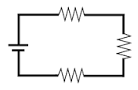
Which resistor has the biggest voltage across it?
2 Ω
3 Ω
4 Ω
all have the same
The total resistance of the circuit is
9 ohms
Less than 9 Ohms
More than 9 Ohms
We cannot tell
The current flowing through the 2 ohms Resistor is 2 Amps, what is the current flowing through the 4 Ohms
(a)
The current flowing through the 2 ohms Resistor is 2 Amps, what is the voltage of the 3 ohms Resistor?
(a)

