
 Worksheets
Knife Skills Pre-Assessment
Total questions: 25
Worksheet time: 13mins
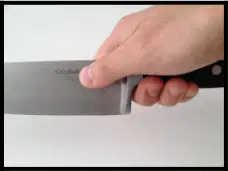
Which is the correct way to hold a knife?
Grip the handle with all four fingers and hold the thumb gently but firmly against the side of the handle.
Grip the handle with all four fingers and thumb.
Grip the handle with three fingers, rest the index finger flat against the blade on one side, and hold the thumb on the opposite side to give additional stability and control.
Grip the handle with three fingers and thumb and place the index finger on top of the spine.

Forward part of the knife that includes the point, used in detailed or delicate cutting.
Bolster
Tip
Tang
Rivets
Heel
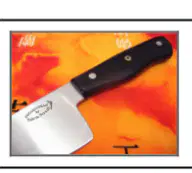
Rear part of edge, opposite the point.
Bolster
Tang
Heel
Spine
Rivets
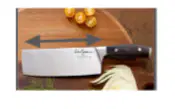
Top of the knife blade, opposite of the knife edge.
Rivets
Spine
Tang
Bolster
Heel
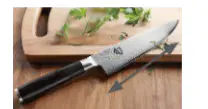
Cutting part of the blade, extends from point to the heel.
Cutting Edge
Tang
Bolster
Heel
Rivets
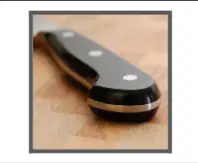
Metal pins used to join the handle to the tang.
Spine
Heel
Bolster
Tang
Rivets
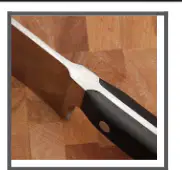
Band that joins the blade of knife to its handle, provides balance for the knife & also helps to protect the hand from getting in the way of the knife edge.
Bolster
Tang
Spine
Heel
Rivets
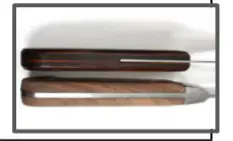
Part of the blade that extends into the handle of the knife, surface to which the handle attached to the blade.
Heel
Rivets
Bolster
Spine
Tang
When cutting food with a chef’s knife…..
Hold the food in your hand.
Cut toward your body.
Put the food on a plate.
Cut away from your body.
What is the purpose of using a cutting board when using a knife?
To protect your countertop
To protect the quality of your knife
To prevent slipping when cutting
All of the above
When cutting with a knife you should do the following.
Keep your eyes on the blade at all times
Use a cutting board
Shape your guiding hand like a bear claw
All of the above
Which of the following knives is the most versatile knife used for slicing, dicing, and mincing?
Paring Knife
Bread Knife
Utility Knife
Chefs Knife
Which of the following knives have long, thin blades and serrated edges used with a sawing motion?
Paring Knife
Bread Knife
Utility Knife
Chefs Knife
Which of the following knives are smaller knives used for detail work or cutting fruits and vegetables?
Paring Knife
Bread Knife
Utility Knife
Chefs Knife
The chiffonade cut is done to cut herbs, leafy greens, and other ingredients into very fine ribbon-like strips. True or False?
True
False
The first step to making any cube or stick cut is to square off. True or False?
True
False
If Jazlyn wants big chunks of potatoes in her soup, she should mince them. True or False?
True
False
Batonnet, Julienne, and Dice are all stick cuts. True or False?
True
False
Which cut will end in uniform cubes?
Batonnet
Mince
Dice
Slice
Two popular cuts for french fries are:
Julienne, bâtonnet
Dice, mince
Bâtonnet, chiffonade
Dice, chiffonade
A brunoise is:
Larger than a small dice
Smaller than a small dice
The same size as a small dice
A type of slice
The proper steps for getting a small dice are:
Cut object in half, make slices, then julienne’s, then small dices.
Cut object in half, then make small dices.
First square off, make slices from the square, make juliennes from the slices, and then small dices from the juliennes.
First square off, make slices from the squares, make batonnetts from the slices, and then small dices from the batonnetts.
Which of the following are stick cuts:
Julienne & Batonnet
Small Dice & Medium Dice
Julienne & Dice
Batonnet & Chiffonade
Which of the follow are not uniform cuts:
Julienne & Batonnet
Mince & Dice
Chiffonade & Dice
Mince & Chiffonade
Which cut is the process of chopping food into very fine pieces?
Dices
Chopping
Mincing
Slicing

