
 Worksheets
Chapter 12 Test
Total questions: 100
Worksheet time: 50mins
Name
Class
Date
1.
Who opposed the war with Mexico, and wanted to know the exact spot Zachary Taylor was fired upon?
a)
Abraham Lincoln
b)
Frederick Douglas
c)
Daniel Webster
d)
William Henry Harrison
2.
With the Adam's-Onis Treaty, Spain ceded Florida to the U.S., but how did the treaty impact the claim on the Oregon Territory?
a)
Spain set their Western Border at the Rocky Mountains
b)
Spain declared the U.S. had to stay out of the Oregon Territory
c)
Spain set their Northern Border and gave up claim to the Oregon Territory
d)
Spain declared war on the British over control of the Oregon Territory
3.

Which land expansion is indicated by the letter A on the map?
a)
Louisiana Purchase
b)
Annexation of Texas
c)
Gadsen Purchase
d)
Oregon Territory
e)
Mexican Cession
4.

Which land expansion is indicated by the letter B on the map?
a)
Louisiana Purchase
b)
Annexation of Texas
c)
Gadsen Purchase
d)
Oregon Territory
e)
Mexican Cession
5.

Which land expansion is indicated by the letter C on the map?
a)
Louisiana Purchase
b)
Annexation of Texas
c)
Gadsen Purchase
d)
Oregon Territory
e)
Mexican Cession
6.

Which land expansion is indicated by the letter D on the map?
a)
Louisiana Purchase
b)
Annexation of Texas
c)
Gadsen Purchase
d)
Oregon Territory
e)
Mexican Cession
7.

Which parallel divided the Oregon Territory in an agreement between Britain and the U.S. in 1846?
a)
42 N
b)
49 N
c)
50 N
d)
54' 40"N
8.

Which battle occurred the farthest north?
a)
San Gabriel
b)
El Brazito
c)
Bear Flag Revolt
d)
Buena Vista
9.
Why was the Oregon Country so important to the Manifest Destiny concept?
a)
It gave the US access to large gold deposits
b)
It removed Spain from the U.S. for good
c)
It connected the U.S. to the Atlantic Ocean
d)
It connected the U.S. to the Pacific Ocean
10.
What does "54-40 or Fight" refer to?
a)
The age range of men that could legally own property in the Oregon Territory
b)
The number of days and minutes James K. Polk gave the British to vacate the Oregon Country before he declared war on them.
c)
The slogan used by James K. Polk when dealing with wanting to get the Oregon Country all the way up to the 54-40 parallel from the British
d)
The parallel line that Britain wanted to divide the Louisiana Purchase territory at with British lands in Canada
11.
Which battle took place where a few hundred Texans such as Davy Crockett and Jim Bowie held off General Santa Ana's army of thousands of troops before ultimately losing but buying Texans much needed time to organize?
a)
San Antonio
b)
San Jacinto
c)
Alamo
d)
Goliad
12.
What were the small settlements called that would essentially be built in a matter of days in spots where prospectors would expect to find gold?
a)
Boom-towns
b)
Ghost-towns
c)
Gold-towns
d)
Dust-towns
13.
What group of people were really the ones that became wealthy as a result of the Gold Rush of 1849?
a)
Merchants
b)
Doctors
c)
Gold Miners
d)
Trail Guides
14.
What church/religion led by Joseph Smith that was later moved to the Utah Territory by Brigham Young became a major cultural element which conflicted with the federal government for years which resulted in a delay in Utah becoming a state?
a)
Catholic
b)
Mormon
c)
Islamic
d)
Presbyterian
15.
Who was the Tennessee backwoodsman who lost his life at the Alamo?
a)
Sam Houston
b)
John Tyler
c)
Davy Crockett
d)
Stephen F. Austin
16.
Founded by the Mormons, which city was originally called Deseret?
a)
San Diego
b)
Santa Fe
c)
Provo
d)
Salt Lake City
17.
What was the high point of the year for mountain men?
a)
trading merchandise
b)
rendezvous
c)
Native American parties
d)
meeting settlers
18.
What philosophy meant that the United States was set apart to extend its boundaries all the way to the Pacific?
a)
rendezvous
b)
joint occupation
c)
emigrant
d)
Manifest Destiny
19.
Santa Anna was captured in the battle of
a)
the Alamo.
b)
San Jacinto.
c)
Gonzales.
d)
Goliad.
20.

Based on the map, which of the following rivers were in Oregon Country? Select all that apply.
a)
Missouri River
b)
Willamette River
c)
Snake River
d)
Columbia River
21.

Which of the following could fill the empty space of the Cause and Effects of Westward Movement chart?
a)
Construction of the Panama Canal is begun.
b)
Native Americans are ceded huge tracts of western land.
c)
Gold is discovered in Oregon Country.
d)
Native Americans are forced off their lands.
22.

Which states did the Mormon Trail pass through between Nauvoo and Salt Lake City?
a)
Illinois, Nebraska, Wyoming
b)
Iowa, Nebraska, Wyoming
c)
Illinois, Iowa, Nebraska
d)
Nebraska, Wyoming, Kansas
23.
The first large-scale migration to Oregon left from
a)
Indianapolis, Indiana.
b)
Atlanta, Georgia.
c)
Columbus, Ohio.
d)
Independence, Missouri.
24.
What was James K. Polk's presidential campaign slogan in 1844?
a)
"Tippecanoe and Tyler too"
b)
"Whigs or Death"
c)
"Fifty-four Forty or Fight"
d)
"Polk to the Rescue"
25.
Great Britain and the United States resolved the Oregon issue by setting the boundary between them at the
a)
40º line of latitude.
b)
54º line of latitude.
c)
60º line of latitude.
d)
49º line of latitude.
26.
After which victory did some Texans leave thinking the war had been won?
a)
Gonzales
b)
San Antonio
c)
Mexico City
d)
Battle of the Rio Grande
27.
Who did the provisional government of the Republic of Texas name as commander in chief of the Texas forces?
a)
Davy Crockett
b)
Jim Bowie
c)
Sam Houston
d)
John Tyler
28.
The United States mainland reached its present size with the
a)
Mexican Cession.
b)
Gadsden Purchase.
c)
capture of Veracruz.
d)
Treaty of Guadalupe Hidalgo.
29.
Who became head of the Mormon church after the founder died in 1844?
a)
Brigham Young
b)
Levi Strauss
c)
Joseph Smith
d)
John Sutter
30.
Who founded the Mormon church?
a)
Levi Strauss
b)
John Sutter
c)
Brigham Young
d)
Joseph Smith
31.
The world's supply of gold was more than doubled by
a)
Levi Strauss.
b)
the California Gold Rush.
c)
boomtowns.
d)
John Sutter.
32.
way to Oregon country
a)
Jim Beckwourth
b)
Santa Fe Trail
c)
ranchos
d)
Oregon Trail
e)
Sam Houston
33.
William Becknell's route
a)
Jim Beckwourth
b)
Santa Fe Trail
c)
ranchos
d)
Oregon Trail
e)
Sam Houston
34.
huge Mexican properties
a)
Jim Beckwourth
b)
Santa Fe Trail
c)
ranchos
d)
Oregon Trail
e)
Sam Houston
35.
What happened immediately in Texas after Mexico gained its independence from Spain in 1821?
a)
Texas seceded from the United States.
b)
Many United States citizens settled in Texas.
c)
Texas petitioned the United States for statehood.
d)
Mexico and the United States fought a war over the Texas border.
36.

What contributed most to the trend shown in the chart?
a)
famine in Ireland
b)
revolution in France
c)
persecution in Russia
d)
industrialization in Great Britain
37.

Which statement best explains the information shown in the table?
a)
Immigrants tended to settle in U.S. cities as the country industrialized.
b)
Immigrants stopped coming to the U.S. during the decade of the Civil War.
c)
The U.S. acquired territory with large urban populations as the country expanded.
d)
The birth rate for the U.S.-born population steadily declined during the late 1800s.
38.
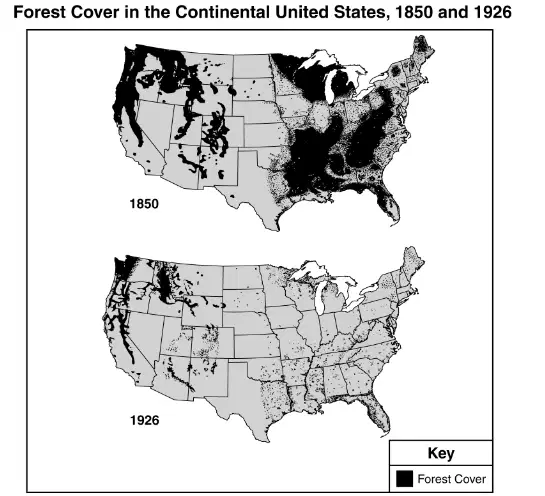
Which conclusion is best supported by the maps?
a)
Advances in technology improved the environment.
b)
Fewer natural resources slowed population growth.
c)
The need for land to cultivate crops increased greatly.
d)
The depletion of timber limited trade opportunities.
39.
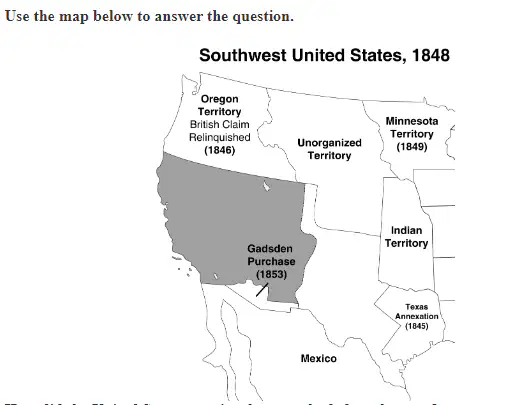
How did the United States acquire the area shaded on the map?
a)
It was purchased from France.
b)
It was ceded by Mexico.
c)
It was purchased from Spain.
d)
It was ceded by Great Britain.
40.
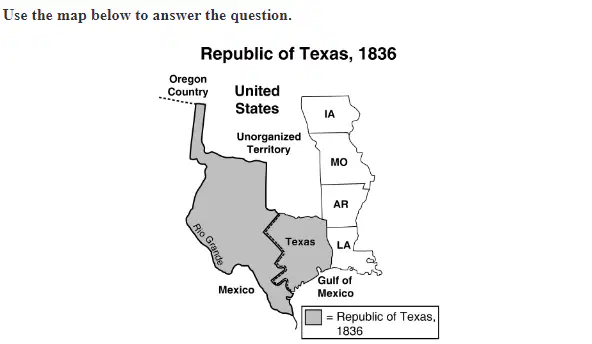
In what way was the land shaded on the map important to the outbreak of the Mexican War?
a)
Mexico maintained its seat of government in the area.
b)
The land was desired for construction of a southern railroad.
c)
The land was known to have large deposits of gold.
d)
Mexico disputed the land claimed by the United States.
41.
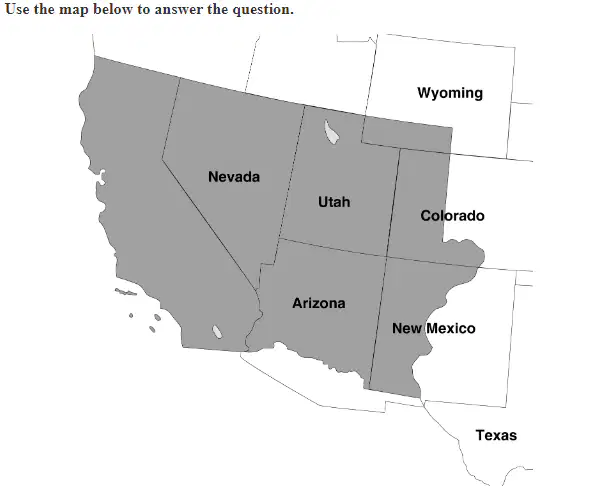
How did the United States acquire land the shaded area on the map?
a)
through the Texas War for Independence
b)
through the Treaty of Guadalupe Hidalgo
c)
through the Compromise of 1850
d)
through the Civil War
42.

How did this Supreme Court decision affect life in the United States?
a)
It gave the federal government a larger role in the national economy.
b)
It forced businesses to work only within the borders of their home state.
c)
It made government officials the main authorities for managing businesses.
d)
It took away any powers states had to make decisions about economic matters.
43.
Religious persecution led to the large-scale settlement of which religious community in Utah beginning in the 1840s?
a)
Mormons
b)
Catholics
c)
Quakers
d)
Muslims
44.
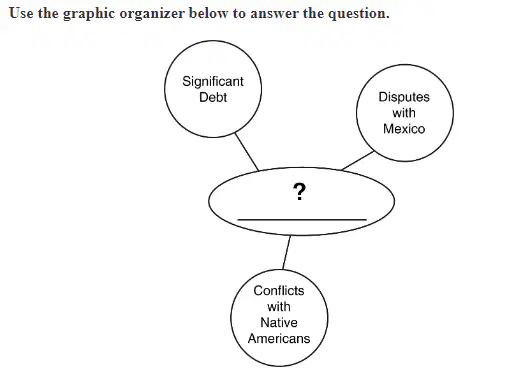
Which option best completes the graphic organizer?
a)
Reasons Texas Desired Annexation
b)
Reasons the United States Purchased Texas from France
c)
Reasons Texas Seceded from the United States
d)
Reasons the Texas Constitution Prohibited Slavery
45.
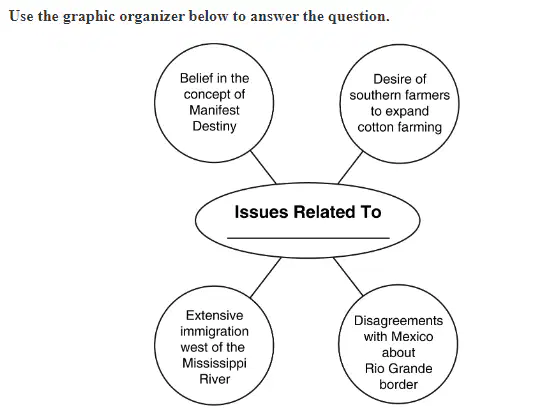
Which option completes the organizer?
a)
Texas’ Annexation into the United States
b)
Spain’s Abandoning of Catholic Missions in Texas
c)
Texas’ Population Decline after Independence
d)
France’s Sale of Texas to the United States
46.

How did this Supreme Court decision affect life in the United States?
a)
It eliminated competition by giving the national bank a monopoly.
b)
It gave the federal government a larger role in the national economy.
c)
It kept state governments from being able to raise any money through taxes.
d)
It caused a move away from a market economy to a government-run economy.
47.
What was the forced removal of the Civilized Tribes to Oklahoma called?
a)
The Great Migration
b)
The Freedom March
c)
The Trail of Tears
d)
The Long Walk
48.
People mainly moved west during the California Gold Rush in 1849 because
a)
they wanted religious freedom.
b)
they were interested in fishing.
c)
they had hopes of getting rich.
d)
they wanted to trade with Native Americans.
49.
Which pair of states had large increases in population in the 1800s due to the discovery of gold?
a)
California and Alaska
b)
Minnesota and Wisconsin
c)
Hawaii and North Dakota
d)
Connecticut and Rhode Island
50.
What happened in Texas immediately after Mexico gained its independence from Spain in 1821?
a)
Texas seceded from the United States.
b)
Many United States citizens settled in Texas.
c)
Texas petitioned the United States for statehood.
d)
Mexico and the United States fought a war over the Texas border.
51.

Which of the following describes someone who would have been most enthusiastic about John L. O'Sullivan's ideas?
a)
an abolitionist
b)
an immigrant laborer
c)
a Mexican rancher in California
d)
a Native American on the Great Plains
52.

What development in US history does this excerpt describe?
a)
People migrated westward in search of religious freedom.
b)
Critics of industrialization established utopian communities.
c)
States’ rights advocates attempted to secede from the Union.
d)
Former slaves established communities in western territories.
53.

Which statement is best supported by this excerpt?
a)
The California Gold Rush created opportunities for entrepreneurs.
b)
Gold prospectors settled in large cities once they arrived in California.
c)
Most people who migrated to California during the Gold Rush became rich.
d)
There were plenty of resources to start businesses in California mining camps.
54.

What best completes the title for this table?
a)
in New England Textile Mills
b)
on the Transcontinental Railroad
c)
in California during the Gold Rush
d)
on Southern Plantations during the Civil War
55.

What conclusion can be drawn from the information regarding the statehood of California in 1850?
a)
The spread of slavery into California made it difficult to negotiate for its statehood.
b)
The state was forced to go through a long period as a recognized U.S. territory.
c)
The United States went to war with Britain to retain control of the gold in California.
d)
The gold rush accelerated the process for California to become a state.
56.

The information is most closely associated with which immigrant group?
a)
Chinese
b)
Irish
c)
German
d)
Italian
57.
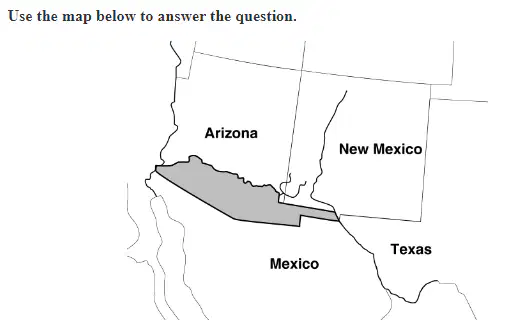
What was the primary reason for the purchase of the territory shaded on the map?
a)
to provide additional land for cotton farming
b)
to provide additional land for Native American tribes
c)
to provide a buffer zone between Mexico and the United States
d)
to provide a southern route for a transcontinental railroad
58.

How did the Compromise of 1850 affect the land shaded on the map?
a)
The Mexican government retained control of the land for another ten years.
b)
Texas agreed to cede the land to the New Mexico Territory.
c)
Texas was forced to recognize Mexican land claims in the area.
d)
The United States utilized the land as Indian Territory.
59.

Which cultural group is described in the passage?
a)
Irish Americans
b)
African Americans
c)
Chinese Americans
d)
Norwegian Americans
60.
Religious persecution led to the large-scale settlement of which religious community in Utah beginning in the 1840s?
a)
Mormons
b)
Catholics
c)
Quakers
d)
Muslims
61.

Which event fulfilled O'Sullivan's vision?
a)
the statehood of territories in the northwest
b)
the formation of international allies during World War I
c)
the completion of the Erie Canal
d)
the passage of the 14th Amendment
62.
How did the United States acquire the Oregon Territory?
a)
purchase
b)
invasion
c)
treaty
d)
war
63.
The United States acquired the Oregon Territory in 1846, and after a war with Mexico, the United States acquired the Mexican Cession in 1848. Which concept relates to the expansion of the US from coast to coast?
a)
The Monroe Doctrine
b)
Federalism
c)
Manifest Destiny
d)
Free Soil
64.
Which of the following was one contributing factor to the outbreak of war between the United States and Mexico?
a)
The United States claimed the Nueces River as the southern border of Texas.
b)
The United States outlawed trade between the two countries.
c)
Mexico was opposed to the annexation of Texas by the United States.
d)
Mexico sought to regain shipping ports along the Gulf Coast.
65.
Which of the following was a result of the Mexican War?
a)
The U.S. restricted slavery west of the Mississippi River.
b)
The U.S. gained control over Puerto Rico, Guam, and the Philippines.
c)
The U.S. forced European countries to leave Central America.
d)
The U.S. gained the territory in present-day California, Nevada, and Utah.
66.
How did railroads most impact farming in the West during the late 1800s?
a)
They connected farms with distant markets for selling their harvest.
b)
They helped large landowners illegally acquire land from homesteaders.
c)
The greater ease of transportation led many farmers to change to cattle ranching.
d)
They made owning large farms more difficult by laying tracks through farmlands.
67.
In the mid-1800s, gold was discovered in the western United States, and mining soon became an important industry in the West.
Which effect was the result of this mining boom?
a)
growth of farms
b)
growth of railroads
c)
growth of forest preserves
d)
growth of manufacturing
68.
What was the outcome of the signing of the 1848 Treaty of Guadalupe Hidalgo?
a)
The United States gained control of Oregon.
b)
Mexico ceded territory to the United States.
c)
The Republic of Texas was established.
d)
Mexico achieved independence from Spain.
69.
What most accounts for the large increase of native Spanish speakers in the United States between 1840 and 1850?
a)
Texas was annexed and land was acquired from Mexico.
b)
Industrialization attracted many Latin Americans to work in factories.
c)
The discovery of gold in California caused many people to settle there.
d)
Political trouble in Spain led to a rise in immigration from that country.
70.
In 1850 and 1852, California passed laws that charged a tax on foreign miners. These taxes were aimed at the large numbers of immigrant miners drawn by the Gold Rush from which country?
a)
China
b)
Russia
c)
Ireland
d)
Germany
71.
Which factor contributed most to the creation of new states in areas acquired as a result of the Mexican War?
a)
population growth due to immigration from Asian countries
b)
reforms implemented during the Reconstruction era
c)
completion of the Transcontinental Railroad
d)
establishment of new cities in the Oregon Territory
72.
As a result of the Gold Rush, the population of California increased by about 250,000 between 1848 and 1852. Which group's population decreased as a result of the Gold Rush?
a)
women
b)
urban residents
c)
Native Americans
d)
Chinese immigrants
73.
What was one reason the United States went to war with Mexico in 1846?
a)
Mexico and the United States were engaged in a border dispute.
b)
The United States retaliated against Mexico for signing a military alliance with France.
c)
The Mexican government had blockaded shipments in the Gulf of Mexico.
d)
The United States feared an invasion by Mexico.
74.
Which event resulted from the US victory in the Mexican War?
a)
California entered the Union as a free state with the Compromise of 1850.
b)
Texas gained its independence and became a republic.
c)
Native American tribes were removed from the southeastern states.
d)
The Transcontinental Railroad was completed.
75.
Which of the following events contributed to the outbreak of war between the United States and Mexico in 1846?
a)
the growing slave trade in Mexico
b)
the granting of statehood to California
c)
the United States annexation of Texas
d)
a military alliance between Mexico and Spain
76.
Which event resulted from a dispute over the southern border of Texas?
a)
the outbreak of the U.S.-Mexican War
b)
the passage of the Wilmot Proviso
c)
the passage of the Missouri Compromise
d)
the formation of the Whig Party
77.
Which document established the northern boundary of the state of Texas?
a)
the Treaty of Paris
b)
the Kansas-Nebraska Act
c)
the Compromise of 1820
d)
the Compromise of 1850
78.
What effect did the US-Mexican War have on Texas?
a)
It brought Texas into the Confederacy.
b)
It led to the creation of the Republic of Texas.
c)
It abolished the institution of slavery in Texas.
d)
It made the lower Rio Grande River the official southern border of Texas.
79.
Which action resulted in Mexico ceding 525,000 square miles of land to the United States?
a)
the purchase of the Louisiana Territory
b)
the passage of the Compromise of 1850
c)
the victory of Texas in its war for independence
d)
the signing of the Treaty of Guadalupe Hidalgo
80.
During the 1840s, which issue caused growing tensions between the United States and Mexico?
a)
the annexation of Texas into the Union
b)
the sinking of Mexican ships along the Texas border
c)
the establishment of Catholic missions in Texas
d)
the discovery of gold in the mountains of western Texas
81.
Which of these issues led to the outbreak of the US-Mexican War?
a)
access to the northern Gulf of Mexico
b)
disagreement over the southern border of Texas
c)
the discovery of silver in northern Mexico
d)
the spread of slavery into Texas
82.
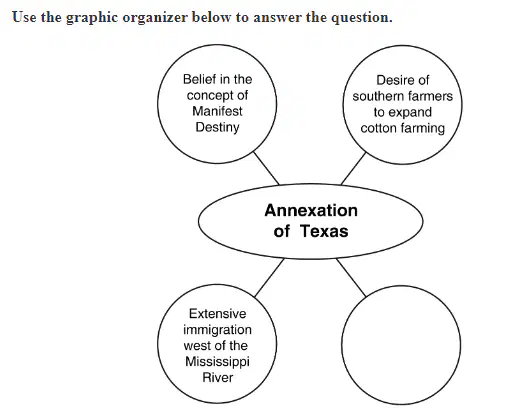
Which of these options fits best in the graphic organizer?
a)
Disagreements with Mexico regarding the Rio Grande border
b)
Discovery of gold in the southern Rocky Mountains
c)
Removal of Native Americans to Indian Territory
d)
Exploration by Lewis and Clark
83.
What was a direct result of the Texas victory at the Battle of San Jacinto on April 21, 1836?
a)
Texas separated from Spain.
b)
Texas joined the Confederacy.
c)
Texas gained its independence from Mexico.
d)
Texas entered the United States as a slave state.
84.

Which statement best explains the information in this excerpt?
a)
The discovery of gold in California attracted Chinese immigrants.
b)
Chinese immigrants found it difficult to adapt to the change in culture.
c)
Immigrants from Europe and China settled in the same city neighborhoods.
d)
Chinese immigrants were among the pioneers who traveled along the Oregon Trail.
85.

Which phrase best completes this diagram?
a)
Expansion of Jim Crow Laws
b)
Creation of the American System
c)
Establishment of the Missouri Compromise
d)
Construction of the Transcontinental Railroad
86.

What event made it necessary to negotiate the Compromise of 1850?
a)
The United States defeated Mexico in the Mexican War.
b)
Texas secured its freedom from Mexico.
c)
Native American tribes were relocated to lands west of the Mississippi River.
d)
Mormon Church members began settling in the Utah Territory.
87.

The events in Texas led to what action by the US government?
a)
It annexed Texas into the Union in 1845.
b)
It refused to recognize the Republic of Texas.
c)
It required Texas to abolish slavery prior to statehood.
d)
It established Texas as a U.S. territory.
88.

Which action resulted from the events listed in the chart?
a)
the secession of Texas from the Union
b)
the purchase of Texas from Spain
c)
the annexation of Texas into the Union
d)
the independence of Texas from Mexico
89.

How did the concerns affect Texas?
a)
Texas was required to pay war debts to Mexico prior to annexation.
b)
Texas was forced to outlaw slavery in its state constitution prior to statehood.
c)
Texas remained an independent republic for years prior to annexation.
d)
Texas petitioned to join the Confederacy rather than the Union after its independence.
90.

What is one reason Texas failed to achieve statehood until 1845?
a)
President Tyler refused to support the annexation of Texas.
b)
The Senate initially rejected the annexation of Texas.
c)
Texas political leaders did not wish to join the Union.
d)
European countries demanded payment of war debts prior to Texas annexation.
91.

What impacts did American's belief in expansion, as expressed by John O'Sullivan, have on the statehood of Texas?
a)
It forced Spain to give up its claim to Texas.
b)
It led to the establishment of reservations in Texas.
c)
It made Texans less likely to want to join the Union.
d)
It caused many in Congress to want to annex Texas.
92.

What factor accounts for this change in California's population?
a)
the discovery of gold
b)
the spread of industrialization
c)
the invention of the steamship
d)
the end of quotas on Asian immigration
93.

The South Pass helped these pioneers travel over what geographical obstacle?
a)
the Great Lakes
b)
the Grand Canyon
c)
the Rocky Mountains
d)
the Mississippi River
94.

What milestone in US transportation history is described in this list?
a)
the Erie Canal
b)
the Oregon Trail
c)
the Cumberland Road
d)
the Transcontinental Railroad
95.

Why was the proposal below considered necessary at the end of the Mexican War?
a)
Northerners feared an increase in the number of slave states.
b)
Southerners feared losing their slaves to Mexican landowners.
c)
Mexico attempted to arm runaway slaves to fight against the Americans.
d)
The federal government attempted to limit slave contact with Native Americans.
96.

In what way did John O'Sullivan's words reflect American ideas about westward expansion?
a)
They suggested that U.S. expansion toward the Pacific Ocean was divinely ordained.
b)
They indicated that Native Americans would willingly give up their tribal lands.
c)
They supported the idea that the U.S. government should provide free land to Americans.
d)
They demonstrated that slavery was well suited for farming in the West.
97.

Which statement best describes the role played by a historical figure in the debates that led to these agreements?
a)
John Quincy Adams sought to open more territories to slavery.
b)
John C. Calhoun argued that the states must obey all federal laws.
c)
Henry Clay offered solutions to satisfy different sides of the issues.
d)
Daniel Webster threatened secession if his state’s needs were not met.
98.
Which issue was most important in the debate over Texas statehood?
a)
taxes
b)
slavery
c)
voting rights
d)
immigration policy
99.
What development enabled California to join the Union as a free state?
a)
Maine became a slave state.
b)
The Thirteenth Amendment was ratified.
c)
Congress agreed to protect slavery in other regions.
d)
The entire state fell above the 36'30° line of latitude.
100.
Although Texas gained its independence from Mexico in 1836, why did it not become a state until 1845?
a)
Texas leaders refused to sign a treaty with the dictator of Mexico.
b)
Texas politicians failed to request statehood from the United States.
c)
Some U.S. politicians feared adding Texas as another slave state to the Union.
d)
The majority of Texas landholders wanted Texas to remain an independent republic.
100 %

