
 Worksheets
SEMI-FINAL EXAM MBD AU
Total questions: 75
Worksheet time: 1hrs 22mins
What is a polymorphism?
The number of genes
A variant in DNA sequence i.e. the number of base repeats
Template DNA
Non of the above
What does RFLP stand for?
Right Fragmented Length of DNA
Restriction Fragment Length Polymorphism
Restriction Enzyme fragment Polymorphism
What does STR stand for?
Single tandem repeat
Single track DNA repeat
Short Track Rest
Short Tandem Repeat
What does VNTR stand for?
Variable Number Tandem Repeat
Restriction enzyme
Variation in Number DNA
Variable number type repeat
I. are pieces of DNA
II. are all the same size
III. are produced through PCR
IV. are created through the action of restriction enzymes
V. are measured in number of base pairs
Tandem repeats of short DNA sequences (2-5 pairs) with varying numbers of repeats between individuals is called ______________________________.
VNTR
STR
PCR
This is a molecule that cuts DNA at a specific sequence.
restriction enzyme
DNA probe
gene
electrophoresis
DNA sequences with a high degree of polymorphism are ___________________.
least useful for DNA analysis
most useful for DNA analysis
not useful for DNA analysis
VNTR and STR sequences (non coding regions of DNA) are what is used to create a DNA profile.
True
False


This type of DNA testing involves cutting the DNA into fragments that can later be separated by length
karyotype
PCR
RLFP

Who matches the crime scene DNA?
suspect #1
suspect #2
suspect #3
none of the suspects match the DNA
Which sequence of DNA bases would pair with this partial strand ATG TGA CAG
TAC TCT GGG
TAC ACT GTC
ATG AAA GCG
AAC CGA TAG
Which sequence of DNA bases would pair with this partial strand TAG TGA CAG
ATC ACT GTC
ATG TGA CAG
Which sequence of DNA bases would pair with this partial strand TAG TGG GAG
ATC ACC CTC
ATG TGA CAG
What is DNA sequencing?
What is the purpose of DNA sequencing?
DNA sequencing is used to count the number of cells in DNA.
DNA sequencing is used to identify the shape of DNA molecules.
DNA sequencing is used to determine the precise order of nucleotides within a DNA molecule.
DNA sequencing is used to determine the color of DNA molecules.
How does DNA sequencing help in genetic research?
DNA sequencing helps in understanding the structure of proteins.
DNA sequencing helps in identifying genetic mutations.
DNA sequencing helps in determining the size of chromosomes.
DNA sequencing helps in measuring the acidity of DNA molecules.

Which part of Sanger (Cycle) Sequencing is NOT found in regular Polymerase Chain Reaction (PCR)?
DNA polymerase
Primers
Deoxyribonucleotides (dNTPs)
Dideoxyribonucleotides (ddNTPs)
DNA template

How are deoxyribonucleotides different from dideoxyribonucleotides? Choose all that apply.
Deoxyribonucleotides are used in both PCR and Cycle Sequencing.
Dideoxyribonucleotides are missing an OH group compared to deoxyribonucleotides.
You cannot add new nucleotides to a deoxyribonucleotide.
Deoxyribonucleotides are NOT found in natural living cells.
Dideoxyribonucleotides are labeled with fluorescent tags.
Place the steps of DNA Sequencing below into their correct order.
A. Detection of fluorescence w/ lasers & sensors
B. PCR w/ fluorescent dideoxynucleotides
C. Separate DNA by size w/ gel electrophoresis
D. Match DNA sequence using BLAST database
A, B, C, D
B, C, A, D
B, A, C, D
D, B, C, A
Which of the following is chemical nucleotide sequencing method
Sanger method
Maxam Gilbert method
Edmans method
Automated sequencing method
The principle of Sanger's method relies on
use of chemicals for base specific cleavage
use of dNTPs for chain termination
use of ddNTPs for chain termination
Use of p32 for chain termination
Automated DNA sequencing is an improvement of Sanger's method where
ddNTPs are used for chain termination
PCR is used for making sequencing
Fluorescently labelled dNTPs are used for chain termination
Fluorescently labelled ddNTPs are used for chain termination
luciferase uses the substrate
apyrase
luciferin
oxyluciferin
Pyrophosphate

Write the correct sequence that matches this chromatogram.
(a)

What is the difference between a deoxynucleotide and a dideoxynucleotide?
A deoxynucleotide is missing a 3'-hydroxyl group on its sugar.
A dideoxynucleotide is missing a 3'- hydroxyl group on its sugar.
A deoxynucleotide is missing a 5'-phosphate group.
A dideoxynucleotide is missing a 5'-phosphate group
What is components are added to the PCR tube for Sanger sequencing. Check all that apply.
DNA sample
taq polymerase
ddNTPs
Primers
dNTPs
When using radioactivity, how many reactions are taking place concurrently in Sanger Sequencing?
1
2
3
4
In the Sanger sequencing method, what causes the termination of each chain of DNA?
The incorporation of a deoxynucleotide
When the DNA polymerase encounters a stop codon
The incorporation of a dideoxynucleotide
Denaturation of the double strand
What is it called when the order of DNA nucleotides is determined for a section of DNA?
DNA sequencing
Denaturation
Gel Electrophoresis
DNA replication
Automated DNA sequencing is an improvement of Sanger's method where
ddNTPs are used for chain termination
PCR is used for making sequencing
Fluorescently labelled dNTPs are used for chain termination
Fluorescently labelled ddNTPs are used for chain termination
What is the first step in designing primers for the Sanger method of DNA sequencing? (NIC)
Selecting the DNA polymerase
Identifying the sequence to be amplified
Choosing the fluorescent dideoxynucleotides
Running gel electrophoresis
Which enzyme is crucial for the Polymerase Chain Reaction (PCR) in the Sanger method?
Ligase
Restriction enzyme
DNA polymerase
RNA polymerase
What is the purpose of gel electrophoresis in the Sanger sequencing method?
To amplify DNA fragments
To cut DNA into smaller fragments
To separate DNA fragments based on size
To visualize the DNA directly
What role do fluorescent dideoxynucleotides play in the Sanger sequencing method? (NIC)
They cut the DNA into smaller pieces.
They amplify the DNA fragments.
They terminate DNA synthesis and allow for detection.
They bind to specific DNA sequences for identification.
Automated base calling in the Sanger sequencing method refers to: (NIC)
Manually reading the sequence of bases from a gel
Using a computer algorithm to determine the sequence of bases from fluorescent signals
Calling out the bases as they are incorporated into the DNA strand
Using a special phone app to record DNA sequences
Which component is not required for the Polymerase Chain Reaction (PCR) in the Sanger method?
DNA template
Primers
RNA polymerase
dNTPs
What is the main reason for using gel electrophoresis after the sequencing reaction in the Sanger method?
To purify the DNA fragments
To replicate the DNA fragments
To separate the DNA fragments by size for sequencing
To attach fluorescent labels to the DNA fragments
How does temperature play a role in the Polymerase Chain Reaction (PCR) used in the Sanger method?
High temperatures are used to separate the DNA strands
Low temperatures are used to activate the DNA polymerase
Constant temperature is maintained throughout the reaction
Temperature is irrelevant in PCR
In the context of the Sanger sequencing method, what is the significance of the chain termination method?
It allows for the amplification of DNA
It is used to cut DNA into smaller fragments
It is a method to visualize DNA fragments
It enables the determination of the DNA sequence by terminating synthesis at specific nucleotides

Larger DNA fragments move through a gel _____________ smaller DNA fragments.
faster than
at the same rate as
slower than
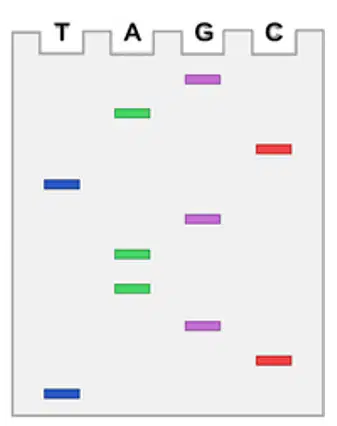
Identify the DNA sequence.
(a)
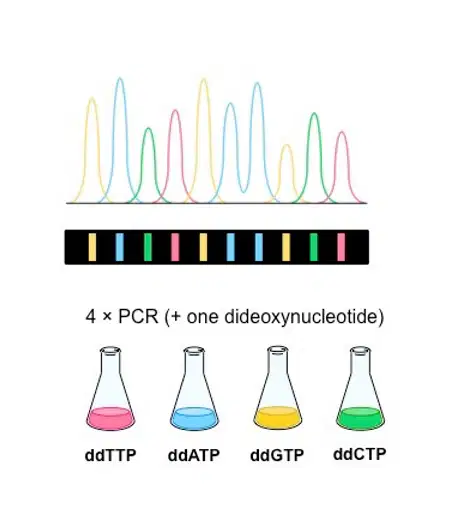
Identify the DNA Sequence
(a)


In Maxam-Gilbert sequencing, hydrazine + salt is used to cleave:
Thymine
Guanine
Cytosine
Adenine
What is a limitation of the Maxam-Gilbert method?
Requires a small amount of DNA
Can read more than 700 bases
Technical complexity
Uses non-toxic chemicals
Dimethyl sulphate + HCL would cleave DNA at --- position
G + C
A +T
G
A
In the Maxam-Gilbert method, the chemicals used for identifying Cytosine and Thymine are….
Hydrazine + piperidine
Dimethyl sulphate in formic acid + piperidine
Hydrazine in NaCl + piperidine
Dimethyl sulphate + piperidine
Which isotope is commonly used for labeling DNA in Maxam-Gilbert sequencing?
Carbon-14
Phosphorus-32
Sulfur-35
Phosphorous-31
The sequence of DNA is read from the gel:
Top to bottom
Bottom to top
Randomly
Left to right
What is the role of piperidine in Maxam and Gilbert sequencing?
It acts as a probe
It cleaves the DNA backbone
It labels the DNA
It denatures proteins
Approximately how many bases can automated Sanger sequencing read per sequencing run?
a) 100 bases
b) 900 bases
c) 10,000 bases
d) 100,000 bases
a
b
c
d
In automated Sanger sequencing, how are DNA fragments detected?
a) By gel electrophoresis only
b) By a microscope
c) By a laser beam detecting fluorescent dyes
d) By chemical reactions
a
b
c
d
Which of the following is a feature of the Illumina sequencing method?
It generates long reads
It is a high-throughput sequencing method
It is a single-molecule sequencing method
It has a high error rate
In Pyrosequencing, light signal detected by the photomultiplier is proportional to
nucleotides incorporated
conversion of luciferin to oxyluciferin
both a and b
none of the above
sequencing by synthesis is applied in
Solid sequencing
liquid sequencing
pyrosequencing
all

