
 Worksheets
World Optometry Day quiz
Total questions: 30
Worksheet time: 15mins
What is the unit of refractive power of a lens?
Meter
Diopter
Candela
Hertz
Which type of lens is used to correct hypermetropia?
Concave
Convex
Cylindrical
Plano
What does Snell's Law describe?
The reflection of light
The bending of light at an interface
The dispersion of light
The absorption of light
What is the far point of a myopic eye with a refractive error of -3.00D?
Infinity
50 cm
33 cm
25 cm
Which layer of the cornea is responsible for maintaining corneal transparency?
Stroma
Endothelium
Epithelium
Descemet's membrane
What is the average axial length of an adult human eye?
18 mm
22 mm
24 mm
26 mm
Which cranial nerve controls pupillary constriction?
Optic nerve (CN II)
Oculomotor nerve (CN III)
Trochlear nerve (CN IV)
Abducens nerve (CN VI)
Which structure in the eye is responsible for aqueous humor production?
Retina
Ciliary body
Cornea
Choroid
What is the normal intraocular pressure (IOP) range in mmHg?
5-10
10-21
15-25
20-30
What is the name of the chart commonly used to test near vision in India?
Snellen chart
Jaeger chart
LogMAR chart
Pelli-Robson chart
What is the term for an unequal refractive power between the two eyes?
Myopia
Hyperopia
Astigmatism
Anisometropia
What does the Jackson Cross Cylinder (JCC) test evaluate?
Myopia
Hyperopia
Astigmatism axis and power
Binocular vision
Which test is commonly used to diagnose keratoconus?
Slit-lamp examination
Applanation tonometry
Corneal topography
Direct ophthalmoscopy
Which visual field test is commonly used to detect glaucoma?
Amsler grid
Confrontation test
Automated perimetry
Maddox rod test
What does the Hirschberg test assess?
Color vision
Binocular coordination
Corneal reflex alignment
Visual acuity
Which type of contact lens is primarily used for keratoconus correction?
Soft spherical lenses
Rigid gas permeable lenses
Daily disposable lenses
Extended wear lenses
What is the main advantage of a scleral contact lens?
Allows oxygen transmission
Provides stable vision for irregular corneas
Reduces tear evaporation
All of the above
What does monovision refer to in contact lens fitting?
Using one lens for distance and one for near vision
Using only one contact lens in one eye
Wearing glasses over contact lenses
Alternating between contact lenses and spectacles
What is the primary function of MyoSmart lenses?
Correct myopia only
Slow down myopia progression
Correct astigmatism
Improve contrast sensitivity
What optical technology does MyoSmart use?
Progressive lenses
Dual-focus design
Defocus Incorporated Multiple Segments (DIMS)
Multifocal lenses
What is the recommended age group for MyoSmart lens wearers?
Infants
6-18 years
20-30 years
Above 40 years
Which company developed MyoSmart lenses?
Essilor
Hoya
Zeiss
CooperVision
What is the main reason MyoSmart lenses slow myopia progression?
Peripheral defocus control
Increased accommodative demand
UV light filtration
Pupil constriction
Which of the following is NOT a commonly used myopia control strategy?
Orthokeratology
Atropine eye drops
Increased screen time
Multifocal contact lenses
The International Myopia Institute defines high myopia as a refractive error of:
≤ -3.00 D
≤ -5.00 D
≤ -6.00 D
≤ -8.00 D
Which layer of the tear film is responsible for reducing evaporation?
Aqueous layer
Lipid layer
Mucin layer
Water layer
What is the average central corneal thickness in a healthy human eye?
250-300 microns
400-450 microns
500-550 microns
600-650 microns
What is the leading cause of blindness worldwide?
Glaucoma
Cataracts
Diabetic retinopathy
Age-related macular degeneration
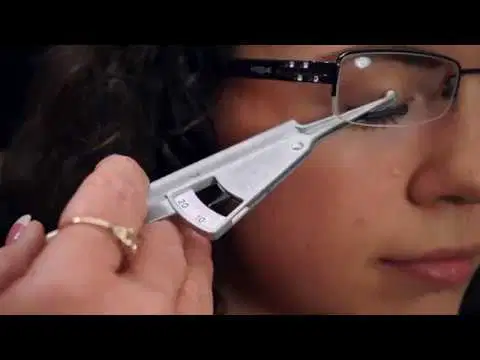
Identify the instrument
Schiotz tonometer
aesthesiometer
Pachymeter
Distometer
Which cells in the retina are responsible for color vision?
a) Rods
b) Cones
c) Bipolar cells
d) Ganglion cells
Rods
Cones
Bipolar cells
Ganglion cells

