wayground logo

Free Printable Worksheets

Font size

S
M
L
XL
Worksheets

Geometry EOC Review - Part E

Total questions: 53

Worksheet time: 2hrs 51mins

Name
Class
Date
1.

Reflect (3,5) over the x-axis.

a)

(2,2)

b)

(3,-5)

c)

(-3,-5)

d)

(-3,5)

2.
Which transformation will result in being similar to the original figure but has a larger area?
a)
Dilation with scale factor of 2
b)
Dilation with scale factor of 1
c)
Dilation with scale factor of .5
d)
Translation 
3.
A triangle is dilated by a scale factor of ⅓ to produce a new triangle. Which of the following best describes the relationship between the perimeter of the original triangle compared to the perimeter of the new triangle?
a)
The perimeter of the new triangle is ⅓ that of the original triangle
b)
The perimeter of the new triangle is 3 times that of the original triangle.
c)
The perimeter of the new triangle is 1/9 that of the original triangle.
d)
The perimeter of the new triangle is 9 times that of the original triangle
4.

When you translate, (x,y+6) will move _____.

a)

6 units right

b)

6 units left

c)

6 units up

d)

6 units down

5.

Write a rule for the translation.

a)

(x -1, y + 2)

b)

(x -2, y + 1)

c)

(x +2, y - 1)

d)

(x +1, y - 2)

6.
Identify the transformation from ABC to A'B'C'.
a)
90o clockwise rotation
b)
90o counter clockwise rotation
c)
Reflection across the y-axis
d)
Reflection across the x-axis
7.

A square with an area of 16 square inches has been dilated to a square with an area of 64 square inches. What is the scale factor of the dilation?

a)

k = 1/2

b)

k = 1/4

c)

k = 2

d)

k = 4

8.
If you were to rotate ABCD 180°  about the origin, what would the coordinate of A' be?
a)
(-5, 5)
b)
(-3, -5)
c)
(-5, 3)
d)
(-3, 3)
9.

Describe the transformation.

a)

90º counterclockwise rotation

b)

180º counterclockwise rotation

c)

90º clockwise rotation

d)

reflection across the origin

10.

Choose ALL the degrees of rotation that will map a regular hexagon onto itself.

a)

90

b)

120

c)

150

d)

240

e)

300

11.
A triangle has vertices with coordinates (2,0), (3, -1) and (-2,-5). If the triangle is dilated by a scale factor of 3 with the origin as the center of dilation, what are the coordinates of the vertices of the image?
a)
(5,3), (6,2), (1,-2)
b)
(6,0), (9,-3), (-6,-15)
c)
(2/3,0), (1,-1/3), (-2/3,-5/3)
d)
(-1,-3), (0,-4), (-5,-8)
12.

Which of the following describes the sequence of transformations shown?

a)

Reflect across the x-axis and then rotate 90º clockwise around the origin

b)

Rotate 90º degrees around the origin and then translate right.

c)

Reflect across the x-axis and then reflect across the y-axis.

d)

Translate up and then rotate 90º counter clockwise about the origin.

13.

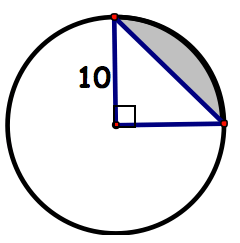
Find the area of the shaded sector.

a)

30.8

b)

5.5

c)

18.1

d)

3.3

14.

Which two equations below are parallel?

(choose one - each choice has 2 equations)

a)

y = 2x + 1 and

x + 2y = 6

b)

y = 2x + 3 and

2x + y = 10

c)

y = 2x - 1 and

x - 2y = 4

d)

y = -x + 4 and

x + y = 2

15.

Determine the equation of a line PERPENDICULAR to 3x + y = 8

and passes through the point (-3, -2), in slope-intercept form.

a)

y=13x3y=\frac{1}{3}x-3

b)

y=13x9y=-\frac{1}{3}x-9

c)

y=13x1y=\frac{1}{3}x-1

d)

y=3x9y=-3x-9

16.

Given ABCD...

A(2, 2) B(3, 4) C(5, 3) D(4, 1)

Name the quadrilateral (give the most specific classification)

a)

Square

b)

Rhombus

c)

Kite

d)

Trapezoid

e)

Quadrilateral

17.

What is the area of the triangle?

a)

60 square units

b)

90 square units

c)

45 square units

d)

30 square units

18.

What is the perimeter of the rectangle? (Round to the nearest tenth)

a)

18

b)

about 23.6

c)

about 25.1

d)

about 21.6

19.

Which sequence of transformations will map PQRT to its image P'Q'R'T'?

a)

A translation, then a reflection over the y-axis.

b)

A reflection over the x-axis, then a translation.

c)

A rotation 90o clockwise, then a reflection over the x-axis.

d)

A rotation 180o clockwise, then a reflection over the y-axis.

20.

Choose the correct set up to find the length of the side x.

a)

sin(37°)=x14\sin\left(37\degree\right)=\frac{x}{14}  

b)

cos(37°)=x14\cos\left(37\degree\right)=\frac{x}{14}  

c)

tan(37°)=x14\tan\left(37\degree\right)=\frac{x}{14}  

d)

None of these are correct

21.

What are angles 1 and 7?

a)

Alternate Interior Angles

b)

Same Side Interior Angles

c)

Alternate Exterior Angles

d)

Corresponding Angles

22.

Which proportion is true?

a)

y0.6=0.70.56\frac{y}{0.6}=\frac{0.7}{0.56}

b)

yx=1.251\frac{y}{x}=\frac{1.25}{1}

c)

x1=0.51.05\frac{x}{1}=\frac{0.5}{1.05}

d)

x0.5=0.61.25\frac{x}{0.5}=\frac{0.6}{1.25}

23.
A jar contains 2 pink, 6 red, and 4 blue marbles. If you pick one marble without looking, what is the probability that the marble you pick will be red or blue?
a)
5/6
b)
1/2
c)
1/3
d)
1/6
24.
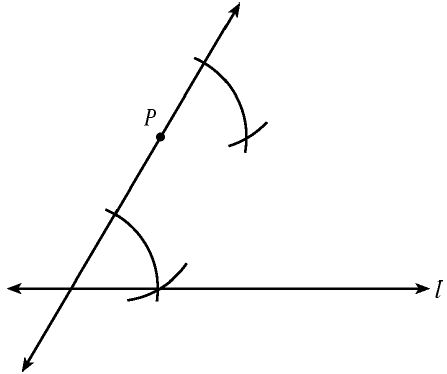
Marsha is using a straightedge and compass to do the construction shown. Which best describes the construction Marsha is doing?
a)
a line through P parallel to line l
b)
a line through P intersecting line l
c)
a line through P congruent to line l
d)
a line through P perpendicular to line l
25.
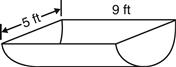
A rancher wants to cut a metal cylinder in half to use as a watering trough as shown.
If the cylinder has a diameter of 5 feet and a length of 9 feet, which value is closest to the volume of the trough in cubic feet? Use π = 3.14.
a)
176.6 ft3
b)
141.3 ft3
c)
88.3 ft3
d)
70.7 ft3
26.

Which expression is equivalent to sin (34)?

a)

sin (56)

b)

cos (56)

c)

tan (34)

d)

cos (34)

27.

A regular hexagon is rotated around its center, H. Which angle of rotation carries the hexagon onto itself?

a)

72 degrees

b)

240 degrees

c)

90 degrees

d)

270 degrees

28.

What is the equation of a circle whose center is at (4,5) and whose radius is 6

a)

(x+4)2 + (y+5)2 = 6

b)

(x-4)2 + (y-5)2 = 36

c)

(x+4)2 + (y+5)2 = 36

d)

(x-4)2 + (y-5)2 = 6

29.
Find the measure of arc AB.
a)
17
b)
34
c)
68
d)
146
30.
Solve for the missing angle.
a)
45o
b)
90o
c)
22.5o
d)
128o
31.
Find the area of each sector.
a)
52.4 in2
b)
18,864 in2
c)
60 in2
d)
10.47 in
32.
a)

A

b)

B

c)

C

d)

D

33.

What is the area of the shaded region? Leave your answer as an exact value.

a)

25π - 50

b)

25π - 100

c)

5π - 50

d)

5π - 100

34.
Find the length of the bold arc.
a)
61.3ft
b)
20.4ft
c)
7351.3ft
d)
22,068ft
35.
Find the area of the shaded region.
a)
144π - 288 cm2
b)
72π - 144 cm2
c)
144π - 72 cm2
d)
144π - 360 cm2
36.
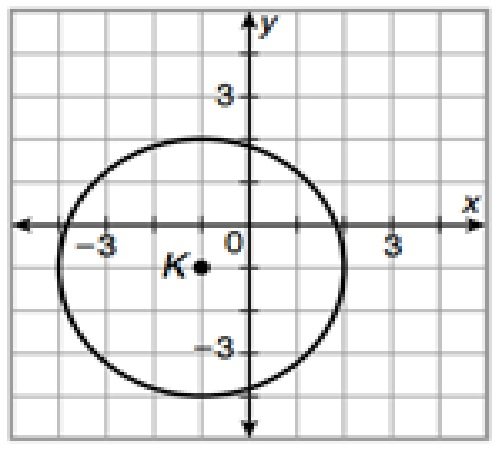
What is the equation of the circle?
a)
(x+1)2 + (y +1)2 = 3
b)
(x+1)2 + (y -1)2 = 3
c)
(x+1)2 + (y +1)2 = 9
d)
(x-1)2 + (y -1)2 = 9
37.
a)
The volume increases by a factor of 8.
b)
The volume increases by a factor of 27.
c)
The volume increases by a factor of 64.
d)
The volume increases by a factor of 16.
38.
Lines AO and BO are tangent. What is the measure of BO?
a)
20
b)
15
c)
10
d)
5
39.
What congruency postulate proves the triangles congruency?
a)
SAS
b)
ASA
c)
SSS
d)
HL
40.
a)
3
b)
43.5
c)
66
d)
87
41.

What does a proof always start with?

a)

Theorems

b)

Given Statement(s)

c)

Postulates

d)

Reasons

42.

What property states that if

a = b and b = c then a = c?

a)

Equality Property

b)

Reflexive Property

c)

Transitive Property

d)

Associative Property

43.

What property states that something is congruent to itself?

a)

Symmetry Property

b)

Congruence Property

c)

Reflexive Property

44.
What is the justification (reason)?
a)
reflexive property
b)
definition of segment bisect
c)
definition of a midpoint
d)
substitution property
45.
If X is between R & T on a line,
then RX + XT = RT
a)
Addition POE
b)
Substitution POE
c)
Angle Addition Post.
d)
Segment Addition Post.
46.
Fill in the missing proofs.
a)
Transitive Property, SAS(Side-Angle-Side)
b)
Reflexive Property, SAS(Side-Angle-Side)
c)
Reflexive Property, Vertical Angles Thm.
d)
Transitive Property, SSS(Side-Side-Side)
47.
Fill in the missing proofs.
a)
Transitive Property, SAS(Side-Angle-Side)
b)
Reflexive Property, SAS(Side-Angle-Side)
c)
Reflexive Property, Vertical Angles Thm.
d)
Transitive Property, SSS(Side-Side-Side)
48.
What is the "statement" for step 3 of the proof? 
a)
∡EDA≅∡DCB
b)
∡AED≅∡BEC
c)
DE=CE
d)
∡AED≅∡CED
49.
Which transformation will result in being similar to the original figure but has a larger area?
a)
Dilation with scale factor of 2
b)
Dilation with scale factor of 1
c)
Dilation with scale factor of .5
d)
Translation 
50.

Reflect (3,5) over the x-axis.

a)

(2,2)

b)

(3,-5)

c)

(-3,-5)

d)

(-3,5)

51.
A triangle is dilated by a scale factor of ⅓ to produce a new triangle. Which of the following best describes the relationship between the perimeter of the original triangle compared to the perimeter of the new triangle?
a)
The perimeter of the new triangle is ⅓ that of the original triangle
b)
The perimeter of the new triangle is 3 times that of the original triangle.
c)
The perimeter of the new triangle is 1/9 that of the original triangle.
d)
The perimeter of the new triangle is 9 times that of the original triangle
52.

Write a rule for the translation.

a)

(x -1, y + 2)

b)

(x -2, y + 1)

c)

(x +2, y - 1)

d)

(x +1, y - 2)

53.
A triangle has vertices with coordinates (2,0), (3, -1) and (-2,-5). If the triangle is dilated by a scale factor of 3 with the origin as the center of dilation, what are the coordinates of the vertices of the image?
a)
(5,3), (6,2), (1,-2)
b)
(6,0), (9,-3), (-6,-15)
c)
(2/3,0), (1,-1/3), (-2/3,-5/3)
d)
(-1,-3), (0,-4), (-5,-8)