
 Worksheets
Weather Test Part 1
Total questions: 66
Worksheet time: 52mins

Match the Global Winds to their correct letter:
Label A
Trade Wind
Label B
Westerlies
Label C
Polar Easterlies
Label the diagram
trade winds
westerlies
equator
north pole
polar easterlies

Which global wind is located at number 1?
trade winds
doldrums
Polar easterlies
horse latitudes

Which global wind is located at number 4?
trade winds
horse latitudes
prevailing westerlies
doldrums

Which global wind is locater at number 5?
trade winds
doldrums
horse latitudes
prevailing westerlies
The Coriolis effect causes ___________.
the Earth to rotate on its axis
earthquakes
global winds to move in a curved path instead of a straight line
the Earth to revolve around the sun
On either side of the equator, early sailors relied on steady winds called ___________.
the doldrums
polar easterlies
jet streams
the trade winds
What direction do winds in the Northern Hemisphere blow?
right
left
straight
cT air mass is
tropical maritime
polar maritime
tropical continental
polar continental
a cP air mass is a
Arctic Continental
Polar Maritime
Polar Continental
Tropical Continental
All of these are air masses that affect the US EXCEPT
cP
cT
mT
mA
Which of these locations did a tropical maritime (mT) air mass originate?
over Antarctica
over a Southern region of the Atlantic Ocean
Over Canada
Over Mexico
If an air mass formed over land, and is mostly dry, which descriptor will likely be part of its name?
Tropical
Arctic
Maritime
Continental


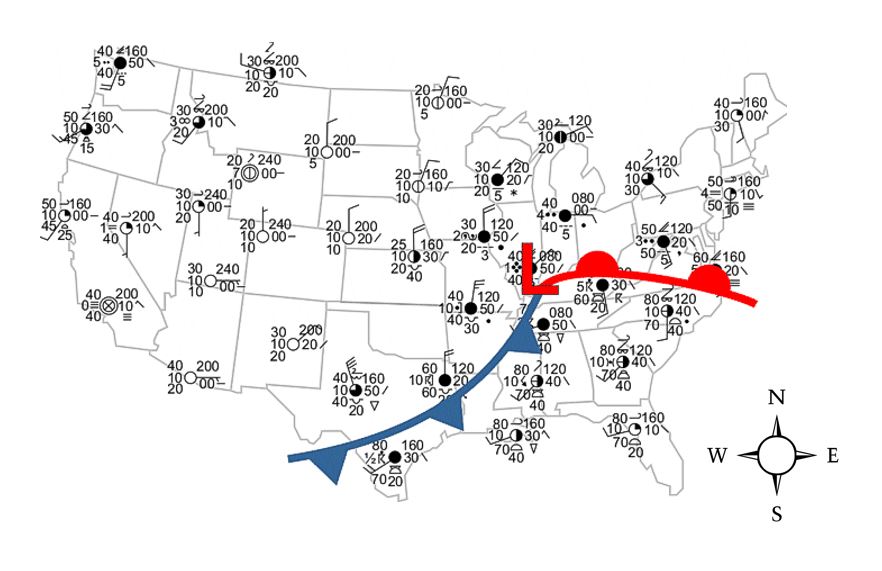
What type of front occurs when a warm air mass and a cold air mass do not have enough energy to move the other one out of the way?
Warm front
Cold front
Stationary front
Occluded front

This map shows a _____ front.
cold
warm
occluded
stationary
This map shows a cP air mass. Which option correctly describes this air mass?
cold and dry
cold and moist
warm and dry
warm and moist

This is the symbol for what kind of front?
cold
warm
occluded
stationary

This diagram shows the formation of what kind of front?
cold
warm
occluded
stationary

This image shows the map symbol for what kind of front?
cold
warm
occluded
stationary
This type of front has a steep slope, meaning it moves quickly and creates short, violent storms.
cold
warm
occluded
stationary
This type of front forms when a warm and cold air mass meets, but neither overtakes the other. This forms long, lingering rain/snow showers.
cold
warm
occluded
stationary
This kind of front forms when a faster moving cold front overtakes a slower moving warm front. When the two cold air masses meet, they wedge up the warm air mass creating clouds and precipitation.
cold
warm
occluded
stationary

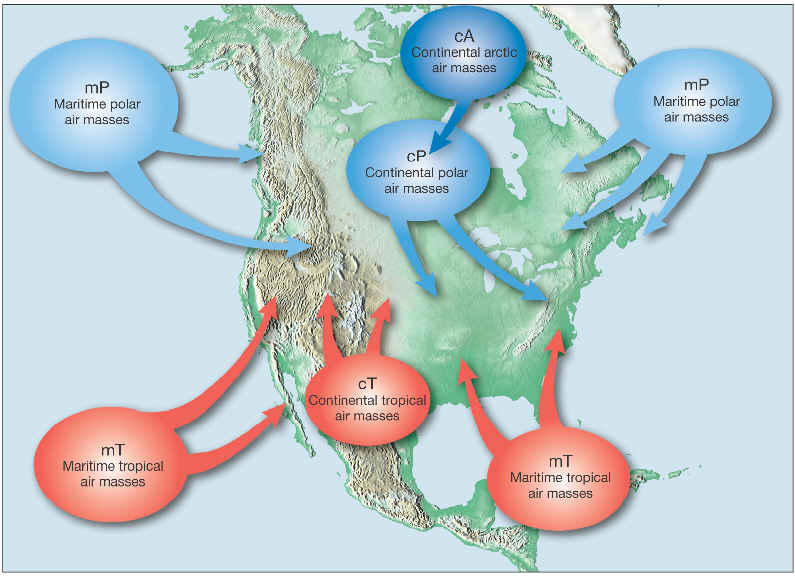
An air mass is a large mass of air that is defined by its temperature and ____________________.
Elevation (altitude)
Water vapor content (humidity)
Strength
Weather

This is the symbol for a _____________ weather front.
Cold
Warm
Stationary
Occluded
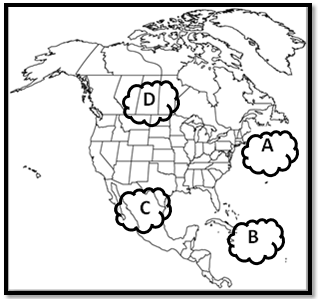


Match the following characteristics of air masses with the word that goes with them.
continental
dry (over land)
maritime
wet/humid (over water)
arctic
cold
polar
cool
tropical
warm

What type of front is being shown in this picture?
cold
warm
stationary
occluded
Type of air mass: extremely cold and very dry
Maritime Tropical
Continental Polar
Continental Arctic
Maritime Polar
Type of air mass: Cool and moist
Continental Polar
Maritime Polar
Continental Tropical
Maritime Tropical
Type of air mass: hot and very dry
Continental tropical
Continental polar
Maritime polar
Maritime tropical

Match the location with the direction of it's prevailing winds.
United States
Northwest
Central America
West
Southern tip of Africa
East
India
Southeast

The curving of wind across our earth is called the Coriolis Effect. It is caused by
(a)

In a low pressure system, (a) and windy weather may occur.
A high pressure system is an capital ______ on a weather map.
A
H
L
P
A low pressure system on a weather map is a capital ____.
A
H
L
P
What type of weather does a high pressure system bring to an area?
happy, sunny clear weather
lousy, cold, rainy weather
fog, lots of fog
lightning
What type of weather does a Low Pressure system bring?
happy, sunny clear weather
lousy, cold, rainy weather
lightning
rainbows and unicorns
A low pressure system winds move in a clockwise direction.
true
false

heavier, sinking air
high pressure
low pressure
lighter, rising air
high pressure
low pressure

low pressure
counterclockwise and inward
counterclockwise and outward
clockwise and inward
clockwise and outward
high pressure
counterclockwise and inward
counterclockwise and outward
clockwise and inward
clockwise and outward

