
 Worksheets
Semester 1 Final Review
Total questions: 64
Worksheet time: 3hrs 52mins

Using the chart, what percentage of the energy comes from all fossil fuels?
41%
20%
86%
25
What is a resource that forms at a rate that is much slower than the rate at which it is consumed?
Renewable Resource
Recycling
Nonrenewable Resource
Natural Resource
Terra's teacher wants her to design a car that can be powered by a renewable resource. Which of the following energy sources would Terra not want to use?
Corn
Wind
Sunlight
Gasoline
Geothermal, wind, and solar are some of the energy resources in which Nevada has an abundant supply. What would be a benefit of their usage compared to other energy sources?
They are relatively cheap to establish.
They are constantly being replenished.
They produce large amounts of carbon dioxide.
They cover relatively small amounts of land.
Which of the following is not a method to reduce soil erosion?
Conservation plowing
Crop rotation
Contour plowing
Clearing vegetation

Which is the least used alternative resource?
Biomass
Wind
Geothermal
Nuclear electric power
Two ways to describe types of igneous rocks are _____
Extrusive and Intrusive
Foliated and Non-Foliated
Clastic and Biochemical
Clastic and Inorganic
Which best describes erosion?
sediment pressing together
dissolved minerals crystallize and glue particles together
particles settle as loosely packed sediment
running water or wind carry away fragments of rock
Which best describes deposition?
sediment pressing together
dissolved minerals crystallize and glue particles together
particles settle as loosely packed sediment
running water or wind carry away fragments of rock
Which process best describes compaction?
particles are squeezed together under pressure
particles glue together as minerals harden
sediment settles
Which process best describes cementation?
particles are squeezed together under pressure
particles glue together as minerals harden
sediment settles

The picture shows a mineral being tested. Which mineral property is being tested in the picture?
cleavage
color
hardness
streak
What is the difference between characteristics and properties of minerals
Properties help to classify & identify minerals but, Characteristics help you determine if a substance is a mineral.
Characteristics help to classify & identify minerals but, Properties help you determine if a substance is a mineral.
Properties help to determine if you should buy minerals but, Characteristics help you determine if a substance is a mineral.
Select all the choices that identify characteristics of a mineral?
Naturally Occurring
Luster
Definite Chemical Composition
Solid
Crystal Structire
Waves dropping sand on the beach is an example of what?
Weathering
Erosion
Deposition
Compaction

-dark, organic material formed in soil from the decayed remains of plants and animals
humus
loam
gravel
clay

Which describes soil composition?
weathered rocks and minerals
dead plants and animals
air and water
all of the above


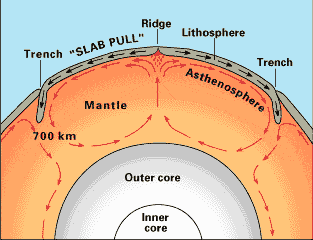
What is the source of energy that drives plate movement?
the subducton of the sea floor
the different densities of the oceanic and crustal plates
convection currents in the Lithosphere
the friction force between the plates that move past each other

Based on the map, what is the best conclusion?
Africa and South America were once joined due to the presence of similar salt deposits
Asia and Antarctica were once joined due to the presence of coal swamps
Africa was once a colder climate due to the glaciated state of its climate in the past
Asia was once an underwater sea world

According to the continental drift hypothesis and the chart, the presence of similar fossils in South America and Africa supports which scientific idea?
Animals easily and frequently travel from Africa to South America.
Species of animals probably traveled between continents on natural rafts (such as trees destroyed in tsunamis).
Land bridges once existed that connected the continents.
South America and Africa were once connected together.

Fossils of ferns have been found on what two continents and what does this suggest?
India and Africa; Africa once once a colder climate
Africa and South America; South America was once a colder climate.
Africa and Australia; Africa was once under water
Africa and Antarctica; Antarctica was once a warmer climate
Which question can best be answered when doing an investigation about earth's layers?
Why do both temperature and pressure stay the same as you move towards the core?
Why do both the temperature and pressure decrease as you move towards the core?
Why do both the temperature and pressure increase as you move towards the core?

Which question can best be answered using the table?
How do we know liquid nickel and iron are the outermost layer and molten rock is the innermost layer?
How do we know solid nickel and iron are the outermost layer and solid rock the innermost layer?

What is B describing?
Crust
Inner core
Outer core
Mantle

Which question can best be answered using the table?
How do we know the outer core is less dense than the crust?
How do we know the density increases as depth increases?
How do we know the inner core is less dense than the mantle?
Which best explains how convection currents move in the mantle?
Warm, less dense molten material rises while cool, more dense material sinks creating convection currents
Cool, less dense molten material rises while warm, more dense material sinks creating convection currents
Warm, more dense molten material rises while cool, less dense material sinks creating convection currents
Cool, more dense molten material rises while warm, less dense material sinks creating convection currents
Which of the following is true regarding the composition of the lithosphere?
The lithosphere is mostly liquid, with some medium-density materials, such as silicon.
The lithosphere is more plastic and flows slowly compared to the solid crust of Earth.
The lithosphere includes the core and the lower portion of the mantle.
The lithosphere includes the crust and the uppermost portion of the mantle, which is solid and rigid.
What is the correct order (starting from the surface) of Earth's layers?
crust, mantle (asthenosphere, lithosphere), outer core, inner core
mantle, outer core, inner core, crust
crust, mantle (lithosphere, asthenosphere), outer core, inner core
outer core, inner core, crust, mantle

Using the image, determine which is the BEST question you could ask to compare/contrast the crust and mantle of the earth.
Is the layer thicker than the outer core?
Is the layer solid?
Does the layer have a temperature of 1,000 Celsius?
Does the the pressure increase and density decrease?
Using the image, determine which is the BEST question you could ask to compare/contrast the Lithosphere and Asthenosphere of the earth.
Does the layer contain rock?
Do plates float on top of this layer?
Does the layer have a temperature of 1,000 Celsius?
Does the the pressure increase and density decrease?
Using the image, determine which is the BEST question you could ask to compare/contrast the Outer core and Asthenosphere of the earth.
Is the layer composed of molten rock?
Is the layer a liquid?
Does the layer have a temperature of 2,200 Celsius?
Does the the pressure increase and density decrease?
Using the image, determine which is the BEST question you could ask to compare/contrast the inner core and lithosphere of the earth.
Is the layer composed of molten rock?
is the layer a solid?
Does the layer have a temperature of 2,200 Celsius?
Does the the pressure, density, and temperature greater than the other layer?
Using the image, determine which is the BEST question you could ask to compare/contrast the inner core and outer core of the earth.
Does the layer contain iron and nickel?
Is the layer in a liquid state?
Does the layer have a temperature of 5,000 Celsius?
Does the the pressure and density increase as the depth increases?

Which indicator would not be good as the only indicator when identifying a mineral?
Color
Breaking Pattern
Specific Gravity
Hardness
How does population growth affect natural resources?
The more people on the planet, the less natural resources that are available for each person.
The less people on the planet, the less natural resources that are available for each person.
The more people on the planet, the more natural resources that are available for each person.

Claim: the consumption of natural resources by humans has a negative impact on the environment. What data would provide evidence for this claim?
Increased human lifespan and decreased ice cap size
Increased human population and decreased habitats for plants and animals
Decreased use of fossil fuel burning by humans and increased use of other resources

Which energy source is used in the following power plant?
Nuclear power
Tidal power
Geothermal power
Hydroelectric power
Which list includes ALL alternative energy sources?
Solar, Hydroelectric, and Coal
Wind, Geothermal, and Natural gas
Biomass, Wind, and Nuclear
Soil, Minerals, and Rocks

