
 Worksheets
Understanding Solutions and Concentration
Total questions: 67
Worksheet time: 2hrs 41mins

How many grams of KNO3 is saturated at 40 degrees?
75
55
65
85
How many grams of C12H22O11(glucose) is saturated at 40 degrees?
240
220
225
250

Which solute is MOST likely a gas? (a)
At what temperature can you fully dissolve 140g of NaNO3?
(a)
62
81
330
At what temperature can you fully dissolve 60g of KNO3?
27
30
37
You cannot determine this
What type of a solution is 60g NaNO3 at 40ºC in 100g H2O?
(a)
Saturated
Supersaturated
What type of a solution is 55g KCl at 70ºC in 100g H2O?
(a)
Saturated
Unsaturated
Match the following terms with their correct definitions.
solute
A substance that is dissolved in a solution.
solvent
A substance that dissolves a solute to form a solution.
soluble
Having the ability to be dissolved in a solvent.
solubility
The amount of solute that can dissolve in a solvent at a specific temperature.
A solution in which more solute can still be dissolved is called
(a)
soluble
saturated

(a) is more soluble at 40 degrees Celsius.

Which substance is least soluble at 0 ºC?
KI
KNO3
KClO3
Ce2(SO4)3

Which solute does not increase in solubility as temperature rises?
(a)
You can make a solution more concentrated by adding more__________.

How many grams of K2Cr2O7, are soluble in 100 g of water at 95 ºC?
83 grams
75 grams
40 grams
12 grams

Which solute is the least soluble at 90 ⁰C?


When 42 grams of potassium chloride ( KCl), is dissolved in 100 grams of water at 50 ºC, the solution can be correctly described as:
supersaturated
saturated
unsaturated
20 grams of NaCl are dissolved in 100 mL of water at 60 0C. How many more grams need to be dissolved for the solution to be saturated?
15 grams
25 grams
6 grams
38 grams

What does this solubility curve show?
Solubility increases as temperature increases
Solubility decreases as temperature increases
Solubility decreases as concentration increases
Solubility is not affected by temperature
25 grams of NaCl are dissolved in 100 mL of water at 60 C. How many more grams need to be dissolved for the solution to be saturated?
13 grams
25 grams
6 grams
38 grams

What does it mean to be an unsaturated solution?
A solution with more solute than solvent
A solution with less than the maximum amount of solute
A solution with the perfect balance of solutes and solvents
A solution with extra solute sitting at the bottom of the solvent
The substance that does the dissolving
Solute
Solvent
Solution
Miscibility

Which of the following will allow for more solute than normal to be dissolved in a solvent?
freezing the solution
shaking the solute
cooling the solution
heating the solution

The most soluble substance at 40 degrees Celcius is
KNO3
NaCl
Pb(NO3)2
KCl

How much KCl will dissolve at 80 degrees Celcius?
52 g
50 g
40 g
60 g

At what temperature will NaCl dissolve 40 g?
80°C
90°C
95°C
85°C

What substance will dissolve 75 g at 40°C ?
KNO3
CaCl2
Pb(NO3)2
NaNO3

The least soluble substance at 10 degrees Celcius is
KClO3
Ce2(SO4)3
K2Cr2O7
NaCl

At approximately what temperature does the solubility of sodium chloride, NaCl, match the solubility of potassium dichromate, K2Cr2O7?
60 ºC
30 ºC
50 ºC
83 ºC
25 grams of NaCl are dissolved in 100 mL of water at 60 C. How many more grams need to be dissolved for the solution to be saturated?
13 grams
25 grams
6 grams
38 grams


John dissolves 54 grams of a solute in a solution he has gently heated near boiling. After a couple of hours he checks the temperature and finds that only 48 grams of solute should dissolve at the present temperature. The solution appears normal otherwise. What type of solution has John made?
unsaturated
saturated
super saturated
unable to determine


Besides stirring, which of the following should be done to make this powder dissolve faster in the liquid?
Add heat to the liquid
Cool the liquid in a freezer
Add more powder to the liquid
Store the mixture in a dark place
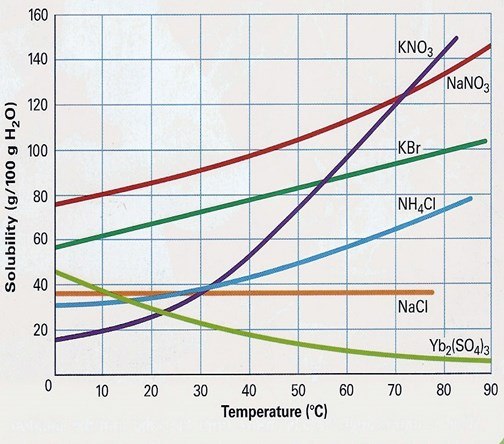
Identify if the following solution would be saturated, unsaturated, or supersaturated: 103 g KBr at 70'C.
Unsaturated
Saturated
Supersaturated

Which of the following refers to the substance that is being dissolved in a solution?
solvent
solute
mixture
Which of the following is an example of a solvent?
sugar
salt
copper sulphate
water

Based on the solubility curve, how many grams of sugar will dissolve in a 100 mL of water at 20°C?
100 g
150 g
200 g
250 g

This is an example of a
Solution
Mixture

Sugar dissolved in water is an example of a
Homogeneous Mixture
Heterogeneous Mixture
Which is an example of a solution?
Salt and Sugar
Salt Water
Jelly beans
Concrete

Which substance is MOST soluble at 90 ºC?
Solid A
Solid B
Solid C

Which solute is least soluble at 90 ⁰C?
solid A
solid B
solid C


Which solute is LEAST soluble at 0 ºC?
A
B
C
D

Which of the following actions will NOT increase the rate of dissolution (dissolving)?
Stirring the solution
Decreasing the temperature
Increasing the surface area of the
solute
Increasing the temperature

Using the provided solubility graph, place the following substances in the proper type of solution formed in 100 g of water.
50 g of KCl at 90°C
50 g of KCl at 60°C
48 g KNO3 at 60°C
80 g KNO3 at 48°C
65 g KNO3 at 70°C
25 g of NaCl at 0°C
10 g SO2 at 60°C
130 g of KI at 0°C
70 g of NH4Cl at 88°C
60 g of HCl at 45°C

Organize these options into solid or gas based on their solubility curves given in the graph.
NaNO3
KI
NaCl
HCl
SO2
NH3
KClO3
NH4Cl

Which of the following will create a supersaturated solution containing 30 grams of KClO3?
Heat the water to 62°C.
Heat the water to 70°C, then let cool to 25°C.
Heat the water to 30°C, then let in cool to 20°C.
Heat the water to 50°C.

At approximately what temperature can 115 g of NaNO3 be dissolved in 100 g of water to create a saturated solution?
(a) °C
How much KCl can be dissolved in 100 g of water at 75°C to form a saturated solution?
(a) g
How many grams of HCl can be dissolved in 50 grams of water at 30°C? (Give the answer to the ones place.)
(a) g
How many grams of NH4Cl can be dissolved in 200 grams of water at 70°C? (Give the answer to the ones place.)
(a) g
What temperature do I have to heat 100 grams of water in order to dissolve 120 grams of NaNO3? (Give the answer to the ones place.)
(a) °C

Placing 100 g of NH3 in 100 g of water at 0°C will result in (a) dissolving.
Placing 50 g of NH4Cl in 100 g of water at 60°C will result in (a) dissolving.
What will occur when more of a solute is placed in a saturated solution?
The temperature of the solution will rise.
The solute will dissolve, creating a supersaturated solution.
The solute will sink to the bottom of the container.
The solvent will absorb the solute and decrease its energy.

Why will 90 grams of NH4Cl never be able to dissolve in 100 g of water?
The water will reach its boiling point before it can dissolve the NH4Cl.
The sample of NH4Cl is hydrophobic and can never dissolve in water.
NH4Cl is a gas, and gases cannot dissolve in water.
The NH4Cl can dissolve in 100 grams of water, but only as a supersaturated solution.

At what temperature can equal masses of KCl and HCl be dissolved in 100 grams of water? (Give the answer to the ones place.)
(a) °C
A solution occurs when the (a) is (b) in a (c) .
There are three types of solutions that can be made. Each type of solution is (a) dependent. (b) solution is formed when there is more solute than the solvent can normally contain. (c) solution is formed when more solute can be added to the solution. (d) solution occurs when the solvent cannot take in any more solute.

