wayground logo

Free Printable Worksheets

Font size

S
M
L
XL
Worksheets

Climate Revision

Total questions: 165

Worksheet time: 2hrs 5mins

Name
Class
Date
1.

What part of a plant is adapted for photosynthesis?

a)

Flowers

b)

Roots

c)

Stem

d)

Leaves

2.

What is the reactant of a reaction?

a)

Something made in a reaction.

b)

Something going into a reaction (an 'ingredient').

3.

Select the two reactants of photosynthesis

a)

Carbon Dioxide

b)

Oxygen

c)

Water

d)

Glucose

e)

Chlorophyll

4.

What is the product of a reaction?

a)

Something made in a reaction.

b)

Something going into a reaction (an 'ingredient').

5.

What are the two products of photosynthesis?

a)

Glucose

b)

Oxygen

c)

Carbon Dioxide

d)

Water

e)

Light

6.

What part of the plant absorbs water from the soil?

a)

Roots

b)

Leaves

c)

Stem

d)

Flowers

7.

How is water transported from the roots to the leaves?

a)

Up the xylem

b)

Up the phloem

c)

Through the stomata

8.

What is the energy source for photosynthesis?

a)

Light

b)

Heat

c)

Water

d)

Electricity

9.

Photosynthesis allows a plant to make its own (a)   .

10.

What are the stomata?

a)

A type of flower

b)

Tiny holes on the bottom of a leaf.

c)

A type of leaf.

d)

Another word for roots.

11.

How does carbon dioxide get into the leaf?

a)

Through the veins

b)

Through the roots

c)

Up the phloem

d)

Up the xylem

e)

Through the stomata

12.

What is the test that we can do to check whether photosynthesis has happened?

a)

The starch test

b)

The sugar test

c)

The protein test

d)

The lipids test

13.

What does a positive result in the starch test look like?

a)

The leaf turns black-blue

b)

The leaf turns white

c)

The leaf stays green

d)

The leaf turns yellow-brown

14.

What chemical do we drop onto a leaf to test for starch?

a)

Iodine

b)

Ethanol

c)

Hydrochloric Acid

d)

pH indicator

15.

What does a negative result in the starch test look like?

a)

The leaf turns black-blue

b)

The leaf turns white

c)

The leaf stays green

d)

The leaf turns yellow-brown

16.

What is the function of chlorophyll??

a)

To absorb light

b)

To absorb heat

c)

To absorb water

d)

To absorb oxygen

17.

Select all adaptions leaves have from the list below.

a)

They have a large surface area

b)

They are thin

c)

They have lots of chloroplasts

d)

They have veins

e)

They are thick

18.
The main source of energy for all life comes from ____.
a)
the Earth
b)
the moon
c)
the sun
d)
the food we eat/make
19.
Why is photosynthesis important?
a)

creates oxygen for animals to breathe

b)

creates energy for animals

c)

creates energy for plants

d)
all of these are correct
20.
What are the products of photosynthesis?
a)
water and carbon dioxide
b)
oxygen and glucose
c)
oxygen and carbon dioxide
d)
oxygen and water
21.
Which gas is removed from the atmosphere during photosynthesis?
a)
hydrogen
b)
oxygen
c)
nitrogen
d)
carbon dioxide
22.
Which statement about photosynthesis is correct?
a)
Plants get the energy they need for photosynthesis from water.
b)
Plants get the energy they need for photosynthesis from soil.
c)
Plants get the energy they need for photosynthesis from sunlight.
d)
Plants do not require energy to perform photosynthesis.
23.
Which sentence correctly describes photosynthesis. (assume there is enough sunlight)
a)
CO2 and water combine and make O2 and glucose
b)
O2 and water combine to make glucose and CO2
c)
O2 and CO2 combine to make water and glucose
d)
CO2 and glucose combine to make O2 and water
24.

Which part of a plant cell is responsible for photosynthesis?

a)

cytoplasm

b)

membrane

c)
chloroplast
d)
nucleus
25.

What is the useful end product of photosynthesis?

a)
carbon dioxide
b)
water
c)
glucose
d)
methane
26.

What is the waste product of photosynthesis?

a)
oxygen
b)

glucose

c)

water

d)

carbon dioxide

27.

Which colour of light do green plants reflect most / absorb least?

a)
Red
b)
Green
c)

Blue

d)

White

28.

The process by which plants make food from sunlight is called.....

a)

Respiration

b)

Photosynthesis

c)

Transpiration

d)

Using food webs

29.

Photosynthesis happens in which part of the plant?

a)

Roots

b)

Petals

c)

Green leaf

d)

Pollen

30.

What is needed for photosynthesis?

a)

Sunlight

b)

Chlorophyll

c)

Water

d)

Carbon dioxide

e)

All of the above

31.

What is the correct equation for photosynthesis?

a)

Oxygen + Carbon Dioxide \rightarrow Chlorphyll + Glucose

b)

Glucose + Oxygen \rightarrow Carbon dioxide + Water

c)

Carbon dioxide + Water \rightarrow Glucose + Oxygen

d)

Carbon Dioxide + Glucose \rightarrow Water + Oxygen

32.

How are leaves adapted for photosynthesis?

a)

They have a big surface area

b)

Chloroplasts are found near the top of the leaf

c)

The underside is covered in stomata

d)

All of the above

33.

What is a 'product' of photosynthesis

a)

Carbon dioxide

b)

Water

c)

Glucose

d)

Chlorophyll

34.

How do plants get the mineral nutrients they need?

a)

From photosynthesis

b)

From respiration

c)

Absorbed through the roots

d)

From the stomata

35.

Stomata are tiny holes on the underside of the leaf, they let .......

a)

nitrogen diffuse in, oxygen out

b)

oxygen diffuse in and carbon dioxide out

c)

carbon dioxide diffuse in, and oxygen out

d)

carbon dioxide diffuse in and out

36.

What do plants depend on in order be pollinated and reproduce?

a)

fertilsers

b)

photosynthesis

c)

nutrients

d)

insects

37.

All of the living organisms in one area, plus their environment is called what?

a)

Ecosystem

b)

Habitat

c)

Species

38.

Plants needed to be pollinated by insects to produce what?

a)

fruits

b)

nuts

c)

seeds

d)

all of the above

39.

What is the producer?

a)

Bird

b)

Worm

c)

Plant

40.

What is the primary consumer?

a)

Leaf

b)

Worm

c)

Bird

41.

What is the secondary consumer?

a)

Plant

b)

Worm

c)

Bird

42.

What is a herbivore?

a)

An animal that eats only animals

b)

An animal that eats only plants

c)

A plant

d)

Something that eats both plants and animals

43.

What is an omnivore?

a)

An animal that eats only plants

b)

An animal that eats other animals only

c)

An animal that is not eaten by anything

d)

An animal that eats both plants and animals

44.
What is one of the reactants of cellular respiration?
a)
energy
b)
glucose
c)
carbon dioxide
d)
water
45.
Which of the following structure is where cellular respiration occurs in the cell?
a)
nucleus
b)
cytoplasm
c)
mitochondria
d)
vacuoles
46.
What are the reactants in the equation for cellular respiration?
a)
oxygen and lactic acid
b)
carbon dioxide and water
c)
glucose and oxygen
d)
water and glucose
47.
What is the correct equation for cellular respiration?
a)
6O2 + C6H12O6 -> 6CO2 + 6H2O + Energy
b)
6O2 + C6H12O6 + Energy -> 6CO2 + 6H2O
c)
6CO2 + 6H2O -> 6O2 + C6H12O6 + Energy
d)
6CO2 + 6H2O + Energy -> 6O2 + C6H12O6
48.
What are the products of aerobic respiration?
a)
Glucose and oxygen
b)
Carbon dioxide and water
c)
Lactic acid
d)
Carbon monoxide
49.
What type of respiration does not require oxygen?
a)
Aerobic
b)
Anaerobic
50.
What happens to your pulse when you exercise?
a)
It increases
b)
It decreases
c)
It stays the same
51.
What is the molecule called that mitochondria produce when they respire glucose?
a)
ATP
b)
ADP
c)
DNA
d)
80p
52.
All living things do which of the following?
a)
Chemosynthesis
b)
Respiration
c)
photosynthesis
d)
all of the answers
53.
The cardiovascular (circulatory) and respiratory system work closely together.
a)
True
b)
False
54.
What metal is in blood that helps blood collect oxygen?
a)
Copper
b)
Gold
c)
Iron
d)
Magnesium
55.
Blood is bright red when it is full of oxygen. 
a)
True
b)
False
56.
Which organ pumps your blood to all your cells?
a)
Liver 
b)
Heart
c)
Brain
d)
Stomach
57.
Out of the organs below, which uses 20% of your energy and dies quickly without oxygen?
a)
Liver
b)
Kidney
c)
Brain
d)
Heart
58.
Which muscle inflates and deflates the lungs?
a)
Alveoli
b)
Lungs
c)
Diaphgrahm
d)
Liver
59.
What is the job of the respiratory system?
a)
To pump blood to all your cells.
b)
To break down food into glucose
c)
To take in Oxygen that will transported by blood.
60.
Which protein in blood helps blood collect Oxygen?
a)
Hydrogen
b)
Haemoglobin
c)
Platelets
d)
Fibrogen
61.
What are the products of anaerobic respiration?
a)
Glucose and oxygen
b)
Carbon dioxide and water
c)
Lactic acid
d)
Carbon monoxide
62.
Which type of respiration is most efficient?
a)
Aerobic
b)
Anaerobic
63.
Which organ breaks down lactic acid?
a)
Liver
b)
Lung
c)
Heart
d)
Bladder
64.
What is the waste energy from respiration given off as?
a)
Heat
b)
Light
c)
Sound
d)
Kinetic
65.
What happens to your breathing rate when you exercise?
a)
It increases
b)
It decreases
c)
It stays the same
66.
Fermentation occurs in the cell's 
a)
cytoplasm
b)
nucleus
c)
cell membrane
d)
cristae
67.
Which of the following structure is where photosynthesis occurs in the cell?
a)
nucleus
b)
chloroplast
c)
mitochondria
d)
endoplasmic reticulum
68.
Carmen conducted an experiment to determine if listening to different types of music would affect a person’s pulse. Her hypothesis was that pulse rate would change with different types of music. Each person listened to seven different selections of music for 30 seconds each. Each person’s pulse was taken before the music and then after each 30-second interval of music. The pulses were taken again after the music selections were completed. Based on her experiment, Carmen concluded that a person’s pulse rate changed when the person listened to different types of music.
Which component is missing from Carmen’s experiment?
a)
a question
b)
a hypothesis
c)
a control group
d)
a description of the experiment
69.
The diagram shows the relationship between photosynthesis and cellular respiration and the organelles in which they occur.
Which statement describes how photosynthesis and cellular respiration are interrelated?
a)
Oxygen is produced during cellular respiration and stored during photosynthesis.
b)
Carbon dioxide and water released by cellular respiration are used in photosynthesis.
c)
Photosynthesis releases the energy that is stored during the process of cellular respiration.
d)
Glucose is used during cellular respiration to produce food that is broken down during photosynthesis.
70.
Which gas is removed from the atmosphere during photosynthesis?
a)
hydrogen
b)
oxygen
c)
nitrogen
d)
carbon dioxide
71.
Why are there less air bubbles as the plant is place further away from the light source
a)
because cellular respiration decreases when there is less light
b)
because the light independent reaction decreases when there is less light
c)
because photosynthesis decreases as a plant is moved further away from a light source
d)
the wavelength increases as a plant is placed further away from a light source
72.
A bacteria that has chlorophyll will be able to do
a)
photosynthesis
b)
cellular respiration
c)
osmosis
d)
active transport
73.
Which of the following is the correct equation for PHOTOSYNTHESIS?
a)
carbon dioxide + water --> oxygen + glucose
b)
carbon dioxide + glucose + water --> oxygen 
c)
oxygen + water --> carbon dioxide + glucose
d)
glucose+ oxygen ---> water + carbon dioxide 
74.

What are the three main types of fossil fuels, you can select multiple.

a)

Crude Oil

b)

Bio-Diesel

c)

Natural Gas

d)

Nuclear

e)

Coal

75.

Fossil Fuels formed over​ (a)   of years from dying animals or plants found in​ (b)   or other aquatic areas.

Choose from the below words
millions
swamps
thousands
mountains
forests
hundreds
76.

There are two things needed to make fossil fuels: Water and (a)   ?

77.

Organize these characteristics into there proper fuel.

Categorize the following

Used 3000 years ago

Used for powering steam engines and Power Plant

Most stable form of Fuel

Used 1900 years ago

Used for Fuel, Heating, and cooking

Most Dangerous Fuel

Used 200 Years ago

Used for plastics, fuel, and heating

Stable but more pliable

Coal
Natural Gas
Crude Oil
78.

Alberta economy is anchored on Oil, Gas, and Coal production and Energy.

a)
True
b)
False
79.

Coal is found in areas of rock called​ (a)   . These can collected either by digging ​ (b)   or at surface digging.

Choose from the below words
seams
underground mining
layers
open-pit mining
strata
80.

Where was the first Oil found in Alberta

a)

Leduc

b)

Red Water

c)

Woodbend

d)

Turner Valley

81.

​ (a)   surveys are used to send sound waves down into the rock to bounce off ​ (b)   rocks and collect data on oil locations.

Choose from the below words
Seismic
reservoir
sediment
Thermal
Electrical
82.

When pressure is to low to get oil up from the reservoir we use (a)   to pump it out.

83.

When refining Oil we use a process called _________ to separate the different types of oil from each other.

a)

Fracking

b)

Distiliing

c)

Boiling

d)

Burning

84.

Natural Gas is found above the reservoir and was usually burnt off before pumping out the oil.

a)
True
b)
False
85.

What is the name of the process that removes carbon dioxide from the air?

a)

Respiration

b)

Transpiration

c)

Photosynthesis

d)

Combustion

86.

Select the organisms that remove carbon dioxide from the air.

a)

Green plants

b)

Algae

c)

Badgers

d)

Insects

87.

In what form is carbon released into the air during respiration?

a)

Solid carbon

b)

Particulates

c)

Carbon monoxide

d)

Carbon dioxide

88.

What is carbon made into in respiration?

a)

Carbon

b)

Glucose

c)

Carbon monoxide

d)

Carbon dioxide

89.

How does carbon get from the air into your body?

a)

Transpiration

b)

Photosynthesis

c)

Respiration

d)

Digestion

90.

Which of these does not add to the amount of carbon compounds in the atmosphere?

a)

Photosynthesis

b)

Decaying animal remains

c)

Burning fossil fuels

d)

Respiring animals

91.
if there is a fire in a forest, there will be less _ in the environment?
a)
nitrogen
b)
oxygen
92.
All of the carbon in existence is continually recycled in the carbon cycle
a)
True
b)
False
93.
How is the burning of fossil fuels related to global warming?
a)
Magic
b)
Fuels are hot
c)
Greenhouse effect
d)
Photosynthesis
94.
Which of the following is an example of a decomposer?
a)
Owl
b)
Fish
c)
Tree
d)
Mushroom
95.
Organisms that do not decompose can be buried and become what?
a)
water
b)
nutrients
c)
air
d)
fossil fuels
96.
Which process converts carbon in the form of sugar into carbon dioxide gas?
a)
Bioremediation
b)
Photosynthesis
c)
Respiration
d)
Transpiration
97.
Combustion is another word for __________.
a)
Transportation
b)
Respiration
c)
Fossil Fuels
d)
Burning
98.
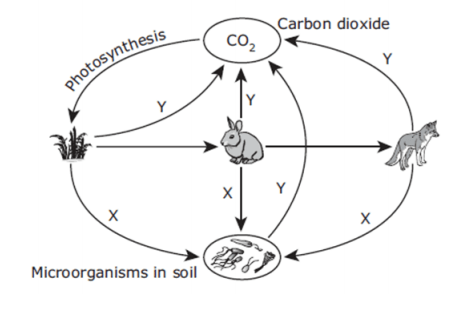
The diagram shows the flow of organic molecules through an ecosystem. What two processes are identified by the labels X and Y?
a)
X : Respiration
Y : Predation
b)
X : Adaptation
Y : Decomposition
c)
X : Fermentation
Y : Nitrogen Fixation
d)
X : Decomposition
Y : Respiration
99.
Which one of these does not add CO2 to the atmosphere?
a)
cooking with gas
b)
planting trees
c)
burning wood
d)
riding in a bus
100.

What are the 3 main fossil fuels?

a)

Coal, Oil, and nuclear fuel

b)

Coal, Oil, and Natural Gas

c)

Electricity, Gas, Petroleum

d)

Coal, Oil, Non-renewable Resources

101.
Fossil fuels are classified as nonrenewable because they.......
a)
require expensive equipment
b)
take millions of years to replace
c)
can be found all over 
d)
provide all the energy we use
102.

Which of these is not a fossil fuel?

a)

Coal

b)

Oil

c)

Electricity

d)

Natural Gas

103.

What is coal made of?

a)

decomposed plant remains

b)

decomposed sea creatures

c)

lava

d)

all of the above

104.
Which layer formed first?
a)
Rock Layer W
b)
Rock Layer X
c)
Rock Layer Y
d)
Rock Layer Z
105.
What is the definition of a renewable resource?
a)
things that don't run out
b)
things that do run out
c)
stuff that makes things happen
d)
none of the above
106.
Oil formation occurs where, millions of years ago, there were large oceans.  This is because oceans have - 
a)
waves that are constantly moving 
b)
great numbers of tiny marine animals
c)
currents that mix the water thoroughly
d)
deep caverns where no light can reach
107.
What is a problem that is linked to the burning of fossil fuels?
a)
Global Warming
b)
geothermal energy
c)
solar power panels
d)
none of the above
108.

5. The Earth provides humans with an unlimited amount of fossil fuels. They are considered renewable.

a)

True

b)

False

109.
Formed from dead marine organisms
a)
Oil and Natural Gas
b)
Coal
c)
Fossil Fuels
110.
What fossil fuel is in the image?
a)
Natural Gas
b)
Steam
c)
Coal
d)
Petroleum
111.
What fossil fuel is in the image?
a)
Coal
b)
Natural Gas
c)
Petroleum
112.

7. Which fossil fuel is the remains of ancient plants?

a)

Coal

b)

Oil

c)

Natural Gas

113.

What conditions are needed to form coal?

a)

Heat and pressure

b)

Heat

c)

Moisture and pressure

d)

Cool and moist

114.
Formed from dead marine organisms
a)
Oil and Natural Gas
b)
Coal
c)
Fossil Fuels
115.
How long does it take for fossil fuels to form?
a)
Millions of years
b)
2 days 
c)
1 day 
d)
5 weeks 
116.
Fossil fuels are classified as nonrenewable because they.......
a)
require expensive equipment
b)
take millions of years to replace
c)
can be found all over 
d)
provide all the energy we use
117.
Energy sources that cannot be replaced once they are used up
a)
Renewable Energy Sources
b)
Non Renewable Energy Sources
118.

Why are fossils fuels so widely used?

a)

They are renewable so they won't run out.

b)

They pollution they produce is less compared to renewable energy sources.

c)

They are easy to obtain and process.

d)

They don't disrupt the environment when mined from the earth.

119.
A combustion reaction is when
a)
A fuel burns realeasing heat and light energy
b)
A substance burns and goes black
120.
The reactants of all combustion reactions are
a)
Fuel and Water
b)
Fuel and Oxygen
c)
Fuel and heat
121.
When a fuel is burnt the gases released are
a)
Oxygen and Carbon
b)
Carbon dioxide and Water
c)
Sulfur dioxide
122.
The test for carbon dioxide is
a)
Limewater turning cloudy
b)
Cobalt chloride paper turning from blue to pink
123.
The test for water is
a)
Limewater turning cloudy
b)
Cobalt chloride paper turning from blue to pink
124.
Combustion reactions are an example of an exothermic reaction because
a)
they release light
b)
they release heat
c)
they give out smoke
125.
The fuel used in a petrol engine is
a)
coal
b)
petrol or diesel
c)
water
126.
When cars burn fuels they release the greenhouse gas __________ which is leading to global warming
a)
Oxygen
b)
water
c)
Carbon dioxide
127.
Incomplete combustion occurs when
a)
there is not enough oxygen
b)
there is not enough fuel
128.
The product of incomplete combustion which is toxic to humans is
a)
Carbon monoxide
b)
water
c)
soot
129.
The product of incomplete combustion which causes respiratory problems
a)
Carbon monoxide
b)
water
c)
soot
130.

Complete the equation for complete combustion

Fuel+ Water -----> (a)   + water

131.

Complete the equation for incomplete combustion

Fuel + Water -----> carbon monoxide + water + (a)  

132.
Which of these isn't in the fire triangle?
a)
Fuel
b)
Heat
c)
Oxygen
d)
Carbon dioxide
133.
Another term for burning is
a)
Fire triangle
b)
Magnesium oxide
c)
Combustion
d)
Bustion
134.
Is combustion a reversible reaction?
a)
Yes.
b)
No.
135.
Water is not used to control fires involving electrical appliances.
a)
False
b)
True
136.
A good fuel burns neither too fast nor too slowly.
a)
True
b)
False
137.
Which of the following is not a combustible substance?
a)
Wood
b)
Cow dung cake
c)
stone
d)
paper
138.
Which of these is NOT an essential part of fire.
a)
Fuel.
b)
Friction.
c)
Heat.
d)
Oxygen.
139.
The conditions which are required for combustion to take place are:
a)
fuel
b)
heat
c)
oxygen
d)
all of these
140.
Which one of the following is not a fossil fuel?
a)
Wood
b)
Coal
c)
Petroleum
d)
Natural Gas
141.
Which type of fire extinguisher should be used on a fire involving flammable liquids such as grease or oil?
a)
Water
b)
Carbon Dioxide 
c)
Dry Chemical
d)
Foam
142.
A compound that contains only carbon and hydrogen and that produces carbon dioxide and water when burned is called a(n)
a)
binary compound
b)
carbonate
c)
ionic compound
d)
hydrocarbon
143.
True or false, bubbling is a sign of a chemical reaction?
a)
True
b)
False
144.

8.7: Combustion is when a __________ reacts with oxygen

a)

petrol

b)

fuel

c)

fire triangle

d)

carbon dioxide

145.
What part of the fire triangle do you remove by spraying water onto a fire?
a)
Heat
b)
Oxygen
c)
Fuel
146.
The word equation for combustion is: fuel + oxygen --> water + ________ __________
a)
Carbon dioxide
b)
Limewater
147.
What do we use limewater to test for?
a)
Carbon dioxide
b)
Water
c)
Heat
d)
Smoke
148.
Why do we burn a fuel?
a)
I don't know.
b)
To release energy
c)
To lose energy
d)
To produce carbon dioxide
149.

How do you test for water from a combustion reaction?

a)

Squeaky pop test

b)

Lime water

c)

Cobalt chloride paper

d)

Chloric cobalt paper

150.

When Cobalt chloride reacts with water it changes from..

a)

blue to pink

b)

pink to blue

c)

yellow to orange

d)

red to blue

151.

The Earth is made up of three main parts, what is the centre called?

a)

Crust

b)

Core

c)

Middle

d)

Mantle

152.

What is the core made up of?

a)

Iron and Copper

b)

Nickel and carbon

c)

Iron and nickel

d)

Nickel and Zinc

153.

The crust and the upper part of the mantle are cracked into a number of large pieces. These are called what?

a)

Continents

b)

Tectonic rafts

c)

Tectonic plates

d)

Earthquakes

154.

What type of rock is formed from magma which is pushed to the surface of the crust?

a)

Igneous

b)

Sedimentary

c)

Metamorphic

155.

What type of rock is formed as a result of heat and increased pressure acting on existing rocks over long periods of time?

a)

Igneous

b)

Sedimentary

c)

Metamorphic

156.

What type of rock is formed from layers of sediments laid down in lakes or seas over millions of years?

a)

Igneous

b)

Sedimentary

c)

Metamorphic

157.

In the rock cycle, what is it called when rocks are broken down into smaller bits?

a)

Transportation

b)

Deposition

c)

Weathering

d)

Erosion

158.

Recycling is better than making things from scratch because:

a)

It uses less of the Earths limited resources

b)

It uses less energy

c)

It saves money as energy is expensive

d)

All of the above

159.

In the carbon cycle, what process removes carbon dioxide from the air?

a)

Respiration

b)

Photosynthesis

c)

Combustion

d)

decomposition

160.

What processes release carbon dioxide in to the air?

a)

Photosynthesis and Combustion

b)

Combustion and Respiration

c)

Photosynthesis and Respiration

161.

How much nitrogen is in our atmosphere?

a)

0%

b)

78%

c)

21%

d)

0.04%

162.

How much oxygen is in our atmosphere?

a)

21%

b)

78%

c)

0.04%

d)

100%

163.

Why are carbon dioxide levels rising?

a)

Burning fossil fuels

b)

Deforestation

c)

Both of the above

164.

Which gas is a greenhouse gas?

a)

Oxygen

b)

Nitrogen

c)

Carbon dioxide

d)

All of the above

165.

The increase in the Earths temperature is called what?

a)

Greenhouse gases

b)

Global temperature rise

c)

Global warming

d)

Global heating