wayground logo

Free Printable Worksheets

Font size

S
M
L
XL
Worksheets

7th Grade Science Final 2023

Total questions: 162

Worksheet time: 2hrs 28mins

Name
Class
Date
1.

Which of the following would be a conclusion?

a)

Is my dog hungry?

b)

My dog was barking because he was hungry.

c)

My dog is barking.

d)

Maybe my dog is barking because he is hungry.

2.

Which of the following is a question?

a)

I put food in the bowl. My dog stopped barking and ate the food. He wagged his tail.

b)

Maybe my dog is barking because he is hungry.

c)

My dog is barking.

d)

Is my dog hungry?

3.

Which of the following is an observation?

a)

Maybe my dog is barking because he is hungry.

b)

My dog is barking.

c)

Is my dog hungry?

4.

Which of the following would be a conclusion?

a)

Is my dog hungry?

b)

My dog was barking because he was hungry.

c)

My dog is barking.

d)

Maybe my dog is barking because he is hungry.

5.

Which of the following is a question?

a)

I put food in the bowl. My dog stopped barking and ate the food. He wagged his tail.

b)

Maybe my dog is barking because he is hungry.

c)

My dog is barking.

d)

Is my dog hungry?

6.

Which of the following is an observation?

a)

Maybe my dog is barking because he is hungry.

b)

My dog is barking.

c)

Is my dog hungry?

7.

What is the first step in the scientific method?

a)

Analyze Data

b)

Report Results

c)

Ask a Question

d)

Experiment

8.

What is the second step of the scientific method?

a)

Hypothesis

b)

Ask a Question

c)

Research

d)

Analyze Data

9.

What is the third step of the scientific method?

a)

Ask a Question

b)

Hypothesis

c)

Research

d)

Experiment

10.

What is the fourth step of the scientific method?

a)

Analyze Data

b)

Collect Data

c)

Conclusion

d)

Experiment

11.

What is the fifth step of the scientific method?

a)

Collect Data

b)

Analyze Data

c)

Research

d)

Conclusions

12.

What is the sixth step in the scientific method?

a)

Research

b)

Analyze Data

c)

Collect Data

d)

Report Results

13.

Data that includes numbers

a)

Constant

b)

Control

c)

Quantitative

d)

Qualitative

14.

Data that includes descriptive words

a)

Constant

b)

Control

c)

Qualitative

d)

Quantitative

15.

A variable that is changed (the cause)

a)

Quantitative

b)

Independent Variable

c)

Dependent Variable

d)

Qualitative

16.

The variable being tested and measured (the effect)

a)

Quantitative

b)

Independent Variable

c)

Dependent Variable

d)

Qualitative

17.

Standard to which experimental results are compared

a)

Constant

b)

Control

c)

Hypothesis

d)

Qualitative

18.

An educated guess that can be tested

a)

Independent Variable

b)

Dependent Variable

c)

Hypothesis

d)

Control

19.

What step is the reason for the experiment? What a person wants to find out.

a)

Question/ Purpose

b)

Research

c)

Hypothesis

d)

Experiment

e)

Analyze

20.

Which step means what you think is going to happen?

a)

Observation

b)

Purpose

c)

research

d)

hypothesis

e)

Experiment

21.

What is the step that means to preform a test.

a)

Conclusion

b)

Purpose/ Question

c)

Hypothesis

d)

Experiment

e)

Research

22.

Qualitative uses the following to aid in observations.

a)

5 senses

b)

numbers

23.

What is an observation?

a)

A description using your five senses.

b)

A good guess about the experiment.

c)

Gathering information about the experiment.

24.

What is the scientific method?

a)

A method of research only scientists use.

b)

A problem solving method that involves developing a hypothesis.

c)

A problem solving method that has no procedures.

d)

None of the above.

25.

A hypothesis is a statement that -

a)

is the same as a theory

b)

can be tested

c)

is almost always true

d)

is almost always false

26.

Which question cannot be answered scientifically because the quantity cannot actually be measured?

a)

How much food does a water buffalo consume in one day?

b)

How fast can a tiger swallowtail butterfly fly?

c)

How heavy is a mature female elephant?

d)

How happy is a chimpanzee when it finds its favorite food?

27.

A student is investigating the effect of plants on indoor air quality and states, "If plants are added to an indoor environment, the air quality will improve." This statement is an example of-

a)

a theory

b)

a procedure

c)

an observation

d)

a hypothesis

28.

What is the dependent variable in this experiment?

a)

Speed

b)

Time

c)

Acceleration

d)

Car

29.

What is the independent variable in this experiment?

a)

Mass of radish

b)

Type of water

c)

Number of trials

d)

Type of radish

30.

A controlled variable...

a)

Remains the same

b)

Measures

c)

Changes

31.

What does a dependent variable do?

a)

Stays the same

b)

Changes

c)

Measures

32.

Which variable changes?

a)

Independent

b)

Dependent

c)

Controlled

33.

True or False

Hypothesis: is the exact explanation for an observation that can be tested by scientific investigations.

a)

True

b)

False

34.

Observation: the act of using one or more of your senses to gather information and taking note of what occurs.

a)

True

b)

False

35.
Dolphin colors range from gray to white
a)
quantitative observation
b)
qualitative observation
36.
Dolphins have smooth skin.
a)
quantitative observation
b)
qualitative observation
37.
Dolphins eat the equivalent of 4% of their body mass each day.
a)
quantitative observation
b)
qualitative observation
38.
There are fourteen penguins.
a)
Observation
b)
Inference
39.

The table top is smooth.

a)

Qualitative Observation

b)

Quantitative Observation

c)

Hypothesis

d)

Inference

40.

The flowers are green and blue.

a)

Qualitative Observation

b)

Quantitative Observation

c)

Inference

d)

Hypothesis

41.

There are 29 students in the classroom.

a)

quantitative observation

b)

qualitative observation

c)

inference

d)

hypothesis

42.

The speed of the car is 55 mph.

a)

Qualitative Observation

b)

Quantitative Observation

c)

Hypothesis

d)

Inference

43.

I predict there will be black M&M's in the bag.

a)

Quantitative Observation

b)

Hypothesis

c)

Inference

d)

Qualitative Observation

44.

I predict if I study, I will get a better grade on the quiz....

a)

Qualitative Observation

b)

Hypothesis

c)

Inference

d)

Quantitative Observation

45.

The girl is 6 years old

a)

quantitative data

b)

qualitative data

46.

The car traveled 70 miles

a)

quantitative data

b)

qualitative data

47.

The juice tastes like oranges

a)

quantitative data

b)

qualitative data

48.

The tree is tall

a)

quantitative data

b)

qualitative data

49.

The box is brown

a)

quantitative data

b)

qualitative data

50.

How does watching TV during studying affect a student’s test grades? Student's grades are the....

a)

independent variable

b)

dependent variable

51.

What effect does decreasing the temperature of a room have on a lifespan of a battery? The temperature of the room is the...

a)

independent variable

b)

dependent variable

52.

Does the type of shoe worn during a 30 meter dash affect the speed of the runner? The speed of the runner is the...

a)

independent variable

b)

dependent variable

53.

Does the flavor of ice cream effect how fast the ice cream melts? The flavor of ice cream is the....

a)

independent variable

b)

dependent variable

54.
Marcos wants to know: Does the type of gasoline put in a car effect how fast the car can drive? What is the independent variable?
a)
Type of gasoline
b)
which car the gas is put into
c)
how fast the car can drive
d)
how much gas is put into the car
55.
Ramone wants to know: does the distance a person kicks a soccer ball effect how well they will do on their math test.  What is the dependent variable?
a)
How far they kick the soccer ball
b)
who the person is
c)
how well they do on the math test
d)
Type of soccer ball.
56.

Describes a group of living things that are no longer living.

a)

fossil

b)

extinct

c)

endangered

d)

dinosaur

57.

The hardened remains of a living thing that died long ago.

a)

fossil

b)

extinct

c)

endangered

d)

minerals

58.

Why are there more animal fossils than plant fossils?

a)

Animals are smaller than plants.

b)

Plants have harder bodies than animals.

c)

Plans have softer bodies than animals.

d)

Animals eat plants.

59.

Which type of fossil would look just like the body part of a once-living thing?

a)

mineral

b)

footprint

c)

cast

d)

petrified wood

60.

Which type of rock are most fossils found?

a)

sedimentary rock

b)

metamorphic rock

c)

igneous rock

d)

fossils

61.

An animal has sharp, pointy teeth, what can we infer about this animal?

a)

The animal lived in the water

b)

The animal lived near the beach.

c)

The animal is a carnivore.

d)

The animal only ate plants.

62.

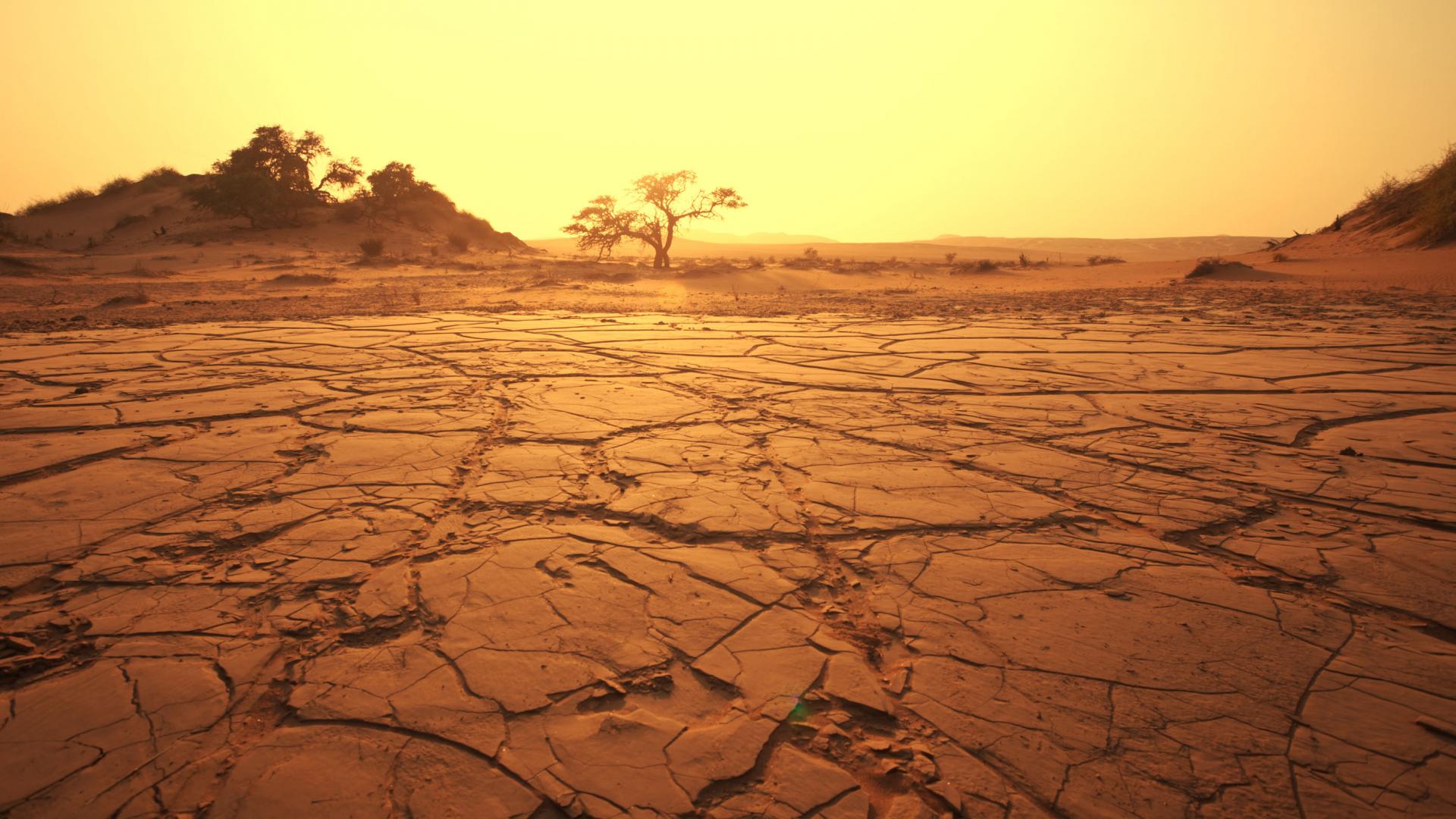
If a scientist found a fish fossil in the desert, what can they infer?

a)

An animal ate the fish.

b)

The water covered the area long ago.

c)

Today's fish looks the same

d)

The fish is endangered.

63.

What needs to happen FIRST for a fossil to form?

a)

A plant or animal must be covered by sediment.

b)

A plant or animal must die and decompose.

c)

Sediments fill a a mold to form a cast.

d)

An earthquake shifts the land up.

64.

Turtles look much like they did millions of years ago. What can we infer about turtle fossils?

a)

They did not change over time.

b)

The turtle survived the ice age.

c)

Turtles went extinct.

d)

Turtles were never endangered.

65.
The diagram shows layers of sedimentary rock and examples of the fossils each layer contains, Which layer contains the oldest fossils? 
a)
A. Layer 2
b)
B. Layer 4
c)
C. Layer 1
d)
D. Layer 3
66.
Which fossil layer is the youngest? 
a)
A. Layer A
b)
B. Layer B
c)
C. Layer C
d)
D. Layer D
67.
How are fossils created?
a)
A. Traces of organisms harden like rock. 
b)
B. Dead organisms are quickly buried for millions of years.
c)
C. Animals get trapped.
d)
D. All of the above
68.
Some students made a model to show one of the first steps in the formation of sedimentary rock.  The students pour 2 cm of light-colored sand into a clear plastic box.  Then they add 1 cm of gravel.  Finally, they pour 2 cm of dark-colored sand on top of the gravel.  Which characteristic of sedimentary rock does this model best show?
a)
A. Sedimentary rock is made of layers.
b)
B. Sedimentary rock is cemented bits of rock.
c)
C. Sedimentary rock is often limestone.
d)
D. Sedimentary rock is common in Texas.
69.

The preserved remains or evidence of ancient living things...

a)

clay

b)

fossils

c)

igneous rocks

d)

silt

70.

Which is a mold?

a)

the impression left by an organism

b)

a copy of the organism, like a statue

71.

A scientist finds footprints in a fossilized stream bed. This is a ________.

a)

carbon film

b)

mineral replacement

c)

cast fossil

d)

trace fossil

72.

Fossils could provide evidence for....

a)

relationships between past organisms and current organisms

b)

past organisms only

c)

current organisms only

73.
Which animal part would most likely form a fossil?
a)
Muscle 
b)
Fur
c)
Lung
d)
Bone 
74.
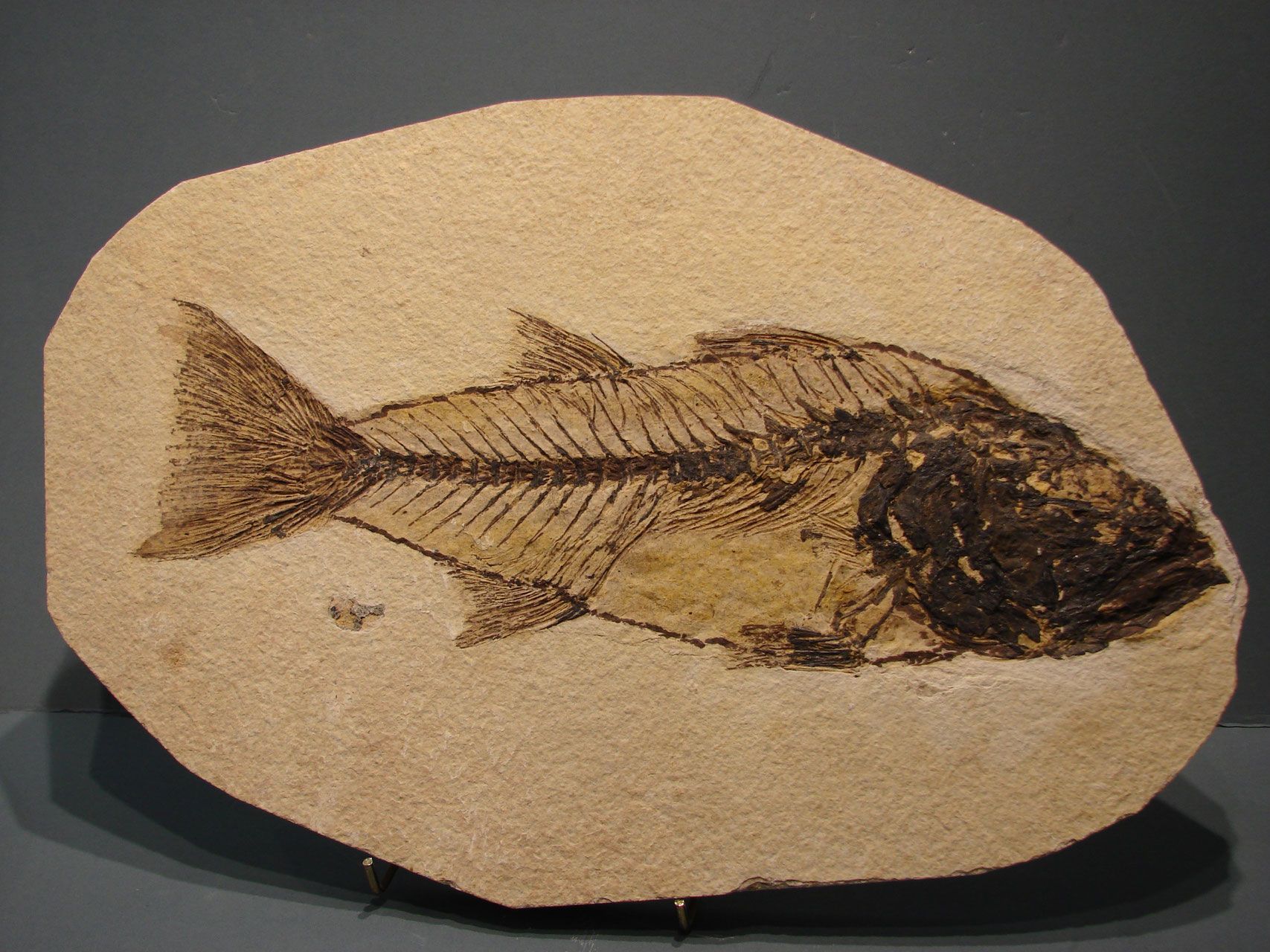
Look at the fossil above. Where would be the BEST place to find it?
a)
desert
b)
jungle
c)
near the ocean
d)
piedmont
75.
If scientists found this fossil, what could they infer?
a)
what fish are like today
b)
that this fish lacked oxygen
c)
what kind of animal ate this fish
d)
that water once covered the area
76.
Which layer formed first?
a)
Rock Layer W
b)
Rock Layer X
c)
Rock Layer Y
d)
Rock Layer Z
77.
Where can the oldest layer be found?
a)
The top layer
b)
The middle layer
c)
They are all the same age
d)
The bottom layer
78.
In which kind of rock do we usually find a fossil?
a)
sedimentary  rock
b)
metamorphic rock
c)
igneous rock
79.

What type of fossils provide evidence of the activities of ancient organisms?

a)

molds and casts

b)

petrified fossils

c)

trace fossils

d)

carbon films

80.

An organism is ______________ if it no longer exits and will never live again on Earth.

a)

rare

b)

extinct

c)

plentiful

d)

missing

81.

What is an extremely thin coating of carbon on rock?

a)

sediment

b)

sap

c)

tar

d)

carbon film

82.

Scientist study the ____________________ to learn about the history of life, past environments on Earth, and how different groups of organisms have changed over time.

a)

fossil record

b)

animal record

c)

historical record

d)

Earth record

83.
Method by which order of events or age of rocks is determined by examining the position of rocks in a layer 
a)
relative dating
b)
absolute dating
c)
radiometric dating
84.

Which type of fossils can be created when an animal walked in mud long ago and then the mud hardened intro rock?

a)

Cast Fossil

b)

Mold Fossil

c)

Trace Fossil

d)

True Form Fossil

85.

Which type of fossil show the organism in 3D form, sticking out from the rock?

a)

Cast Fossil

b)

Mold Fossil

c)

Trace Fossil

d)

True Form Fossil

86.

Scientists use which type of fossils to study animal behavior; how they moved?

a)

Cast Fossil

b)

Mold Fossil

c)

Trace Fossil

d)

True Form Fossil

87.

Scientists can use plaster in order to make a cast fossil from what type of fossil?

a)

Cast Fossil

b)

Mold Fossil

c)

Trace Fossil

d)

True Form Fossil

88.

Which type of fossil is this?

a)

Mold

b)

Cast

c)

Preserved original remains

d)

Trace

89.
When an organism dies, its soft parts _________ quickly or are eaten by animals.
a)
fade away
b)
disappear
c)
get washed away
d)
decay
90.
Biodiversity refers to
a)
extinct species
b)
the variety of species on Earth
c)
nonrenewable resources
d)
the rate of species decline
91.
Sustainability refers to
a)
how many species are present in an ecosystem
b)
when a species goes extinct
c)
how long a species lives
d)
the ability to maintain ecological process over long periods of time.
92.
The higher the biodiversity, the more sustainable an ecosystem is.
a)
True
b)
False
93.
Which best explains why producers are at the beginning of all food chains?
a)
They turn dead animals into nutrients
b)
They provide shelter for smaller animals
c)
The transfer energy from the sun into food
94.

A drought has hit this grassland biome. How will this affect the rabbit population?

a)
The rabbits will increase in number.
b)
The rabbit population will stay the same.
c)
The rabbit population will decrease.
d)
The rabbit population will become extinct immediately.
95.
Brown trout consume (eat) more tadpoles when the fly larvae reduce in number (decrease).  This proves...
a)
The dependence of organisms and biodiversity in an ecosystem
b)
Diversity increases as organisms decrease
c)
Losing an animal is good for ecosystems
d)
Changes in ecosystems create new organisms
96.
In a grassland ecosystem, lions prey on wildebeest. The population of lions has declined steadily because of illegal hunting. What will most likely happen to the population of wildebeest?
a)
The wildebeest population will increase
b)
The wildebeest population will decrease
c)
The wildebeest population will remian the same
97.
Humans are not affected by the biodiversity of ecosystems.
a)
True
b)
False
98.

What is true about sustainability?

a)

Having a small number of species increases biodiversity

b)

Sustainability is how organisms change over time

c)

Sustainability is how much rainfall and sunlight an ecosystem receives

d)

The more different types of species you have (biodiversity) the better an ecosystem can sustain itself

99.

A certain area of the Indian ocean is expected to dry up and become a desert over thousands of years. What will happen to the sustainability of this ocean?

a)

Sustainability would increase because the number of species would increase

b)

Sustainability would remain the same

c)

Sustainability would decrease because the number of species would decrease

d)

Not enough information is given

100.

Which of the following would cause biodiversity to DECREASE?

a)

Water

b)

Forest Fires

c)

Sunlight

d)

Producers

101.

A hurricane hit a tundra and a forest. A tundra is less biodiverse than the forest. Which biome would be impacted the most?

a)

The forest because it has more species and it wouldn't be able to sustain itself as well as the tundra

b)

They would be impacted the same

c)

The forest because it has more producers

d)

The tundra because it has less species and it wouldn't be able to sustain itself as well as the forest

102.

When biodiversity increases

a)

Sustainability decreases

b)

Sustainability remains the same

c)

Sustainability also increases

d)

Sustainability becomes greater by 2

103.

When biodiversity decreases

a)

Sustainability also decreases

b)

Sustainability remains the same

c)

Sustainability increases

d)

Sustainability is not impacted

104.
What is the difference between biotic and abiotic?
a)
Biotic are non-living things
b)
Abiotic are living organisms
c)
Biotic is life,
Abiotic is non-living
d)
Biotic is non-living, Abiotic is living
105.
What does biodiversity mean?
a)
Only one species in an area.
b)
The different amount of species in an area
c)
All abiotic life
d)
Nitrogen fixation
106.
Which option is abiotic?
a)
Plants
b)
Bacteria
c)
Water
d)
Fungi
107.
Which option is biotic?
a)
Plants
b)
Air
c)
Water
d)
Energy
108.
What percentage of energy is passed on to each tropic level?
a)
10%
b)
50%
c)
90%
d)
100%
109.
What might happen if you remove a primary consumer from the ecosystem?
a)
There would be more food for secondary consumers.
b)
The number of primary consumers would increase.
c)
The number of plants would increase.
d)
The number of secondary consumers would increase.
110.
How do producers obtain energy?
a)
They conduct photosynthesis.
b)
They consume plants.
c)
They consume primary consumers.
d)
They consume secondary consumers.
111.
Non-living factor that affects an ecosystem
a)
biotic factor
b)
abiotic factor
c)
food chain 
d)
biome
112.
Consumer that eats plants
a)
heterotroph
b)
herbivore
c)
producer
d)
community
113.
A large ecosystem is called a ______
a)
Ecosystem
b)
Habitat
c)
Biome
d)
Niche
114.
Which biome is the driest?
a)
Desert
b)
Tundra
c)
Taiga
d)
Rainforest
115.
Which Biome has permafrost?
a)
Temperate Forest
b)
Rainforest
c)
Taiga
d)
Tundra
116.
Which biome has deciduous trees (which lose their leaves)?
a)
Temperate Forest
b)
Rainforest
c)
Grasslands
d)
Taiga
117.
Which biome has wide-open fields of grass?
a)
Taiga
b)
Grasslands
c)
Temperate Forest
d)
Rainforest
118.
Which biome has the most variety of plants and animals?
a)
Temperate Forest
b)
Rainforest
c)
Tundra
d)
Grasslands
119.
Which biome is home to lions, zebras, wildebeests, giraffes, and elephants?
a)
Grasslands
b)
Tundra
c)
Rainforest
d)
Temperate Forest
120.
Which biome is home to jaguars, anacondas, leopards, gorillas, and poisonous tree frogs?
a)
Grasslands
b)
Temperate Forest
c)
Rainforest
d)
Tundra
121.
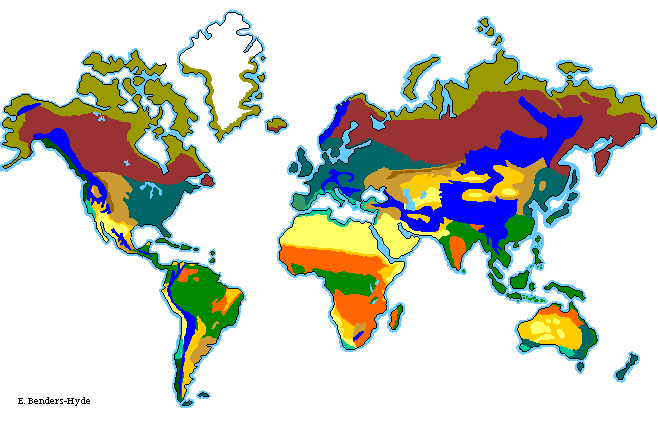
The ability to conserve water is an important adaptation in which biome?
a)
Coniferous Forest
b)
Deciduous Forest
c)
Desert
d)
Tundra
122.
Which symbols best describe mutualism?
a)
+,+
b)
+,-
c)
+,0
d)
-,0
123.
Which symbols best describe parasitism?
a)
+,+
b)
+,-
c)
+,0
d)
-,0
124.
Which symbols best describe commensalism?
a)
+,+
b)
+,-
c)
+,0
d)
0,0
125.

The three types of symbiotic relationships are:

a)

Mutualism, commenalism, pariatism

b)

Prey, predator, producer

c)

Parasitism, mutism, commonism

d)

What are symbiotic relationships?

126.

Temperature, light, air, water, and soil are all _____ parts of the environment

a)

alive

b)

biotic

c)

abiotic

d)

living

127.

What is an example of a biotic factor?

a)

skunk

b)

rocks

c)

soil

d)

water

128.

A population is...

a)

A group of one species in one area

b)

Multiple species that live in one area

c)

All of the living and nonliving things in an area

d)

None of these

129.

An animal that eats only plants.

a)

scavenger

b)

omnivore

c)

herbivore

d)

carnivore

130.
What is an ecosystem?
a)
A group of animals that are the same species.
b)
Soil, water, air and sunlight
c)
All the living and non living things that interact in an area.
d)
North America
131.
Which is a non-living part of an ecosystem?
a)
Sunlight
b)
Air
c)
Water
d)
All of these
132.
What is the name for all the animals of the same species living in an ecosystem?
a)
Population
b)
Community
133.
What is the name for all the living things in an ecosystem?
a)
Population
b)
Community
134.
An animal that hunts other animals for food is called a ___________________.
a)
Villian
b)
Predator
c)
Prey
d)
Fred
135.
An animal that is hunted by other animals for food is called _____________________ .
a)
Victim
b)
Sally
c)
Predator
d)
Prey
136.
All of the nonliving parts of an ecosystem are __________.
a)
biotic
b)
biology
c)
abiotic
d)
biography
137.
All of the living AND non-living things in an area that interact with each other are called a/an __________.
a)
community
b)
habitat
c)
population
d)
ecosystem
138.
A group of different species that live together and interact in an environment are called a/an __________.
a)
community
b)
habitat
c)
population
d)
ecosystem
139.
What are biotic factors?
a)
dead things
b)
living things/ organisms
c)
weather
d)
plants
140.
Which is an example of a BIOTIC factor?
a)
lightning
b)
algae
c)
sand
d)
clouds
141.
A relationship where both organisms benefit is called __________.
a)
mutualism
b)
commensalism
c)
parasitism
142.
A relationship where one organism benefits and one organism is harmed is called __________.
a)
mutualism
b)
commensalism
c)
parasitism
143.
A relationship where one organism benefits and one organism is unaffected is called __________.
a)
mutualism
b)
commensalism
c)
parasitism
144.
A bird in a tree watched as a lion stalked, attacked, and then ate a zebra. Which of these animals was the prey?
a)
bird
b)
lion
c)
zebra
d)
all of the above
145.
An individual living thing is a/an ___________.
a)
habitat
b)
ecosystem
c)
organism
d)
population
146.
What term describes all living factors in an environment?
a)
abiotic
b)
zoological
c)
biotic
d)
biological
147.
What term describes all nonliving factors in an environment?
a)
abiotic
b)
zoological
c)
biotic
d)
biological
148.

How does population growth affect natural resources?

a)

The more people on the planet, the less natural resources that are available for each person.

b)

The less people on the planet, the less natural resources that are available for each person.

c)

The more people on the planet, the more natural resources that are available for each person.

149.
Remora are small fish with a sucker-like organ that allows them to attach themselves to larger animals like a shark.  By doing this, the remora is able to gain protection from the presence of the shark while helping the shark stay clear from parasites.  This relationship shows _?
a)
 parasitism
b)
mutualism       
c)
commensalism
d)
predation
150.
What factor would cause animals of the same species to begin competing with one another?
a)
increase in precipitation         
b)
the presence of decomposers
c)
the introduction of a new food source
d)
limited supply of resources
151.
In an ecosystem, members of the lizards are observed eating members of the insect population.  In this same ecosystem, birds are also observed using insects as a food source.  The relationship between lizards and birds would best be described as –
a)
predator
b)
 competitive
c)
parasitic
d)
mutualistic
152.
Living things depend on many different _________ in order to survive.
a)
resources
b)
environments
c)
ecosystems
d)
interactions
153.
Ecosystems depend on organisms to ________ with each other to maintain stability.
a)
interact
b)
build
c)
eat
d)
grow
154.
Plants compete for air, water, ________ within ecosystems.
a)
space, and sound
b)
sunlight, and wind
c)
space, and sunlight
155.

A ____________________ Relationship is when two living things "fight" for limited resources.

a)

Dependent

b)

Competitive

156.

Is this CLOUD BIOTIC or ABIOTIC?

a)

Biotic

b)

Abiotic

157.

Is this OWL BIOTIC or ABIOTIC?

a)

Biotic

b)

Abiotic

158.

Is this ROCK BIOTIC or ABIOTIC?

a)

Abiotic

b)

Biotic

159.

Ecosystem relationships: What happens to an herbivore population when a predator population INCREASES?

a)

Decrease

b)

Increase

c)

Stay the same

160.

Ecosystem relationships: What happens to an herbivore population when a predator population DECREASES?

a)

Increase

b)

Decrease

c)

Stay the same

161.

This abiotic factor could cause a population to leave the area!

a)

Disease

b)

Increase in temp

c)

Less prey

162.

Changes in this biotic factor could cause an increase in a population....

a)

Increase in predators

b)

Increase in prey

c)

Change in dissolved oxygen levels