wayground logo

Free Printable Worksheets

Font size

S
M
L
XL
Worksheets

End of the Year Quiz- What have you learned this year?

Total questions: 160

Worksheet time: 2hrs 6mins
Name
Class
Date
1.
If you are not sure what to do during a lab activity:
a)
guess
b)
change lab partners
c)
ask a teacher
d)
just sit quietly and do nothing
2.
You should never ______ chemicals in the lab. 
a)
taste
b)
touch
c)
smell
d)
all of the above
3.
When is it OK to eat or drink in the lab?
a)
Always
b)
Never
4.
If you break glassware in the lab, you should...
a)
Tell the teacher
b)
Clean it up quickly before the teacher notices
c)
Scream at the top of your lungs
5.
When in the lab...
a)
long sleeves and loose clothing should be rolled up
b)
closed toe shoes should be worn
c)
long hair should be pulled back
d)
all of the above
6.
The proper technique for smelling chemicals is ______________
a)
keeping your nose close to the glassware
b)
wafting
c)
to sniff only a small amount
d)
Trick question; you never are allowed to smell chemicals in class
7.
An experiment is performed on plants to see how different liquids affect plant growth. Each plant in the experiment is given a different liquid; water, apple juice, or milk. Each plant has the same amount of soil, sunlight, and listens to the same music. In this investigation, the independent variable is ...
a)
The type of plant
b)
The amount of sunlight
c)
The type of music
d)
The type of liquid
8.
An experiment is performed on plants to see how different liquids affect plant growth. Each plant in the experiment is given a different liquid; water, apple juice, or milk. Each plant has the same amount of soil, sunlight, and listens to the same music. In this investigation, what are the controlled variables?
a)
Type of plant, amount of music, and sunlight
b)
Water, apple juice, milk
c)
Plant growth
9.
An experiment is performed on plants to see how different liquids affect plant growth. Each plant in the experiment is given a different liquid; water, apple juice, or milk. Each plant has the same amount of soil, sunlight, and listens to the same music. In this investigation, what is the dependent variable?
a)
Type of plant
b)
Water, apple juice, milk
c)
Plant growth
10.
Does the type of shoes affect the running speed?Which is the correct testable question?
a)
If the subject wears boots, then the subject will jump the fastest.
b)
If the subject wears heels, then the subject will run the slowest.
c)
The subject wears Nike, then the subject will run the fastest.
d)
If I wear Nike, then I will run the slowest.
11.

Does the type of ball affect the bouncing height?

Which hypothesis is correct?

a)
If the subject bounces a ping pong ball, then the ping pong ball will bounce the highest.
b)
If we use a big ball, the ball will bounce really high.
c)
She can use a basketball, then the ball will bounce the lowest.
d)
If the subject uses a bowling ball, the bowling ball will bounce the lowest.
12.
If a piece of matter changes shape, what happens to its mass?
a)
It increases
b)
It decreases
c)
it changes randomly
d)
it stays the same
13.
Mass is a property of ___________.
a)
waves
b)
energy
c)
matter
d)
light
14.
What is the definition of "weight"?
a)
measure of the force of gravity on your body
b)
the time it takes to get on a ride 
c)
the amount of matter in an object
d)
the size of an object
15.
What is the mass on this triple beam?
a)
270g
b)
202g
c)
273g
16.
What is the volume of the liquid in this graduated cylinder?
a)
19 mL 
b)
35 mL 
c)
24 mL 
d)
1.9 mL
17.
What is the scale on this graduated cylinder?
a)
.1 mL per line
b)
.2 mL per line
c)
.5 mL per line
d)
1 mL per line
18.
4620 cm = _____  m
a)
46.2
b)
462
c)
.462
d)
46200
19.
1 centimeter = ___ meters
a)
10 millimeter
b)
20 millimeter
c)
30 millimeter
d)
40 millimeter
20.
What is the boiling point of water?
a)
0 degrees celcius
b)
32 degrees celcius
c)
100 degrees celcius
d)
I have no idea.
21.
An object that allows heat or electricity to pass through easily is a
a)
Insulator
b)
Conductor
22.
Which liquid has the highest density? 
a)
corn syrup
b)
lamp oil
c)
rubbing alcohol
d)
honey
23.
What object would best complete this circuit?
a)
A battery
b)
a peice of yarn
c)
an insulator
d)
a conductor
24.

It would be slower and harder to swim in honey than water because honey is

a)

Colder

b)

More viscous

c)

More coloured

d)

More natural

25.

To change states ( eg. from ice to water) requires a change in the amount of

a)

Heat energy

b)

Kinetic energy

c)

Potential energy

d)

Elastic energy

26.
Some power plants produce energy by burning coal. In these power plants, the heat from burning coal is used to boil water. Which statement best describes the changes that occur when burning coal and boiling water?
a)
Burning coal and boiling water are both physical changes
b)
Burning coal and boiling water are both chemical changes
c)
Burning coal is a chemical change, and boiling water is a physical change
d)
Burning coal is a physical change and boiling water is chemical change
27.
When water boils, water vapor is produced and escapes into the air. Which BEST describes this change?
a)
Melting
b)
Freezing
c)
Physical Change
d)
Chemical Change
28.
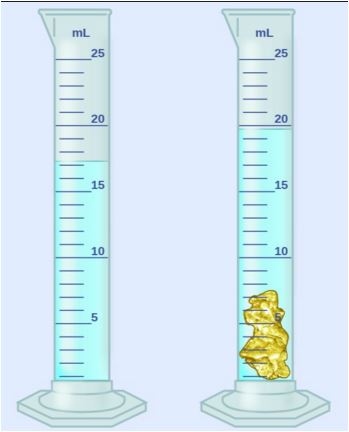
An irregularly shaped piece of gold was lowered into a graduated cylinder holding a volume of water equal to 17 ml. The height of the water rose to 20 ml. If the mass of the gold was 27 g, what was its density?
a)
9 g/mL
b)
10.5 g/mL
c)
6.5 g/mL
d)
8 g/mL
29.
An irregularly shaped stone was lowered into a graduated cylinder holding a volume of water equal to 2 ml. The height of the water rose to 7 ml. If the mass of the stone was 25 g, what was its density?
a)
30g/mL
b)
5g/mL
c)
20g/mL
d)
2.77g/mL
30.
A block of aluminum occupies a volume of 15.0 mL and weighs 40.5 g. What is its density?
a)
2.8g/mL
b)
2.7g/mL
c)
2.66.g/mL
d)
2.5g/mL
31.
Which of these grouping of elements could have the characteristic of luster (shiny)?
a)
Metal
b)
Nonmetal
c)
metalloids
d)
Both metals and metalloids
32.
Which of these grouping of elements could have the characteristic of brittle?
a)
Metal
b)
Nonmetal
33.
Which of the following is a good conductor of heat?
a)
Metal
b)
Nonmetal
c)
Metalloid
34.
One property of a nonmetals is that it is a good conductor of electricity?
a)
true
b)
false
35.
Which element is a metalloid?
a)
Titanium
b)
Selenium
c)
Potassium
d)
Polonium
36.
Which of the following is not a compound?
a)
HCl
b)
Cl
c)
NaCl
d)
CO2
37.
Which of the following represents an element?
a)
H2O
b)
H2
c)
NaCl
d)
CaCO3
38.
What type of energy is in this picture?
a)
Kinetic
b)
Potential
c)
Electromagnetic
39.
When plants convert the sun's energy into food, which type of energy does the sun energy become?
a)
kinetic
b)
chemical
c)
thermal
40.
Energy causes ___________ to occur.
a)
change
b)
motion
c)
age
41.
What form of energy?
a)
Mechanical (kinetic) energy
b)
Chemical (kinetic) energy
c)
Sound (potential) energy
d)
Sound (kinetic) energy
42.
What kind of energy?
a)
Thermal (kinetic) energy
b)
Thermal (potential) energy
c)
Nuclear (kinetic) energy
d)
Mechanical (kinetic) energy
43.
What form of energy?
a)
Thermal
b)
Electrical
c)
Mechanical
d)
Radiant
44.
What kind of energy?
a)
Radiant
b)
Electrical
c)
Thermal
d)
Chemical
45.
What form of energy is stored in the bonds between molecules of matter?
a)
chemical energy
b)
heat energy
c)
kinetic energy
d)
mechanical energy
46.
At what position does the rock have the greatest kinetic energy?
a)
A
b)
B
c)
D
d)
E
47.
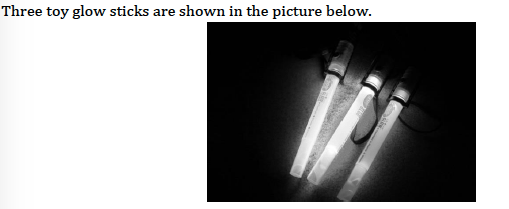
The glow sticks produce light for a short amount of time. The light from the glow stick is a conversion from what to what?
a)
thermal to light
b)
gravitational to potential
c)
radiant to electrical
d)
chemical to light
48.
Wind turbines and windmills convert what energy to another?
a)
Kinetic to electric
b)
Gravitational potential to electric
c)
Mechanical to potential
d)
Thermal to sound
49.
Non-Renewable resources are also known as what?
a)
Fossil Fuels
b)
Renewable
c)
Solar Energy
d)
Hydroelectric Energy
50.
what is a non renewable resource?
a)
water
b)
wind
c)
coal
d)
biomass
51.
What is an example of a renewable resource?
a)
hydroelectric
b)
oil
c)
coal
d)
fossil fuel
52.
Fossil fuels are Renewable resources. True or False?
a)
True
b)
False
53.
Do Renewable energy sources run out?
a)
Yes 
b)
No
54.
Energy we get from burning living things
a)
Hydroelectricity 
b)
Wind Energy
c)
Biomass Fuel
d)
Hydrogen Power
55.
Which is NOT an advantage of geothermal power?
a)
renewable
b)
no pollution
c)
you don't have to transport it
d)
geysers and volcanoes are everywhere
56.
__________ is an energy resource that WILL run out in the next several hundred years.
a)
Renewable Energy Resource
b)
Nonrenewable Energy Resource
57.
Coal is a __________ energy resource.
a)
Renewable
b)
Nonrenewable
58.
What percentage of our energy use comes from fossil fuels?
a)
25%
b)
45%
c)
61%
d)
86%
59.
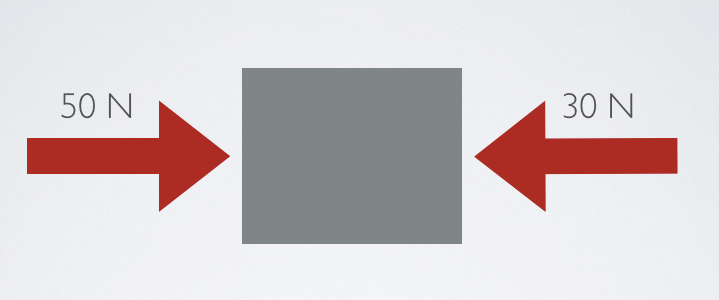
What is the net force?
a)
20 N 
b)
0 N 
c)
400 N 
d)
40 N 
60.
How will this object move? 
a)
It won't move. 
b)
It will move to the right. 
c)
It will move to the left. 
d)
It will move up. 
61.
A wheeled cart is moving to the right at a constant speed.  Two forces of equal magnitude are acting upon the cart. Which of the following best describes the forces and motion of the cart?
a)
Balanced Forces, Constant Speed
b)
Balanced Forces, Acceleration
c)
Unbalanced Forces, Constant Speed
d)
Unbalanced Forces, Acceleration
62.
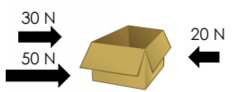
What is the net force?
a)
40 N left
b)
0 N Balalnced
c)
400 N right
d)
40 N right
63.
Calculate the Net Force. 
a)
60N, Left 
b)
40N, Right 
c)
0N
d)
60N, Right
64.
In a tug of war the left team pulls with a force of 200N. The right team pulls with a force of 150N. What is the resultant force?
a)
50N to the left.
b)
350N to the left.
c)
350N to the right.
d)
50N to the right.
65.
The ideal mechanical advantage of a block and tackle depends on the 
a)
input force
b)
output force
c)
number of pulleys
d)
numbers of strands or ropes. 
66.
What is a pulley system? 
a)
A simple machine that consist of a wheel and a rope 
b)
A simple machine that consist of a board and a rope
c)
A simple machine that uses a wedge 
d)
A diving board 
67.
The longer the inclined plane, the ___________________ to move the object
a)
the less input force you need
b)
the more input force you need
c)
the more output force you need
d)
the less output force you need
68.
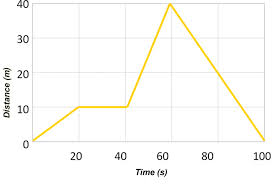
What type of speed is this graph showing?
a)
constant speed
b)
not moving
c)
speed increasing
d)
speed increasing at a constant rate
69.
What happened during A to B point?
a)
not moving
b)
increasing speed at a constant rate
c)
moving at a constant speed
d)
moving at 10 m/sacceleration
70.
What happened during C to D point?
a)
not moving
b)
increasing speed at a constant rate
c)
moving at a constant speed
d)
moving at 0 m/sacceleration
71.
How long did it take this object to travel 10 m?
a)
0 s
b)
10 s
c)
15 s
d)
20 s
72.
During which interval is the object slowing down?
a)
A to B
b)
D to E
c)
E to F
d)
G to H
73.
A Spring Scale is used to measure?
a)
length or distance
b)
temperature
c)
force or weight
d)
mass
74.
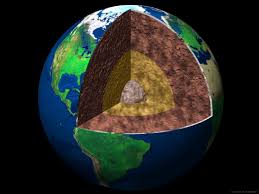
Which layer of Earth is located above the outer core?
a)
crust
b)
inner core
c)
mantle
d)
lithosphere
75.
Which layer of Earth is located above the outer core?
a)
crust
b)
inner core
c)
mantle
d)
lithosphere
76.
Which layer is made up of iron and nickel?
a)
Crust
b)
Mantle
c)
Inner Core
d)
Lithosphere
77.
What is the top layer of the Earth's surface called? 
a)
Mantle
b)
Innercore
c)
Outercore
d)
Crust
78.
Name this boundary
a)
Convergent
b)
Divergent
c)
Transform
d)
Sergent
79.
Name the boundary
a)
divergent
b)
convergent
c)
transform
d)
sergent
80.
Name the boundary
a)
convergent
b)
transform
c)
divergent
d)
sergent
81.

The Himaylayan Mountains were created at what type of convergent boundary?

a)

oceanic - oceanic

b)

continental - continental

c)

oceanic - continental

82.
Sand Andreas Fault formed at this type of boundary-
a)
Transform Boundary
b)
Convergent Boundary
c)
Divergent Boundary
d)
Hot Spot
83.
Mid Ocean Ridge forms at type of boundary-
a)
Transform Boundary
b)
Convergent Boundary
c)
Divergent Boundary
d)
Hot Spot
84.
Himilayan Mountains
a)
converging continent to continent
b)
earthquake in subduction zone
c)
converging ocean to continent
d)
transformational
85.
This is an example of -
a)
convergent
b)
divergent
c)
transform
86.
This is an example of -
a)
convergent
b)
divergent
c)
transform
87.
This is an example of -
a)
convergent
b)
divergent
c)
transform
88.
Identify the correct plate based on the letter given:
Plate B
a)
Pacific 
b)
Antartic
c)
South American
d)
Eurasian
89.
Identify the correct plate based on the letter given:
Plate J
a)
North American
b)
Antartic
c)
African
d)
Eurasian
90.
Identify the correct plate based on the letter given:
Plate D
a)
North American
b)
Indo-Australian
c)
South American
d)
Eurasian
91.

What plate is located at number 5

a)

North American

b)

South American

c)

African

d)

Nazca

92.

What plate is located at number 7

a)

North American

b)

South American

c)

Pacific

d)

Nazca

93.
What are the two layers in the Earth in which convection currents occur?
a)
crust and core
b)
inner core and outer core
c)
outer core and mantle (asthenosphere)
d)
outer core and lithosphere
94.
Heat transfer always goes from-
a)
Cold to Hot
b)
Hot to Cold
c)
Heat doesn't transfer
d)
Freezing to Cold
95.
Conduction is heat transfer by -
a)
Touch
b)
Circles
c)
Waves
96.

The tea in the cup has __________ thermal energy than the pot

a)

less

b)

more

c)

the same

97.

What is the transfer of thermal energy in a fluid by the movements of warmer and cooler fluids?

a)

conduction

b)

convection

c)

radiation

98.

The transfer of thermal energy by collisions between particles that make up matter is called ________.

a)

convection

b)

conduction

c)

radiation

99.

Identify the type of energy tranfer:

a)

radiation

b)

conduction

c)

convection

100.
Which type of rock results from melting and cooling of magma?
a)
Igneous
b)
Metamorphic
c)
Sedimentary
d)
Extrusive
101.
Which type of rock forms from extreme heat and pressure?
a)
Igneous
b)
Sedimentary
c)
Organic
d)
Metamorphic
102.
A metamorphic rock changes into an igneous rock by what two processes?
a)
Melting and cooling
b)
Extreme heat and pressure
c)
Compaction and cementation
d)
Weathering and erosion
103.
Wind, water, and ice breaking down rock is called
a)
Erosion
b)
Deposition
c)
Compaction
d)
Weathering
104.
When sediments are pressed together tightly, this is called ____________.
a)
Compaction
b)
Cementation
c)
Weathering
d)
Erosion
105.
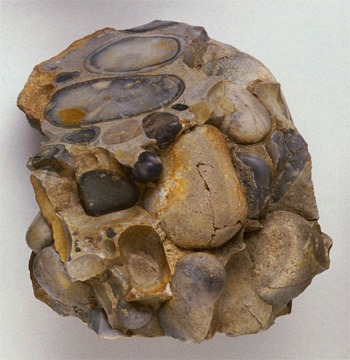
This rock was formed by smaller pieces of rock that settled at the bottom of a lake millions of years ago. What type of rock is this?
a)
Sedimentary
b)
Igneous
c)
Metamorphic
106.
Each rock type can follow only one pathway of the rock cycle.
a)
True
b)
False
107.
Cooling & crystalization produce
a)
igneous rocks
b)
metamorphic rocks
c)
sedimentary rocks
108.
The color of a mineral in powder form is called the mineral's 
a)
hardness
b)
specific gravity
c)
luster
d)
streak
109.
How light reflects off of a mineral is called the mineral's 
a)
luster
b)
streak
c)
cleavage
d)
fracture
110.
The following image shows what mineral property?
a)
Hardness
b)
Streak
c)
Cleavage
d)
Density
111.
Diamond has a hardness of ___ on Mohs Hardness Scale.
a)
1
b)
5
c)
8
d)
10
112.
A mineral breaks into pieces like are shown in the picture. How would you describe its breakage?
a)
Fracture
b)
Cleavage
c)
Glassy
d)
Waxy
113.
Which mineral property is being shown here?
a)
luster
b)
hardness
c)
cleavage
d)
streak
114.
Which of these minerals is softer than glass?
a)
Topaz 
b)
Corundum 
c)
Calcite 
d)
Orthoclase 
115.
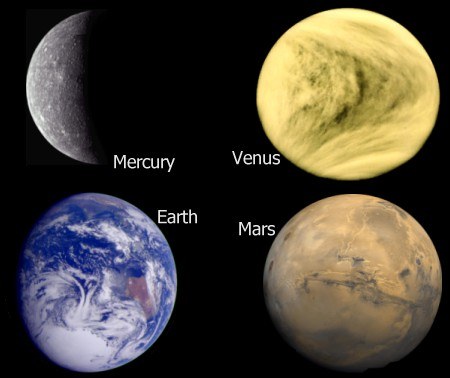
Which is the largest object in our solar system?
a)
Sun
b)
Jupiter
c)
Earth
d)
Pluto
116.
Which planet is closest to the sun?
a)
Uranus
b)
Mercury
c)
Neptune
d)
Earth
117.
Which is the second closest planet to the sun?
a)
Earth
b)
Saturn
c)
Venus
d)
Mercury
118.
Which planet is third from the sun?
a)
Mars
b)
Pluto
c)
Venus
d)
Earth
119.
Which is the fourth planet from the sun?
a)
Mars
b)
Saturn
c)
Earth
d)
Jupiter
120.
Which planet is fifth from the sun?
a)
Saturn
b)
Jupiter
c)
Mars
d)
Earth
121.
Which is the sixth planet from the sun?
a)
Earth
b)
Uranus
c)
Saturn
d)
Neptune
122.
Which planet is seventh from the sun?
a)
Saturn
b)
Earth
c)
Venus
d)
Uranus
123.
Which planet is farthest from the sun?
a)
Neptune
b)
Pluto
c)
Earth
d)
Uranus
124.
A ball of ice and dust with a tail of gas and dust pointing away from the sun.
a)
Asteroid
b)
Comet
c)
Moon
d)
Meteor
125.
A small object that appears as a streak of light as it enters earth's atmosphere.
a)
Asteroid
b)
Comet
c)
Moon
d)
Meteor
126.
A small rocky object orbiting the sun.
a)
Asteroid
b)
Comet
c)
Moon
d)
Meteor
127.
A natural satellite of a planet.
a)
Asteroid
b)
Comet
c)
Moon
d)
Meteor
128.
Earth's ________ on its axis causes day and night.
a)
rotation
b)
revolution
c)
phase
d)
comet
129.
The moon is a natural  ______ of Earth.
a)
comet
b)
axis
c)
satellite
d)
space probe
130.
Earth and the other planets closest to the Sun are made mostly of _______
a)
gas
b)
metal
c)
water
d)
rock
131.

What is gravity?

a)

The force that brings things down

b)

The force that pushed things together

c)

The force that brings things toward the earth or any other body with mass

d)

The force that makes mass

132.

On the moon, you will weigh ___________ then on Earth.

a)

less

b)

more

c)

the same

d)

twice as much

133.

Why do you weigh less on the moon?

a)

There is more gravity

b)

There is less gravity

c)

The moon is big

d)

The moon is small

134.
What country was the first to put a man into space?
a)
USA
b)
Canada
c)
Russia
d)
England
135.
What was the name of the first satellite to orbit Earth?
a)
Sputnik
b)
Skylab
c)
Challenger
d)
Curiosity
136.
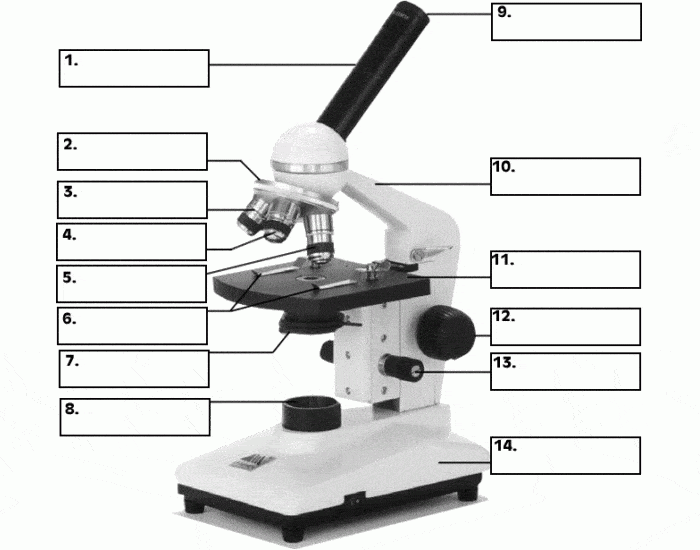
Part 9
a)
Body tube
b)
Eyepiece
c)
Objective
d)
Light Source
137.
Part 10
a)
Stage
b)
Arm
c)
Base
d)
Diaphragm
138.
Part 11
a)
Stage Clips
b)
Stage
c)
Diaphragm
d)
Illuminator
139.
This holds the eye piece and connects it to the objective
a)
Arm
b)
Base
c)
Body Tube
d)
Objective
140.
Part 12
a)
Fine Adjustment Knob
b)
Coarse Adjustment Knob
c)
Diaphragm
d)
Objective
141.
Part 13
a)
Fine Adjustment Knob
b)
Course Adjustment Knob
c)
Stage
d)
Diaphragm
142.
Part 14
a)
Stage
b)
Diaphragm
c)
Base
d)
Illuminator
143.
This bring the specimen into sharp focus
a)
Coarse Adjustment Knob
b)
Fine Adjustment Knob
c)
Eyepiece
d)
Diaphragm
144.
Part 1
a)
Eyepiece
b)
Body Tube
c)
 Arm
d)
Objective
145.
Part 2
a)
Objectives
b)
Body Tube
c)
Revolving Nosepiece
d)
Stage
146.
Part 3
a)
Low Objective
b)
Medium Objective
c)
High Objective
d)
Revolving Nosepiece
147.
Part 6
a)
Stage
b)
Stage Clips
c)
Diaphragm
d)
Arm
148.
Part 7
a)
Stage
b)
Stage Clips
c)
Light Source
d)
Diaphragm
149.
What are the names of the domains?
a)
Eukarya, Bacteria, Archaea
b)
Eubacteria, Archaebacteria, Protista, Animalia, Fungi, Plantae
150.
What does autotrophic mean?
a)
Has a nucleus
b)
No nucleus
c)
Makes its own food
d)
Gets its food from others
151.
What does unicellular mean?
a)
1 parent
b)
2 parents
c)
1 cell
d)
More than 1 cell
152.
What does prokaryotic mean?
a)
Has a nucelus
b)
No nucleus
c)
Makes its own food
d)
Gets its food from others
153.
What does asexual reproduction mean?
a)
1 parent
b)
2 parents
c)
1 cell
d)
More than 1 cell
154.
What does heterotrophic mean?
a)
Has a nucleus
b)
NO nucleus
c)
Makes own food
d)
Gets its food from others
155.
What does eukaryotic mean?
a)
Has a nucelus
b)
No nucleus
c)
Makes own food
d)
Gets its food from others
156.
What does sexual reproduction mean?
a)
1 parent
b)
2 parents
c)
1 cell
d)
More than 1 cell
157.
What do the domains Bacteria and Archaea have in common?
a)
They both have a nucelus
b)
They are both lacking a nucleus
c)
They are both made of many cells
d)
They are both dead
158.
What makes the domain Eukarya unique?
a)
All organisms in this domain are multicellular
b)
All organisms in this domain reproduce sexually
c)
It's the only domain that has a nucleus
d)
It's the only domain that is lacking a nucelus
159.
What do all living things have in common?
a)
They are all made up of 1 or more cells
b)
They all have a nucleus where the DNA is stored
c)
They all rely on other organisms to feed themselves
d)
They all reproduce asexually
160.
Where is the DNA stored in a prokaryotic cell
a)
Inside the nucleus
b)
There is no DNA in a prokaryotic cell
c)
The DNA floats freely in the cell
d)
The DNA is in the cytoplasm