
 Worksheets
Knee
Total questions: 27
Worksheet time: 9mins
A patella usually dislocates in what direction?
lateral
medial
anterior
posterior
The mechanism of injury that leaves the PCL at greatest risk for injury is which of the following?
Hyperextension of the knee
Landing on the anterior aspect of the bent knee
A varus stress witht the knee fully extended
A valgus stress with the knee fully extended
True or False: A third degree MCL sprain usually presents with valgus instability.
True
False
True or False: Jumper's knee is tendinitis of the hamstring tendon caused by repeated landing stress.
True
False
The quadriceps muscles primary job is to do which of the following?
flex the knee
extend the knee
rotate the knee
flex the hip
Which of the following conditions is common to runners and cyclists and causes pain over the lateral femoral condyle?
Pes anserine tendinitis
Jumper's knee
Biceps femoris tendonitis
Iliotibial band syndrome
During locomotion your quads are responsible for ? and your hamstrings are responsible for ?
inversion, eversion
knee extension, hip flexion
acceleration, deceleration
deceleration, acceleration
Which of the following structures have the responsibility of cushioning the knee during impact activity?
cruciate ligaments
meniscus
femoral condyles
collateral ligaments
Which of the following structures is the main source of stability in the knee?
menisci
cartilage
bones
ligaments
Which of the following is not a hamstring muscle?
semimembranosus
soleus
semitendinosus
biceps femoris
Which of the following is not part of the quadriceps muscle group?
rectus femoris
vastus medialis
vastus lateralis
biceps femoris
The anterior cruciate ligament prevents which of the following?
varus stress
valgus stress
anterior translation of the tibia relative to the femur
posterior translation of the tibia relative to the femur
The anterior cruciate ligament is most often injured during what phase?
During deceleration and a change of direction
During deceleration and running in straight line
During acceleration and running in a straight line
During acceleration and a change of direction
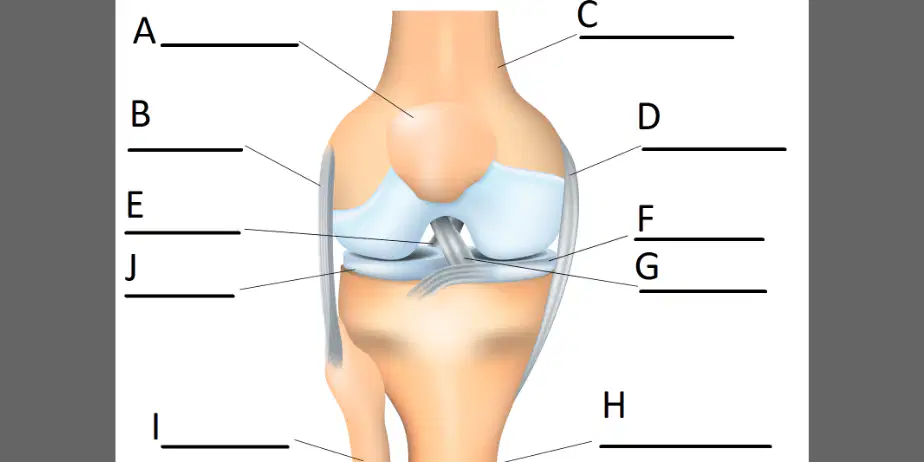
Which of the following is the patella?
A
B
C
J
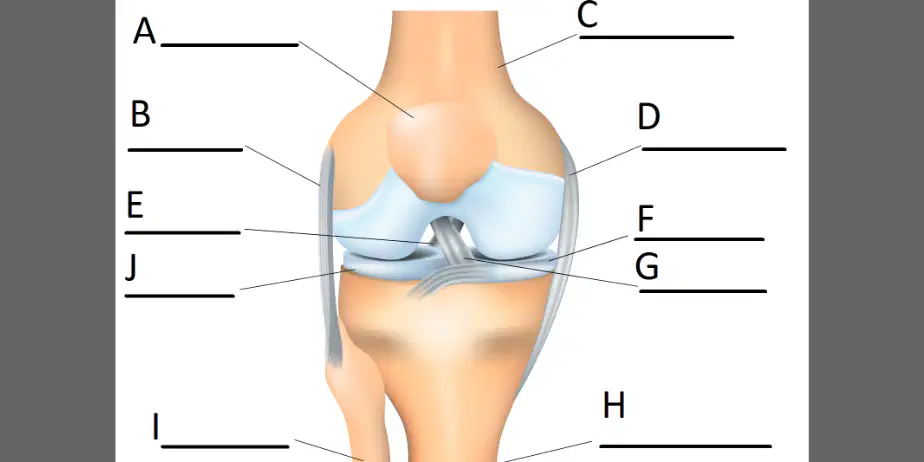
Which of the following is the lateral meniscus?
B
D
F
J
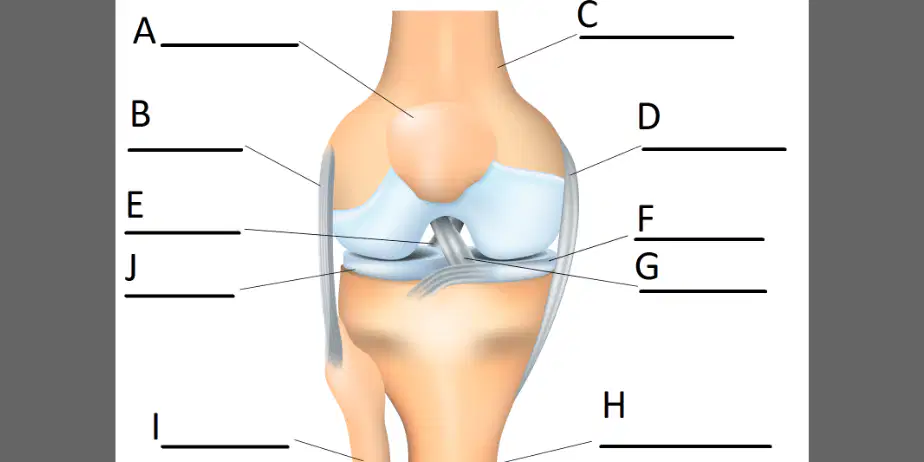
Which of the following is the anterior cruciate ligament?
C
E
G
H
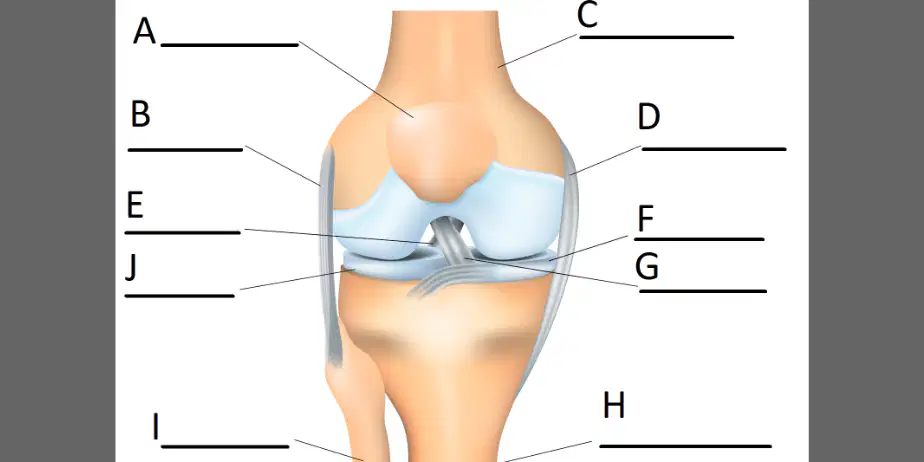
Which of the following is the medial collateral ligament?
B
C
D
F
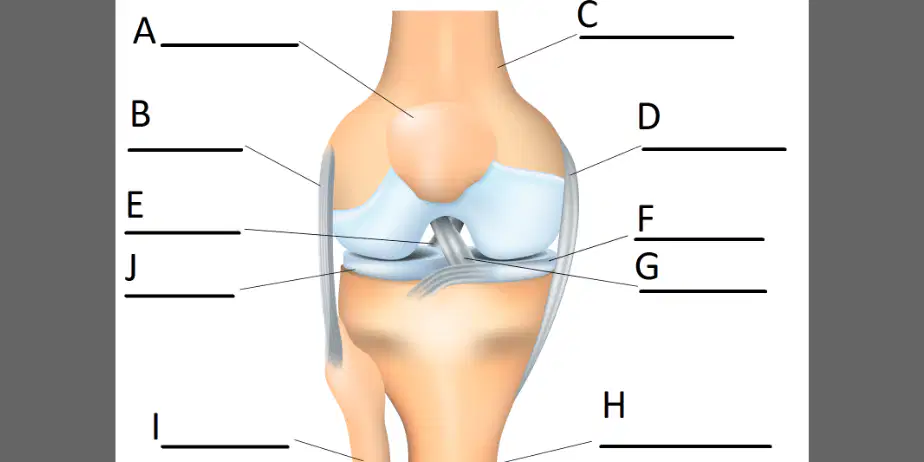
Which of the following is the fibula?
A
C
H
I
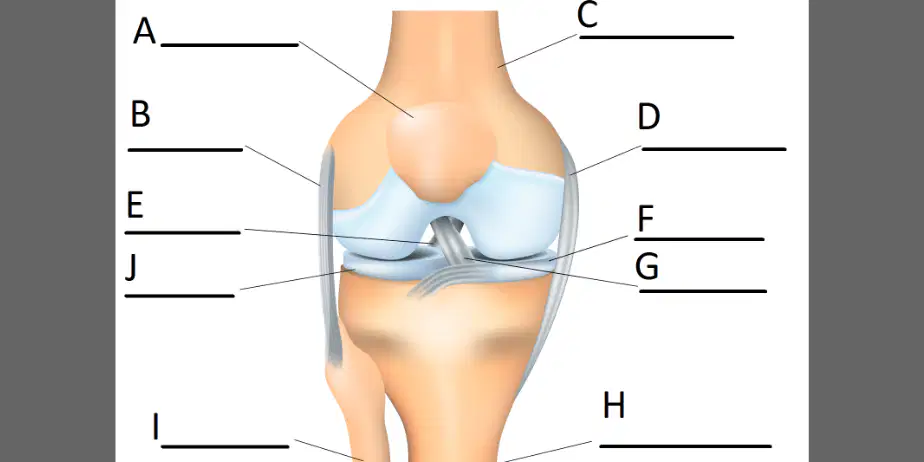
Which of the following is the femur?
A
C
H
I

Which of the following is the lateral collateral ligament?
B
D
G
H
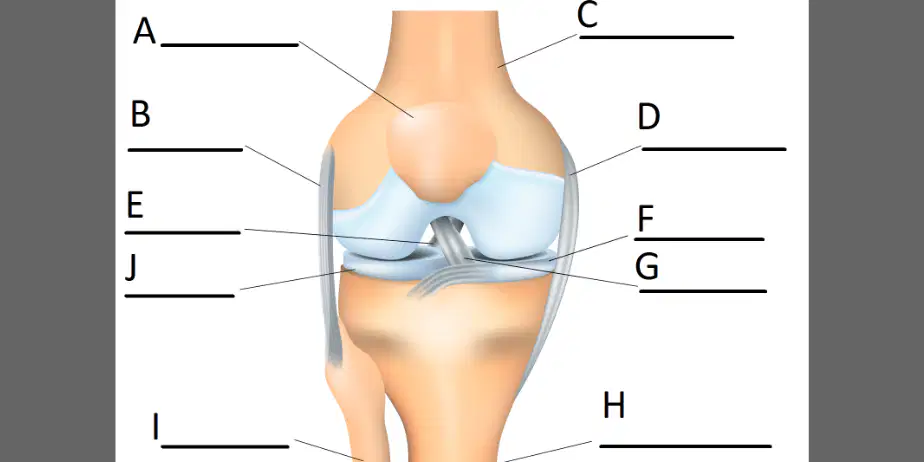
Which of the following is the posterior cruciate ligament?
E
F
G
J
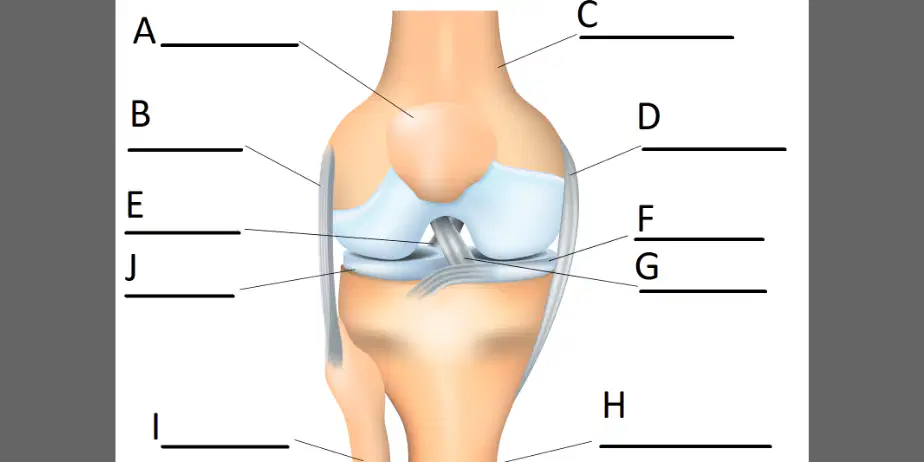
Which of the following is the medial meniscus?
C
D
F
J
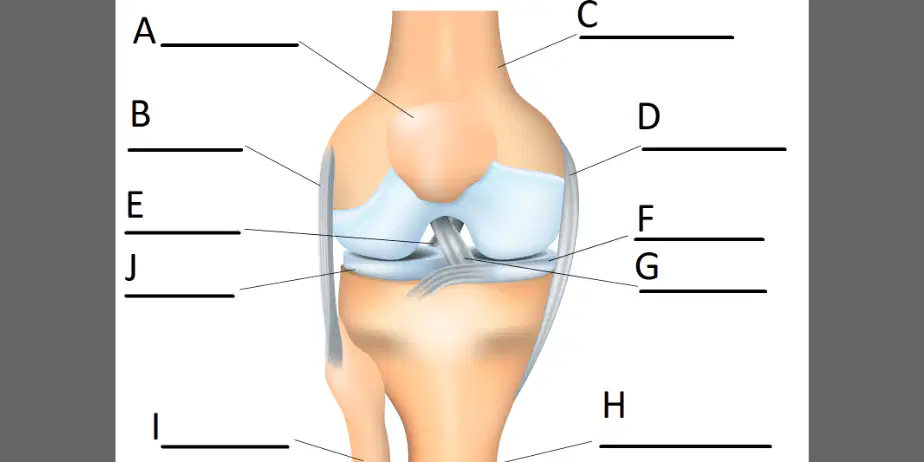
Which of the following is the tibia?
A
C
H
I
Which injury is characterized by swelling above the knee that is similar to a balloon?
patellar subluxation
pre-patellar bursitis
Osgood-Schlatter disease
Chondromalacia patella
Which injury is characterized by ongoing pain at the attachment of the patellar tendon at the tibial tubercle?
patellar subluxation
pre-patellar bursitis
Chondromalacia patella
Osgood-Schlatter disease
Which injury is a result of a varus force?
Medial Collateral Ligament sprain
Lateral Collateral Ligament sprain
Anterior Cruciate Ligament sprain
Posterior Cruciate Ligament sprain
Which injury is a result of a valgus force?
Medial Collateral Ligament sprain
Lateral Collateral Ligament sprain
Anterior Cruciate Ligament sprain
Posterior Cruciate Ligament sprain

