
 Worksheets
The Nervous System-Nerves
Total questions: 30
Worksheet time: 15mins
Explain how the nervous system processes stimuli.
The nervous system processes stimuli by transmitting signals through neurons.
The nervous system processes stimuli by using hormones to communicate between cells.
The nervous system processes stimuli by converting them into chemical signals in the brain.
The nervous system processes stimuli by storing them in the spinal cord for later use.
What is the role of the brain when you hear music?
The brain processes the rhythm and melody.
The brain ignores the music.
The brain only processes the lyrics.
The brain is not involved in hearing music.
What does your brain do when you want to move to the beat of the music?
It sends signals to your muscles to move.
It analyzes the rhythm of the music.
It releases dopamine to make you feel good.
It increases your heart rate.
What does the nervous system do with stimuli from the environment?
It ignores them.
It processes them.
It amplifies them.
It stores them.
Which of the following is a function of the nervous system?
Collects stimuli
Processes stimuli
Decides how to respond
All of the above
What is the main function of the peripheral nervous system ?
To process sensory information and coordinate responses
To connect the central nervous system to the limbs and organs
To regulate involuntary body functions
To control voluntary muscle movements
What do sensory neurons detect?
Sensory neurons detect space.
How does the brain send its response after processing input in the central nervous system?
Through electrical impulses via neurons
By releasing hormones into the bloodstream
By generating sound waves
Through magnetic fields
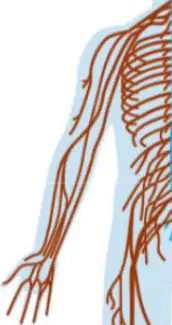
What color represents the Peripheral Nervous System in the figure?
A) Blue
B) Orange
C) Green
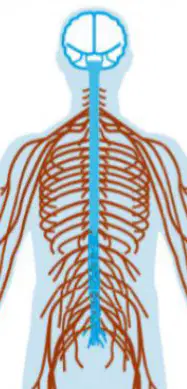
The Central Nervous System is made up of the brain and the ____.
Spinal cord
Heart
Lungs
Kidneys
The central nervous system processes signals from the peripheral nervous system by:
transmitting signals directly to muscles
interpreting signals and coordinating responses
storing signals for future use
blocking signals from reaching the brain
The brain plays a crucial role in the central nervous system by:
controlling voluntary actions and processing sensory information
regulating the digestive system
producing hormones for growth
filtering waste from the blood
The nervous system receives information from the environment and the body's internal state through:
motor neurons
interneurons
sensory neurons
glial cells
The central nervous system sends signals to muscles and glands to produce a response through which type of neurons?
Sensory neurons
Motor neurons
Interneurons
Relay neurons
The sensory input process when you see a hot stove involves:
Visual recognition and neural processing
Auditory recognition and neural processing
Tactile recognition and neural processing
Olfactory recognition and neural processing
The brain processes information when it detects heat from a hot stove by:
activating sensory neurons that send signals to the spinal cord and brain, triggering a reflex action to move away from the heat.
sending signals directly to the muscles to contract and move away from the heat without involving the brain.
using only the spinal cord to process the information and respond to the heat.
ignoring the heat and continuing to process other sensory information.
The motor output response when your hand touches a hot stove is:
Pulling the hand away quickly
Keeping the hand on the stove
Pressing the hand harder
No response
What are the specialized cells in the nervous system responsible for sending signals?
The specialized cells in the nervous system responsible for sending signals are called neurons.
The specialized cells in the nervous system responsible for sending signals are called glial cells.
The specialized cells in the nervous system responsible for sending signals are called axons.
The specialized cells in the nervous system responsible for sending signals are called dendrites.
Nerves can send signals to and from the central nervous system, like a ________.
wire
river
book
cloud
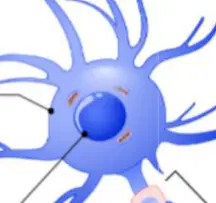
What is the part of the neuron that contains the nucleus?
Cell Body
Axon
Dendrite
Synapse
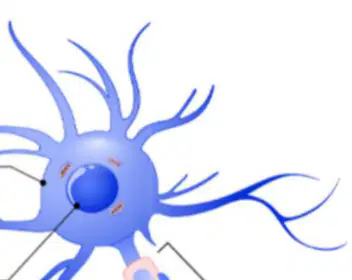
Which part of the neuron is responsible for receiving signals?
Dendrites
Axon
Cell body
Synapse
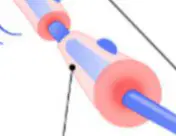
What is the function of the myelin sheath in a neuron?
Insulates the axon and speeds up nerve impulse transmission
Protects the neuron from damage
Stores neurotransmitters
Regulates the entry and exit of ions

Which of the following is a part of a neuron?
Cell wall
Axon
Chloroplast
Ribosome
Neurons receive ______ through their dendrites.
signals
blood
oxygen
hormones
The function of myelin in neurons is to:
protect the neuron
increase the speed of nerve impulse conduction
store neurotransmitters
supply nutrients to the neuron
When the myelin is healthy, nerve signals are sent and received quickly.
True
False
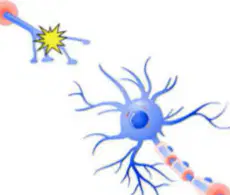
What is the gap between two neurons called?
Axon
Synapse
Dendrite
Neurotransmitter
What role do neurotransmitters play in neuron communication?
They transmit signals between neurons.
They insulate neurons.
They provide energy to neurons.
They repair damaged neurons.
What are the potential consequences if a neuron fails to accurately pass signals?
Loss of signal transmission
Improved cognitive function
Increased neuron growth
Enhanced memory retention
What is a doctor who specializes in diagnosing, treating, and managing brain disorders called?
Cardiologist
Neurologist
Dermatologist
Oncologist

