
 Worksheets
INST/POLS 184 Exam 2 Review
Total questions: 53
Worksheet time: 27mins
Because the US supported one side and the USSR the other, the war in Afghanistan during the 1980s was an example of what?
Proxy war
Spillover
Terrorism
Irredentism
Most religious conflicts are fought because opposing groups disagree on the proper way to worship.
True
False
If you were a rebel, what feature would you NOT want your country to have?
Mountains
Large population
Ill-equipped military
Advanced economy
A rebel group that splits into factions may trigger which of the following mechanisms of bargaining failure?
A) Issue indivisibility
B) Commitment problems
C) Incomplete information
D) Incomplete information and incentives to misrepresent.
Strategy of terrorist attack that tries to make the target government act disproportionately and alienate moderates.
Coercion
Provocation
Spoiling
Outbidding
Since 9/11, which types of groups in the US have committed the most acts of terrorism?
A) Leftist
B) Right-wing
C) Islamist
D) Evangelical
Since 9/11, which types of groups in the US engaging in acts of terrorism have received the most attention from law enforcement?
Leftist
Right-wing
Islamist
Evangelical
Incomplete information and incentives to misrepresent is one of the three mechanisms that lead to civil war/terrorism because
A) The government has no ability to fight against the opposition
B) Governments don't know if they can trust opposition leaders
C) It is difficult to know the opposition's numbers or effectiveness
D) There is not a solution that both sides prefer to war
Commitment problems are one of the three mechanisms that lead to civil war/terrorism because
The opposition will not believe commitments made by the government
There is no solution the opposition is willing to commit to
Leadership can't secure commitments from other parts of the government
Third parties don't want to make commitments to mediate negotiations
A strategy of terrorist attacks intended to sabotage a prospective peace between two negotiating parties is called
Outbidding
Provocation
Coercion
Spoiling
Issue indivisibility is one of the three mechanisms that lead to civil war/terrorism because
There is never a bargaining space leading up to a civil war
There is no possible compromise that both sides prefer to war
Governments never negotiate with opposition groups
Without trust, it is impossible to find a solution acceptable to all parties
The intended audience of a terrorist attack is limited to those immediately affected.
True
False
Civil wars in which both sides receive outside help last longer than wars where only one side (or neither) receives help.
True
False
States are usually weaker than their rebels.
True
False
One reason groups engage in terrorism is because of weakness relative to their target.
True
False
Those who engage in acts of terrorism must have political ends.
True
False
Actors whose interests are not widely shared within the community are called
Extremists
Moderates
Home population
Freedom fighters
What is the difference between an insurgency and terrorism?
Insurgencies target rich governments and terrorism targets poor governments
Insurgencies target militaries and terrorism targets civilians
Insurgencies result in fewer deaths than terrorism
Insurgencies occur in the countryside and terrorism takes place in urban areas
Separatists want to create an independent state, and irredentists want to break away from one state and attach to another.
True
False
Which of the following is a possible solution to a domestic conflict over regime?
Negotiated secession
Power sharing agreement
Autonomy
Policy concessions
If a Houston resident hijacked a Chicago Crime Tours bus demanding that Houston become the 'Second City', this would be
international terrorism
insurgency
interstate war
domestic terrorism
The 1939 Molotov-Ribbentrop Pact (between the Soviet Union and Germany) is an example of a(n)
Defensive alliance
International Organization
Offensive alliance
Non-aggression pact
All alliances are formed to balance a stronger state.
True
False
The United Nations is an example of a(n)
Non-aggression pact
Defensive alliance
Offensive alliance
Collective security organization
Ideally, collective security organizations should include all countries.
True
False
Alliances allow members to cooperate militarily in the event of war.
True
False
U.N.-sanctioned Chapter VII missions do not require the consent of the host nation.
True
False
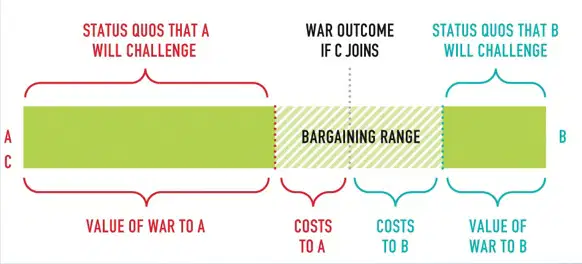
If States C and A are allies and share common interests, which of the following is true?
Both State A and State C prefer a deal as far to the right as possible
Both State A and State C prefer a deal as far to the left as possible
Both State A and State C are Pareto optimal
State B gets its ideal outcome

If States A & C are allies, the more of the good State A gets, the happier State C is.
True
False
The international system has no police force similar to what exists in most countries.
True
False
A description of peacekeeping missions can be found in the UN Charter.
True
False
What is unique about the P-5 members of the UN Security Council?
They don't have to send troops to peacekeeping operations.
A 'no' vote by any one of them kills the resolution under consideration.
They are the five highest contributors to UN peacekeeping operations.
The rules of sovereignty do not apply to them.
Interests held by a small number of actors within the country are called
Bureaucratic Interests
Economic Interests
National Interests
Particularistic Interests
Which of the following can NOT be considered an example of a domestic actor?
U.S. Chamber of Commerce and the National Association of Manufacturers
World Health Organization
Political leaders
Public
What is the collection of organizations that carry out most tasks of governance within the state?
Media
Secretariat
Bureaucracy
National Interest Groups
Leader approval ratings can improve due to the rally effect, which depends on dramatic international events.
True
False
The Cuban American National Foundation (CANF) is an example of an economic interest group.
True
False
International conflicts may give leaders an opportunity to blame foreigners for the country's problems. This is called
Accountability
Scapegoating
International Blaming
Burden Sharing
A bargaining interaction that occurs after one actor threatens to use force if its demands are not met is called
Compellence
Crisis bargaining
Deterrence
Risk-return trade-off
Actors, including international organizations, that are outside the bargaining situation are known as
Institution
Indirect Actor
Direct Actor
Third parties
A war that is fought with the anticipation that an attack by the other side is imminent is called
Preemptive war
Preventive war
Civil War
Interstate War
A war fought with the intention of keeping an adversary from becoming stronger in the future is called
Interstate War
Preemptive war
Civil War
Preventive war
A set of deals that both parties in a bargaining interaction prefer over the reversion outcome is known as
Bargaining range
Risk-return trade-off
Value of war
Reservation point
The deal that gives an actor the lowest utility (worst deal) possible while still being preferred to war is the war outcome.
True
False
World War II was an example of what type of war?
Civil War
Interstate War
Limited War
A crisis
Under the bargaining model of war, the value of war is
The share of the good a state expects to win in war minus the costs of war
The deal that gives an actor the lowest utility while still better than war
An actor's most preferred outcome
What an actor expects to get having fought the war.
Which one of these is NOT typically a goal/aim that might lead states to war?
Territory
Policies
Credibility
Regime
Resolve is the unwillingness of an actor to endure costs in order to acquire a particular good.
True
False
The calculation between trying to get a better deal and trying to avoid a war is
A) Bargaining range
B) Coercive diplomacy
C) Risk-return trade-off
D) Compellence
A security dilemma can lead to arms races or war because of the fear of being attacked.
True
False
Incomplete information concerns future uncertainty, whereas commitment problems deal with the current situation.
True
False
The effort to deter attacks on one's own country
Compellence
General deterrence
Extended deterrence
Brinkmanship
Which of the following is NOT an example of a costly signal?
A) Brinkmanship
B) Tying hands
C) Paying for power
D) First-strike advantage

