wayground logo

Free Printable Worksheets

Font size

S
M
L
XL
Worksheets

End of unit 9

Total questions: 74

Worksheet time: 1hrs 8mins

Name
Class
Date
1.

In order to magnetize an object for electromagnetism, it needs to have iron or steel (ex. a rod or nail).

a)

True

b)

False

2.

Electricity is needed for electromagnets.

a)

True

b)

False

3.

Electromagnets need a power source.

a)

True

b)

False

4.

Electromagnets do NOT have a north and south pole.

a)

True

b)

False

5.

Electromagnets can be turned on and off.

a)

True

b)

False

6.

What are the components of the electromagnets?

a)

battery, wire and bulb

b)

battery , copper wire and paper clips

c)

battery, copper wire and iron nail

d)

battery, wire and aluminum

7.

Electric currents produce _____________

a)

electron clouds

b)

magnetic fields

c)

sound waves

8.

How can the strength of an electromagnet be increased? (mark all that apply)

a)

increase the current flowing through the coil

b)

increase the number of coils

c)

add an amplifier to it

d)

put iron core inside the coil

9.
Surrounding every magnet is a __________  __________.
a)
magnetic field
b)
electrical current
c)
another magnet
d)
an enemy
10.
What are the ends of a magnet called?
a)
East and west poles
b)
Left and Right ends
c)
North and South ends
d)
North and South poles
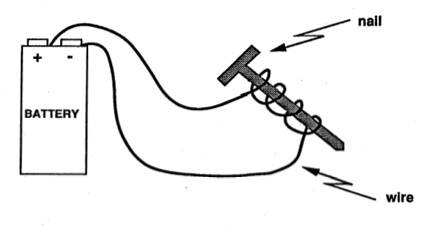
11.
This is a picture of a simple electromagnet. How can the electromagnet be made stronger?
a)
Add more coils of wire to the nail.
b)
Use a smaller battery.
c)
Reverse the poles of the magnet.
d)
Remove all the coils and the nail.
12.

A type of magnet that has temporary magnetic effect when electric current flows through it.


This refer to

a)

Electric

b)

Electronic

c)

Electrostatic

d)

Electromagnet

13.
How are electromagnets different from magnets?
a)
magnets can be turned on/off
b)
you can turn an electromagnet on/off
c)
magnets are more powerful
d)
magnets have a North and South pole
14.
What would increase the strength of an electromagnet?
a)
Increasing the amount of current flowing through the wire.
b)
Inserting a wooden core inside the coil
c)
Changing the direction of the current
d)
Decreasing the number of coils of wire
15.

What would happen if you took one end of the wire off the battery?

a)

The nail will be a magnet.

b)

The nail would no longer be a magnet

c)

Nothing will happened.

d)

The nail will heats up.

16.

Which part of the electromagnets turned into a magnet when electricity flows through a coiled wire?

a)

Battery

b)

Copper wire

c)

Iron Nail

d)

Bulb

17.
In order for an electromagnet to be formed, an __________ current must pass through a coil of __________ wrapped around an ________ core.
a)
wire, iron, electric
b)
electric, wire, iron
c)
iron, electric, wire
d)
excited, hair, apple
18.

What is the role of the battery in the electromagnet?

a)

It provides light energy for the electromagnet.

b)

It provides magnetic field for the electromagnet.

c)

It provides sound energy for the electromagnet.

d)

It provides the power source for the electromagnet.

19.

What happens if you reverse the electrical current by switching the wire ends?

a)

It explodes

b)

It makes it stronger

c)

It reverses the direction of the magnetic field

d)

It makes it weaker

20.

How do you know if the direction of the magnetic field is reversed?

a)

The compass changes direction

b)

The whole thing explodes

c)

It can only lift 1 paper clip

d)

It can lift more paper clips than before

21.

The magnetic field around an electromagnet is similar to that around a _____ _____

a)

Bar magnet

b)

Horseshoe magnet

c)

Ring Magnet

d)

Button magnet

22.

You can make an electromagnet that is much stronger than a permanent magnet.

a)

True

b)

False

23.

Using a _________ __________in the core will make a stronger electromagnet.

(a)  

24.

Most cores are made of _______.

a)

Iron

b)

Copper

c)

Aluminum

d)

Wood

25.

which one is the strongest eletromagnet?

a)

50 turns on the coil, low current,

copper core

b)

100 turns on the coil,

high current,

iron core

c)

50 turns on the coil, low current,

iron core

d)

100 turns on the coil,

low current,

iron core

26.
Which is NOT an insulator.
a)
Wool
b)
Plastic
c)
Copper
d)
Glass
27.

What material is commonly used to create the core of an electromagnet?

a)

Iron

b)

Glass

c)

Plastic

d)

Wood

28.

How does increasing the number of coils affect an electromagnet?

a)

It decreases the strength

b)

It has no effect

c)

It makes it permanent

d)

It increases the strength

29.

What is the primary function of an electromagnet in a circuit?

a)

To generate heat

b)

To provide resistance

c)

To convert electrical energy into mechanical energy

d)

To store energy

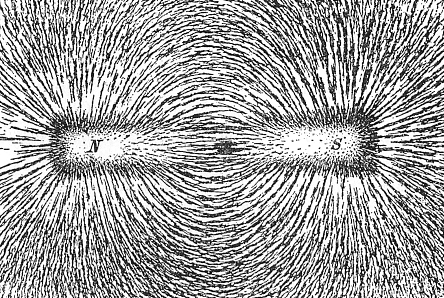
30.
What do the lines around this magnet represent?
a)
North Pole
b)
South Pole
c)
Magnetic Declination
d)
Magnetic Field
31.
As the distance between two magnets increases (they get farther apart), the force between them:
a)
Increases
b)
Decreases
c)
Stays the Same
32.
If you cut a magnet in half, what happens to the poles?
a)
One half gets the North Pole, the other half gets the South Pole
b)
Both halves get only a North Pole
c)
Both halves get only a South Pole
d)
Both halves get a North pole and a South Pole
33.
What is responsible for the Magnetic Field around Earth?
a)
The Earth's crust
b)
The Earth's molton iron core
c)
The Earth's mantel
d)
The Sun
34.
The strongest part of a magnet is...
a)
the bars.
b)
the force field.
c)
the poles. 
d)
the middle.
35.

If a glass plate is placed over a magnet and iron filings are sprinkled over the glass, a pattern will be visible. What does this pattern indicate?

a)

The magnetic field

b)

The electrostatic field

c)

The piezoelectric effect

d)

The chemical reaction of the magnet and the filings

36.
What will happen when these magnets are brought close together?
a)
They will attract each other.
b)
They will repel each other.
c)
Both magnets will turn to the left
d)
Both magnets will turn to the right
37.
Earth acts like a giant magnet because its center is made up MOSTLY of
a)
granite
b)
limestone
c)
iron
d)
nickel
38.
Why does a compass needle point north?
a)
The compass is a bar magnet
b)
Because north is up
c)
Because it's magic
d)
It lines up with the Earth's magnetic field
39.
The magnet's shown will
a)
not move
b)
attract
c)
repel
d)
all of the above
40.
Which of the following could be used as the core of a simple electromagnet?
a)
drinking straw
b)
iron nail 
c)
a soda bottle
d)
an ink pen
41.
A piece of nickel will be attracted to
a)
only the north pole of an electromagnet
b)
only the south pole of an electromagnet
c)
either pole of an electromagnet
d)
the iron core of an electromagnet
42.
Electric current flowing through a wire produces
a)
static electricity
b)
an open circuit
c)
a permanent magnet
d)
a magnetic field
43.
What is the purpose of an iron core in an electromagnet?
a)
to hold the loops of wire in place
b)
to make the magnetic force stronger
c)
to change the direction of the electric current
d)
to change the direction of the magnetic force
44.
A scientist observed that the needle of a compass moved when it was placed near a wire carrying an electric current.  What did this observation show?
a)
Opposite charges attract.
b)
Electric current generates a magnetic field.
c)
Magnetized wires generate electricity.
d)
Like charges repel.
45.

How do magnetic field lines move?

a)

always from the south pole towards the

north pole

b)

always from the north pole towards the

south pole

c)

always from the pole to the middle

d)

depends of the type of magnet

46.

Magnetic field lines that are drawn closer to each other show ___.

a)

a decrease in polarity

b)

an increase polarity

c)

a smaller magnetic force

d)

a greater magnetic force

47.

Which answer describes the pictures correctly?

a)

Both drawings show attraction of magnetic forces.

b)

The left drawing shows repulsion and the right drawing shows attraction of magnetic forces.

c)

Both drawings show repulsion of magnetic forces.

d)

The left drawing shows attraction and the right drawing shows repulsion of magnetic forces.

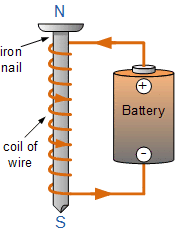
48.
This is a picture of a simple electromagnet. How can the electromagnet be made stronger?
a)
Add more coils of wire to the nail.
b)
Use a smaller battery.
c)
Reverse the poles of the magnet.
d)
Remove all the coils and the nail.
49.

A type of magnet that has temporary magnetic effect when electric current flows through it.


This refer to

a)

Electric

b)

Electronic

c)

Electrostatic

d)

Electromagnet

50.

Once a paperclip touches a magnet and becomes a magnet itself, does a paperclip STAY that way? Or does it stop being a magnet?

a)

stay that way forever

b)

stop being a magnet

c)

stay that way for a short time

51.
How is Earth's magnetic field similar to that of a magnet?
a)
It is hundreds of miles long
b)
It has north and south poles
c)
It is made in Earth's core
d)
It is shaped like a horseshoe
52.
The strongest part of a magnet is...
a)
the bars.
b)
the force field.
c)
the poles. 
d)
the middle.
53.
You can make an electromagnet stronger by...
a)
increasing the current through the wire
b)
make the iron core bigger
c)
increase the number of loops around the core
d)
All of these
54.
What kind of magnet can be turned on and off?
a)
refridgerator magnet
b)
electromagnet
c)
magnetite
d)
iron
55.
A simple electromagnet can be made with which of the following?
a)
an electric current
b)
a turbine and nail
c)
a nail, a wire, and a battery
d)
a compass and a battery
56.

How can a wire become magnetic?

a)

point it north

b)

add a resistor

c)

heat it up

d)

run a current through it

57.
2 ways to increase the magnetic force of an electro-magnet
a)
Increase the current flow, reduce the number of coils
b)
Increase the voltage, decrease the number of coils
c)
Increase the number of coils and the current flow
d)
Spread out the coils, replace iron core with rubber.
58.
How is a permanent magnet DIFFERENT from a temporary magnet?
a)
A permanent magnet attracts materials made of iron.
b)
A permanent magnet has poles.
c)
A permanent magnet has a magnetic field.
d)
A permanent magnet keeps its magnetism for a long time.
59.

Two like poles are held close to one another within each other's force field. Which statements are TRUE? SELECT ALL THAT APPLY.

a)

The poles will repel when released

b)

The poles will attract when released

c)

The poles have high PE before being released

d)

The poles have low PE before being released

60.
Where are the magnetic force the strongest in this picture?
a)
Location 1
b)
Location 2
c)
Location 3
d)
Location 4
61.

Which poles repel or push apart each other?

a)

north and south

b)

south and north

c)

south and south

62.

Which poles attract each other?

a)

north and north

b)

south and south

c)

north and south

63.

Which item would the magnetic domains be the most unaligned?

a)

glass jar

b)

steel nail

c)

bar magnet

64.

Which item would have the most aligned domains?

a)

a pencil eraser

b)

an iron railing

c)

an aluminum can

65.
What is responsible for the Magnetic Field around Earth?
a)
The Earth's crust
b)
The Earth's molton iron core
c)
The Earth's mantel
d)
The Sun
66.
If you cut a magnet in half, what happens to the poles?
a)
One half gets the North Pole, the other half gets the South Pole
b)
Both halves get only a North Pole
c)
Both halves get only a South Pole
d)
Both halves get a North pole and a South Pole
67.
Earth acts like a giant magnet because its center is made up MOSTLY of
a)
granite
b)
limestone
c)
iron
d)
nickel
68.
A refrigerator magnet is an example of a:
a)
magnetic material
b)
permanent magnet
c)
horseshoe magnet
d)
temporary magnet
69.
If you drop or heat up a a magnet, what will eventually happen to it?
a)
the magnet will become stronger
b)
the magnet will demagnetize
70.
Inside of magnets there are tiny magnets called _______
a)
atoms
b)
domains
c)
mini magnets
71.
Magnetic NORTH is actually geographic _________
a)
SOUTH
b)
NORTH
c)
EAST
d)
WEST
72.
If the end of an unknown magnet sticks to a magnet pole labeled "North" the unknown end must be...
a)
North
b)
South
c)
East 
d)
West
73.
Magnets stick to any materials that are made of
a)
Iron, Nickel, Copper
b)
Iron, Nickel, Cobalt
c)
Ions, Nickel, Cobalt
d)
Iron, Lead, Cobalt
74.

Unlike (opposite) poles _____, like (same) poles _____

a)

repel, attract

b)

connect, repel

c)

attract, repel

d)

repel, connect