
Font size
 Worksheets
Gas Law Exam
Total questions: 50
Worksheet time: 2hrs 24mins
In the ideal gas law, P = (a) , V = (b) , n = (c) ,
R = (d) , and T = (e)
Match the following Laws to their definitions
If pressure increases, then volume decreases.
Boyle's Law
If volume increases, then temperature increases.
Charles' Law
If pressure increases, then temperature increases.
Gay-Lussac's Law
Introduces the mole term "n" and the gas constant "R"
Ideal Gas Law
Solve the following problem:
What is the volume of a balloon if it contains 3.2 moles of helium at a temperature of 20⁰C and 1.2 atm?
106.55 K
53.3 L
293 K
64.15 L
Solve the following probem:
What pressure is required to contain 0.23 moles of nitrogen gas in a 4.2 L container at a temperature of 45⁰C?
1.43 atm
0.048 atm
2.49 atm
19.32 atm
A gas tank carrying 55L of Cl2 has a pressure of 2.6atm and a temperature of 289K. How many moles of chlorine gas are in the tank?
6.03 mol
0.55 mol
1.45 mol
0.75 mol

The pressure of a gas is reduced from 1200.0 mm Hg to 850.0 mm Hg as the volume of its container is increased by moving a piston from 85.0 mL to 350.0 mL. What would the final temperature be if the original temperature was 90.0°C?
1059
124
0.016
62.4

A sample of NO2 in a 40 L metal cylinder at 0.4 atm has its temperature changed from 80 K to 500 K while its volume is simultaneously changed by a piston to 1 L. What is the final pressure in atmospheres?
(a)

The temperature of 60 L (V1) of a gas is changed from 50 K (T1) to 500 K (T2). During this, the pressure also changes from 0.8 atm (P1) to 4.0 atm (P2) What is the new volume of the gas in liters (V2)?
(a)

A gas experiences a change in pressure from 9 atm (P1) to 3 atm (P2). If its new volume is 90 L (V2), what was its original volume in liters (V1)?
(a)
Which of the following has the greatest amount of molecule movement at a given temperature?
Gas
Liquid
Solid
They all have the same movement
What is 50 °C in Kelvin?
What will happen to the volume of a gas under constant temperature if the pressure increases?
Increase
Decrease
Nothing
Explosion!
How are pressure and volume related?
Directly
Inversely
They aren't related
Exponentially

If the pressure of a gas starts out at 200 kPa and increases to 600 kPa, what would the initial temperature be if it ended up at 300K?
50K
200K
400K
100K
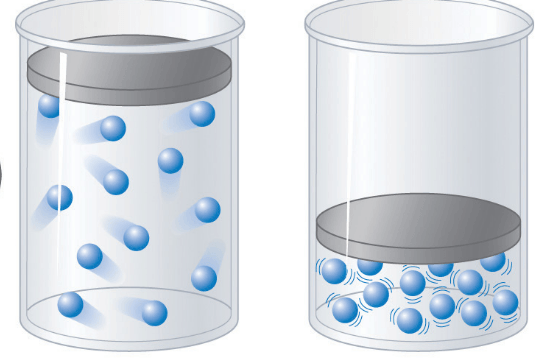
As the temperature of a substance increases so does the ___ of the molecules.
Potential Energy
Kinetic Energy


The first postulate of the KMT is that all matter is made up of
tiny particles
molecules
cells
mass
According the KMT, the particles are in
different states
organized patterns
constant motion
various containers
In a solid, what keeps each particle trapped in the same small volume and with the same surrounding particles.
strong attractions between particles
ionic bonds
lack of particle motion
low temperatures
what is happening at a particle level when a solid becomes a liquid?
The particles decrease in motion, collapsing the organized structure.
The increased movement of particles causing them to break out of their fixed positions.
The particles flatten and shrink into a smaller structure.
A particle party!
If the particles are moving fast enough to complete break the attraction pulling it back towards other particles, what process is occuring?
sublimation
melting
freezing
evaporation
Which of the following postulates of kinetic molecular theory explains why a liter of gas is essentially a liter of empty space?
The particles in a gas are considered to be small, hard spheres with insignificant volumes.
The motion of the particles in a gas is rapid, constant, and random.
The collisions between particles in a gas are perfectly elastic.
Equal volumes of gases at the same temperatures and pressure contain equal numbers of moles
Which of the following is one of the assumptions of kinetic molecular theory?
collisions between gas particles and the wall of a container are inelastic
the temperature of the gas depends on the average potential energy of the gas particles
gas particles are much larger than the space between them
the volume of a gas is mostly empty space
Solid-->liquid
Melting
Liquid-->gas
Boiling or evaporations
Gas-->liquid
Condensation
Liquid-->Solid
Freezing
Match the following units to their names.
Pressure (measured with Mercury)
mmHg
Volume
L
Temperature
K
Pressure
atm
Moles
mol
Guy- Lussac's Law
Avogadro's Law
Dalton's law
Coulombs law
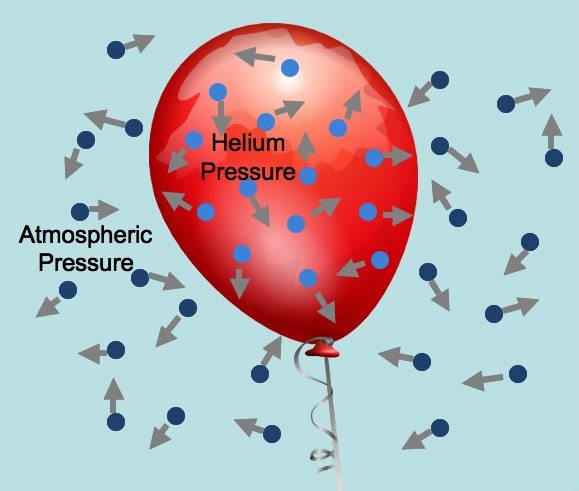

A Balloon is inflated by filling it with Helium.
Which Individual Gas Law is this an example of?
Boyle
Charles
Dalton
Avogadro
If a hairspray can is heated, what can be expected of the pressure of the gas inside the can?
The pressure will increase
The pressure will decrease
The pressure will remain constant
The pressure will equalize

The pressure of the gas in the balloon in the ice water will be:
Greater than that of the balloon in the boiling water.
Less than that of the balloon in the boiling water.
The same as that of the balloon in the boiling water.
Not enough information to answer the statement.

The diagram below shows a gas with an initial pressure of 4.0 atm and a volume of 0.520L in a cylinder at a constant temperature. The gas expands inside the cylinder and pushes the piston up to a volume of 2.03L. What is the final pressure of the gas after the expansion?
0.72 atm
1.0 atm
2.41 atm
8.17 atm

A rigid cylinder with a movable piston contains 50.0 liters of Hydrogen gas at 30.0° C with a pressure of 1.00 atmosphere. What is the volume of the gas in the cylinder at STP?
45.0 L
45.5 L
54.0 L
55.51 L

Which of the statements below are true of the substance represented in the diagram?
The kinetic energy between the particles in container B is greater than the kinetic energy in container C.
The substance in container C exhibits a greater amount of kinetic energy than the substance in container A.
Container B has the highest number of particles.
The particles in container B are moving at a greater speed than the particles in container C.
154.9 psi
Container A: 760 torr
Container B: 1000 torr
Container C: 1500 torr
Container D: 2000 torr
What is the value of 78.6 oC in Kelvin?
(a)
A steel tank occupies 9.583 L and contains 1.90 mol N2 gas at 31.8 °C. Calculate the pressure of N2 in the tank.
(a)
What size container is needed to hold 7.00 mol of a gas at 342 K and 255 kPa?
(a)

