
NEW
Font size
 Worksheets
blood vessels
Total questions: 46
Worksheet time: 23mins
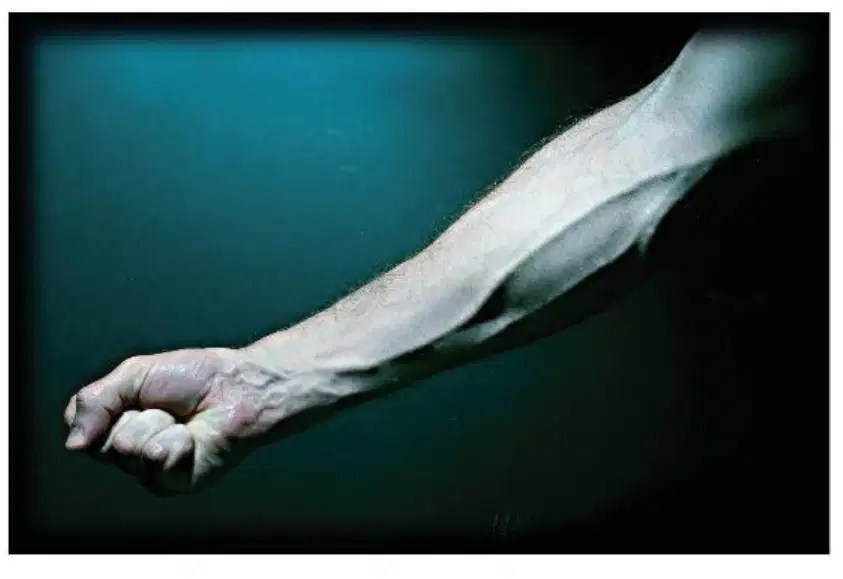
What do the superficial veins of the upper limb indicate?
The depth of blood vessels
The extent, prominence, and importance of these structures to the body
The color of blood
The temperature of the skin
What are the three types of blood vessels mentioned in the text?
Arteries, capillaries, and veins
Arteries, veins, and nerves
Capillaries, veins, and nerves
Arteries, nerves, and capillaries
What is the function of arteries in the circulatory system?
Carry blood toward the heart
Carry blood away from the heart
Link the two parts of the system
Directly serve cellular needs
Which type of blood vessel carries blood toward the heart?
Arteries
Capillaries
Veins
Nerves
What role do capillaries play in the circulatory system?
Carry blood away from the heart
Carry blood toward the heart
Link the two parts of the system and serve cellular needs
Transport oxygen directly to the heart
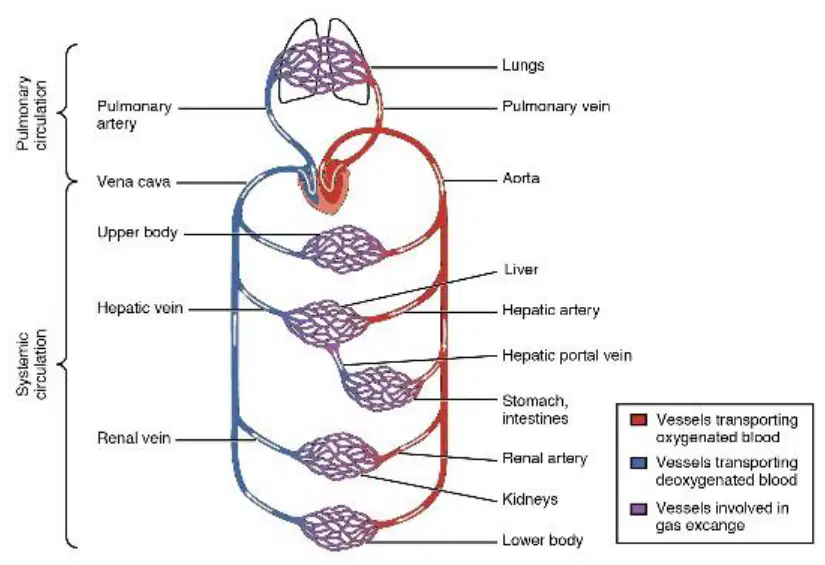
What is the primary function of the pulmonary circuit in the cardiovascular system?
To move blood from the left side of the heart to the body and back
To move blood from the right side of the heart to the lungs and back
To transport nutrients to the liver
To regulate blood pressure
What does the systemic circuit do in the cardiovascular system?
Moves blood from the right side of the heart to the lungs
Moves blood from the left side of the heart to the head and body
Transports oxygenated blood to the kidneys
Regulates the heartbeat
In the cardiovascular system, what do the arrows in the diagram indicate?
The speed of blood flow
The direction of blood flow
The temperature of the blood
The pressure of the blood
What do the colors in the cardiovascular diagram represent?
Different types of blood cells
Relative levels of oxygen concentration
Blood pressure levels
Blood sugar levels
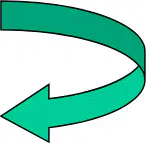
What is the correct order of blood flow starting from the heart?
Heart, Veins, Venules, Capillaries, Arterioles, Arteries
Heart, Arteries, Arterioles, Capillaries, Venules, Veins
Heart, Capillaries, Arterioles, Arteries, Veins, Venules
Heart, Venules, Veins, Arterioles, Capillaries, Arteries
What are the three tunics that compose arteries and veins?
Tunica interna, tunica media, and tunica externa
Tunica externa, tunica media, and tunica adventitia
Tunica media, tunica interna, and tunica intima
Tunica externa, tunica intima, and tunica adventitia
What is the space in the middle of a blood vessel where the blood is located called?
Lumen
Atrium
Ventricle
Sinus
What are capillaries primarily composed of?
Endothelium
Muscle tissue
Connective tissue
Cartilage
What is the function of the tunica interna (tunica intima) in blood vessels?
It controls dilation and constriction of vessels.
It lines the lumen of all vessels.
It contains collagen fibers.
It carries blood to the walls of the vessel.
Which layer of blood vessels is regulated by the sympathetic nervous system?
Tunica interna
Tunica externa
Tunica media
Subendothelial layer
What is the primary component of the tunica externa (tunica adventitia)?
Endothelial cells
Smooth muscle
Collagen fibers
Elastic fibers
What is the role of vasa vasorum in larger vessels?
To line the lumen of vessels
To regulate vessel dilation
To carry blood to the walls of the vessel
To control the sympathetic nervous system
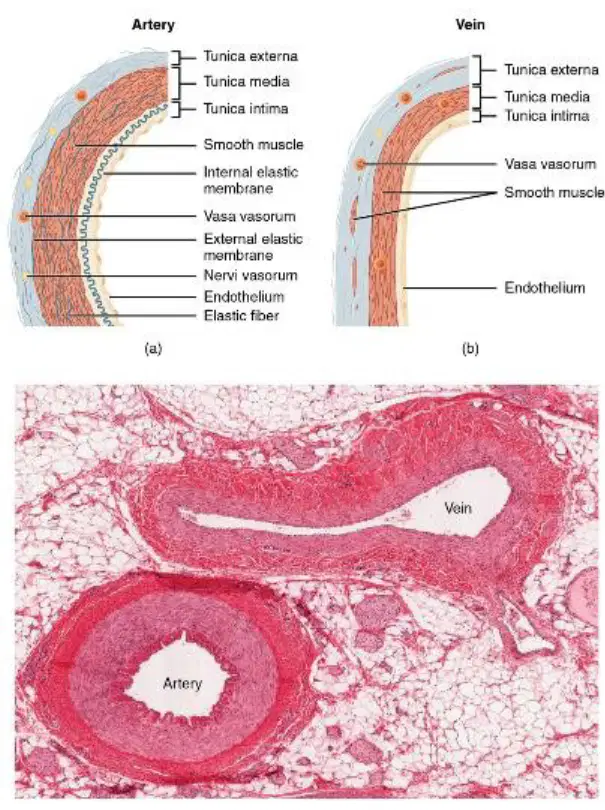
What is the main reason the walls of arteries are thicker than those of veins?
To accommodate more blood volume
To withstand higher blood pressure
To allow faster blood flow
To store more oxygen
Which of the following is a feature shared by both arteries and veins?
Tunica externa
Valves
Thicker walls
Wider lumen

What are the three types of blood vessels shown in the diagram?
Artery, Vein, and Capillary
Nerve, Muscle, and Bone
Artery, Nerve, and Muscle
Vein, Bone, and Capillary
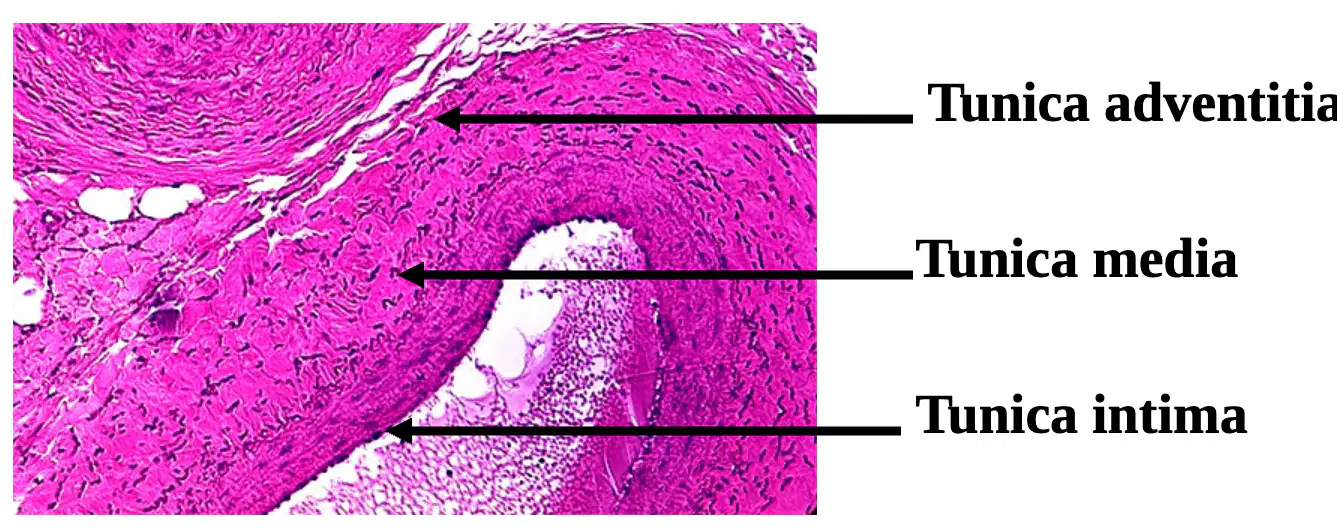
What are the three layers of a vein as shown in the diagram?
Tunica adventitia, Tunica media, Tunica intima
Tunica externa, Tunica interna, Tunica muscularis
Tunica fibrosa, Tunica elastica, Tunica interna
Tunica externa, Tunica media, Tunica interna
What is the outermost layer of an artery called?
Tunica intima
Tunica media
Tunica adventitia
Tunica externa
Which layer of an artery is responsible for its muscular and elastic properties?
Tunica intima
Tunica media
Tunica adventitia
Tunica externa
What is the innermost layer of an artery called?
Tunica intima
Tunica media
Tunica adventitia
Tunica externa
What are capillaries composed of?
Muscle cells rolled into a small tube
Endothelial cells rolled into a small tube
Nerve cells rolled into a small tube
Connective tissue rolled into a small tube

What are the three major types of capillaries?
Continuous, fenestrated, and sinusoid
Arterial, venous, and lymphatic
Elastic, muscular, and arterioles
Systemic, pulmonary, and portal
What are capillaries?
The largest blood vessels
The smallest blood vessels
Blood vessels with thick walls
Blood vessels that do not allow blood cells to pass
How thick are the walls of capillaries?
Two cells thick
Three cells thick
One cell thick
Four cells thick
How do blood cells pass through capillaries?
In clusters
In pairs
In single file
In groups of four
Which of the following is NOT a structural type of capillary?
Continuous
Fenestrated
Sinusoidal
Tubular
Where are continuous capillaries most abundant?
In the liver and kidneys
In the skin and muscles
In the lungs and heart
In the stomach and intestines
What type of junctions connect adjacent cells in continuous capillaries?
Gap junctions
Desmosomes
Tight junctions
Adherens junctions
What is the role of intercellular clefts in continuous capillaries?
They prevent fluid passage
They allow the passage of fluids
They strengthen the capillary walls
They transport oxygen
What do continuous capillaries of the brain constitute?
The blood-brain barrier
The blood-liver barrier
The blood-heart barrier
The blood-lung barrier

What is the function of the tight junctions in continuous capillaries?
To allow free passage of large molecules
To prevent leakage of fluid and molecules
To facilitate the movement of red blood cells
To increase the surface area for absorption

Which component of continuous capillaries is responsible for the exchange of small molecules?
Pericyte
Intercellular cleft
Basement membrane
Endothelial nucleus

What is the role of pinocytotic vesicles in continuous capillaries?
To transport large molecules across endothelial cells
To provide structural support
To regulate blood flow
To produce red blood cells
Where are fenestrated capillaries commonly found?
In the brain
In the small intestines
In the skin
In the muscles
What characteristic feature do fenestrated capillaries possess?
Thick walls
Smooth surfaces
Endothelium with pores
No permeability
Which of the following is true about fenestrated capillaries?
They are the least permeable capillaries
They are found in the lungs
They are the most permeable capillaries
They have no pores

What is the function of fenestrations (pores) in fenestrated capillaries?
To allow large molecules and cells to pass through
To prevent any substances from passing through
To facilitate the exchange of small molecules and fluids
To strengthen the capillary walls

Which component of the fenestrated capillaries is responsible for structural support?
Endothelial cell
Basement membrane
Red blood cell
Pinocytotic vesicles

What role do pinocytotic vesicles play in fenestrated capillaries?
They transport large proteins across the capillary wall
They provide structural support
They are involved in the uptake of fluids and small molecules
They prevent the passage of red blood cells
Where are sinusoidal capillaries commonly found?
Heart and lungs
Liver and bone marrow
Skin and muscles
Kidneys and bladder
What is a characteristic feature of sinusoidal capillaries?
They have small lumens
They are impermeable
They have large lumens
They are rigid
What do sinusoidal capillaries allow to pass between the blood and surrounding tissues?
Only small molecules
Only gases
Large molecules like proteins and blood cells
Only water

