
 Worksheets
Geologic History Vocabulary
Total questions: 32
Worksheet time: 16mins

The definition of absolute dating is:
A method of determining the age of an object in years.
A technique used to estimate the relative age of fossils.
A process of arranging geological events in a sequence.
A way to measure the decay of radioactive isotopes.

Catastrophism in geologic history refers to:
a theory that Earth's features are mostly accounted for by gradual, continuous processes
The idea that Earth's history has been characterized by a series of extreme, rapid, worldwide events.
a theory that Earth's features are mostly accounted for by extraterrestrial impacts
a theory that Earth's features are mostly accounted for by human activities

The concept of continental drift explains the movement of which of the following?
Oceans
Continents
Mountains
Rivers

An eon in geologic terms is:
a period of one million years
the largest division of geologic time
a period of one thousand years
a division of time shorter than an era

Define the term era in the context of geologic history.
the second-longest division in the geologic time scale, measured in tens- to hundreds-of-millions of years
A specific year in the calendar used by geologists.
A type of rock formation found in a specific region.
A method of dating fossils using radioactive isotopes.

Index fossils are used to:
fossils of organisms belonging to species that existed in large numbers for a relatively short amount of geologic time; used to date the rocks in which they are found
Identify the type of rock
Measure the temperature of the past
Predict future geological events

A mid-ocean ridge is:
a deep trench in the ocean floor
an oceanic rift zone that consists of long mountain chains with a central rift valley; divergent boundary
a flat plain on the ocean floor
a coral reef system

What is meant by the term period in geology?
A division of time in the geological time scale.
A type of rock formation.
A method of dating fossils.
A type of mineral found in the Earth's crust.

Explain the concept of relative dating.
Relative dating is a method of determining the age of a fossil by comparing its placement with that of fossils in other layers of rock.
Relative dating is a technique used to determine the absolute age of a rock or fossil.
Relative dating involves the use of radiometric techniques to date rocks and fossils.
Relative dating is a method that uses the decay of isotopes to determine the age of rocks.

Seafloor spreading is a geological process that occurs at mid-ocean ridges, where new oceanic crust is formed through volcanic activity and then gradually moves away from the ridge.
A process of mountain formation
A process of oceanic crust formation at mid-ocean ridges
A process of erosion on the seafloor
A process of sediment deposition
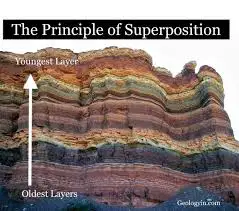
The principle of superposition states:
the ordering of sedimentary layers of rock with the oldest on the bottom and the youngest on top; a principle that states younger rocks lie above older rocks if they layers have not been disturbed
that energy cannot be created or destroyed, only transformed from one form to another
that every action has an equal and opposite reaction
that the total energy of an isolated system remains constant

Define uniformitarianism in geology.
The principle that slow geological processes, such as weathering and erosion, have remained the same over time
The belief that geological features are formed by sudden events
The idea that Earth's geology is constantly changing due to human activity
The concept that geological formations are unique to each region

What is the definition of absolute dating?
Determining the age of an object based on measurable physical or chemical qualities or associations with written records.
Estimating the age of an object based on the layer of earth in which it was found.
Dating an object by comparing it to other objects found in the same context.
Using the position of an object in a sequence to determine its age.

What is the definition of Catastrophism?
The idea that Earth's history has been characterized by a series of extreme, rapid, worldwide events.
The idea that Earth's history has been characterized by slow, gradual changes.
The idea that Earth's history has been characterized by random, unpredictable events.
The idea that Earth's history has been characterized by human intervention.

Catastrophism in geology is best explained by which of the following statements?
It is the theory that Earth's features are mostly accounted for by gradual, continuous processes.
It is the theory that Earth's features are mostly accounted for by sudden, short-lived, violent events.
It is the theory that Earth's features are mostly accounted for by extraterrestrial impacts.
It is the theory that Earth's features are mostly accounted for by human activities.

Which supercontinent is believed to have existed millions of years ago?
Pangaea
Gondwana
Laurasia
Rodinia

What is the longest division of time in the geologic time scale?
Eon
Era
Elon
Epoch

Explain the significance of an 'Eon' in the geologic time scale.
An eon is the largest division of geologic time, lasting billions of years.
An eon is a short period in geologic time, lasting only a few years.
An eon is a division of time used only in astronomy, not geology.
An eon is a term used to describe the age of a specific rock formation.

What is the second-longest division in the geologic time scale?
A) Period
B) Era
C) Eon
D) Epoch

What does a fossil ammonite represent?
Remains of an extinct sea mammal
Remains of a dinosaur
Remains of a bird
Remains of a plant

The significance of index fossils in geology is to:
determine the age of rock layers
identify the mineral composition of rocks
predict future geological events
measure the temperature of ancient climates

A mid-ocean ridge is:
a deep-sea trench
a type of ocean current
a mountain range on the ocean floor
a large oceanic plateau

Which of the following best describes a mid-ocean ridge?
A) A mountain range on land
B) An oceanic rift zone with long mountain chains and a central rift valley
C) A deep-sea trench
D) A coastal plain
A 'Period' in geological terms is:
a unit of time in the geological time scale
a type of rock formation
a method of dating fossils
a type of mineral

The definition of relative dating is:
A method of determining the age of an object in comparison to another, without necessarily determining their absolute age.
A technique used to date materials such as rocks or carbon, in which trace radioactive impurities were selectively incorporated when they formed.
A method of dating that provides a specific age or date range for an object.
A process of determining the age of an object by measuring the amount of a specific isotope present.

What is the process by which new oceanic lithosphere forms at mid-ocean ridges?
Seafloor spreading
Subduction
Convection currents
Plate collision

Which of the following statements is true about mid-ocean ridges?
They are convergent plate boundaries.
They are divergent plate boundaries.
They are transform plate boundaries.
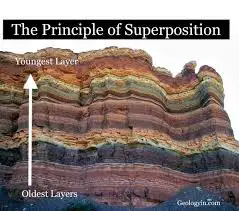
The principle of superposition in geology states that in any sequence of undisturbed layers of sedimentary rock, the oldest layer is at the bottom and the layers become progressively younger toward the top.
The oldest layer is at the bottom and the layers become progressively younger toward the top.
The youngest layer is at the bottom and the layers become progressively older toward the top.
All layers are of the same age.
The age of the layers cannot be determined.
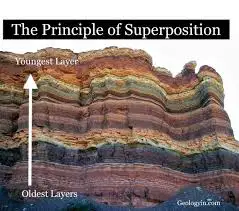
According to the principle of superposition, where are the oldest layers of rock found?
The oldest layers of rock are found at the bottom.
The oldest layers of rock are found at the top.
The oldest layers of rock are found in the middle.
The oldest layers of rock are found randomly.

True or False: The principle of superposition states that younger rocks lie above older rocks if the layers have not been disturbed.
True
False

The principle of uniformitarianism states that:
geological processes have always occurred at the same rate
the Earth is flat
all geological formations are man-made
the universe is expanding

Which processes are primarily responsible for shaping Earth's surface according to uniformitarianism?
Erosion and sedimentation
Volcanic eruptions and earthquakes
Meteor impacts and asteroid collisions
Human activities and deforestation

