
 Worksheets
Mock Regents Review
Total questions: 78
Worksheet time: 39mins
Which description of the atom is based on the results of the gold foil experiment in the early 1900s?
Atoms are small, dense, indivisible spheres
Atoms are composed of protons, electrons, and neutrons
Atoms have small, dense, positively charged nuclei.
Atoms have electrons with wavelike properties.
On the Periodic Table, the number of protons in an atom of an element is indicated by its
atomic mass
atomic number
selected oxidation states
number of valence electrons
Every chlorine atom has
7 electrons
17 neutrons
a mass number of 35
an atomic number of 17
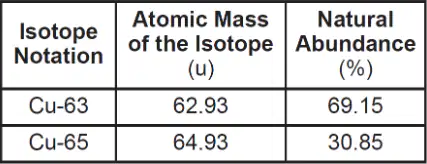
The table below gives the atomic mass and the abundance of the two naturally occurring isotopes of copper. Which numerical setup can be used to calculate the atomic mass of the element copper?
(62.93 u)(30.85) + (64.93 u)(69.15)
(62.93 u)(69.15) + (64.93 u)(30.85)
(62.93 u)(0.3085) + (64.93 u)(0.6915)
(62.93 u)(0.6915) + (64.93 u)(0.3085)
A potassium atom has a mass number of 37. What is the number of neutrons in this atom?
15
18
22
37
Which phrase describes the different isotopes of an element?
same number of electrons and a different number of protons
same number of protons and a different number of electrons
same number of protons and a different number of neutrons
same number of neutrons and a different number of protons
Which two notations represent isotopes of the same element?
147 N and 187 N
207 N and 2010 Ne
147 N and 1710 Ne
197 N and 1610 Ne
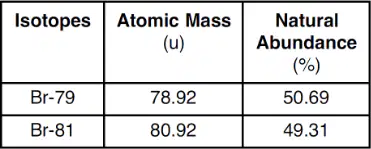
Which numerical setup can be used to calculate the atomic mass of the element bromine?
(78.92 u)(50.69) + (80.92 u)(49.31)
(78.92 u)(49.31) + (80.92 u)(50.69)
(78.92 u)(0.5069) + (80.92 u)(0.4931)
(78.92 u)(0.4931) + (80.92 u)(0.5069)
An orbital is defined as a region of the most probable location of
an electron
a neutron
a nucleus
a proton
Compared to an electron in the first electron shell of an atom, an electron in the third shell of the same atom has
less mass
less energy
more mass
more energy
When a ground state electron in an atom moves to an excited state, the electron
absorbs energy as it moves to a higher energy state
absorbs energy as it moves to a lower energy state
releases energy as it moves to a higher energy state
releases energy as it moves to a lower energy state
Which electron configuration represents the electrons of a phosphorus atom in an excited state?
2-8-5
2-8-6
2-7-6
2-7-4
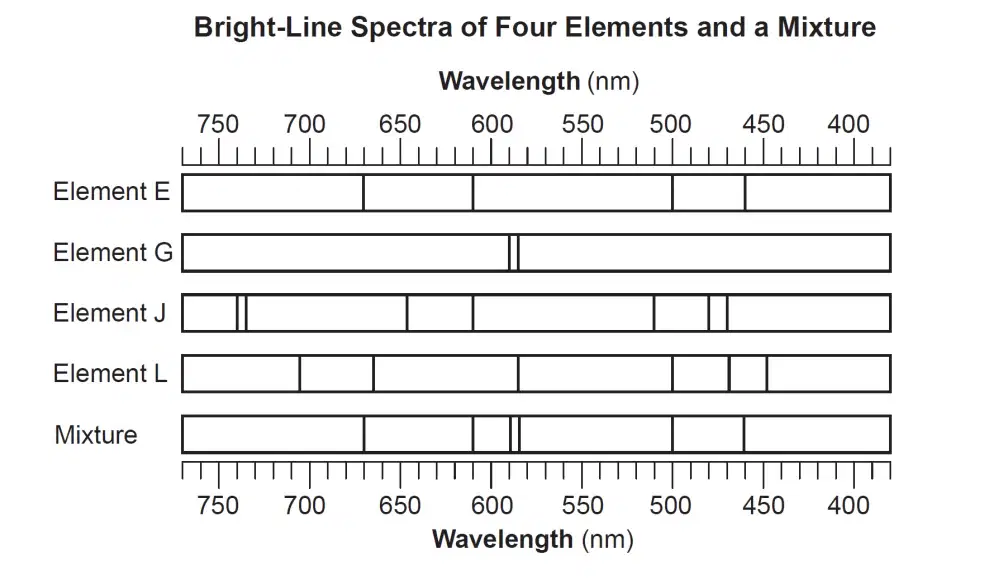
The bright-line spectra produced by four elements and a mixture of two of these elements are represented in the diagram below. Which elements are present in the mixture?
A) L and G
B) L and J
C) E and G
D) E and J
According to the wave-mechanical model of the atom, electrons are located in
orbitals
circular paths
a small, dense nucleus
a hard, indivisible sphere
The elements on the Periodic Table of the Elements are arranged in order of increasing
atomic mass
atomic number
mass number
oxidation state
The element in Group 14, Period 3, of the Periodic Table is classified as a
metal
noble gas
metalloid
nonmetal
Which list of elements consists of a metal, a metalloid, and a noble gas?
aluminium, sulfur, argon
magnesium, sodium, sulfur
sodium, silicon, argon
silicon, phosphorous, chlorine
Which statement describes a chemical property of iron?
Iron is malleable.
Iron conducts electricity.
Iron reacts with nitric acid.
Iron has a high melting point.
At STP, graphite and diamond are two solid forms of carbon. Which statement explains why these two forms of carbon differ in hardness?
Graphite and diamond have different ionic radii.
Graphite and diamond have different molecular structures.
Graphite is a metal, but diamond is a nonmetal.
Graphite is a good conductor of electricity, but diamond is a poor conductor of electricity.
Krypton atoms in the ground state tend not to bond with other atoms because their
second electron shell contains eight electrons
third electron shell contains eighteen electrons
innermost electron shell contains two electrons
outermost electron shell contains eight electrons
Which element is a liquid at STP?
bromine
cesium
francium
iodine
Oxygen can exist as diatomic oxygen gas, O2(g), or ozone, O3(g). These two forms of oxygen have
the same molecular structure and the same properties
different molecular structures and different properties
the same molecular structure and different properties
different molecular structures and the same properties
Which Lewis electron-dot diagram represents a nitrogen atom in the ground state?


An element with a partially filled d sublevel in the ground state is classified as
a halogen
a transition metal
an alkali metal
an alkaline earth metal
When an F atom becomes an F⁻ ion, the F atom
gains a proton
loses a proton
gains an electron
loses an electron
Compared to the number of electron shells and radius of an aluminum atom in the ground state, a boron atom in the ground state has
fewer electron shells and a smaller radius
fewer electron shells and a larger radius
more electron shells and a smaller radius
more electron shells and a larger radius
Which general trends in atomic radius and electronegativity are observed as the elements in Period 3 are considered in order of increasing atomic number?
Atomic radius decreases and electronegativity increases.
Atomic radius increases and electronegativity decreases.
Both atomic radius and electronegativity increase.
Both atomic radius and electronegativity decrease.
Which sample of matter is classified as a mixture?
NaCl(s)
CH₃OH(ℓ)
SO₂(g)
KNO₃(aq)
What is the formula for iron(II) oxide?
FeO
FeO₂
Fe₂O
Fe₂O₃
What is the chemical formula for ammonium sulfide?
(NH₄)₂S
(NH₄)₂SO₃
(NH₄)₂SO₄
(NH₄)₂SO₂
What is a chemical name for the compound PbO₂?
lead(I) oxide
lead(II) oxide
lead(III) oxide
lead(IV) oxide
Which formula is the empirical formula for ethane, C₂H₆?
CH
CH₃
C₂H₆
C₄H₁₂
What is the molecular formula for CH₃CH₂COOCH₃?
C₂H₄O
C₂H₄O₂
C₄H₈O
C₄H₈O₂
What is the gram-formula mass of Mg(NO₃)₂?
86 g/mol
134 g/mol
148 g/mol
172 g/mol
What is the total number of moles of oxygen atoms in 1 mole of N₂O₃?
1
2
3
5
What is the number of moles of CO₂ in a 220.-gram sample of CO₂ (gram-formula mass = 44 g/mol)?
0.20 mol
5.0 mol
15 mol
44 mol
A substance has an empirical formula of CH₂ and a molar mass of 56 grams per mole. The molecular formula for this compound is
A) CH₂
B) C₄H₆
C) C₄H₈
D) C₈H₄
What is the empirical formula of a compound that contains 30.4% nitrogen and 69.6% oxygen by mass?
NO
NO₂
N₂O₃
N₂O₅
What is the percent composition by mass of nitrogen in (NH₄)₂CO₃ (gram-formula mass = 96.0 g/mol)?
14.6%
29.2%
58.4%
87.5%
Given the equation representing a reaction: F₂(g) + 2KCl(aq) → 2KF(aq) + Cl₂(g) Which type of chemical reaction is represented by the equation?
synthesis
decomposition
single replacement
double replacement
Given the equation representing a reaction: 2NaCl → 2Na + Cl₂ Which type of reaction does this equation represent?
double replacement
decomposition
synthesis
single replacement
Given the unbalanced equation: __Fe₂O₃ + __CO → __Fe + __CO₂ When the equation is correctly balanced using the smallest whole-number coefficients, what is the coefficient of CO?
1
2
3
4
Given the equation representing a reaction: Cl₂(g) + 2I2(aq) → 2Cl2(aq) + I₂(s) What is the number of moles of electrons gained by Cl₂(g) when 2.0 moles of electrons are lost by I2(aq)?
1.0 mol
2.0 mol
3.0 mol
4.0 mol
Given a balanced equation representing a reaction: 2CO(g) + O₂(g) → 2CO₂(g) + energy Which mass of O₂(g) reacts completely with 5.6 grams of CO(g) to produce 8.8 grams of CO₂(g)?
1.6 g
2.8 g
3.2 g
14.4 g
Given the reaction: Mg + H₂SO₄ → MgSO₄ + H₂ How many grams of H₂SO₄ are needed to produce exactly 11.2 liters of H₂, measured at STP?
24.5
49.0
98.0
196
Given the equation representing a reaction: F + F → F₂ Which statement describes the changes that occur during this reaction?
A) A bond is formed as energy is absorbed.
B) A bond is formed as energy is released.
C) A bond is broken as energy is absorbed.
D) A bond is broken as energy is released.
What occurs when potassium reacts with chlorine to form potassium chloride?
Electrons are shared and the bonding is ionic.
Electrons are shared and the bonding is covalent.
Electrons are transferred and the bonding is ionic.
Electrons are transferred and the bonding is covalent.
Which type of bond forms when electrons are equally shared between two atoms?
a polar covalent bond
a nonpolar covalent bond
a hydrogen bond
an ionic bond
Which formula represents a molecule with an asymmetrical distribution of charge?
Cl2
CO2
CH4
H2O
What is the amount of heat that must be absorbed to increase the temperature of a 130.-gram sample of water from 20.0°C to 50.0°C?
3.90 × 10³ J
1.63 × 10⁴ J
4.34 × 10⁴ J
2.94×10⁵ J
Which sample of zinc has atoms with the highest average kinetic energy?
5.0 g of Zn at 40.°C
10. g of Zn at 30.°C
15 g of Zn at 20.°C
20. g of Zn at 10.°C
What is the temperature, in degrees Celsius, of a sample of matter at 35 K?
−238°C
−308°C
35°C
308°C
Which phase change results in an increase in disorder?
I2(g) → I2(s)
Cl2(l) → Cl2(g)
N2O4(g) → N2O4(l)
H2O(l) → H2O(s)
According to the kinetic molecular theory, the particles of an ideal gas
constantly move in circular paths
have no attractive forces between them
do not transfer energy when the particles collide
are separated by small distances relative to their sizes
Under which conditions will a real gas behave more like an ideal gas?
high pressure and high temperature
high pressure and low temperature
low pressure and high temperature
low pressure and low temperature
A rigid cylinder with a movable piston contains a sample of hydrogen gas. At 330. K, this sample has a pressure of 150. kPa and a volume of 3.50 L. What is the volume of this sample at STP?
0.233 L
1.96 L
4.29 L
6.26 L
Which set of values represents standard pressure and standard temperature?
1 atm and 101.3 K
1 kPa and 273 K
101.3 kPa and 0°C
101.3 atm and 273°C
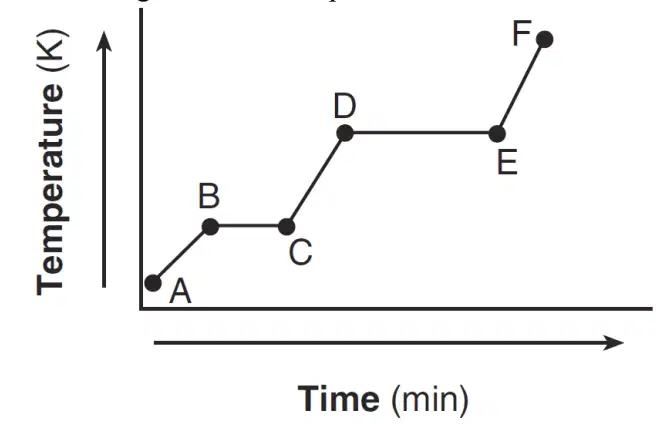
The heating curve below represents a sample of a substance starting as a solid below its melting point and being heated over a period of time. Which statement describes the energy of the particles in this sample during interval DE?
A) Both potential energy and average kinetic energy increase.
B) Both potential energy and average kinetic energy decrease.
C) Potential energy increases and average kinetic energy remains the same.
D) Potential energy remains the same and average kinetic energy increases.
How many joules of heat are absorbed to raise the temperature of 435 grams of water at 1 atm from 25°C to its boiling point, 100.°C?
4.5 X 10⁴ J
1.4 X 10⁵ J
2.5 X 10⁷ J
7.4 X 10⁷ J
What is the amount of heat required to completely melt a 200.-gram sample of H2O(s) at STP?
334 J
836 J
66800 J
452000 J
Which term identifies a force of attraction that exists between molecules of water?
covalent bonding
hydrogen bonding
ionic bonding
metallic bonding
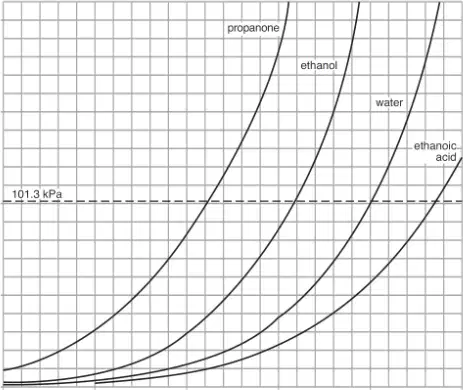
Based on Table H, which compound has the weakest intermolecular forces at 75°C?
ethanoic acid
ethanol
propanone
water
The difference in which property allows the separation of a sample of water and sand by using filter paper and a funnel?
boiling point
melting point
particle size
sample volume
Which process can be used to separate a mixture of two liquids having different boiling points?
deposition
distillation
filtration
sublimation
Based on Table G, which compound is less soluble in water as the temperature increases from 0°C to 100°C?
KNO3
NH3
KClO3
NH4Cl
When PbI2(s) is added to Na2CO3(aq), a white precipitate is formed. According to Reference Table F, the white precipitate most likely is
KNO3
PbCO3
NaI
Na2CO3
When 5 grams of KCl are dissolved in 50. grams of water at 25°C, the resulting mixture can be described as
heterogeneous and unsaturated
heterogeneous and supersaturated
homogeneous and unsaturated
homogeneous and supersaturated
What is the molarity of a NaOH solution containing 0.125 mole of NaOH in 0.200 L of water?
0.025 M
0.250 M
0.625 M
1.60 M
A solution has a mass of 2000. grams and contains 0.050 gram of dissolved solute. What is the concentration in parts per million of this solution?
5.0 ppm
25 ppm
50. ppm
100. ppm
A reaction between two different gases is most likely to occur when the colliding molecules have the proper orientation and sufficient
charge
energy
mass
volume
As the temperature of a reaction increases, it is expected that the reacting particles collide
more often and with greater force
more often and with less force
less often and with greater force
less often and with less force
Given the reaction: Zn(s) + 2 HCl(aq) → Zn²⁺(aq) + 2 Cl⁻(aq) + H₂(g) If the concentration of HCl(aq) is increased, the frequency of reacting collisions will
decrease, producing a decrease in the reaction rate
decrease, producing an increase in the reaction rate
increase, producing a decrease in the reaction rate
increase, producing an increase in the reaction rate
Given the equation: I₂(s) → I₂(g) Which phrase describes this change?
endothermic chemical change
endothermic physical change
exothermic chemical change
exothermic physical change
Which expression represents the heat of reaction for a chemical change?
(PEproducts) + (PEreactants)
(PEproducts) – (PEreactants)
(PEproducts) ÷ (PEreactants)
(PEproducts) × (PEreactants)
Given the reaction at equilibrium: 2 SO₂(g) + O₂(g) ↔ 2 SO₃(g) + heat Which change will shift the equilibrium to the right?
increasing the temperature
increasing the pressure
decreasing the amount of SO₂(g)
decreasing the amount of O₂(g)
Which term represents the disorder of a system?
entropy
mole
quanta
pressure
Which condition is necessary for a chemical reaction to occur spontaneously?
ΔS must be negative.
ΔS must be positive.
ΔG must be negative.
ΔG must be positive.
Which two particles each have a mass approximately equal to one atomic mass unit?
positron and electron
positron and neutron
proton and electron
proton and neutron

