
 Worksheets
Wave Behavior
Total questions: 74
Worksheet time: 40mins
Refraction occurs when a wave changes its (a) as it passes through a different medium.
frequency
color
intensity
speed
Houses with carpet are much quieter than houses with tile or hardwood floors because of sound wave
absorption
diffraction
reflection
refraction
Which is an example of a compressional wave?
sound wave
X-ray
gamma ray
water wave
Increasing the amplitude of a sound wave will make it ____________
louder
have a higher pitch
travel faster
produce beats
Ocean waves crash on the beach at a velocity of 3.5 m/s. If the distance between the crests of each wave is 4 m, find the frequency of the waves.
0.88 Hz
1.14 Hz
0.0088 Hz
14.0 Hz

The picture to the right shows which wave behavior?
absorption
reflection
diffraction
refraction
An echo is an example of sound wave
absorption
reflection
diffraction
refraction
What is the velocity of a wave having a frequency of 25 Hz and a wavelength of 10 m?
250 m/s
2.5 m/s
35 m/s
0.4 m/s
A glass prism is able to bend light because
light is refracted as it enters a different medium
the prism creates destructive interference
energy is diffracted when it encounters an obstacle
the glass and the light’s wavelength create resonance
In 1 second, 4 crests of a wave pass a certain point. What is the wave’s frequency?
0.25 Hz
0.25 m/s
4 Hz
4 m/s
When an ambulance with its siren on is moving away from you, the wavelength of the sound gets and the pitch of the sound gets.
shorter, lower
longer, higher
longer, lower
shorter, higher
In order for reflection to occur, the wave must (a) an object.
bounce off
bend around
pass through
be absorbed by
The bending of light waves as they pass through one medium to another is called:
refraction
reflection
diffraction
interference

A ray of light falls on the mirror pictured to the right. Which ray best describes the path of the light reflected from the mirror?
C
B
A
D
X-rays, UV waves, and sound waves all have what in common?
They are all part of the electromagnetic spectrum
They all transmit energy
They all need a medium to be transmitted
They can all travel in a vacuum like outer space
Which of the following would result in constructive interference if they were to collide?
a crest and a trough
a compression and a rarefaction
two crests
a crest and a rarefaction

In the figure to the right, the angle of incidence is identified by:
Angle B
Angle A
Angle C
Angle D

In the same figure above, ray #2 is called the:
reflected ray
refracted ray
normal ray
incident ray

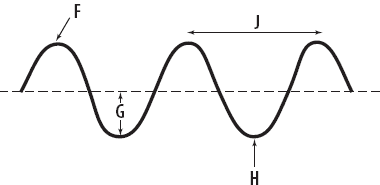
How many wavelengths are in the picture?
2
3
4
5
Light waves travel the fastest in ...
solids
liquids
gases
empty space

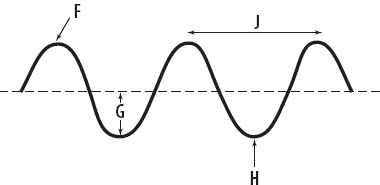
What type of wave is shown in the picture?
compression
transverse
multiple
particle
The highest point on a transverse wave is the
crest
compression
rest position
trough
A wave that can travel through matter and empty space is a:
electromagnetic wave
longitudinal wave
transverse wave
all waves

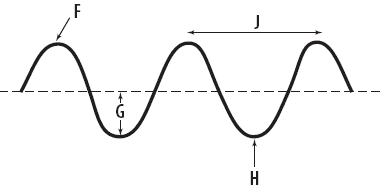
#1 refers to
wavelength
crest
trough
amplitude

#3 refers to the
amplitude
wavelength
crest
trough
When the frequency of a wave increases, what happens to the wavelength?
The wavelength decreases.
The wavelength is not directly affected by the frequency of a wave.
More specific information is needed to form a conclusion about the wavelength.
The wavelength increases.

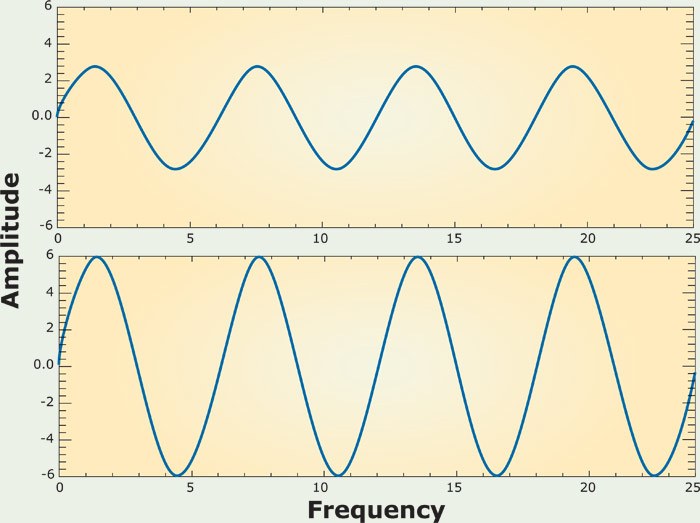
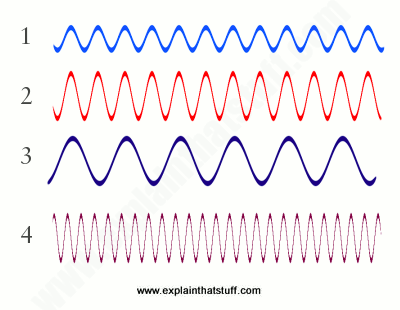
Which wave has the greatest frequency?
1
2
3
4
What is a medium?
the substance through which a wave can travel
something between a small and a large?
a pattern of vibration that simulates when a wave is standing still
the distance from any point on a wave to an identical point on the next wave
A wave has frequency of 50 Hz and a wavelength of 10 m. What is the speed of the wave?
500 m/s
5 m/s
50 m/s
0.5 m/s
A wave has wavelength of 10 m and a speed of 340 m/s. What is the frequency of the wave?
34 Hz
34 m/s
3400 m/s
3400 Hz
A guitar string vibrates with a frequency of 320 hz. If the wavelength of the vibration is 0.23 meters what is the speed of the wave?
A) 73.6 m/s
B) 73.6 m/hz
C) 320.23 m/s
D) 1391.3 hz
Which has the LONGEST wavelength and, therefore, the lowest frequency/energy?
Radio Waves
Gamma Rays
Visible Light
Infrared rays
Which section of the spectrum is the ONLY one we can see?
Visible Light
X-rays
Gamma Rays
Ultraviolet Rays

High frequency waves have (a) wavelengths.
short
the same
varying
long
All electromagnetic waves have the same...
speed
wavelength
frequency
energy
The acronym (letters) used to remember visible light is ___________.
ROYGBIV
KTPERRY
DOGPOUND
ROMERO
Select the correct order of waves on the Electromagnetic Spectrum.
Radio, Micro, Infra, Visible, Ultra, X-ray, Gamma
Vis, Micro, Infra, Ultra, X-ray, Gamma, Radio
Micro, Radio, Vis, Infra, Ultra, X-ray, Gamma
Gamma, X-ray, Ultra, Vis, Infra, Micro, Radio
Calculate the frequency of green light in a vacuum with a wavelength of 530x10−9m and a speed (c) of 3.00x10⁸ ?
5.66 x 10^14 Hz
6x10¹⁶Hz
6.2587 x10¹⁶ Hz
517 x 10^{12} Hz
A ray of light is incident on a plane mirror and the angle of incidence is 25 degrees. What is the angle of reflection?
25 degrees
0 degrees
90 degrees
50 degrees
The angle of incidence is (a) the angle of reflection
45 degrees
30 degrees
60 degrees
90 degrees

What type of interference?
Diffraction
Refraction
Absorption
Reflection

What type of interference?
Destructive Interference
Constructive Interference
Reflection
Rarefaction

Look at the picture. What property allows Jack to hear Jill on the other side of the door?
Reflection
Refraction
Diffraction
Scattering

The picture shows a prism. What property of waves causes the light to look like a rainbow as it exits the prism?
Reflection
Refraction
Diffraction
Transmission

Look at the diagram. At which positions will the overlapping waves have the most constructive interference?
Positions #1 & #5
Positions #2 & #3
Positions #3 & #4
Positions #4 & #5


What type of interference do noise cancelling headphones use?
Constructive Interference
Destructive Interference



Which EM waves have the longest wavelength?
radio
x-rays
ultraviolet
gamma rays
Which EM waves have the shortest wavelength?
radio
x-rays
ultraviolet
gamma rays
Which EM waves are invisible? (more than one correct answer)
radio
visible
ultraviolet
gamma rays
Which EM waves are have a SHORTER wavelength than visible?
radio
none
infrared
x-rays
Which EM waves are have the lowest frequency?
radio
none
infrared
x-rays
Which EM waves are have the highest energy & are the most dangerous?
radio
gamma rays
infrared
x-rays
Which color waves have the lowest frequency?
red
yellow
green
violet
Which color waves have the shortest wavelength?
red
yellow
green
violet
What happens to frequency when wavelength decreases?
stays the same
decreases
increases
There is no relationship between wavelength & frequency.
Which type of electromagnetic wave travels fastest through a vacuum?
radio
gamma rays
visible light
They all travel at the same speed.

The diagram shows a person observing a thunderstorm located several kilometers away. The person hears the thunder several seconds after seeing the lightning. Which statement accurately explains the difference in observations of sound and light by the observer?
Human eyes see light faster than their ears can hear sound.
The medium the waves are traveling through is different for each type of wave.
Light waves travel faster than sound waves.
Sound waves travel faster than light waves.

Which EM wave has a frequency just higher than radio waves?
ultraviolet radiation
visible light
infrared waves
microwaves
What type of EM wave is given off by all objects?
ultraviolet radiation
infrared radiation
gamma rays
visible light
What electromagnetic wave has the longest wavelengths and lowest frequencies?
Microwaves
Ultraviolet Rays
Infrared Waves
Radio Waves

What electromagnetic wave do humans emit as heat energy?
infrared light
ultraviolet light
visible light
microwaves
The color blue has more energy than the color red.
True
False

