
 Worksheets
M1.SETS1-3
Total questions: 125
Worksheet time: 1hrs 3mins
The set of intelligent students in a class is:
a null set
a singleton set
a finite set
not a well defined collection
The number of the power set of {a, b, c} is:
3
6
6
8
Which one is different from the others?
empty set
void set
zero set
null set
If A = {x, y} then the power set of A is :
{x*, y*}
{ϕ, x, y}
{ϕ, {x}, {y}}
{ϕ, {x}, {y}, {x,y}}
Consider the following sets. I. A = {1, 2, 3} II. B = {x ∈ R ; x² – 2x + 1 = 0} III. C = {1, 2, 3} IV. D = {x ∈ R ; x³ – 6x² + 11x – 6 = 0} Which of the following are equal?
A = B = C
A = C = D
A = B = D
B = C = D
If X= {1, 2, 3, …, 10} and ‘a’ represents any element of X, then the set containing all the elements satisfy a² + 2 = 6, a ∈ X is
{4}
{3}
{2}
{5}
Two finite sets have m and n elements. The total number of subsets of the first set is 56 more than the total number of subsets of the second set. The values of m and n are:
7, 6
6, 3
5, 1
8, 7
The set {x : x is an even prime number} can be written as
{2}
{2,4}
{2,14}
{2,4,14}
Given the sets A = {1,3,5}, B = {2,4,6} and C = {0,2,4,6,8}. Which of the following may be considered as universal set for all the three sets A, B and C?
{0, 1, 2, 3, 4, 5, 6}
{ϕ}
{0, 1, 2, 3, 4, 5, 6, 7, 8, 9, 10}
{1, 2, 3, 4, 5, 6, 7, 8}
Which of the following collections are sets ?
The collection of all the days of a week
A collection of 11 best hockey player of India.
The collection of all rich person of Delhi
A collection of most dangerous animals of India.
Consider the following sets. A = {0}, B = {x : x > 15 and x < 5}, C = {x : x – 5 = 0}, D= {x : x² = 25}, E= {x : x is an integral positive root of the equation x² – 2x – 15 = 0} Choose the pair of equal sets
A and B
C and D
C and E
B and C
If a set is denoted as B = ϕ, then the number of element in B is
3
2
1
0
Let X = {1, 2, 3, 4, 5}. Then, the number of elements in X are
3
2
1
5
Let A = {(1, 2), (3, 4), 5}, then which of the following is incorrect?
{3, 4} ∉ A as (3, 4) is an element of A
{5}, {(3, 4)} are subsets of A but not elements of A
{1, 2}, {5} are subsets of A
{(1, 2), (3, 4), 5} are subset of A
If ϕ denotes the empty set, then which one of the following is correct ?
ϕ ∈ ϕ
ϕ ∈ {ϕ}
ϕ ∉ {ϕ}
0 ∈ {ϕ}
Which one of the following is an infinite set ?
The set of human beings on the earth
The set of water drops in a glass of water
The set of trees in a forest
The set of all primes
The set A = {x : x ⋳ R, x2 = 16 and 2x = 6} equals
ϕ
{14, 3, 4}
{3}
{4}
A = {x : x ≠ x} represents
{x}
{1}
{ }
{0}
Which of the following is a null set ?
{0}
{x : x > 0 or x < 0}
{x : x² – 4 or x = 3}
{x : x² + 1 = 0, x ∈ R}
Let A = {1, 3, 5} and B = {x : x is an odd natural number less than 6}. Then, which of the following are true?
I. A ⊂ B II. B ⊂ A III. A = B IV. A ∉ B
I and II are true
I and III are true
I, II and III are true
I, II and IV are true
If X = {1, 2, 3}, then the number of proper subsets is
5
6
7
8
The number of non-empty subsets of the set {1, 2, 3, 4} is 3 × a. The value of 'a' is
3
4
5
6
If A = {a, {b}}, then P(A) equals.
{ø, {a}, {{b}}, {a, {b}}}
{ø, {a}}
{ø, {a}, {b}}
The set builder form of given set A = {3, 6, 9, 12} and B = {1, 4, 9, ......, 100} is
A = {x : x = 3n, n ∈ N and 1 ≤ n ≤ 5}, B = {x : x = n², n ∈ N and 1 ≤ n ≤ 10}
A = {x : x = 3n, n ∈ N and 1 ≤ n ≤ 4}, B = {x : x = n², n ∈ N and 1 ≤ n ≤ 10}
A = {x : x = 3n, n ∈ N and 1 ≤ n ≤ 4}, B = {x : x = n², n ∈ N and 1 < n < 10}
Which of the following sets is a finite set?
{x : x ∈ Z and x² − 5x + 6 = 0}
{x : x ∈ Z and x² is even}
{x : x ∈ Z and x > −10³}
All of these
Which of the following is a singleton set?
{x : |x| = 5, x ∈ N}
{x : |x| = 6, x ∈ Z}
{x : x² + 2x + 1 = 0, x ∈ N}
{x : x² = 7, x ∈ N}
Which of the following is not a null set?
Set of odd natural numbers divisible by 2
Set of even prime numbers
{x : x is a natural number, x < 5 and x > 7}
{y : y is a point common to any two parallel lines}
If A = {x : x = n², n = 1, 2, 3}, then number of proper subsets is
3
6
7
4
Which of the following has only one subset?
{ø}
{4}
{4,5}
{ø, 4}
Which of the following statement is FALSE
If A = {x : x² = 4, x ∈ N} ⊂ B = {−2} then A ≠ B
If A = {x : |x| < 2, x ∈ I}, B = {−1,1}, then A = B
If {1, 2, 3, 4, 5}, B = {2, 1, 3, 3, 4, 4, 5} then A = B
If A = {x² − 5x + 7 = 0, x ∈ R} and B = ø, then A = B
Which of the following is/are true? I. If A is a subset of the universal set U, then its complement A' is also a subset of U. II. If U' = {1, 2, 3, ......, 10} and A' = {1, 3, 5, 7, 9}, then (A')' = A.
Only I is true
Only II is true
Both I and II are true
None of these
Assertion : The subsets of the set {1, {2}} are {ø, {1}, {{2}}} and {1, {2}}. Reason : The total number of proper subsets of a set containing n elements is 2ⁿ − 1.
Assertion is correct, reason is correct; reason is a correct explanation for assertion.
Assertion is correct, reason is correct; reason is not a correct explanation for assertion.
Assertion is correct, reason is incorrect
Assertion is incorrect, reason is correct
The set {21,32,43,54,65,76} in the set-builder form is
{x:x=n+1n, where n∈N and 1<n<6}
{x:x=n+1n, where n∈N and 1≤n<6}
{x:x=n+1n, where n∈N and 1≤n≤6}
None of the above
The set {x : x is a positive integer less than 6 and 3⁻ˣ−¹ is an even number} in roster form is
{1, 2, 3, 4, 5}
{1, 2, 3, 4, 5, 6}
{2, 4, 6}
{1, 3, 5}
If B = {x : x is a student presently studying in both classes X and XI}. Then, the number of elements in set B are
finite
infinite
zero
None of these
Consider: X = Set of all students in your school. Y = Set of all students in your class. Then, which of the following is true?
Every element of Y is also an element of X
Every element of X is also an element of Y
Every element of Y is not an element of X
Every element of X is not an element of Y
If A ⊂ B and A ≠ B, then
A is called a proper subset of B
A is called a super set of B
A is not a subset of B
B is a subset of A
Which of the following is correct? I. Number of subsets of a set A having n elements is equal to 2ⁿ. II. The power set of a set A contains 128 elements then number of elements in set A is 7.
Only I is true
Only II is true
Both I and II are true
Both I and II are false
If A = ø, then the number of elements in P(A) is
3
2
1
0
The set of real numbers {x : a < x < b} is called
open interval
closed interval
closed interval
semi-closed interval
Which of the following is true?
a ∈ {{a}, b}
{b, c} ⊂ {a, {b, c}}
{a, b} ⊂ {a, {b, c}}
None of these

The interval [a, b] is represented on the number line as
(a)
(b)
(c)
(d)

The interval represented by a ———— b is
(a, b)
[a, b]
[a, b)
(a, b)
The number of elements in P[P(P(∅))] is
2
3
4
5
The cardinality of the set P(P(P(∅))) is
0
1
2
4
Let A, B, C be three sets. If A ∈ B and B ⊂ C, then
A ⊂ C
A ⊆ C
A ∈ C
A ⊄ C
The number of elements in the set {(a, b) : 2a² + 3b² = 35, a, b ∈ Z}, where Z is the set of all integers, is
2
4
8
12
If the sets A and B are given by A = {1, 2, 3, 4}, B = {2, 4, 6, 8, 10} and the universal set U = {1, 2, 3, 4, 5, 6, 7, 8, 9, 10}, then
{ A ⋃ B } ' = {5,7,9}
{ A ⋂ B } ' = {1,5,7,6,7}
{ A ⋂ B } ' = {1,5,7,6,7,8}
None of these
If A = {1, 2, 3, 4}, B = {2, 3, 5, 6} and C = {3, 4, 6, 7}, then
A – (B ⋂ C) = {1, 3, 4}
A – (B ⋂ C) = {1, 2, 4}
A – (B ⋃ C) = {2, 3}
A – (B ⋃ C) = {ϕ}
If the sets A and B are as follows :
A = {1, 2, 3, 4}, B = {3, 4, 5, 6}, then
A – B = {1, 2}
B – A = {5}
[(A – B) – (B – A)] Ç A = {1, 2}
[(A – B) – (B – A)] È A = {3, 4}
Consider the following relations:
I. A – B = A – (A ⋂ B)
II. A = (A ⋂ B) ⋃ (A – B)
III. A – (B ⋃ C) = (A – B) ⋃ (A – C)
Which of these is/are correct?
Both I and III
Only II
Both II and III
Both I and II

What does the shaded portion of the Venn diagram below represent?
(P ∩ Q) ∩ (P ∩ R)
((P ∩ Q) − R) ∪ ((P ∩ R) − Q)
((P ∪ Q) − R) ∩ ((P ∩ R) − Q)
((P ∩ Q) ∪ R) ∩ ((P ∪ Q) − R)
Let A = {x : x ∈ R, |x| < 3}; B = {x : x ∈ R, |x − 1| ≥ 1} and A ∪ B = R − D, then the set D is
{x : 1 < x ≤ 2}
{x : 1 ≤ x < 2}
{x : 1 ≤ x ≤ 2}
None of these
If A ∪ B ≠ ϕ, then n(A ∪ B) = ?
n(A) + n(B) − n(A ∩ B)
n(A) − n(B) + n(A ∩ B)
n(A) − n(B) − n(A ∩ B)
n(A) + n(B) + n(A ∩ B)
Which of the following properties are associative law?
A ∪ B = B ∪ A
A ∪ C = C ∪ A
A ∪ D = D ∪ A
(A ∪ B) ∪ C = A ∪ (B ∪ C)
Let V = {a, e, i, o, u} and B = {a, i, k, u}. Value of V − B and B − V are respectively
{e, o} and {k}
{e} and {k}
{o} and {k}
{e, o} and {k, i}
Let A = {a, b}, B = {a, b, c}. What is A ∪ B?
{a, b}
{a, c}
{a, b, c}
{b, c}
Let A = {x : x is a multiple of 3} and B = {x : x is a multiple of 5}. Then A ∩ B is given by:
{15, 30, 45,...}
{3, 6, 9,...}
{5, 10, 15, 20...}
{5, 10, 20,...}
Let A = {a, b} and B = {a, b, c}. Then, A ⊂ B. If A ⊂ B, then A ∪ B = B.
Statement I is true
Statement II is true
Both are true
Both are false
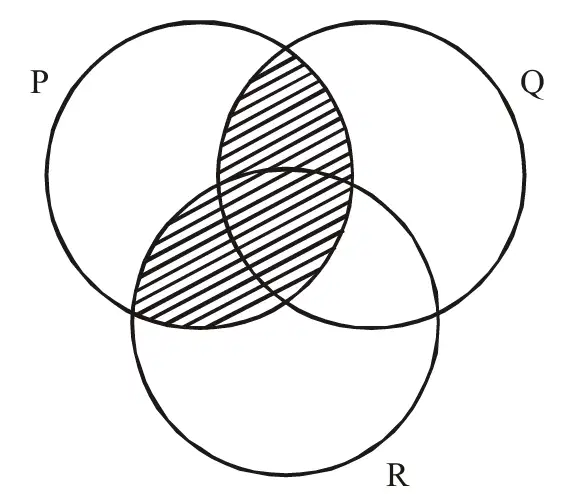
What does the shaded region represent in the figure given below?
(P ∪ Q) − (P ∩ Q)
P ∩ (Q ∩ R)
P ∩ Q ∩ (P ∩ R)
(P ∩ Q) ∪ (P ∩ R)
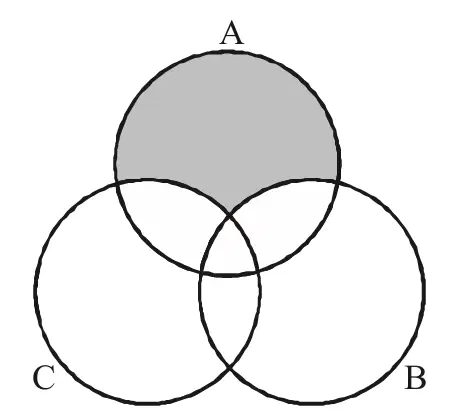
The shaded region in the given figure is
A ∩ (B ∪ C)
A ∪ (B ∩ C)
A ∩ (B − C)
A − (B ∪ C)
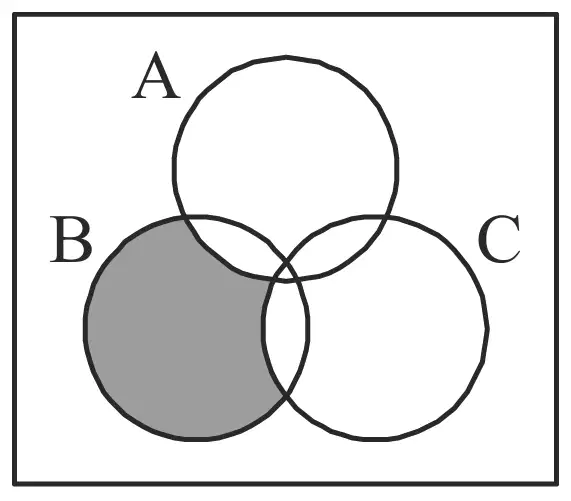
The shaded region in the given figure is
B ⋂ (A ⋃ C)
B ⋃ (A ⋂ C)
B ⋂ (A – C)
B – (A ⋃ C)
If A = {x : x is a multiple of 3} and
B = {x : x is a multiple of 5}, then A – B is equal to
A ⋂ B
A ⋂ B
A ⋂ B
A ⋂ B
If U = {1, 2, 3, 4, ......, 10} is the universal set of A, B and A = {2, 4, 6, 8, 10}, B = {4, 6} are subsets of U, then given sets can be represented by Venn diagram as
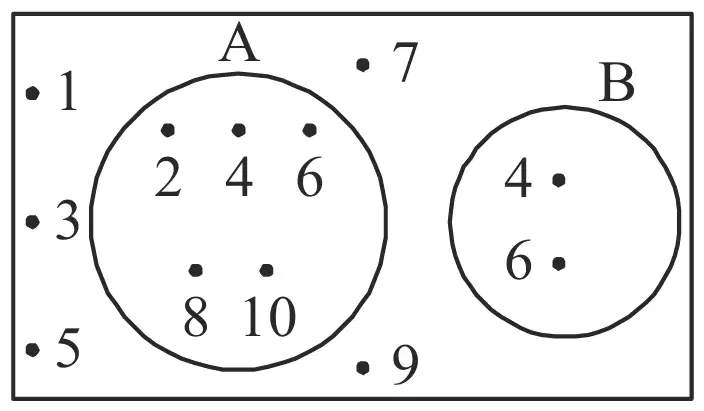
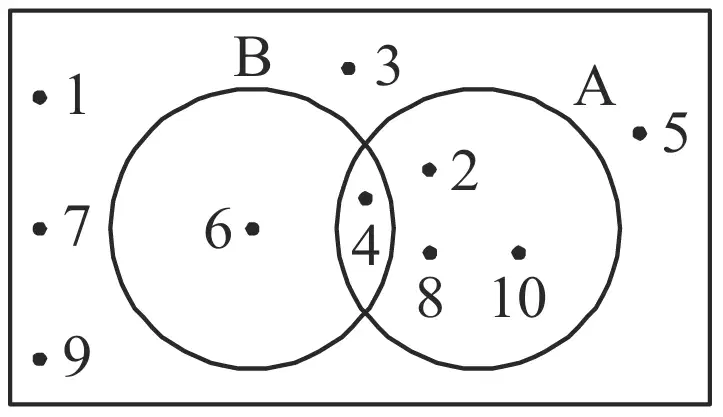
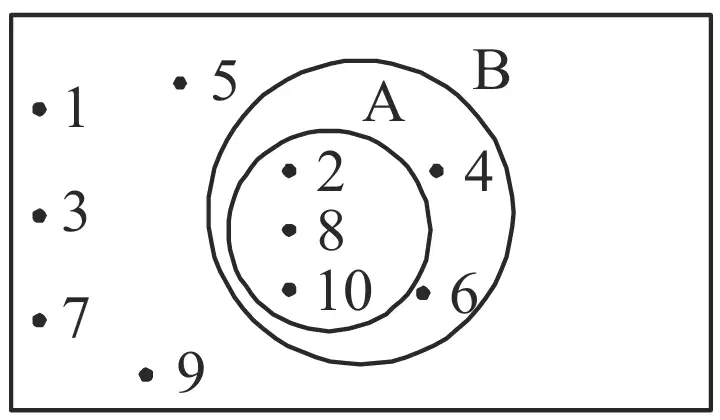
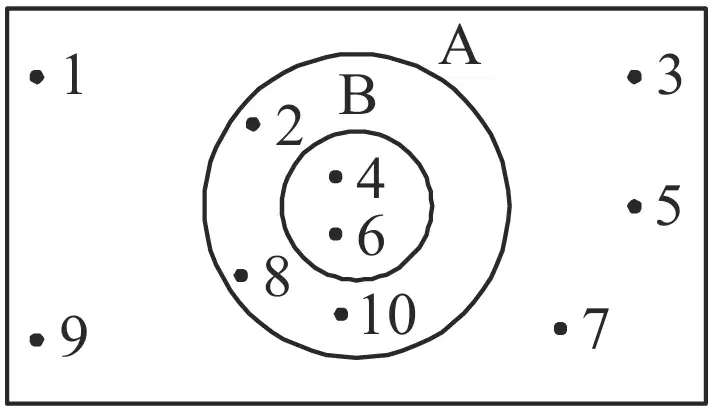
Most of the relationships between sets can be represented by means of diagrams which are known as
rectangles
circles
Venn diagrams
triangles
Which of the following represent the union of two sets A and B?
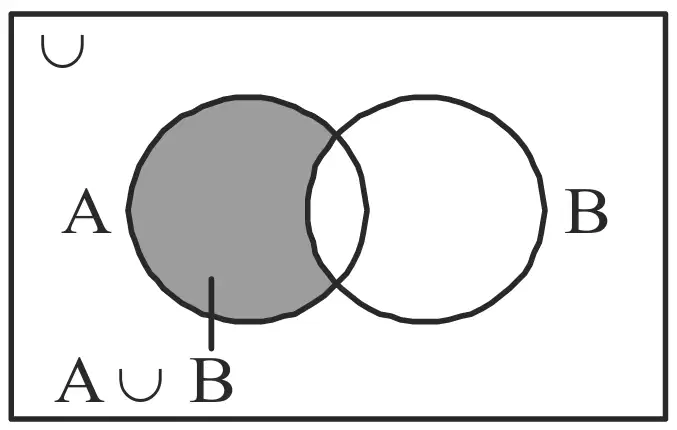
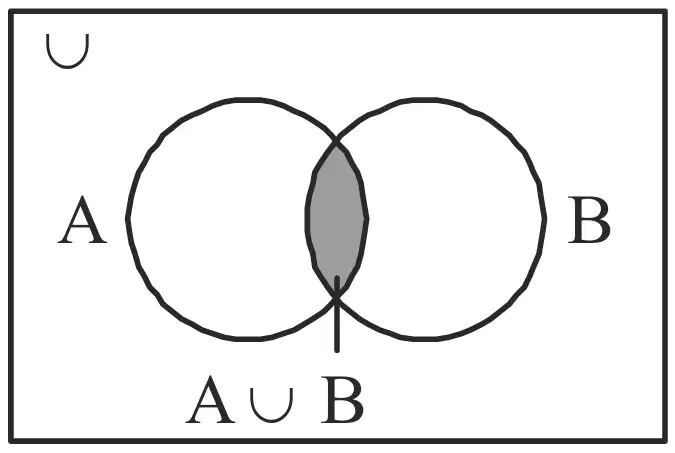
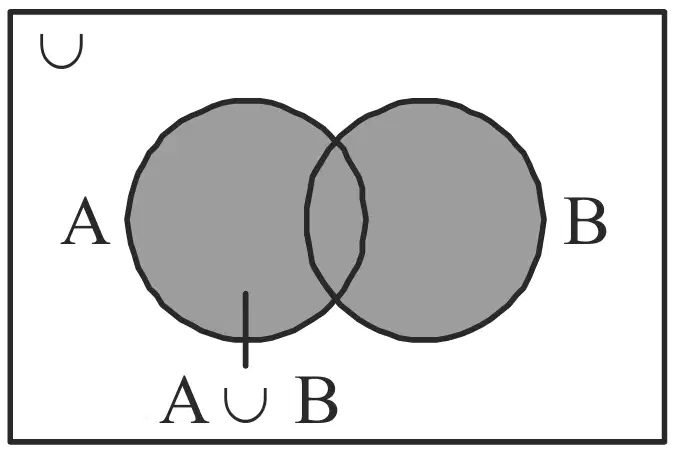
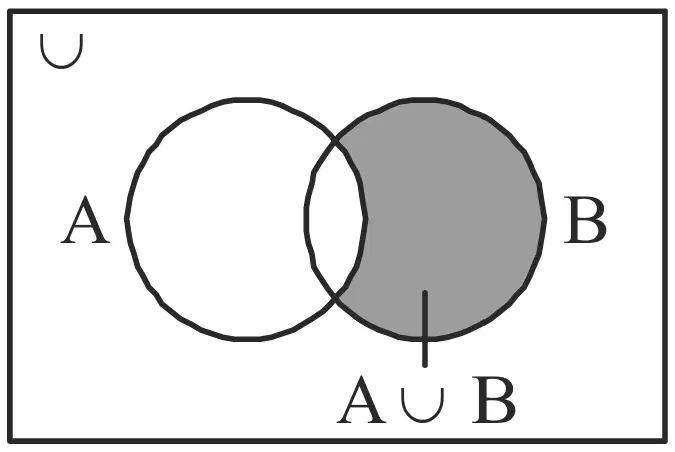
Which of the following are correct?
I. A − B = A − (A ∩ B).
II. A = (A ∩ B) ∪ (A − B).
III. A − (B ∪ C) = (A − B) ∪ (A − C).
I and II
II and III
I, II and III
None of these
Assertion : For any two sets A and B, A − B = B − C. Reason : If A be any set, then A ∩ A' = ϕ.
Assertion is correct, reason is correct; reason is a correct explanation for assertion
Assertion is correct, reason is correct; reason is not a correct explanation for assertion
Assertion is incorrect, reason is incorrect
Assertion is incorrect, reason is correct
If A is the set of the divisors of the number 15, B is the set of prime numbers smaller than 10 and C is the set of even numbers smaller than 9, then (A ∪ C) ∩ B is the set
{1, 3, 5}
{1, 2, 3}
{2, 3, 5}
{2, 5}
Let X and Y be two non-empty sets such that X ∩ A = Y ∩ A = ϕ and X ∪ A = Y ∪ A for some non-empty set A. Then
X = Y
X ≠ Y
X ⊂ Y
X ⊃ Y
Let X = {Ram, Geeta, Akbar} be the set of students of Class XI, who are in school hockey team and Y = {Geeta, David, Ashok} be the set of students from Class XI, who are in the school football team. Then, X ∩ Y is
{Ram, Geeta}
{Ram}
{Geeta}
None of these
Which of the following represent A – B?
{x : x ∈ A and x ∉ B}
{x : x ∉ A and x ∈ B}
{x : x ∈ A or x ∈ B}
{x : x ∉ A or x ∉ B}
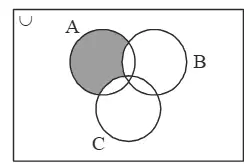
The shaded region in the given figure is
A ∩ (B ∪ C)
A ∪ (B ∩ C)
A ∩ (B – C)
A – (B ∪ C)
If A and B are non-empty subsets of a set, then (A – B) ∪ (B – A) equals to
(A ∩ B) ∪ (A ∪ B)
(A ∪ B) – (A – B)
(A ∪ B) – (A ∩ B)
(A ∪ B) – B
Let A, B, C are three non-empty sets. If A ⊂ B and B ⊂ C, then which of the following is true?
B – A = C – B
A ∩ B ∩ C = B
A ∪ B = B ∪ C
A ∪ B ∪ C = C
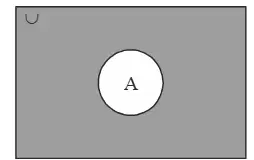
In the Venn diagram, the shaded portion represents
complement of set A
universal set
set A
None of these
Let
A= {3, 6, 9, 12, 15, 18, 21}
B= {4, 8, 16, 20}
C= {2, 4, 6, 8, 10, 12, 14, 16} and
D= {5, 10, 15, 20}
Which of the following is incorrect?
I. A – B= {4, 8, 16, 20}
II. (C – B) ∩ (D – B)= ϕ
III. C – (A ∩ B)= D
Only II & III
Only II
Only III
None of these
Let S = the set of all triangles, P = the set of all isosceles triangles, Q = the set of all equilateral triangles, R = the set of all right-angled triangles. What do the sets P ∩ Q and R – P represents respectively ?
The set of isosceles triangles; the set of non-isosceles right angled triangles
The set of isosceles triangles; the set of right angled triangles
The set of equilateral triangles; the set of right angled triangles
The set of isosceles triangles; the set of equilateral triangles
If A∩B = {ax : x ∈ N} and bN ∩ cN = dN, where b, c ∈ N are relatively prime, then
d = bc
c = bd
b = cd
None of these
If U = {1, 2, 3, 4, 5, 6, 7, 8, 9, 10}, A = {1, 2, 3, 5}, B = {2, 4, 6, 7} and C = {2, 3, 4, 8}, then which of the following is true?
(B ∪ C)′ = {1, 5, 9, 10}
(C – A)′ = {1, 2, 3, 5, 6, 7, 9, 10}
Both (a) and (b)
None of these
If A and B are any two sets, then A ∪ (A ∩ B) is equal to
A
B
A²
B²
The smallest set A such that A ∪ {1, 2} = {1, 2, 3, 5, 9} is
{2, 3, 5}
{3, 5, 9}
{1, 2, 5, 9}
None of these
Consider the following relations :
I. A′ = (A ∩ B) ∪ (A – B)
II. A – B = A′ – (A ∩ B)
III. A – (B ∪ C) = (A – B) ∪ (A – C)
Which of these is correct?
I and III
I and II
Only III
II and III
If A and B are non-empty sets, then P(A) ∪ P(B) is equal to
P(A ∪ B)
P(A ∩ B)
P(A) = P(B)
None of these
Let U be the set of all boys and girls in school. G be the set of all girls in the school. B be the set of all boys in the school and S be the set of all students in the school who take swimming. Some but not all students in the school take swimming.
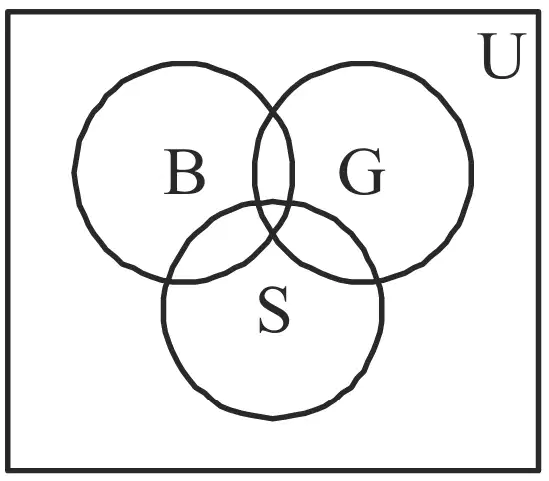
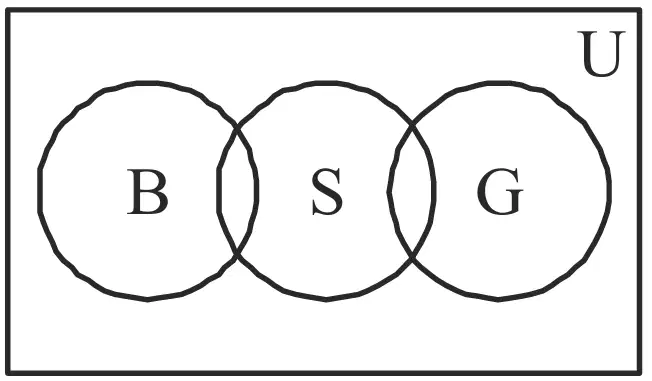
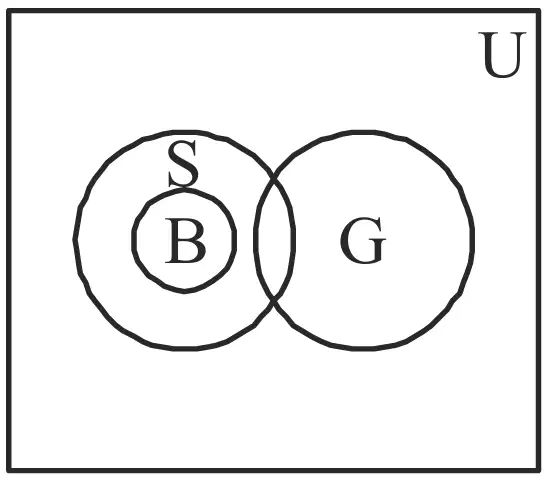
None of these
If A and B are two sets, then (A – B) ∪ (B – A) ∪ (A ∩ B) is equal to
Only A
A ∪ B
(A ∪ B)′
None of these
If aN = {ax : x ∈ N} , then the set 3N ∩ 7N is
21N
10N
4N
None of these
If A = {x ∈ R : 0 < x < 3} and B = {x ∈ R : 1 ≤ x ≤ 5} then A ∩ B is
{x ∈ R : 0 < x < 1}
{x ∈ R : 3 ≤ x ≤ 5}
{x ∈ R : 0 < x < 1 or 3 ≤ x ≤ 5}
{x ∈ R : 1 < x < 3}
If A and B are sets, then A ∩ (B – A) is
A
B
∅
None of these
If n(A) = 3, n(B) = 6 and A ⊆ B. Then, the number of elements in A ∪ B is equal to
3
9
6
None of these
If A = {x : x is a multiple of 4} and B = {x : x is a multiple of 6}, then A ∩ B consists of all multiples of
16
12
8
4
Each student in a class of 40, studies at least one of the subjects English, Mathematics and Economics. 15 study English, 22 Economics and 26 Mathematics, 5 study English and Economics, 14 Mathematics and Economics and 2 study all the three subjects. The number of students who study English and Mathematics but not Economics is
3
5
10
4
A survey of 500 television viewers produced the following information, 285 watch football, 195 watch hockey, 115 watch basket-ball, 45 watch football and basket ball, 70 watch football and hockey and 50 watch hockey and basket ball, 50 do not watch any of the three games. The number of viewers, who watch exactly one of the three games is
325
310
405
372
Out of 500 boys in a school, 224 played cricket, 240 played hockey and 336 played basketball. Of the total 64 played both basketball and hockey, 80 played cricket and basketball and 40 played cricket and hockey, 24 played all the three games. The number of boys who did not play any games is
56
216
240
160
Let V = {a, e, i, o, u}, V – B = {e, o} and B – V = {k}. Then, the set B is
{a, i, u}
{a, e, k, u}
{a, i, k, u}
{a, e, i, k, u}
In a statistical investigation of 1003 families of Calcutta, it was found that 63 families have neither a radio nor a T.V., 794 families has a radio and 187 has T.V. The number of families in that group having both a radio and a T.V is
36
41
32
None of these
If A and B are finite sets, then which one of the following is the correct equation?
n (A – B) = n (A) – n (B)
n (A – B) = n (B – A)
n (A – B) = n (A) – n (A ∩ B)
n (A – B) = n (B) – n (A ∩ B)
In a group of 52 persons, 16 drink tea but not coffee, while 33 drink tea. How many persons drink coffee but not tea ?
17
36
23
19
If S and T are two sets such that S has 21 elements, T has 32 elements, and S ∩ T has 11 elements, then number of elements S ∪ T has
42
50
46
None of these
Let n(U)=700,n(A)=200,n(B)=300,n(A∩B)=100, then n (A'∩ B') is equal to
400
600
300
None of these
There are 600 student in a school. If 400 of them can speak Telugu, 300 can speak Hindi, then the number of students who can speak both Telugu and Hindi is :
100
200
300
400
In a group of 500 students, there are 475 students who can speak Hindi and 200 can speak Bengali. What is the number of students who can speak Hindi only ?
275
300
325
350
In a survey of 400 students in a school, 100 were listed as taking apple juice, 150 as taking orange juice and 75 were listed as taking both apple as well as orange juice. Then, which of the following is/are true?
Only I is true
Only II is true
Both I and II are true
None of these
If n(A) = 8 and n (A ∩ B) = 2, then n[(A ∩ B)' ∩ A] is equal to
8
6
4
2
A market research group conducted a survey of 2000 consumers and reported that 1720 consumers like product P1 and 1450 consumers like product P2. What is the least number that must have liked both the products?
1150
2000
1170
2500
Out of 500 car owners investigated, 400 owned car A and 200 owned car B, 50 owned both A and B cars. Then
100 owned car A only
150 owned car B only
50 owned exactly one car
The given data is incorrect
In a city 20 percent of the population travels by car, 50 percent travels by bus and 10 percent travels by both car and bus. Then persons travelling by car or bus is
80 percent
40 percent
60 percent
70 percent
In a battle 70% of the combatants lost one eye, 80% an ear, 75% an arm, 85% a leg, x% lost all the four limbs. The minimum value of x is
10
12
15
None
Which of the following is correct?
I. n(S ∪ T) is maximum when n (S ∩ T) is least.
II. If n(U)=1000,n(S)=720,n(T)=450, then least value of n(S ∩ T)=170.
Only I is true
Only II is true
Both I and II are true
Both I and II are false
In a school, there are 20 teachers who teach Mathematics or Physics of these, 12 teach Mathematics and 4 teach both Maths and Physics. Then the number of teachers teaching only Physics is
4
8
12
16
In a town of 10000 families, it was found that 40% families buy newspaper A, 20% families buy newspaper B and 10% families buy newspaper C, 5% buy A and B, 3% buy B and C and 4% buy A and C. If 2% families buy all of three newspapers, then the number of families which buy only A is
400
3300
2000
500
A town has total population of 25000 out of which 13000 read 'The Times of India' and 10500 read 'The Hindustan Times'. 2500 read both papers. The percentage of population who read neither of these newspapers is
16%
18%
20%
25%
If n(A) = 1000, n(B) = 500 and if n(A ∩ B) ≥ 1 and n(A ∪ B) = p, then
500 ≤ p ≤ 1000
1001 ≤ p ≤ 1498
1000 ≤ p ≤ 1498
1000 ≤ p ≤ 1499
Consider the following statements.
I. If A1 is the set of first n prime numbers, then n=2⋃∞An is equal to {2, 3, 5, 7, 11, 13, 17, 19, 23, 29}
II. If A and B are two sets such that n(A ∪ B) = 50, n(A) = 28, n(B) = 32, then n(A ∩ B) = 10.
Which of these is correct?
Only I is true
Only II is true
Both are true
Both are false
A class has 175 students. The following data shows the number of students opting one or more subjects. Maths–100, Physics–70, Chemistry–40, Maths and Physics–30, Maths and Chemistry–28, Physics and Chemistry–23, Maths, Physics and Chemistry–18. How many have offered Maths alone?
35
48
60
22
A set A has 3 elements and another set B has 6 elements. Then
3 ≤ n(A ∪ B) ≤ 6
3 ≤ n(A ∪ B) ≤ 9
6 ≤ n(A ∪ B) ≤ 9
0 ≤ n(A ∪ B) ≤ 9
60 employees in an office were asked about their preference for tea and coffee. It was observed that for every 3 people who prefer tea, there are 2 who prefer coffee. For every 6 people who prefer tea, there are 2 who drink both of tea and coffee. The number of people who drink both is the same as those who drink neither. How many people drink both tea and coffee?
10
12
14
16
In a certain town 25% families own a phone and 15% own a car 65% own neither a phone nor a car. 2000 families own both a car and a phone. Consider the following statements in this regard (1) 10% families own both a car and a phone (2) 35% families own either a car or a phone. 40,000 families live in the town. Which one of the statements are correct?
1 and 2
1 and 3
2 and 3
1, 2 & 3
A market research group conducted a survey of 1000 consumers and reported that 720 consumers liked product A and 450 consumers liked product B. What is the least number that must have liked both products?
170
280
200
None
Given n(U) = 20, n(A) = 12, n(B) = 9, n(A ∩ B) = 4, where U is the universal set, A and B are subsets of U, then n(A ∪ B)'= ?
17
9
11
3
Suppose A1, A2, ……, A30 are thirty sets each having 5 elements and B1, B2, ……, B30 are n sets each with 3 elements. Let i=1⋃30Ai=j=1⋃nBj=S and each element of S belongs to exactly 10 of the A's and exactly 9 of the B's. Then n is equal to
15
3
45
35
Two finite sets have m and n elements. The number of subsets of the first set is 112 more than that of the second set.
4, 7
7, 4
4, 4
7, 7
The set (A ∩ B)' ∪ (B ∩ C) is equal to
A' ∪ B ∪ C
A' ∪ B' ∪ C
A' ∪ C
A' ∩ B
Let F1 be the set of parallelograms, F2 the set of rectangles, F3 the set of rhombuses, F4 the set of squares and F5 the set of trapeziums in a plane. Then F1 may be equal to
F2 ∩ F3
F3 ∩ F4
F2 ∪ F5
F2 ∪ F3 ∪ F4 ∪ F1
Let S = set of points inside the square, T = set of points inside the triangle and C = set of points inside the circle. If the triangle and circle intersect each other and are contained in a square.
S ∩ T ∩ C = φ
S ∪ T ∪ C = S
S ∪ T ∪ C = φ
S ∪ T = S ∩ C

