
 Worksheets
Physical Science - Unit 4 Extra Credit
Total questions: 65
Worksheet time: 5hrs 25mins
In the reaction between calcium metal and chlorine gas to produce calcium chloride. How would chlorine gas be represented?
C
Cl
Cl₂
C₂
LT1 Lead Nitrate + Sodium Iodide ----> Sodium Nitrate + Lead Iodide What are the reactants in the above equation?
lead nitrate, sodium iodide
sodium nitrate, lead iodide
sodium iodide, lead iodide
lead nitrate, sodium nitrate
Which statement about endothermic reactions is correct?
Energy is always created in the form of heat.
Energy is transferred from the surroundings to the reactants.
Energy is used to force electrons to move to higher energy levels.
Energy is transferred from the reactants to the surroundings.
In an exothermic reaction
the products have more energy than the reactants.
the reactants have more energy than the products.
the energy of the reactants and products is equal.
the activation energy is greater than the energy of the products.
According to the Law of Conservation of Mass, in a balanced chemical equation, the mass of the reactants is equal to the
atoms in a molecule.
volume of the reactants.
atomic mass of the elements.
mass of the products.
LT2 The law of conservation of mass can be demonstrated by a chemical reaction. Which of the following models of a chemical reaction best represents the law of conservation of mass?
(a)
According to the law of conservation of mass, if two atoms of copper are used in the reactant, how many atoms of copper must be a part of the product?
0
1
2
4
How many iodine atoms are in 4 CrI₃?
3
9
12
36
How many Dinitrogen trioxide molecules are represented by “6 N₂O₃”?
1
2
6
12
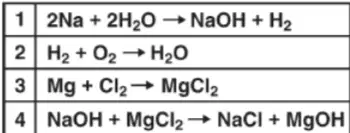
The following equations represent chemical reactions. Which equation shows that the total mass during a chemical reaction stays the same?
Equation 1
Equation 2
Equation 3
Equation 4
In Antoine Lavoisier's classic experiment, mercuric (II) oxide is heated in a sealed container. The solid red powder is changed into silver liquid mercury and oxygen gas. If Lavoisier heated 50 grams of powdered mercuric oxide to produce 46.5 grams of liquid mercury, how much oxygen would be released?
3.5 grams
4 grams
5 grams
3 grams
A physical science group wants to design a lab to compare the mass of reactants versus the mass of products for a chemical reaction between baking soda and vinegar. Which is the most appropriate procedure to gather relevant data?
Measure 3.5 g of baking soda into a cup. Pour 2.5 g of vinegar into a bag. Pour the baking soda into the bag. Seal the bag closed. Measure the mass of the bag after the reaction is complete.
Measure the masses of an empty bag and an empty cup. Measure 3.5 g of baking soda into a cup. Pour the baking soda into the bag. Seal the bag closed. Measure the mass of the bag after the reaction is complete.
Measure 3.5 g of baking soda into a cup. Pour 2.5 g of vinegar into the same cup. Measure the mass of the cup after the reaction is complete.
Measure the masses of an empty bag and an empty cup. Measure 3.5 g of baking soda into a cup. Place vinegar in bag. Place the cup inside the bag and seal the bag closed. Pour the baking soda onto the vinegar. Measure the mass of the bag after the reaction is complete.
During science lab, Mr. Smith’s students tested the reactivity of aluminum in copper II chloride. When aluminum was added to a solution of copper II chloride, bubbles were produced. Based on the Law of Conservation of Matter, if 45 grams of aluminum are added to 45 grams of copper II chloride to produce 12 grams of copper, how much aluminum chloride would also be produced? The formula for the chemical reaction is as follows: Al + CuCl₂ → AlCl₃ + Cu
102 grams
57 grams
78 grams
90 grams
A physical science group wants to analyze lab data to compare the mass of reactants versus the mass of products for a chemical reaction between baking soda and vinegar. Which is the most appropriate procedure to make meaningful conclusions? Measurements before the reaction: - Mass of empty bag: 8.85 g - Mass of empty cup: 2.20 g - Mass of cup with baking soda: 5.7 g - Mass of bag with vinegar: 11.35 g Measurements after the reaction: - Mass of bag with cup and products: 17.05 g
Compare the total mass of reactants before the reaction to the total mass of products after the reaction.
Measure the temperature change during the reaction.
Analyze the color change of the reactants and products.
Use a pH indicator to measure acidity before and after the reaction
A synthesis reaction is a reaction between at least two different chemicals in which:
one compound is decomposed by an electric current.
one compound burns in the presence of oxygen.
one compound breaks down into at least two new products.
one new, more complex compound is formed.
Classify the following reaction: Sulfur dioxide reacts with carbon to yield sulfur and carbon monoxide
Single Replacement
Double Replacement
Synthesis
Decomposition
Which of the following equations is NOT balanced?
KOH + HCl → KCl + H2O
2Ca + O2 → 2CaO
NaCl + H2SO4 → Na2SO4 + HCl
Fe + S → FeS
Which of the following correctly represents the word equation: Carbon and aluminum oxide react to form aluminum and carbon dioxide.
C + Al2O3 --> Al + CO2
C + AlO --> Al + CO2
AlO3 --> Al + CO2
C + Al2O3 --> Al + CO2
LT5 Students were asked to balance the equation below. Evaluate their responses. Which statement is correct? Original Equation: Zn + HCl → ZnCl2 + H2 Student Answers: Student A: Zn + H2Cl2 → ZnCl2 + H2 Student B: Zn +2HCl → ZnCl2 + H2 Student C: Zn + HCl → ZnCl + H
All of the students are correct because there are the same number of Zn, H, and Cl atoms on both sides of the equations.
Student B is correct because he used the correct subscripts to have the same number of Zn, H, and Cl atoms on both sides of the equations.
Student B is incorrect because he used a coefficient to have the same number of Zn, H, and Cl atoms on both sides of the equations.
Student C is incorrect because he changed the subscripts to have the same number of Zn, H, and Cl atoms on both sides of the equations.

Fe + S --> FeS
-->
mean?
Fe + S --> FeS
H2SO4
reaction.
The Law of Conservation of Mass States
Energy cannot be created nor destroyed, it can only change form.
Mass cannot be created nor destroyed, it can only change form.
Mass can be created or destroyed, it cannot change form.

Which of the models of a chemical reaction best represents the Law of Conservation of Mass?
A
B
C
D

Which of the models of a chemical reaction best represents the Law of Conservation of Mass?
A
B
C
D

Which of the models of a chemical reaction best represents the Law of Conservation of Mass?
A
B
C
D

A student pours hydrochloric acid (HCl) into an open beaker that contains a piece of magnesium (Mg). A chemical reaction occurs, and the data for the reaction is shown in the image. Was there a total mass increase or a total mass decrease for this experiment?
There was a increase in mass.
There was a decrease in mass.
There was no change in mass.
A student heated a 10 gram sample of a chemical in an open container. A chemical reaction occurred, and the mass of the sample was measured again. The mass of the sample was found to be less than before the reaction. Which of the following best explains the decrease in mass of the sample?
The heat caused the chemical to become less dense.
The reaction gave off more heat than was added.
Some of the lighter particles were destroyed.
Some of the particles escaped as a gas formed.
A student dissolved 25 grams of salt into 1,000 grams of water. What should the mass of the saltwater mixture be?
975 grams
1,000 grams
1,025 grams
2,500 grams
A student measures the mass of an iron nail to be 25 grams. The student heats the nail over a bunsen burner and measures the mass of the nail afterwards. The mass of the nail is found to be greater after burning. Which of the following best explains the increase in mass of the nail?
The heat caused the compound to become more dense.
The reaction gave off less heat than was added.
Some of the heavier particles multiplied inside the nail.
Extra particles from the air were added to the nail during burning.
What type of reaction is Fe + Cl2 → FeCl3
Synthesis
Decomposition
Single Replacement
Combustion
None of these
What type of reaction is C2H2 + O2 → CO2 + H2O
Synthesis
Decomposition
Single Replacement
Combustion
None of these
What type of reaction is BF3 + Li2SO3 → B2(SO3)3 + LiF
Synthesis
Decomposition
Single Replacement
Combustion
None of these
What type of reaction is Ag2O → Ag + O2
Synthesis
Decomposition
Single Replacement
Combustion
None of these
What type of reaction is C5H10 + O2 → CO2 + H2O
Synthesis
Decomposition
Single Replacement
Combustion
None of these
What type of reaction is Zn + HCl → H2 + ZnCl2
Synthesis
Decomposition
Single Replacement
Combustion
None of these
What type of reaction is H2 + N2 → NH3
Synthesis
Decomposition
Single Replacement
Combustion
None of these
What type of reaction is (NH2)3PO4 + Pb(NO3)4 → NH4NO3 + Pb3(PO4)4
Synthesis
Decomposition
Single Replacement
Combustion
None of these
What type of reaction is FeBr3 + H2SO4 → HBr + Fe2(SO4)3
Synthesis
Decomposition
Single Replacement
Combustion
None of these
What type of reaction is Fe + H2SO4 → H2 + FeSO4
Synthesis
Decomposition
Single Replacement
Combustion
None of these
What type of reaction is Mg + Br2 → MgBr2
Synthesis
Decomposition
Single Replacement
Combustion
None of these
What type of reaction is KClO3 → KCl + O2
Synthesis
Decomposition
Single Replacement
Combustion
None of these
What type of reaction is K2CO3 → K2O + CO2
Synthesis
Decomposition
Single Replacement
Combustion
None of these
What type of reaction is CH4 + O2 → CO2 + H2O
Synthesis
Decomposition
Single Replacement
Combustion
None of these
What type of reaction is NaOH + HCl → H2O + NaCl
Synthesis
Decomposition
Single Replacement
Combustion
None of these
What type of reaction is SeCl6 + O2 → SeO2 + Cl2
Synthesis
Decomposition
Single Replacement
Combustion
None of these

