wayground logo

Free Printable Worksheets

NEW

Font size

S
M
L
XL
Worksheets

Ionic/Covalent and Vsepr Test

Total questions: 46

Worksheet time: 2hrs 32mins

Name
Class
Date
1.
What is the VSEPR theory used to predict?
a)
Bond Strength
b)
Polarity
c)
Molecular Shape
d)
Electronegativity
2.

What is the molecular geometry of a molecule with two bonding pairs and no lone pairs of electrons?

a)

Tetrahedral

b)

Trigonal planar

c)

Linear

d)

Octahedral

3.

What is the molecular geometry of a molecule with three bonding pairs and one lone pair of electrons?

a)

Tetrahedral

b)

Linear

c)

Trigonal pyramidal

d)

Octahedral

4.

How many bonding pairs and lone pairs of electrons are present in a molecule with trigonal planar molecular geometry?

a)

1 bonding pair and 2 lone pairs

b)

3 bonding pairs and 0 lone pairs

c)

4 bonding pairs and 1 lone pair

d)

2 bonding pairs and 1 lone pair

5.
What is the MOLECULAR geometry of the central oxygen?
a)
Linear
b)
Trigonal Planar
c)
Bent
d)
Tetrahedral
6.
What is the best explanation of VSEPR theory?
a)
It explains the shapes that electrons make around atoms when they repel
b)
It explains how many electrons fit into an element's valent shell
c)
It explains why electrons pair up
d)
It explains why electrons repel each other
7.

Which one of the following is the correct bond angle between atoms adopting a trigonal planar geometry?

a)

180°

b)

109.5°

c)

90°

d)

120°

8.
 A lone pair is defined as
a)
A pair of bonding electrons
b)
One non-bonding electron
c)
A pair of non-bonding electrons
d)
A pair of electrons on the central atom
9.
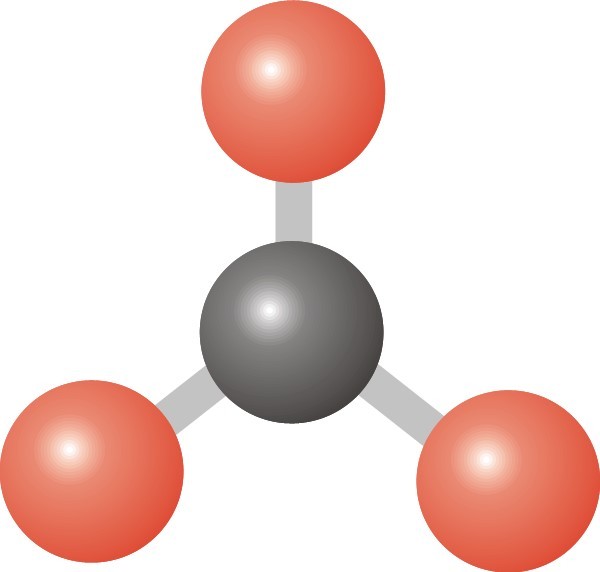
What molecular shape is the structure shown here? (BCl3)
a)
linear
b)
trigonal planar
c)
tetrahedral
d)
trigonal pyramidal
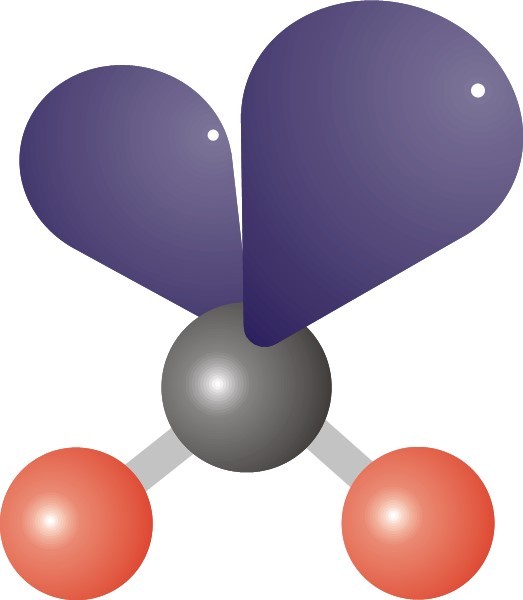
10.

What shape would this have?

a)

Trigonal planar

b)

Pyramidal

c)

Tetrahedral

d)

Bent

11.
Choose the correct shape for this molecule:
a)
linear
b)
Trigonal pyramidal
c)
Bent
d)
Tetrahedral
12.
*
a)
trigonal pyramid
b)
linear
c)
bent
d)
angular
13.

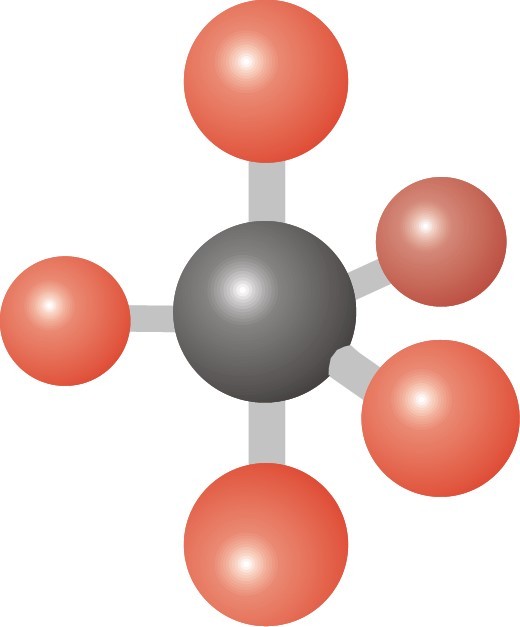
What shape is shown here?

a)

Octahedral

b)

Tetrahedral

c)

Trigonal bipyramidal

d)

Seesaw

14.

What shape is shown here?

a)

Octahedral

b)

Tetrahedral

c)

Trigonal bipyramidal

d)

Seesaw

15.
What molecular shape is the structure shown here? (BeCl2)
a)
linear
b)
bent
c)
trigonal planar
d)
tetrahedral
16.

How many Covalent bonds does ammonia have?

a)

1

b)

2

c)

3

d)

4

e)

5

17.

How many lone pairs of elctrons does ammonia have?

a)

1

b)

2

c)

3

d)

4

e)

5

18.
What molecule could this be? 
a)
BF3
b)
CH4
c)
H2O
d)
CO2
19.
Who could this be? 
a)
CO2
b)
NH3
c)
H2S
d)
CH4
20.
What elements generally make a covalent bond?
a)
metal and nonmetal
b)
2 nonmetals
c)
metal
d)
none of the above
21.
In chemical compounds, covalent bonds form when
a)
the electronegativity difference between two atoms is very large.
b)
electrons are completely transferred between two metals.
c)
pairs of electrons are shared between two nonmetal atoms.
d)
two nonmetal atoms are attracted to each other by opposite charges.
22.
Predict the bond that will form between Be and F.
a)
Ionic
b)
Covalent
23.
Predict the bond that will form between Se and Cl
a)
Ionic
b)
Covalent
24.

Which of these is the shape of BF3?

a)
b)
c)
d)
e)
25.

Which of these is the shape of CO2?

a)
b)
c)
d)
e)
26.

Which bond below is Ionic?

a)

H​20

b)

CO2

c)

NaBr

d)

CH4

27.

Which of the following elements would most likely form an ionic bond with chlorine (Cl)?

a)

Sodium (Na)

b)

Carbon (C)

c)

Hydrogen (H)

d)

Oxgen (O)

28.

Which of the following is a property of covalent bonds?

a)

High electrical conductivity

b)

High melting and boiling points

c)

Soluble in water

d)


Low melting and boiling points

29.

Why do atoms bond?

a)

To become stable

b)

To become unstable

c)

To switch places

d)

To become bigger

30.

How many electrons does a stable atom have?

a)

4

b)

14

c)

6

d)

8

31.

A cation...

a)

Has a neutral charge

b)

Has a positive charge

c)

Has a negative charge

d)

Has no charge

32.

Valence electrons are found

a)

in the innermost energy level of an atom

b)

in the middle energy levels of an atom

c)

in the outermost energy levels of an atom

33.

Why do all bonds form?

a)

so the number of protons equals the number of electrons

b)

so an atom can become unstable

c)

to fill the outermost energy level

34.
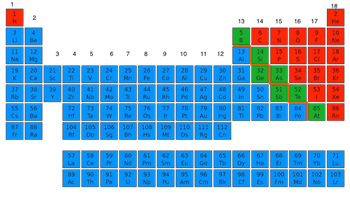
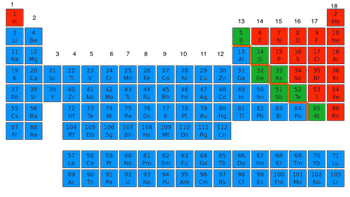
Where are the nonmetals located on the periodic table? 
a)
Blue
b)
Red
c)
Green
35.
Where are metals located on the periodic table?
a)
Blue
b)
Green
c)
Red
36.
Atoms that gain electrons become...
a)
negatively charged
b)
positively charged
c)
remain neutrally charged
d)
21
37.

How many valence electrons does hydrogen have?

a)

1

b)

2

c)

3

d)

4

38.

_________are more likely to lose electrons and become a positive ion.

a)

Nonmetals

b)

Noble Gases

c)

Protons

d)

Metals

39.

An atom with 3 valence electrons "wants" a full shell, so it can either gain 5 or lose 3. Which is more likely to occur?

a)

Gain 5

b)

Lose 3

c)

Nothing

40.

What is the reason why Noble gases are so stable?

a)

They have an even number of electrons

b)

They have no electrons

c)

They have a full outer shell of electrons

d)

They bond with other atoms

41.
Which of the following diatomic molecules will form a double bond?
a)
H2
b)
O2
c)
N2
d)
F2
42.
Which of the following diatomic molecules will form a triple bond?
a)
H2
b)
Cl2
c)
O2
d)
N2
43.
How many bonds does Carbon ALWAYS make?
a)
4
b)
1
c)
8
d)
3
44.
How many electrons does each line indicate are shared?
a)
1
b)
2
c)
3
d)
4
45.

Electronegativity is a measurement of the ability of a nucleus to...

a)

attract bonding electrons

b)

attract other nuclei

c)

attract electrons in the non-valence energy levels

46.

How many valence electrons does Oxygen (O) have?

a)

6

b)

8

c)

15

d)

16