
Font size
 Worksheets
ling continued
Total questions: 85
Worksheet time: 1hrs 3mins
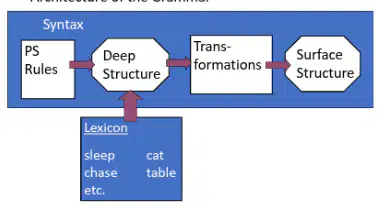
What is the basic word order of the language specified by?
VOS
SOV
SVO
VSO
OVS
What is the structure that gets pronounced and sent to the phonology?
Deep Structure (D-Structure)
Surface Structure (S-Structure)
Phonetic Representation
Syntactic Representation
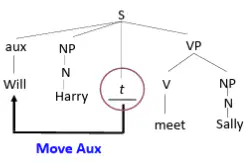
Explain the transformational rule 'Move Aux'.
The transformational rule 'Move Aux' involves moving an auxiliary verb to the beginning of a sentence to form a question.
The transformational rule 'Move Aux' involves moving a noun to the end of a sentence to form a question.
The transformational rule 'Move Aux' involves moving an adjective to the beginning of a sentence to form a question.
The transformational rule 'Move Aux' involves moving a verb to the end of a sentence to form a question.
What is the S-Structure of the sentence?
Will Harry meet Sally?
Harry will meet Sally.
S-Structure: Does Harry like Sally? What is the D-Structure of the sentence?
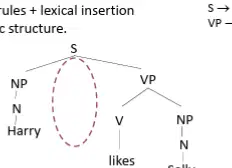
Does Harry like Sally?
Yes, Harry likes Sally.
No, Harry does not like Sally.
It is not known if Harry likes Sally.
Harry dislikes Sally.
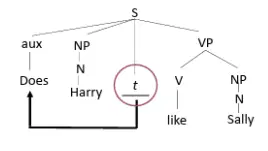
In Yes/No questions, what happens to the auxiliary verb (Aux)?
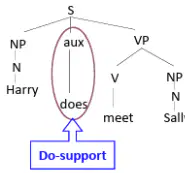
What is used to form a question when there is no auxiliary verb in a simple verb phrase?
What is the transformation rule for moving the auxiliary verb in wh-questions?
The auxiliary verb is moved to the beginning of the sentence.
The auxiliary verb is moved to the end of the sentence.
The auxiliary verb is not moved.
The auxiliary verb is replaced with a main verb.
What is the transformation rule for moving the wh-word in wh-questions?
The wh-word is moved to the beginning of the sentence.
The wh-word is moved to the end of the sentence.
The wh-word is replaced with a pronoun.
The wh-word is removed from the sentence.
The base structure of the sentence 'Who will Harry meet?' is:
Subject-Verb-Object
Subject-Verb
Verb-Object
Subject-Object
In the example 'Who will Harry meet?', what happens when the auxiliary verb 'will' is moved to the front?
The sentence becomes 'Will who Harry meet?'
The sentence becomes 'Will Harry meet who?'
The sentence becomes 'Who will meet Harry?'
The sentence becomes 'Will Harry who meet?'
In the example 'Who will Harry meet?', what happens when the wh-word 'who' is moved to the complementizer position?
The sentence becomes ungrammatical.
The sentence changes to 'Who Harry will meet?'
The sentence changes to 'Harry will meet who?'
The sentence remains the same.
What is the D-Structure of the question 'Who will Harry meet'?
A) Harry will meet who.
B) Who will meet Harry.
C) Harry who will meet.
Fill in the blank: In the S-Structure, the wh-word moves to the ______ position and the auxiliary verb moves to the front.
complementizer
subject
object
predicate
What is the S-Structure for the question: Where are you going?
Where are you going?
You are going where?
Going where are you?
What is the S-Structure for the question: Who might Pat meet?
Pat might meet who?
Who might Pat meet?
Meet who might Pat?
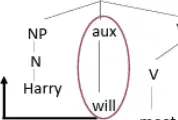
Explain the process of Wh-question derivation as shown in the image.
The process involves moving the Wh-word to the beginning of the sentence.
The process involves adding a Wh-word at the end of the sentence.
The process involves replacing the main verb with a Wh-word.
The process involves removing the subject of the sentence.
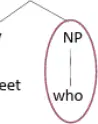
What is the role of the Wh-word in the D-Structure?
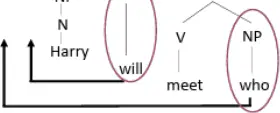
What happens in Step 2 of the Wh-question derivation process?
Step 2 involves moving the Wh-word to the beginning of the sentence.
Step 2 involves identifying the auxiliary verb.
Step 2 involves adding a question mark at the end of the sentence.
Step 2 involves checking the subject-verb agreement.
The resulting structure in Step 3 of the Wh-question derivation process is:
a tree with a moved Wh-element
a linear sequence of words
a nested set of clauses
an unordered list of phrases
What is the base form of a sentence before any transformations take place?
S-Structure
D-Structure
V-Structure
O-Structure
Fill in the blank: The wh-word 'what' moves from its base position (object) to the ______ position at the beginning of the sentence.
Comp
Subj
Obj
Adj
What is the purpose of moving the auxiliary verb 'did' to the front of the sentence?
To form a statement
To create a wh-question structure
To form the Yes/No question structure
To emphasize the subject
What is the final S-Structure after transformations?
Harry saw what
What Harry saw
What did Harry see?
Harry did see what
The process of moving the wh-word and auxiliary verb in sentence transformation involves:
reordering the words to form a question
adding a prefix to the verb
changing the tense of the verb
removing the auxiliary verb
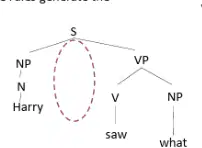
What is generated by the phrase structure rules in Step 1?
A) Surface Structure
B) Deep Structure
C) Intermediate Structure
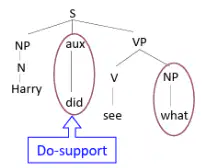
In Step 2, what is inserted to support the structure?
Auxiliary (Aux) is inserted.
Foundation (Fnd) is inserted.
Beam (Bm) is inserted.
Column (Col) is inserted.
1. Sentence: "Should Sue quit her job?" This is a Yes/No question, so we need to apply transformations to derive this structure from the corresponding declarative sentence.
A) Yes
B) No
What is the original declarative sentence (D-Structure) from which the question is derived?
How many transformations were applied to change the declarative sentence "Sue should quit her job" into the Yes/No question "Should Sue quit her job?"
One transformation
Two transformations
Three transformations
Four transformations
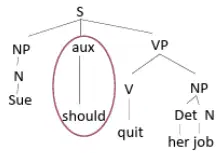
Indicate how the sentence 'Who will Sandy meet in the park?' has been transformed. How many transformations?
The sentence has been transformed into a question with one transformation.
The sentence has been transformed into a question with two transformations.
The sentence has been transformed into a statement with one transformation.
The sentence has been transformed into a statement with two transformations.
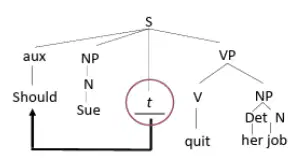
Indicate how the sentence 'Sandy will meet who in the park' has been transformed. How many transformations?
The sentence has been transformed into a question with one transformation.
The sentence has been transformed into a question with two transformations.
The sentence has been transformed into a statement with one transformation.
The sentence has been transformed into a statement with two transformations.
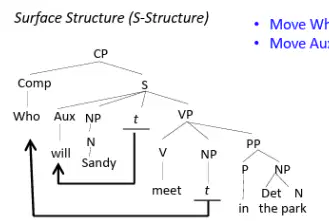
Be able to indicate how the sentence 'Where does Sandy meet Harry?' has been transformed.
The sentence is a question asking about the location of a meeting.
The sentence is a statement about Sandy meeting Harry.
The sentence is a command for Sandy to meet Harry.
The sentence is an exclamation about Sandy meeting Harry.
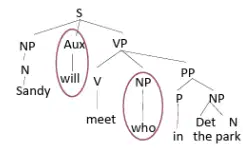
Be able to indicate how the sentence 'Sandy meets Harry where' has been transformed.
The sentence has been changed to a question.
The sentence has been changed to a statement.
The sentence has been changed to an exclamation.
The sentence has been changed to a command.
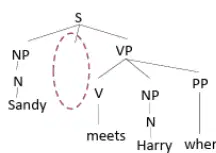
What is the main verb in the Deep Structure (D-Structure) diagram?
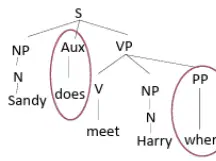
Explain the transformation from Deep Structure to Do-support in the given diagrams.
The transformation involves the insertion of 'do' in the structure.
The transformation involves the deletion of 'do' from the structure.
The transformation involves the movement of 'do' to the end of the sentence.
The transformation involves replacing 'do' with another auxiliary verb.
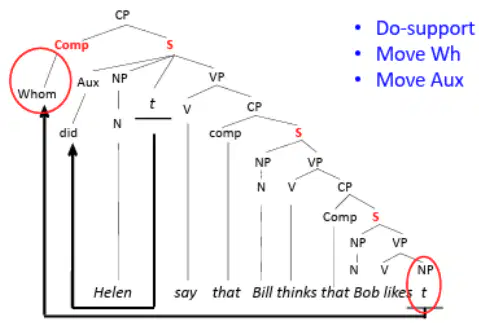
Be able to indicate how the sentences below have been transformed. How many transformations?
One transformation
Two transformations
Three transformations
Four transformations
In English, Wh-words move to the front of the sentence to form a question.
True
False
In English, what moves to the front to form a question?
Wh-word and auxiliary verb
Subject and verb
Adjective and noun
Preposition and object
In Japanese and Swahili, what is added to indicate a question?
Question marker
Exclamation mark
Period
Comma
In Spanish, what creates the question?
Subject-verb inversion
Rising intonation
Adding a question word
Using a question mark
In English, how is a Wh-question formed from the declarative sentence 'Bob found the dog'?
A) Did Bob find what?
B) What did Bob find?
C) Bob did find what?
D) What Bob did find?
In Japanese, how is the Wh-question formed from the declarative sentence 'Taro-ga inu-o mituketa'?
Taro-ga nani-o mituketa-no?
Taro-ga doko-o mituketa-no?
Taro-ga dare-o mituketa-no?
Taro-ga itsu-o mituketa-no?
In Spanish, what moves to the front to form a question?
The verb moves to the front.
The subject moves to the front.
The adjective moves to the front.
The noun moves to the front.
What is the question formation rule for English according to the table?
In Japanese, how does the question formation differ from English?
Which language relies on verb movement to the front for question formation?
Spanish
French
German
Italian
How do children learn language patterns and rules according to the text?
Children pick up language patterns and rules without explicit instruction.
Children learn language patterns through formal education only.
Children need constant correction to learn language patterns.
Children learn language patterns by memorizing grammar books.
The role of imitation in language learning is:
to facilitate understanding of grammar rules
to help in vocabulary acquisition
to improve pronunciation
all of the above
What does explicit teaching involve in language learning?
It involves implicit learning through exposure.
It involves teaching language rules directly.
It involves learning through games and activities.
It involves learning through immersion.
An example of analogy in language learning is:
Using metaphors to explain concepts
Comparing new words to known words
Memorizing vocabulary lists
Practicing pronunciation drills
The two types of reinforcement in parental reinforcement are:
Positive and Negative Reinforcement
Intrinsic and Extrinsic Reinforcement
Primary and Secondary Reinforcement
Continuous and Partial Reinforcement
Is correction effective if the child is at a particular stage in language development?
True
False
Chomsky's Innateness Hypothesis regarding language acquisition suggests that:
language is learned through imitation and reinforcement.
language is an innate ability and humans are born with a universal grammar.
language is acquired through social interaction and communication.
language is a cultural artifact that varies significantly across different societies.
What is Universal Grammar according to the text?
A theory that suggests all humans are born with an innate understanding of grammar
A set of rules specific to the English language
A method of teaching grammar in schools
A computer program for language translation
The process of language acquisition as mentioned in the text is described as:
a natural and intuitive process
a structured and formal process
a difficult and complex process
an artificial and learned process
What does the Poverty of the Stimulus argument suggest about Universal Grammar?
It suggests that Universal Grammar is innate and not learned from environmental input.
It argues that language is entirely learned from environmental input.
It claims that language acquisition is impossible without formal education.
It proposes that language is a cultural invention with no biological basis.
The Move Aux Rule in English for forming yes-no questions involves moving which part of the sentence?
The subject
The auxiliary verb
The main verb
The object
Which hypothesis suggests moving the first auxiliary to the front?
Hypothesis I
Hypothesis II
What is the correct hypothesis for moving the auxiliary in the sentence structure?
A) Move the first auxiliary to the front.
B) Move the highest auxiliary to the front.
According to the summary, what rule is stated in terms of structure rather than linear order?
The rule of syntax
The rule of semantics
The rule of phonology
The rule of pragmatics
In the context of the given diagrams, which auxiliary should be moved to the front according to the structure-dependent rule?
Auxiliary A
Auxiliary B
Auxiliary C
Auxiliary D
How does the child acquire the rule of moving the highest auxiliary to the front in English yes-no questions?
By imitation of adult speech
Through innate grammatical rules
By trial and error
Through formal education
What does the learner need to know about structure-independent rules according to the nativist formula?
Structure-independent rules are allowed.
Structure-independent rules are not allowed.
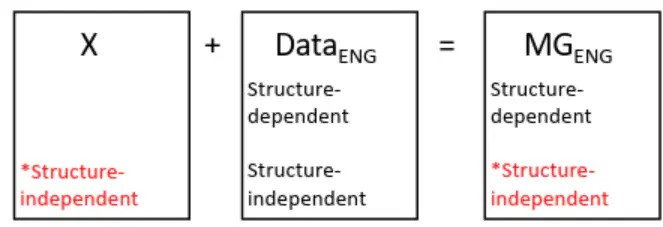
What’s in X?
Option A
Option B
Option C
Option D
Do Children Consider the “Move the First” Rule?
Yes, they do consider it.
No, they do not consider it.
Sometimes they consider it.
It depends on the context.
What is the age range of the participants in the experiment?
18-25 years
26-35 years
36-45 years
46-55 years
How many groups were the participants divided into?
One
Two
Three
Four
What is the mean age of Group 1?
20 years
25 years
30 years
35 years
What is the mean age of Group 2?
20 years
25 years
30 years
35 years
The children are encouraged to ask a question to which character during the experiment?
The Scientist
The Teacher
The Robot
The Astronaut
What type of questions are children asked to form?
Multiple-choice questions
Open-ended questions
True or false questions
Fill in the blank questions
Which of the following is a test sentence used in the experiment?
The dog that is sleeping is on the blue bench.
The cat is on the mat.
The boy is playing with a toy.
The goal of using various sentence types in the experiment is to:
enhance the complexity of the experiment.
test different linguistic structures.
improve the clarity of communication.
increase the length of the text.
What percentage of grammatical questions were made by Group I (Age 4;3)?
62%
38%
80%
60%
Fill in the blank: Is [the boy who (a) watching Mickey Mouse] is happy? (structure-independent error, Type III).
What type of error is "Is [the boy who is being kissed by his mother] is happy?"?
Type I (Prefix Error)
Type II (Restarting Error)
Type III (Structure-Independent Error)
How many ungrammatical questions were made in total?
168
101
31
70
What is the significance of structure-dependent rules in language acquisition according to the Poverty of Stimulus Argument?
They help in understanding complex sentences.
They are innate and not learned from the environment.
They are learned through repetition and practice.
They are irrelevant to language acquisition.
What is the crucial data needed to distinguish between the first and highest auxiliary in sentences with more than one auxiliary? Example: "Is [the boy who was watching TV] __ crying?"
The highest auxiliary (e.g., "was") must be moved, not the first.
The first auxiliary (e.g., "is") must be moved, not the highest.
Both auxiliaries must be moved simultaneously.
No auxiliary needs to be moved.
According to Legate & Yang (2002) - Analysis of CHILDES Database, what does the input data available to children in English fail to provide?
The crucial data to distinguish between the first and highest auxiliary movement.
The ability to understand complex sentences.
The rules for subject-verb agreement.
The vocabulary needed for basic communication.
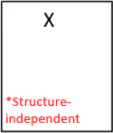
In the formula 'X + DataENG = MGENG', what must the learner know about structure-independent rules?
The learner must know that structure-independent rules are not allowed.
The learner must know that structure-independent rules are always applicable.
The learner must know that structure-independent rules are optional.
The learner must know that structure-independent rules are flexible.
The Critical Period Hypothesis for Language Acquisition suggests that there is a specific time frame during which language acquisition occurs most easily and beyond which it becomes much more difficult. What is this time frame called?
Sensitive Period
Critical Period
Optimal Learning Window
Language Acquisition Phase
Why Does the Critical Period Provide an Argument for the Innateness of Language?
Because it suggests that language acquisition is biologically timed and not solely dependent on environmental factors.
Because it shows that language can be learned at any age without difficulty.
Because it proves that language is a learned behavior through social interaction.
Because it indicates that language development is entirely dependent on cultural exposure.

